
Hughes’ Spruce Goose and the 1933 Soviet Kalilin K7 (above) are some flying ungreen monsters from the past.
Green Prophet was at the last Paris Air Show looking for green innovation in the sky. Now we take a look at some of the old flying monstrosities that got us to where we are today: The world aeronautics industry, after being considered no more than a curiosity venture during WWI and the 1920’s, finally began to get serious about the role that aircraft could play in both civilian and military use during the early to mid 1930’s. During this time, commercial passenger and cargo airline flights began to become reality and the use of these “flying machines” as a viable military weapon also began to take shape.
With oil being cheap and plentiful, there was no problem in supplying fuel for aircraft, and along with this, there was virtually no concern for the effects that aircraft would have on the global environment. Some countries, especially Germany and the Soviet Union began to seriously consider the advantage large aircraft would have as both troop carriers and for use in bombing enemy cities in wartime.
In fact, Nazi Germany was able to effectively test its newly developed military fighters and bombers during the 1936-39 Spanish Civil War, which assisted Germany greatly for its subsequent invasion of Poland in September, 1939, and resulted in the outbreak of WWII.
But it was the Soviets who tried to develop a gigantic type of aircraft that could not only carry large quantities of bombs but large numbers of troops as well. This led to the building of a huge prototype aircraft known as the Kalilin K-7 (pictured above), a monstrous aircraft that had a 173 foot (53 metre) wingspan and which was so heavy that two extra engines had to be added. This is to the already 6 engines that had been originally designed to lift the 24,400 kg behemoth off the ground.

 Non-profit groups from 18 developing countries called on Saudi Arabia to “stop playing an obstructionist role” in the current climate change negotiations in Barcelona, claiming the oil kingdom’s delaying tactics will hurt the world’s poor.

 Climate change activists are pooling their resources as we speak in Barcelona at the

 It is finally raining in Israel and other parts of the Middle East; but the region’s acute water shortage is far from being over. An Israeli company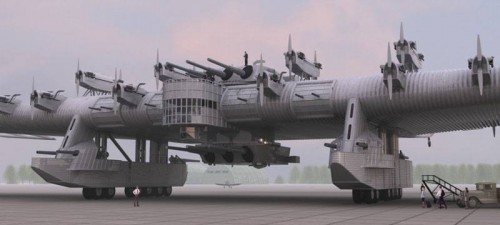

 With a $23 million investment, SolarEdge takes PV systems to the next level of efficiency.





 A model of Al Reem Island in Abu Dhabi. A playground for foreigners or ecological nightmare?