Home Blog Page 662

Doha Bank and UNESCO Join Together to Green the Middle East

1

sahara desert shotGreening the Desert? A Qatar bank and the UN are now partners.

Parts of the Middle East, especially in the Persian Gulf area will get a bigger environmental boost thanks to an alliance between Qatar’s Doha Bank and the UN’s Educational, Scientific and Cultural Organization, UNESCO.

In an article published in the Eye of Dubai news site, the Doha Bank, one of the Qatar Emirate’s largest, has entered into a formal alliance with the UN organization to work together on various environmental programs to promote a greener environment.

Ecomum Throws a Green Birthday Party

2

Birthday parties can be delightful events but they can also be stressful and very unhealthy for your children and the earth. With the stress on many parents these days to invite whole classes of children, to entertain, feed and send them home with a party bag, it is no wonder that we are left with piles of left over junk food, plastic plates and cups and plastic party bags filled with cheap, made in china toys, that usually break the same day and are full with chemical packed candies.

So how to keep your little ones smiling and the earth green?

Well it is easier and often cheaper than you may believe, it’s all about changing your perspective and being a little radical, and not conforming.

Entertainment

There are so many ideas out there for all age groups. The traditional games are still loved by every child, the delight and anticipation of pass the parcel is one of my favorites, add an extra twist with questions, forfeits and games between each layer. Musical chairs or statues, gets them dancing and burns that energy off. A treasure hunt gets their minds working too and is good for all ages, for the young ones use picture clues.

Parties are not just about games, I took my daughter to a party recently where they all decorated their own cakes, it kept them all very busy and very happy for about half an hour, heaven for us nattering mums! If you don’t want to go the sweet route, let them make their own pizzas, this is a definite winner for everybody, as you are also cutting out the stress of preparing food.

If you really want to you can have a green theme for the party too, get your children’s creative juices flowing and get recycling all the wrapping paper from presents, you can make giant paper pompoms (this is another great cheat as it also gives them something to take home too!).

Food & Party Bags

Fast, convenient, junk food is very tempting and I do understand time is precious but there are options just as easy, sometimes more fun for the children and you, and definitely healthier. The pizza option we’ve already mentioned, other options that the kids can get involved in too, are making burgers, fruit smoothies and a taco bar. My daughter’s last birthday cake was made from organic wholewheat flour, organic cocoa, organic eggs and goat’s milk, and the kids loved it.

As for the party favors, well we’ve covered the present with a make your own craft, and harking back to my childhood, a piece of scrummy birthday cake wrapped in a paper napkin (and no bag!). An idea I think I might use next year is a plant pot and a packet of seeds, they paint and decorate the pot in the party, then just pop a slice of cake in there with some flower or veggie seeds. If you feel you need to add some more bulk, try dried fruits and fruit leathers, fresh popcorn is always a winner too.

“I always recommend to friends and family to send eco-friendly ecards for birthdays, so as not to be left with a big pile of paper cards. But at the end of a party, you could be left with heaps of disposable plates, cups and burst balloons, all very unfriendly to the environment.

I keep a stack of plastic cups, plates and bowls at home all year round, as they are supremely handy when friends come to play and they are the best for parties too. If you really can’t get your head around washing up after, there are plenty of greener, biodegradable options available today.

As for decorations, balloons are quite nasty things, when you dig a bit deeper you discover a plethora of chemicals, there are eco-options made from latex but as yet I have only found them sold to performers here in Israel. So no balloons, big deal, get creative with your kids, paper chains, paper pompoms, all made with old wrapping paper, newspapers, enjoy!

Israel, Egypt Considering Joint Solar Energy Project in Sinai

9

israel egypt solar energyIsraeli Minister Ben-Eliezer addressing the Eilat energy conference this morning. (photo by Daniel Cherrin).

Israel and Egypt are discussing a possible collaborative solar energy project in the Sinai desert, Israel’s Minister of Industry, Trade and Labor Binyamin Ben-Eliezer announced this morning at the third annual Eilat-Eilot Renewable Energy Conference.

According to Ben-Eliezer, he and Prime Minister Benjamin Netanyahu discussed the issue with Egyptian President Hosni Mubarak on a recent visit to Egypt. According to the plan, Israel would supply the technology, with Egypt supplying the land required for the project. The electricity produced from the project would power both states, with excess energy being sold to other countries. President Mubarak reportedly expressed his interest in the idea, and agreed to explore the issue.

If carried out, the project could go a long way toward solving one of the major obstacles to the development of renewable energy in Israel: land. Much of the discussion this week at the 3-day conference has revolved around the need to develop renewable energy projects, especially solar energy, that utilize limited land resources in an efficient manner.

Organic Supermarket in Dubai Brings Organic (but not local) Trend to UAE

6

Organic Foods & Cafe, an organic supermarket and cafe in Dubai, brings a range of organic products to the United Arab Emirates and defines part of its mission as “furthering learning about what is healthy for us and our world and environment around us and promote it.”

The supermarket attempts to create a welcoming and warm environment where customers learn that eating organic doesn’t have to be scary or strange.  The cafe offers delicious organic dishes (many of which are vegetarian), such as brie & apple omelettes, mushroom and turkey ham pizza, roasted pumpkin salad, an ostrich special, and freshly squeezed pineapple and cucumber juices.

While their organic values are in the right and their menu sounds delicious, many of their organic products are sourced from overseas and it seems as though very few products are local.  In the “Meet the Growers” section of their website, farms are located in countries such as South Africa and Austria.  (The one “local” Middle Eastern farm seemed to be Sekem in Egypt.)

Which leads us back to the big green food question: what’s more important – organic or local?

EU Gives $4 Million Grant to Med and Red Sea Coral Reef Studies

2

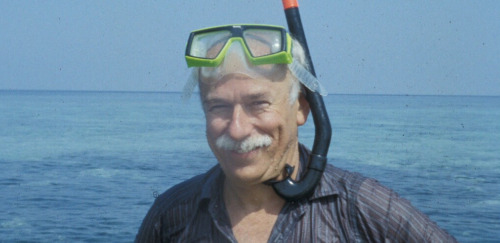
Getting close to his subject: marine biologist Prof. Zvy Dubinsky hopes to understand the changes global warming will cause to the world’s delicate coral reefs. A new EU grant will give the corals a chance.

Israeli marine biologist Zvy Dubinksy is worried. Coral reefs all over the world – from the Great Barrier Reef in Australia to the Red Sea in Israel – are dying, and global warming is the culprit.

Now the professor from Bar Ilan University in Israel hopes to do something about it. He and his team of researchers from the Faculty of Life Sciences have just been awarded a prestigious $4 million grant from the European Research Council to study the effects of global warming on corals in the Mediterranean and Red Seas in the hope that they can come up with data that will help scientists bio-engineer remedies to global warming in advance.

Upbeat Mood at Carbon-Neutral Eilat Energy Event as AORA Solar Leaves Stealth Mode

2

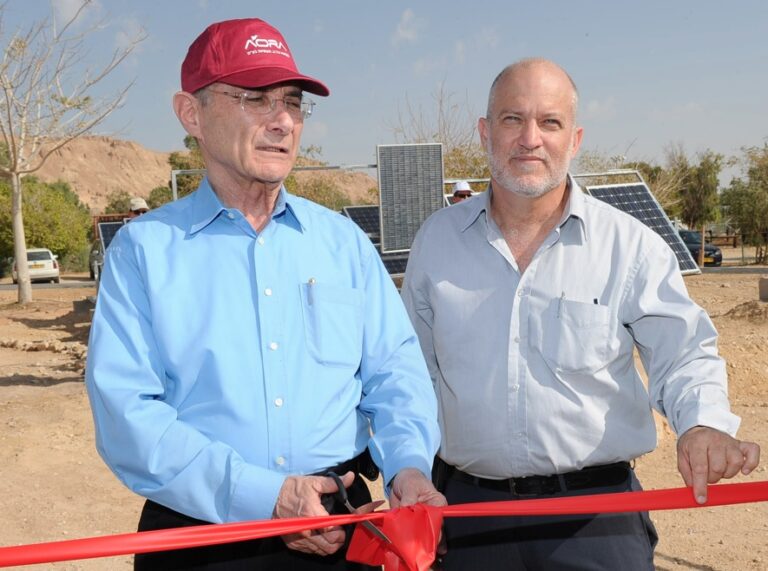
Uzi Landau and Udi Gat launching the Arava Validation Center on Tuesday; Credit: Aran Dolev
Despite some grumbling about zigzags in government policy and bureaucratic obstacles, the mood at the third annual Eilat-Eilot International Energy Conference & Exhibition seemed upbeat during Day 1 of the three-day event, which opened in Eilat on Tuesday. The CEO of Sunday Energy, Kobi Dinar, even cited Rabbi Nahman of Breslov in expressing optimism in the face of regulatory hurdles and uncertainty: “If you believe that you can damage, then believe that you can fix.”

The turnout also reflected the growing interest in renewable energy: According to the event’s organizers, some 2,000 people are attending the conference – about twice as many as last year. However, despite its billing as an international event and a lineup of several VIP guests from abroad (including U.S. Congressman Steve Israel and German Bundestag member Herman Scheer), it is mainly a gathering of Israelis. (Only a few participants used the earphones provided for simultaneous translation from Hebrew.)

Abu Dhabi Rich Pay Millions For Camels While Arab World Stays Poor

24

The price a pedigree camel fetches could fuel a small town. Is it moral for camel races to continue, while much of the Arab world lives in poverty?
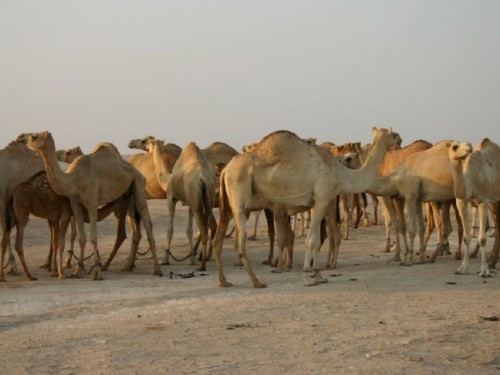
Walk a mile for a camel? It certainly seems like rich people living in Abu Dhabi and other UAE states are more than willing to do this – especially when the camels in question are pedigree racing dromedaries used for sport in the Sheikdom and other locations in the Middle East.

While possessing and racing these “splendid beasts,” as Lawrence of Arabia once referred them to be, is not really in itself environmentally damaging, spending so much money on them is an issue; especially if this kind of eccentric hobby is at the expense of abuse to the animals themselves and to children who care for and even race these ships of the desert.

The situation regarding children being forced to become “camel jockeys” became so serious that under pressure of international organizations such as the UN ‘s UNICEF children’s relief organization, camel racing by underage riders became illegal in 2005. And less than a year later, a conference was held in Riyadh, Saudi Arabia, to make camel racing using children a criminal act.

Parkinson’s in Arab Communities Linked to Pesticides

2


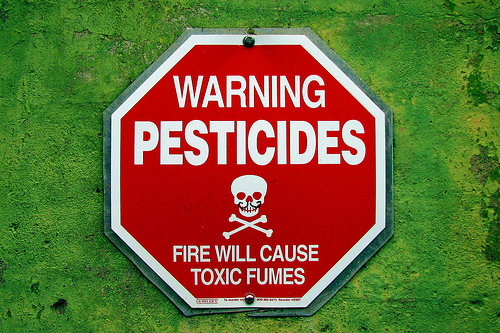
spraying pesticidesNeed another reason to eat organic?  Or at least pesticide-free?

In a study to be published this month, Israeli researchers examining the prevalence of Parkinson’s disease in the Wadi Ara Arab communities in northern Israel found an unusually high prevalence of the disease in the areas of Baqa al-Gharbiyeh. 

Baqa al-Gharbiyeh, an Arab community, has an incidence of 73.39 cases per 100,000 residents, in comparison to surrounding communities like Umm al-Fahm (34.84 cases), Kafr Qara (25.45), and Ara and Arara (18.45 cases).

The reason for this disparity, the researchers explain, is exposure to agricultural pesticides. Update: Later studies in the United States in 2014 show a direct link between DDE, a metabolite of DDT, and the brains of people who have Alzheimer’s.

Dr. Rafik Masalha, head of the epilepsy clinic at Soroka Medical Center in Be’er Sheva, explains: “In Baqa there is higher exposure to industrial agriculture, which includes the use of pesticides, and there are many more farmers compared to other communities in Wadi Ara, whose livelihood is more based on urban work or construction.

Pesticides in the brain

“It was proved that pesticides inhaled can affect the brain stem, which is responsible for the production of dopamine.”

Dopamine is a vital brain chemical. Deficiency causes Parkinson’s, a degenerative disease of the central nervous system that affects motor skills and speech.

According to the research, residents of Baqa al-Gharbiyeh are exposed to pesticides that are dumped by small airplanes. They may also be exposed to pesticides by drinking contaminated water, although the Israeli Ministry of Health says it has not recorded any unusual concentrations of pesticides in Baqa al-Gharbiyeh’s drinking water. 

A statement released by the Ministry read:

“The use of pesticides in Israel is reasonable and under supervision. Well water is examined routinely and meets the strictest standards set by the World Health Organization and the US health authorities. If pollution is found in a well, it is shut down. Pollution in wells as a result of pesticides is rare in Israel.”

To date, the Ministry of Health does not maintain a database on Parkinson’s patients, so this research is the first to discuss the disease within the context of community and environmental health.

In Turkey a researcher was threatened he would go to jail if he continued to talk about the link between industrial pollutants in his village and the high incidence of heavy metals in breast milk. If you live in the Middle East speaking up isn’t easy. Especially when your life is at stake. 

More on pesticides:
Turkey Bans 74 Pesticides for the EU
Make Bugs, Not Pesticides
Souls Wait for Heaven as Toxic Pesticides From Israel Pulled from Sunken Ferry

Tel Aviv Port's "Pop-Up Design Store" Features Many Upcycling Designers

11

[youtube]http://www.youtube.com/watch?v=3MDxk0qAnu0[/youtube]

Tel Aviv’s port (or “namal”) has in recent years become a trendy hot spot.  A little too trendy.  And often their trendiness does not go hand in hand with eco-friendliness.  But sometimes it does, like with their (too chic and elitist for some) farmer’s market and, this month, with their Pop-Up Design Store, Rafsoda.

Rafsoda means raft in Hebrew, and the store definitely allows playful Israeli design to temporarily float alongside the waves of the Mediterranean.

Open as of February 2nd, the temporary store will only remain open until February 22nd and the impermanence of the structure is reflected in the fact that reclaimed materials were used to create the store furnishings.  Instead of internal walls, the store makes use of old wooden doors, window frames, and shutters.  (Check out the construction of the store in the video clip above.)

Several of the 62 designers represented use upcycled or recycled materials, and many of them have been featured on Green Prophet (although there were some fresh surprises!).  These designers include:

Foodbridge Blog Bridges Cultures Through Cooking

14

There’s really no better way to get to know someone than by sitting down and sharing a meal. Sarah Melamed, plant biologist and naturalist, aims to make those connections happen by recreating recipes from all over the Middle East and the Mediterranean on her eclectic blog, Foodbridge.

In multicultural Israel, where Melamed lives, every kitchen offers tempting regional dishes. But most of us don’t follow our noses to find out more. What we like about Foodbridge is that when the author tastes something she likes, she tracks the recipe down, collecting the food traditions of the people who cook it along the way.

Uber-Designed Kindergarten Provides Beautiful Environment, but not a Sustainable Environment

5

A beautiful, uber-designed kindergarten was recently completed in Ramat Hasharon, a suburb of Tel Aviv in Israel.  A collaboration of Sarit Shani Hay (who makes unique toys, children’s furnishings, and textiles) and Lev-Gargir architects, the design philosophy for the space was that “the environment children grow up in strongly reflects how their sensibilities develop and that childhood should be celebrated.”

The design of the school reflects the utopian ideals of its designers that children should be encouraged to be creative, sensitive, imaginative, and original.

But shouldn’t the future of these children be celebrated as well?

While unique, inviting, and extremely aesthetic, the design of the kindergarten is inherently non-sustainable.  Budget and practicality were guiding factors in selecting the materials for the design, and so the entire school is carpeted in light blue PVC (polyvinyl chloride).  The furnishings were constructed from plywood, formica, and whole wood.

Sunray Solar and Sun Power Combine in $277 Million Deal

13

sunray solar and sun power investment dealThe world solar energy industry looks even brighter following the purchase of  Sunray Renewable Energy by the American solar energy giant Sun Power Corporation and solar array manufacturer in a $277 million deal reported in The Marker.

SunRay, headed by Israeli CEO Yoram Amiga, was the first foreign solar energy company allowed to do business in Israel, after Israel’s local solar energy market was opened to outside companies in 2009. Prior to SunRay’s entrance, Israel’s solar energy market had been confined to local companies; some of which, such as Solel Solar Systems, were themselves bought up by foreign companies like Siemens , which wound up purchasing Solel for an even larger sum than the SunRay/Sun Power deal – $418 million USD.

The world solar energy market seems to be getting hotter, now that big solar energy and industrial companies like Siemens and Sun Power are looking to consolidate their share in the increasingly expanding solar energy market.

SunPower, a leader in the solar panel manufacturing industry is very interested in expanding its operations in the Mediterranean region, which may explain why it wanted to acquire SunRay; which is headquartered in Malta and has solar fields already established in Greece, France, Israel, Italy, Malta, Spain, and in the U.K.

A SunPower Private Solar Panel Installation
SunRay’s Israel operations are largely handled through their local subsidiary SunRay Israel Blue White, which is working on projects for fields of solar photovoltaic panels in the Negev.  SunRay has entered into contracts with several kibbutz cooperative settlements to build solar power farms; and has submitted plans to erect solar panel arrays at Kibbutz Urim in the northern Negev region.

This puts SunRay in direct competition with Israeli companies like Arava Power, which has signed deals to erect solar panel arrays in 15 kibbutz and agricultural settlements.

Arava Power is now partnered with Siemens, which purchased a 40% stake in Arava Power, via Siemen’s investment company, Siemens Project Ventures. The solar power investment world is getting complex!

It appears that interest in solar energy is picking up following a number of setbacks in 2009, including the world economic recession and countries like Germany reducing government subsidies paid to solar energy companies that sell their electricity to the government electricity grid.

But the sun seems to be shining brighter on Sun Power’s solar energy ventures; and according to the Marker article, will now have photovoltaic projects in Europe totaling more than 1,200 megawatts.

Israel’s solar energy future is also looking much brighter, thanks to the decision by the Israeli government to set new quotas for smaller solar energy installations (up to 50 kilowatts), and for home solar energy systems up to 4 kilowatts to be allowed without restrictions until the end of 2014.

Since SunPower is one of the major solar panel suppliers in Israel, its solar energy future in Israel, via SunRay Israel Blue White, also looks bright.

Other Solar Energy Articles of Interest:

Siemens Buys Israel’s Solel Solar for $418 Million

Arava Power to Electrify the Negev Desert With 15 Solar Energy Deals

Every Day is Like Sunday with Sunday Solar Energy

Better Place Launches Test Drive and Electric Car Education Facility in Israel

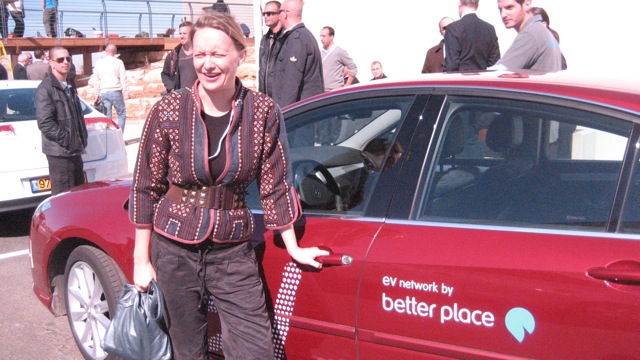
better place education and test drive facility israel photoKarin attends Better Place press conference as company launches its electric car testing facility for the public, in Israel. The sun’s in her eyes as she clutches the door of the new Renault Nissan car. Or maybe she’s blinded by all the excitement?

The media gathered outside the old oil storage containers –– a remnant of the past that line highway #2 on the way from Tel Aviv to Herzylia. The news we were interested in hearing about was not about Better Place’s $350 investment earlier in January, but about the roll out of the Better Place electric education facility that invites the public to test-drive the electric car. We wanted to know when this company will make its vehicles available to the public and on what terms.

Shai Agassi, the CEO of Better Place, a man of rock star status known for propelling the idea to mainstream investors all over the world was there, as were representatives from Renault-Nissan and investor types from HSBC and other firms. I’ve never seen more black suits in one room in my life.

The Israeli press (those not wearing the black suits) were there as were reporters from the international community including CNN, NBC and Bloomberg, but the people asking the tough questions were the Israeli press like Haaretz very contrarian at times, and which wasn’t sold on the Better Place package.

Israel is still relying on coal power. How can the Better Place electric car help wean the country off oil?

Dria Peterson's Handmade Creations, Born From a Geneology of Vegetarianism and Recycling

11

It’s not every day that you come across something called a “Feminist Woman Eco Art Doll” – whether you’re looking on Etsy or elsewhere.  But for Dria Peterson, its creator, it is only natural.

Because why wouldn’t you make new things out of recycled and vintage fabrics, and reclaimed handspun sheep’s wool?  Oh, and did we mention that everything is handmade?

Dria lives in the Amirim vegetarian village in the Galilee region of Israel, where her family lives an actively sustainable life.  Her mom and brother are bakers and have a whole meal bakery, her other brother is a carpenter and makes ecological and organic wooden toys and furniture, and her sister runs a small health food shop.  Oh, and they all do it in the same place – at the family home: Bait 77.

So with such a green background, is it any wonder Dria’s creations include the Feminist Woman Eco Art Doll?

Dria says that recycling and reusing were normal parts of her life when she was growing up, but that beyond that she has always loved to make things.  Even as a child, she remembers knitting clothes for her dolls.

Haifa University Reduced Electricity Consumption by 22% in 2008-09

6

Though their lofty ideals of higher education are admirable, universities are often nevertheless subject to frequent budget cuts and funding shortages.  This can force university administrations to take drastic measures and reduce important educational resources… or, in the case of Haifa University, it can lead the administration to save money by going green.

During the 2008-09 academic year, the University of Haifa reduced electricity consumption by 22%, fuel oil consumption by 64%, and water consumption by 11% as compared with the 2007-08 academic year.  These impressive reductions in resource usage led the Ministry of Environmental Protection to certify the University of Haifa as a “Green Campus”.

But this not only saved resources, it saved money as well.  The electricity conservation alone amounted to a savings of 2,400,000 NIS.  That’s a whole lot of green.  Baruch Marzan, Vice President for Administration and Chairman of the Green Campus Council at the University of Haifa, said that “less electricity consumption not only reduces costs – it minimizes CO2 emissions and air pollution.”