Home Blog Page 634

Israeli Citizen Group "Save Adullam" To Fight Oil Shale Plans

8

adullam-park-oil-shale Israel’s Energy Initiatives’ (IEI) oil shale ambitions threaten the environment, and livelihood of Judean hills residents. [image courtesy of Moshe Moreno]

By now, with the world’s worst oil spill off the Gulf of Mexico causing irreparable damage, and with numerous cleaner alternatives to choose from, a wiser civilization might leave destructive, polluting energy in the ground, or below the sea, and harness the sun and the wind instead. But the American IDT Corporation is pushing a potentially ruinous oil shale scheme in Israel with a license that permits them to bypass environmental assessments or community engagement.

Israeli Company Makhteshim-Agan Industries Invests $1 Billion in Pesticides

3

Makhteshim-Agan Industries pesticidesAgrochemicals might be big business, but they are a bad deal for the environment and human health.

Israeli firm, Makhteshim-Agan Industries, believes that there is a bright future for chemical pesticides. It has just bet $1 billion dollars on this hope, buying out the Albough chemical manufacturer in a move which, according to Ha’aretz, will transform the Israeli company into the “biggest generic player” in North America’s pesticides industry.

There’s big money to be made from agrochemicals, although whether Makhteshim-Agan’s investment was wise financially remains a moot point since since Albough’s businesses focuses on a single product – the broad-spectrum herbicide, glyphosate:

Making Innovation Matter in Water's Terms

Ambika, a research analyst who specializes on Middle East environment issues including conflict and water, reports on her trip to Sweden, where she finds grassroots solutions like the Peepoo Bag –  ones that could impact the developing world.

Along the banks of the beautiful Lake Siljan, in the idyllic town of Leksand, Sweden, over 1600 people from 120 countries came together for the 5th Global YES Summit in partnership with the Tallberg Foundation. The Summit brought together almost 150 projects and new ideas, developed by people who have a desire to tackle the challenges facing us today.

These projects and initiatives attempt to solve issues of social cohesion, climate change, environmental degradation, poverty, and youth unemployment. These ideas, which are focused mainly on the grassroots and community level, have the potential to start an innovation revolution in developing societies.

The projects were divided into five broad themes of water, energy, land, cities and people. Each project was not only environmentally sustainable in its own way, but extremely innovative in its approach. Several of these projects, such as the Peepoople bags, SolarCool, KickStart, Solvatten, and others, simply adapted existing knowledge into effective inventive solutions for the future. These exciting new innovations are mostly uncomplicated and easy to implement, with the power to change and transform the society they are introduced into.

Syria Campaigns to Curb Country's Voracious Plastic Bag Appetite

plastic bags syria damascus market spice phot0 Estimates of 15 million bags per day consumed in Damascus alone! Moshe uncovers news in Arabic – that Syrians are launching a campaign to “say no to plastic bags.”

Where bags litter highways, byways and in a region where camels choke on plastic bags, Syria is joining other countries in the Middle East, such as Lebanon, the UAE, campaigning to ban plastic bags. The Syrian Ministry of Environment is launching a campain to cut down on plastic bags because of their bad effects to human beings as well as to the environment.

Technofarm’s Irrigation Project Aims to Boost Libya’s Self-sufficiency in Food Production

3

irrigation projects great man made river libya photo mapNew agriculture projects feed Libya, thanks to the Great Man Made River. The artificial irrigation project, the most expensive in history, is good while it lasts.

BENGHAZI, Libya — Greg Cunningham is a long, long way from home. Since early 2004, the Colorado agribusiness consultant has lived in eastern Libya — growing wheat and corn irrigated with water piped in from the Sahara Desert. Cunningham, general manager of Technofarm International Ltd., holds the distinction of being the first American businessman in Libya once the doors opened. But risk-taking is nothing new for this 54-year-old entrepreneur, who’s lived and worked in at least 20 countries from Egypt to the Philippines.

“We did not have an ambassador here even a year ago, and a lot of American companies are uncomfortable investing in a country where there’s no active embassy,” Cunningham told The Diplomat. But he added that “Libya’s a very friendly place. Never in five years has anybody given me any trouble.”

Are Iran Oil Sanctions Finally Kicking In?

iran oil sanctionsAs major oil companies pull out of Iran, analysts differ over the import of new economic sanctions.

By all objective standards, this week Iran is facing some version of a moment of truth. Responding to the impending imposition of beefed-up United Nations economic sanctions, French oil company Total announced publicly that it was suspending oil shipments to Iran and the Spanish oil giant Repsol withdrew from a contract to develop part of a large Iranian oil field. Even Iran’s neighbor, the United Arab Emirates, announced a series of moves to comply with the strengthened sanctions regime.

But analysts disagree over the import of the sanctions, and the degree to which the new approach will influence the Iranian government.

“These new sanctions will target Iran’s financial sector, Iran’s ability to trade, Iran’s ability to communicate with the external world and travel, which begins to target the energy sector, and squeeze a number of companies connected to the revolutionary guard,” Dr Emanuele Ottolenghi, a Senior Fellow at the Foundation for the Defense of Democracies and author of Under a Mushroom Cloud – Europe, Iran and the Bomb, told The Media Line. “All of these things combined will have a significant effect.”

“Obviously, it could have been much tougher, but there are some aspects of the resolution which if implemented honestly, conscientiously and resolutely can do a great deal of damage at a time when the Iranian economy is particularly fragile due to the vast incompetence of the current government. And the internal political situation makes the government more vulnerable,” he continued. “If you look at sanctions as a way to slow down and damage the efforts of the regime then these efforts are valuable.”

“Those who think that sanctions will solve the problem are wrong: sanctions are not going to convince President Ahmadinejad or the Supreme Leader Khamenei to reconsider their approach to nuclear power, nor are sanctions going to bring down the regime,” Dr Ottolenghi said.

“But if properly implemented, sanctions can achieve two goals: first, to reduce the ability of Iran to procure and acquire sensitive technology abroad which will significantly slow down the Iranian race to nuclear weapons. The second value of the sanctions is that they will immensely raise costs for Iran to engage in all of its illicit activities, wreaking havoc into the system by, for example, by sowing discontent among those within the regime who are in it just for the profit.”
But Dr. Seyed Mohammad Marandi, a professor at the University of Tehran, argued that the sanctions would fail in their stated goals.

“I don’t think that sanctions will have a major effect on Iran, especially since the Iranians had been preparing for the sanctions for quite awhile now,” he told The Media Line. “Iran is trading less and less with Europe and North America; and has been finding alternative partners in Asia, Latin America and Africa.

“Beyond diversifying its trade, Iran has also become more independent, for example in its consumption of oil, with heavy investment in oil refineries,” Dr Marandi said. “So Iran is much more independent than it was a few years ago.”

“There will be a minor effect,” he continued. “For example hospitals will have difficulty importing equipment from Europe. But at the end of the day it’s not going to have a major effect on the Iranian economy, and the irony is that the more sanctions that the west places on Iran, the greater the gap between them and the less leverage Western countries have over Iran.”

Dr Mehrdad Khonsari, a former Iranian diplomat and Senior Research Consultant at the Centre for Arab and Iranian Studies, argued that the sanctions would delay, but not solve, the principal conflict between Iran and the West.

“The sanctions will obviously have some kind of an effect on the Iranian economy by making conditions worse for all Iranians,” he told The Media Line. “But it will not be of sufficient strength or magnitude to force the Iranian government to change its stance or go a different way.”

“Life will become harder, Iran’s flexibility within the international community will be marginalized, but it doesn’t mean that the sanctions will achieve the behavior which they are aimed at achieving,” Dr Khonsari continued. “The oil companies are not pulling out, and those who are buying Iran’s oil are still buying the oil. What they are doing is essentially making sure that there is no new investment or technology and that production levels don’t increase.”

“If the international community were serious about containing Iran’s development towards nuclear weapons, they would recognize reality: we are moving towards a military confrontation, which is exactly what Ahmadinejad wants,” he said. “Sanctions are not working; diplomacy is not working; so what else is left? The choice is very clear.”

More on oil, green news and not-so green, from the Middle East:
Saudi Arabia to Replace Oil With Solar Power
Jordan Activists Worry About Oil Spill in Red Sea
Red Sea Oil Spill Cover Up Worse Than Expected
(This story is reproduced from the Middle East News Source – The Media Line)

Above image via azrainman

Smokers Decompose Slower Than Non-Smokers


“Smoked pigs” decompose slower than those that don’t smoke. (They were actually injected with nicotine).

With smoking rampant in the Middle East, and rates in children increasing all the time, a new CSI study, using pigs of all creatures has found that those injected with nicotine decompose slower than those pigs which weren’t injected, reports the New Scientist.

I.D.E. Launches Third Desalination Plant in Israel

0

ide desalination israelShimon Peres, Shari Arison and other notables toast water to Israel’s latest desalination plant, dubbed the largest of its kind in the world.

With news of new business in China this week, IDE launches its third desalination plant in Israel:
Champagne glasses containing the finest fresh water were raised in a toast last month to celebrate the opening of Israel’s third desalination plant, this one in the northern city of Hadera. Lauded as the largest reverse osmosis desalination facility in the world, the plant that takes water from the Mediterranean Sea and makes it safe to drink is expected to produce 127 million cubic meters of water each year – enough to meet the water needs of one in every six Israelis. But is it green?

Created with an investment of nearly half a billion dollars, the plant was built by IDE Technologies, an Israeli company that has already built two seawater desalination plants on the country’s Mediterranean Sea coastline, along with the Housing and Construction Group, a real estate and development firm owned by the Arison Group.

It was the government that put in place the plan to create the desalination plant, to meet the demands of a growing population and an imperiled water supply, dependent almost entirely on winter rainfall.

aerial view desalination plant IDE IsraelAerial view of the new desalination plant in Hadera.

In a 25-year agreement with the government and with its full blessing, the water will be produced at just over 50 cents per cubic meter. IDE’s first desalination plant, built on the coast in Ashkelon, has been performing well since 2005, according to company reports. There is a third plant at Palmahim, just south of Tel Aviv, and two more are planned along the coast, in Ashdod and Soreq.

A new era of cheap water?

“The success of the mega-desalination plant concept has ushered in a whole new era of plentiful, affordable water for a world facing severe water challenges,” says Avshalom Felber, IDE Technologies CEO, in a press statement. “With the launch of the Ashkelon plant in 2005, we pledged to continue pursuing further breakthroughs in plant capacity and water cost.”

Ofer Kotler, CEO of the Housing and Construction Group (‘Shikun U’Binui’ in Hebrew) says: “As one of the most complex and largest building projects our group has ever undertaken, we are especially pleased to present this plant to a country facing severe water challenges.”

The project was financed via a consortium of international banks, including the European Investment Bank, Calyon, a French investment bank, and Portuguese investment bank Esperito Santo. Back in 2007, Euromoney, a prestigious business and investment magazine, touted the ‘global village’-style economic deal for the Hadera plant as the Project Finance Deal of the Year.

ide desalinationInside the Hadera desalination facility in Israel.

IDE boasts technological breakthroughs in the fields of thermal and membrane desalination, and also, perhaps surprisingly for a country in the Middle East, in snowmaking. In desalination, the salt is removed from seawater using a process called Reverse Osmosis (RO) one of two ways to use desalination membranes to process water. In RO, water from a highly pressurized salty solution is channeled through a water-permeable membrane to separate it from its salty component. The second approach found in desalination plants like in Saudi Arabia is via a process called electrodialysis.

IDE is owned by two mega-industrial companies in Israel. The chemical company ICL has a 50 percent stake in IDE (this company also extracts potash and chemicals from the Dead Sea) and Delek Group, an energy and infrastructure investment company and holding tank, owns the other half.

The new desalination plant at Hadera is the largest of its kind in the world, and is expected to produce enough water for one in six Israelis.

Not an environmentally correct solution

Environmentalists in Israel do not see desalination as a definitive long-term solution for solving the water crisis in Israel and the Middle East, however. One prominent group is Friends of the Earth Middle East (FOEME), whose Israel director Gidon Bromberg points out that desalination plants have a lot of corporate money at stake, in the hands of a few stakeholders.

In addition, in the context of climate change and protection of local environments, reliance on the extremely energy-intensive and pollution-emitting desalination process doesn’t appear to be a viable long-term solution, he says.

Bromberg and others dedicated to the protection of local water resources suggest that water-strapped countries like Israel, Jordan and others in the region first identify more effective means of reducing water use at home and cut back on water-intensive agricultural practices.

This debate between industry and the environment isn’t new, and now is the time to create common ground and circumvent a crisis, Shmulik Shai, general manager of H2ID, the Hadera desalination plant, tells me.

He says that for the past five years Israel has been facing a severe shortage in its three main sources of water: The Sea of Galilee, its mountain aquifer and its coastal aquifers. Below the red line in terms of volume and nitrates, if the country doesn’t find a solution now, these sources could be damaged indefinitely, he warns.

“The balance of rainwater is not good enough,” says Shai. If there’s one short season of rain and a spike in population, Israel’s semi-arid climate could find itself with a “chronic shortage problem,” he continues. And while 70 percent of the country’s water is supplied by rain that falls in the winter months, there are periods of drought in Israel when the rain does not come down at all. To make things worse, rainfall is not evenly distributed, he remarks.

The new plant will furnish a good portion of the 750 million cubic meters of water that Israelis require for personal use, he says. And among the desalination technologies that the Hadera plant utilizes are those developed by IDE, including new processes and new mechanisms, such as how to pressurize the water. To date, IDE has constructed some 400 desalination plants in 40 countries, with a total water output of 2,000,000 cubic meters per day.

More on desalination:
Saudi Arabia to Use Sun Power at Desalination Plant
New Hadera Desalination Plant Could Revive the Dying Jordan River
Japan and Saudi Arabia Co-develop Desalination Technologies

Read our series of interviews with Israeli water experts:
1. All the Water in Israel: Interviews with Government, Analysts and Researchers
2. Interview with Israel’s past water commissioner, Shimon Tal
3. Gidon Bromberg on Water Security and Sustainability in the Middle East
4. Read our interview with Israel’s Water Commission
5. Interview with Eli Ronen, the Chairman of Mekorot
6. Interview with Ranaan Borel (SPNI) on Water Security in Israel

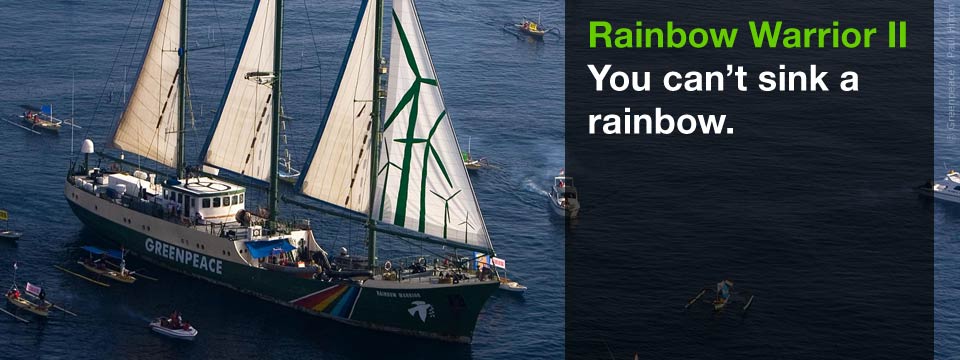
Greenpeace’s Flagship, the Rainbow Warrior, to Grace Tel Aviv and Haifa’s Harbors

1

Put down your matkot and take a tour of Greenpeace’s flagship, the Rainbow Warrior, this week.

Beachgoers on Tel Aviv and Haifa’s shores will be seeing something a little different over the next days, in the form of Greenpeace International’s famous flagship – the Rainbow Warrior.  The most famous of all of Greenpeace’s eco-activist ships, the Rainbow Warrior’s name was inspired by a native American prophecy that predicted a time when human greed would make the earth sick and a band of warriors would descend from a rainbow to heal it.  And so the ship travels the globe, protesting environmental crimes and disasters. 

Israel's Kibbutzim: Renewal through Cleantech?

3

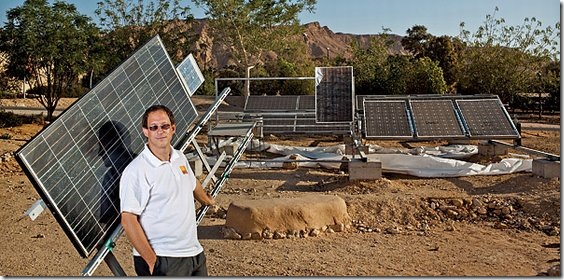
Abramowitz Arava PowerProfitability + altruism + saving the planet? Yosef I. Abramowitz from Arava Power, Kibbutz Ketura Israel – one of the latest ventures in clean tech launched from an Israeli kibbutz.

The Kibbutz Movement celebrated its centenary in 2010, but the last decades of the 20th Century were not kind to Israel’s collective settlements. The shift in Israel’s economy, politics and society beginning in the late 70s stripped the kibbutzim of their status and pioneering role, and brought harsh economic realities to their doorsteps. Being the pioneer elite for Zionism was no longer enough; kibbutzim were now required to pay their own way as well.

The patient has now stabilised, but in many cases this has meant kibbutzim having to abandon their socialist ideals and privatise their internal economies. While kibbutzim still offer an attractive lifestyle, based on their bucolic setting and community orientation, they have not managed to regain their sense of mission and purpose and leadership role in Israeli society. They are moving into the business of clean tech, Bloomberg reports.

Cleantech 2010 Shows Clean Tech Industry as Growth Engine for Israel

0

Israel CleantechIsrael’s solar, water and other cleantech companies showcased their products this week at an exhibition in Tel Aviv. (Image via Israel Export Institute)

In his keynote address at the Cleantech 2010 Expo in Tel Aviv yesterday, the governor of Israel’s central bank, Stanley Fischer, emphasized the potential of cleantech as a growth engine for Israel and called for increased private investment to drive this growth.

“The field can serve as an engine for growth, and assist in diversifying exports and export [markets] and thereby reduce harm from [economic] crises. In addition, developing the sector will help promote environmental issues in Israel, reduce Israel’s dependence on imported fuel and assist Israel’s integration in the OECD,” Fischer explained, as reported in the Haaretz daily.

Book Review for Light Summer Reading: French Lessons by Peter Mayle

book-review-french-lessonsIf you like to beguile the slow, hot summer hours with a good food book, you will love this one.

Author Peter Mayle, famous for his series of books on life in Provence as a British ex-pat, traveled left Provence to get a better taste of  food festivals in other regions. He sat down at long trestle tables all over France and celebrated frog’s legs with plenty of garlic. Blissful cheeses. Chickens with blue feet.

Mayle experiences a wine tasting that goes on all afternoon and needs “a medicinal bottle of champagne” to cure the resulting hangover. (Something like what this reviewer experienced after the IsraWine Expo 2010.)A truffle auction that kicks off at early Mass. A marathon where sweating, cross-dressing runners wait for each other to catch up. Hilariously, the proper etiquette involved in kissing a fellow Frenchman.

Clare Dissects Post-apocalypse Britain in 'Everyone Can Be a Hero'

everyone can be a hero book coverI have quite a taste for post-apocalyptical fantasies myself (such as Cormac McCarthy’s chilling ‘The Road’, reviewed here earlier on GP), so I picked up ‘Everyone Can Be A Hero’ with some eagerness.  It is a novel for teenagers set in a Britain devastated by a nuclear accident, where the remaining population is forced to return to the skills of the past in order to survive – quite a contrast to books like Let the Snog Fest Begin! or the ubiquitous Twilight series which throng the 12+ shelves in Waterstones and other bookshops.

The cover of Everyone Can Be a Hero is promising.  It’s made of cardboard, laced with rough string, and my worries that this would mean it would be hard to open the book properly were not fulfilled.  The paper is recycled.  All of which sets the scene well for a new reality in which resources are scarce.  Life is indeed different in this 2040 world. Roads have returned to wilderness.  Children skate to school.  Families all have allotments and grow their own food.  There are some great ideas in here:  I particularly liked the annual M1 sailboarder race.

Seven Tips for Modest Moms: Choosing a Green Breastfeeding Cover

hijab-baby-motherFor many mothers in the Middle East, breastfeeding in public is an issue because of modesty. In my post on breastfeeding in hijab, I mentioned Muslim women who use nursing covers. In this post I’ll explain what a cover does and how to choose one that is functional, comfortable and “green.”

Libya's Pivot Irrigation in the Sahara Proves Money Can Do Anything

pivot irrigation libyaLibyan pivot irrigation at Al KHufrah Oasis: These are not crop circles or part of an Alien movie plot!

Libya, in North Africa, now drilling for oil with BP is a country that is not exactly known for having ample  quantities of fresh water let alone enough water to be used to any extent in agriculture. Yet this North African desert country, ruled by a man who most people consider to be a bit “eccentric” (if not entirely off the wall)  has been involved for years in growing crops by a method known as pivot irrigation.