
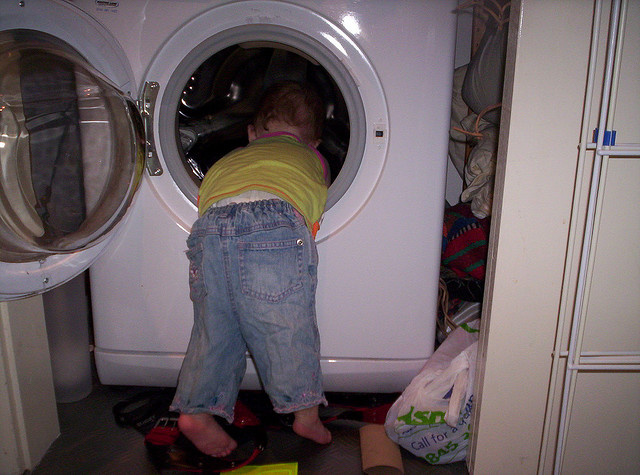
 For me, cloth diapers meant two or three extra loads of laundry a week.
When I read that Karin decided to “walk the walk” and switch to reusable diapers with her young baby, I could see that she and her husband, along with readers, have the same questions that people asked back when I used cloth diapers for my two youngest. Are reusable cloth diapers really worth the trouble? Aren’t they messy and smelly? How green are they, really, especially with the water shortage? And in the Middle East the price isn’t so attractive either.
For me, reusable cloth diapers were a practical choice, not only an idealistic one. Here’s why:
- Convenience. I found reusables more convenient than the disposable diapers I had used with my older children. It meant a couple of extra loads a week. I used Chinese pre-fold diapers, which are flat, square layers of cotton with a few extra layers in the middle. They took little time to hang out and dried quickly, they didn’t need folding, and had no elastic that would wear out. I kept a large enough supply to fill one washing load, plus a few extra. The waterproof, fitted covers for the pre-folds could be washed in any load or rinsed by hand, so I only needed 3 or 4 in each size.
Cloth diapers mean no more late-night diaper runs to the store, and you don’t have to take out the garbage as often. If I ran out of diapers, I stuffed a cover with a receiving blanket or small towel. - Smell. To keep cloth diapers from smelling, use a minimum of detergent. Urine interacts with soap residue to make a strong chemical reaction. Most people use too much detergent in their machines. Disposable diapers smell bad when they are new and worse once they get wet. After a day or two they smell horrid.
- Mess. When the babies were still exclusively breastfed, I tossed the diaper in the bucket until wash day. Once solids were introduced, I used a spray attachment to briefly rinse poop into the toilet. Any stains came out after two or three washes at most. There’s no need to pre-soak, as is sometimes recommended.
- Cost. When calculating costs, include water, electricity and detergent. My costs also included the diapers, which lasted for two babies, and the covers, which didn’t. I ordered the supplies from the US and people brought them for me, but not everyone has this option. It’s possible to recycle cotton clothes to make your own with minimal sewing skills, and there’s a market for used diapers here too. I sold mine to a grateful new mom, although I still wonder whether I should have saved them for the grandchildren.
- Environment. Brendan I. Koerner of Slate claims that with today’s energy-efficient machines, there’s no question that reusables are more environmentally friendly than disposables. As for water, the production of disposables uses water, some say double the amount needed for laundering cloth. Even if the water doesn’t come from a local supply, we should be thinking globally. And we are importing all of that material that will end up in local landfills. Water, at least, is a renewable resource and waste water in Israel is recycled. Then we have to consider the energy and pollution involved in producing and transporting the diapers. Reusable diapers also use resources in their production, but this is spread out over the life of the diapers. Until we use disposable clothes or bed linens, I think it’s reasonable to launder diapers.
Read more on cloth diapers from a dad’s perspective here.
The kids whose diapers I washed are now 9 and 7, but I still remember the satisfaction of bypassing the baby products aisle in the grocery store. If I had to do it again, though, I would choose elimination communication, a method of training children to recognize cues that greatly reduces the amount of time children spend in diapers. That is by far the greenest choice.
More Green Posts by Hannah Katsman:
Twelve Tips for Saving Water in the Kitchen
Breastfeed Your Baby in a Hijab: Public Breastfeeding in the Middle East
A Fading Art: Understanding Breastfeeding in the Middle East













 After recovering from the shock of motherhood, Karin tries an eco-compromise by using washable diapers half of the time.


 Three years of extra snow has weakened Ireland’s salt stocks, demonstrating an overall lack of preparedness for the effects of climate change. Outline of Birket Maraqi salt lake in the oasis of Siwa, Egypt


