Research from the Wildlife Conservation Society (WCS) and the University of Queensland, published in Ocean & Coastal Management, found that nearly three out of four marine protected areas (MPAs) worldwide are exposed to sewage pollution.
At a time when climate anxiety can feel abstract and overwhelming, and being Jewish something people may need to hide in big cities, Adamah Los Angeles is trying something different: turning Jewish values into local climate action with dirt-under-the-fingernails practicality.
For families with kids, pets, or anyone trying to build a cleaner outdoor space, removing old astroturf is one of the simplest ways to reduce unnecessary exposure to plastics and heat. Some past studies suggest that if kids have played on these surfaces you need to wash their hands.
Artificial turf, the green plastic stuff that is supposed to look like grass, was sold to many home-owners as a clever compromise: a green-looking surface that makes you feel homey, but which needs no mowing. It survives heavy use, and in dry places like Middle East deserts, and in California or Texas, it can replace thirsty lawns. But it is toxic.
“In the midst of uncertain time, renewable energy remains consistent and steadfast in its expansion,” said Francesco La Camera, IRENA’s Director-General. “A more decentralised energy system, with a growing share of renewables and more market players, is structurally more resilient.”
Research from the Wildlife Conservation Society (WCS) and the University of Queensland, published in Ocean & Coastal Management, found that nearly three out of four marine protected areas (MPAs) worldwide are exposed to sewage pollution.
At a time when climate anxiety can feel abstract and overwhelming, and being Jewish something people may need to hide in big cities, Adamah Los Angeles is trying something different: turning Jewish values into local climate action with dirt-under-the-fingernails practicality.
For families with kids, pets, or anyone trying to build a cleaner outdoor space, removing old astroturf is one of the simplest ways to reduce unnecessary exposure to plastics and heat. Some past studies suggest that if kids have played on these surfaces you need to wash their hands.
Artificial turf, the green plastic stuff that is supposed to look like grass, was sold to many home-owners as a clever compromise: a green-looking surface that makes you feel homey, but which needs no mowing. It survives heavy use, and in dry places like Middle East deserts, and in California or Texas, it can replace thirsty lawns. But it is toxic.
“In the midst of uncertain time, renewable energy remains consistent and steadfast in its expansion,” said Francesco La Camera, IRENA’s Director-General. “A more decentralised energy system, with a growing share of renewables and more market players, is structurally more resilient.”
Research from the Wildlife Conservation Society (WCS) and the University of Queensland, published in Ocean & Coastal Management, found that nearly three out of four marine protected areas (MPAs) worldwide are exposed to sewage pollution.
At a time when climate anxiety can feel abstract and overwhelming, and being Jewish something people may need to hide in big cities, Adamah Los Angeles is trying something different: turning Jewish values into local climate action with dirt-under-the-fingernails practicality.
For families with kids, pets, or anyone trying to build a cleaner outdoor space, removing old astroturf is one of the simplest ways to reduce unnecessary exposure to plastics and heat. Some past studies suggest that if kids have played on these surfaces you need to wash their hands.
Artificial turf, the green plastic stuff that is supposed to look like grass, was sold to many home-owners as a clever compromise: a green-looking surface that makes you feel homey, but which needs no mowing. It survives heavy use, and in dry places like Middle East deserts, and in California or Texas, it can replace thirsty lawns. But it is toxic.
“In the midst of uncertain time, renewable energy remains consistent and steadfast in its expansion,” said Francesco La Camera, IRENA’s Director-General. “A more decentralised energy system, with a growing share of renewables and more market players, is structurally more resilient.”
Research from the Wildlife Conservation Society (WCS) and the University of Queensland, published in Ocean & Coastal Management, found that nearly three out of four marine protected areas (MPAs) worldwide are exposed to sewage pollution.
At a time when climate anxiety can feel abstract and overwhelming, and being Jewish something people may need to hide in big cities, Adamah Los Angeles is trying something different: turning Jewish values into local climate action with dirt-under-the-fingernails practicality.
For families with kids, pets, or anyone trying to build a cleaner outdoor space, removing old astroturf is one of the simplest ways to reduce unnecessary exposure to plastics and heat. Some past studies suggest that if kids have played on these surfaces you need to wash their hands.
Artificial turf, the green plastic stuff that is supposed to look like grass, was sold to many home-owners as a clever compromise: a green-looking surface that makes you feel homey, but which needs no mowing. It survives heavy use, and in dry places like Middle East deserts, and in California or Texas, it can replace thirsty lawns. But it is toxic.
“In the midst of uncertain time, renewable energy remains consistent and steadfast in its expansion,” said Francesco La Camera, IRENA’s Director-General. “A more decentralised energy system, with a growing share of renewables and more market players, is structurally more resilient.”
Research from the Wildlife Conservation Society (WCS) and the University of Queensland, published in Ocean & Coastal Management, found that nearly three out of four marine protected areas (MPAs) worldwide are exposed to sewage pollution.
At a time when climate anxiety can feel abstract and overwhelming, and being Jewish something people may need to hide in big cities, Adamah Los Angeles is trying something different: turning Jewish values into local climate action with dirt-under-the-fingernails practicality.
For families with kids, pets, or anyone trying to build a cleaner outdoor space, removing old astroturf is one of the simplest ways to reduce unnecessary exposure to plastics and heat. Some past studies suggest that if kids have played on these surfaces you need to wash their hands.
Artificial turf, the green plastic stuff that is supposed to look like grass, was sold to many home-owners as a clever compromise: a green-looking surface that makes you feel homey, but which needs no mowing. It survives heavy use, and in dry places like Middle East deserts, and in California or Texas, it can replace thirsty lawns. But it is toxic.
“In the midst of uncertain time, renewable energy remains consistent and steadfast in its expansion,” said Francesco La Camera, IRENA’s Director-General. “A more decentralised energy system, with a growing share of renewables and more market players, is structurally more resilient.”
Research from the Wildlife Conservation Society (WCS) and the University of Queensland, published in Ocean & Coastal Management, found that nearly three out of four marine protected areas (MPAs) worldwide are exposed to sewage pollution.
At a time when climate anxiety can feel abstract and overwhelming, and being Jewish something people may need to hide in big cities, Adamah Los Angeles is trying something different: turning Jewish values into local climate action with dirt-under-the-fingernails practicality.
For families with kids, pets, or anyone trying to build a cleaner outdoor space, removing old astroturf is one of the simplest ways to reduce unnecessary exposure to plastics and heat. Some past studies suggest that if kids have played on these surfaces you need to wash their hands.
Artificial turf, the green plastic stuff that is supposed to look like grass, was sold to many home-owners as a clever compromise: a green-looking surface that makes you feel homey, but which needs no mowing. It survives heavy use, and in dry places like Middle East deserts, and in California or Texas, it can replace thirsty lawns. But it is toxic.
“In the midst of uncertain time, renewable energy remains consistent and steadfast in its expansion,” said Francesco La Camera, IRENA’s Director-General. “A more decentralised energy system, with a growing share of renewables and more market players, is structurally more resilient.”
Research from the Wildlife Conservation Society (WCS) and the University of Queensland, published in Ocean & Coastal Management, found that nearly three out of four marine protected areas (MPAs) worldwide are exposed to sewage pollution.
At a time when climate anxiety can feel abstract and overwhelming, and being Jewish something people may need to hide in big cities, Adamah Los Angeles is trying something different: turning Jewish values into local climate action with dirt-under-the-fingernails practicality.
For families with kids, pets, or anyone trying to build a cleaner outdoor space, removing old astroturf is one of the simplest ways to reduce unnecessary exposure to plastics and heat. Some past studies suggest that if kids have played on these surfaces you need to wash their hands.
Artificial turf, the green plastic stuff that is supposed to look like grass, was sold to many home-owners as a clever compromise: a green-looking surface that makes you feel homey, but which needs no mowing. It survives heavy use, and in dry places like Middle East deserts, and in California or Texas, it can replace thirsty lawns. But it is toxic.
“In the midst of uncertain time, renewable energy remains consistent and steadfast in its expansion,” said Francesco La Camera, IRENA’s Director-General. “A more decentralised energy system, with a growing share of renewables and more market players, is structurally more resilient.”
Research from the Wildlife Conservation Society (WCS) and the University of Queensland, published in Ocean & Coastal Management, found that nearly three out of four marine protected areas (MPAs) worldwide are exposed to sewage pollution.
At a time when climate anxiety can feel abstract and overwhelming, and being Jewish something people may need to hide in big cities, Adamah Los Angeles is trying something different: turning Jewish values into local climate action with dirt-under-the-fingernails practicality.
For families with kids, pets, or anyone trying to build a cleaner outdoor space, removing old astroturf is one of the simplest ways to reduce unnecessary exposure to plastics and heat. Some past studies suggest that if kids have played on these surfaces you need to wash their hands.
Artificial turf, the green plastic stuff that is supposed to look like grass, was sold to many home-owners as a clever compromise: a green-looking surface that makes you feel homey, but which needs no mowing. It survives heavy use, and in dry places like Middle East deserts, and in California or Texas, it can replace thirsty lawns. But it is toxic.
“In the midst of uncertain time, renewable energy remains consistent and steadfast in its expansion,” said Francesco La Camera, IRENA’s Director-General. “A more decentralised energy system, with a growing share of renewables and more market players, is structurally more resilient.”
What does it take to make people stop wearing fur? Maybe this recent campaign launched by the Anti-Fur Coalition in Israel.
Israel took a historic step last year to ban the import and marketing of animal fur, except for Streimels used by Ultra-Orthodox Jews.
Pamela Andersen, honorary ambassador of People for the Ethical Treatment of Animals (PETA), lauded the bill and encouraged Ultra-Orthodox to consider alternatives.
Even so, following pressure from pro-fur groups, the bill was put on hold, much to the disgust of the Anti-Fur Coalition. With help from the Draftfcb+ Shimoni Finkelstein Barki ad agency, the group launched the “There’s no beauty in cruelty” campaign.
Although shark fining was completely unheard of in the region at one point – as it’s not part of Arabian cuisine- the practice is gaining momentum and shark fishing is definitely on the rise.
UAE Is Market Hub for Shark Fins
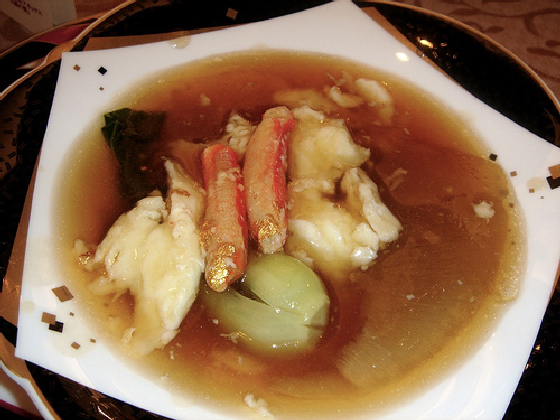
A week ago, shark fin soup served at a Dubai function did court controversy but the fact remains that shark fin soup is ‘not uncommon in Dubai’. According to a news report on the issue by UAE 7 Days (link not working in 2022), the UAE still plays its part in the controversial trade and is the market hub for what is still seen as a high-status delicacy.
Although shark fining was banned in the United Arab Emirates in 2008, sharks fins are openly sold in the fish markets of Dubai. It is estimated that around 70 million sharks are killed for their fins each year and the UAE provides nearly 10 percent of this world total supply of shark fins.
Shark Dissection Carried Out In Name of Nature
The complete disregard for the shark population was illustrated by another incident around a month ago in Abu Dhabi where a group of teenagers dissected two sharks- all in the name of learning about the environment.
Apparently, the activity was organised by a diving and education charity Tawasul which aims to teach children about marine biodiversity. Even more shocking is the fact that the dissection was supervised by Rima Jabado who, according to the UAE National, “has been working for more than a year to determine how much local fishing is contributing to the rapid decline of sharks, which are also disappearing globally.”
Fining and Death of Pups Major Threat
The biggest threat to the shark population comes from hunting shark pups, catching pregnant females and fining. Ibrahim Al Zu’bi from the Emirate Diving Association told UAE 7 Days that continued shark fining and indiscriminate fishing could spell disaster for the ecosystem.
“If you over-fish anything, you will eventually see a negative impact on the marine system,” Al Zu’bi explained.
Image via Julia Spaet- KAUST PhD student researching shark populations in the Red Sea.
These sick baby turtles covered in barnacles are two of many turtles received for treatment in Dubai.
Scientists are puzzled over the record number of mostly endangered Hawksbill turtles being admitted to the Dubai Turtle Rehabilitation Project. The 210 turtles that have been brought in for treatment significantly exceeds the numbers received in previous years. While the cause for this increase is unclear, it appears that with coral reefs that nurture turtle food in drastic decline, the sick reptiles are not able to acquire sufficient food.
Garbage dumps roll into the sea? Rola suggests ways for energy intensive Lebanon to help ease its waste and energy problems.
As Lebanon enters another waste crisis in the cities of Sidon and Tyre, with reportedly thousands of tons of waste piled up on the streets, the country finds itself once again looking for an urgent solution for its overfilled land capacity. With equally pressing power supply shortages, it’s time domestic petty politics are set aside and more attention is given to opportunities that modern waste management technology has to offer.
Cycling holidays are tempting travellers to eco-friendly ways of seeing the Middle East
In recent months Green Prophet has reported on all aspects of cycling in the Middle East, from new resources for visitors wanting to visit the Middle East by bicycle, to calls for a Critical Mass-style ‘cycling revolution’ in Cairo. In line with the growing enthusiasm for this cheap, green means of transport, two new initiatives are making it easier for travellers in the Middle East to opt for eco-friendly ways of getting around.
In Jordan, tour operator Terhaal has launched its ‘Dead 2 Red’ biking holidays, travelling from Madaba, via historic sights such the memorial to Moses on Mount Nebo, the ‘rose-red’ Nabataean city of Petra and the Crusader castle of Kerak, and via eco-tourism destinations such as the Nature Reserve at Dana. The trip concludes at the Red Sea resort of Aqaba. As well as environmentally conscious tourism, Terhaal also emphasises a community element, with cyclists getting to eat and stay with local families.
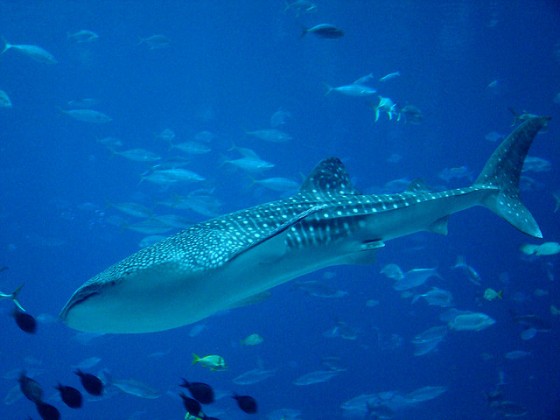
Despite the popular notion that sharks are a threat to human life, the reality is that we as humans form a bigger threat to the survival of sharks. In the Middle East, the growth of shark fishing and shark fining is becoming a serous threat to the shark population in Arabian waters.
Although the UAE passed a decree banning shark fining in 2008, the Gulf state is still a major hub for the sale of sharks and shark fins. It provides around 10% of the global supplies of shark fins.
Credit: Julia Spaet- PhD student at KAUST researching shark populations in the Red Sea.
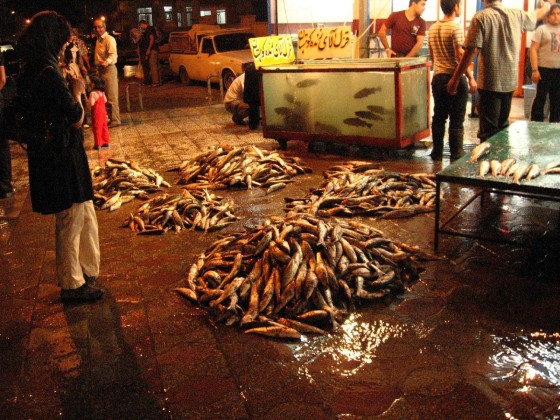
A fish market in Iran. Oman along with Iran are another two countries who are contributing to the decline of the shark population by taking part in the lucrative shark fin trade.
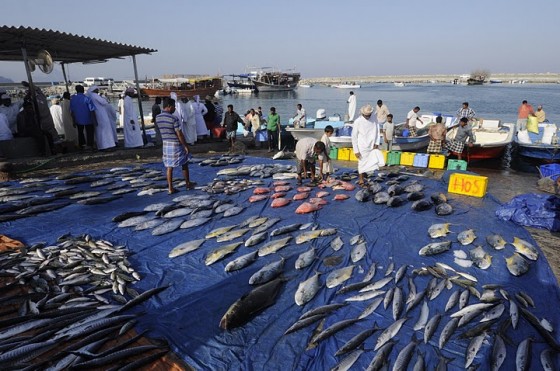
An Omani fish market where shark fining is still legal. In Oman, shark fining is not permitted at sea but allowed on land- conservationists have questioned whether this distinction makes any difference for the survival of the species.
A single shark fin can fetch more than $1,300- in the UAE the price of shark fins are rising as the numbers of sharks dwindle and the demand continues to grow. A bowl of shark fin soup can cost $100.
Sharks play important roles in maintaining healthy marine ecosystems. As predators they help control the numbers of their prey so that they don’t grow to levels unsustainable for the ecosystem.
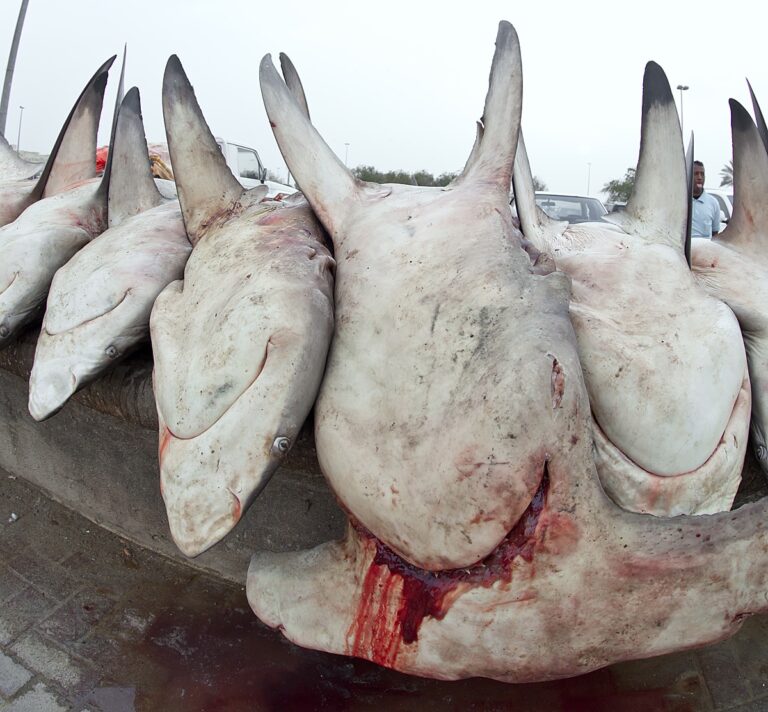
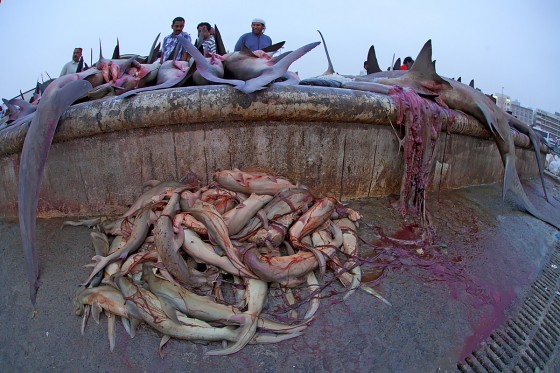
A female hammerhead shark was recently killed along with its 45 pups in Dubai. Experts believe that sharks are disappeared around the globe at an alarming rate with some species down by 90 percent. The hammerhead shark- like the female and pups pictured here- is one of the worst affected species.
Credit: PhD student at KAUST researching shark populations in the Red Sea.
Taking place for the eighth consecutive year, the Green Globe award ceremony is held by Life and Environment – the umbrella organization for over 120 Israeli environmental organizations. This annual green “Oscar”-like awards event recognizes environmental activist excellence in the governmental, business, and civilian sectors.
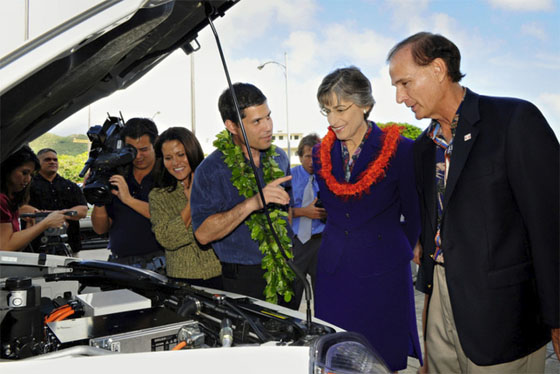
Hawaii has just invested $2.6 million in stimulus funds in a public private partnership in electric vehicle infrastructure planned since 2008 to help jump start the adoption of electric vehicles. Better Place, with $854,000, and Aerovironment with $820,000 were the leaders among six road-ready electric vehicle innovators to receive a share of the funding.
To coincide with World Water Day, we take a look at a wastewater project planned for Palestine’s green city
The Arab region is believed to be one of the driest in the world– 70% of the land is dry and rainfall is sparse and the effects of climate change will only exacerbate the situation. As today is World Water Day, as well as highlighting the problems the region faces, here at Green Prophet we also want to celebrate the success stories of the region.
The planners behind Palestine’s first planned and green city called Rawabi (or ‘Hills’ in Arabic) have recently given the go-ahead for a feasibility study for a new regional wastewater facility which strengthens their commitment preserving water.
Care for a slab of Frankenstein steak? Just glue meat scraps together with transglutaminase and serve ’em up, hot. Side of blood clots, optional.
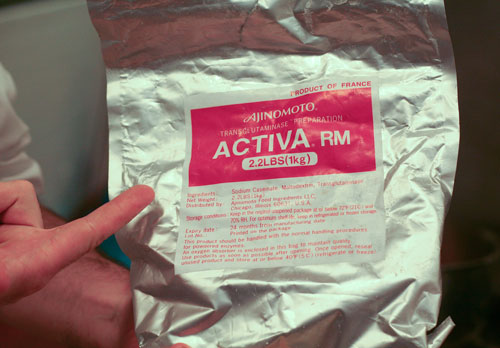
The white powder sold by the kilo, above, is the meat industry’s dirty little secret. It’s “meat glue.” It makes pieces of beef, lamb, chicken or fish that would normally be thrown out stick together so closely that it looks like a solid piece of meat. See also our posts on Israel’s frozen fish scandal and how garlic from China is scary stuff.
Restaurants and butchers can now sell their scraps as premium meat. Good way to use them up – and charge premium prices for them too. Best of all, you don’t have to tell the customer. Once the glued meat is cooked, even professional butchers can’t tell the difference.
Abu Dhabi plans to switch off in style on March 26th, with 71 organizations taking part in the WWF’s Earth Hour.
On March 26, 2011, 71 government, public, and private organizations in Abu Dhabi will join the World Wildlife Fund’s international initiative to switch off the lights for Earth Hour. In keeping with a host of the Emirate’s day-to-day energy-saving initiatives including the “Turn-it-off campaign,” several businesses will turn off their lights between 8.30 and 9.30 p.m. Khaleej Times reports 14 major hotel chains are among those that will participate.
After four decades of power, Gaddafi continues to drool over Libya’s oil.
Unlike the former presidents of Egypt and Tunisia, Libya’s Muammar Gaddafi has no intention of relinquishing control of his country.
Members of the North Atlantic Treaty Organization (Nato) responded to his defiance over the weekend with a fractured Operation Odyssey Dawn, which resulted in an attack on Libya’s military control center. In addition to the obvious detriment ongoing military activity is having on that country’s cultural, environmental, historical, and social fabric, oil prices are rising.
Physicist and guest blogger Susan Goodman puts the Japan nuclear news in proportion to non-scientists.
Perhaps in the west we still retain some false sense of culpability for the discovery of nuclear fission. Maybe the very name Fukushima has resonances with that of Hiroshima – invoking memories of horrors that for most of us are well before living memory. Something has to explain the irrational, overhyped, disinformation that has pervaded much of the western media since Japan’s cataclysmic earthquake and tsunami triggered the crisis in a clump of that nation’s nuclear reactors.
Disinformation exemplified by the headline used in the Green Prophet last week “Japan Nuclear Meltdown Will Seriously Affect World Environment”. The hysterical headlines abounded in the western press, and even that premier of news agencies, the BBC, included as part of its World Service news coverage the strained tones of a Japanese woman who had decided to leave Tokyo because of a (negligible) rise in radiation in that city, adding “the radiation levels should be zero”. What listener could fail to agree with that? Except that we are all exposed to natural radiation, with over 97 percent originating in the rocks of the earth or in outer space, nothing to do with the meddling of man. Levels of radiation are never zero.
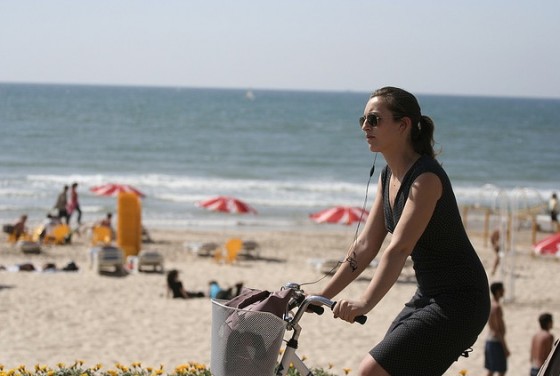
If bike riding or jogging in Tel Aviv, the sea front is less polluting
Ever wonder why you feel dizzy or have acute shortage of breath when engaging in moderate outdoor exercise like bike riding or jogging in cities where air pollution is higher than normal – especially in heavily polluted Middle Eastern cities like Tehran and Cairo? New medical studies are finding out that too much exposure to air pollution during your younger life will result in brain damage later on in life. The studies, which include MRI brain scans, are finding out that diseases such as multiple sclerosis, dementia, Parkinson’s disease, and strokes are the result of exposure to air pollution particles, especially “extra fine” particles. What makes matters worse, this exposure is even more debilitating if it occurs when engaging in stressful body activities like sports or exercise.

 What does it take to make people stop wearing fur? Maybe this recent campaign launched by the Anti-Fur Coalition in Israel.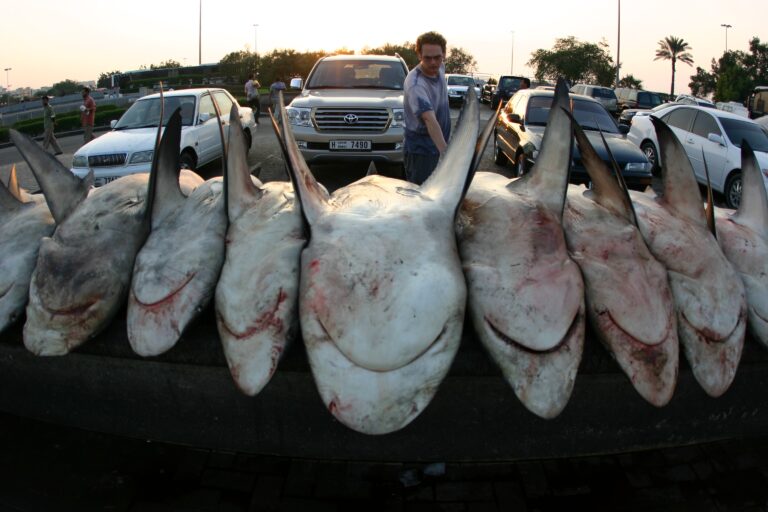












 After four decades of power, Gaddafi continues to drool over Libya’s oil.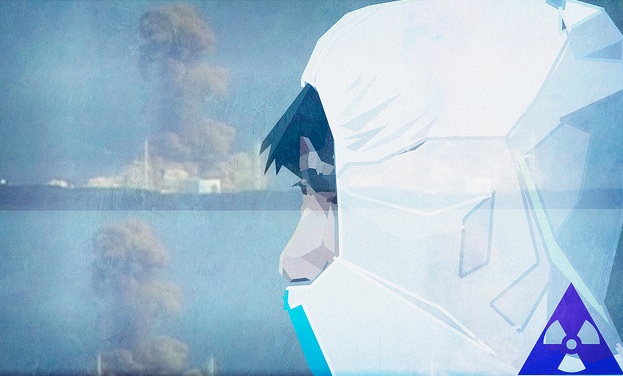
 Physicist and guest blogger Susan Goodman puts the Japan nuclear news in proportion to non-scientists.