“In the midst of uncertain time, renewable energy remains consistent and steadfast in its expansion,” said Francesco La Camera, IRENA’s Director-General. “A more decentralised energy system, with a growing share of renewables and more market players, is structurally more resilient.”
Health insurance is a regulated financial product. Insurers operate under binding contracts, overseen by state insurance commissioners, that legally obligate them to pay claims meeting policy terms. Policyholders who believe a covered claim was wrongfully denied have legal recourse through state regulatory channels.
The New Zealand Merino Company, now rebranded as Zentera, has quietly removed the phrase “world’s leading ethical wool brand” from its website, a notable change that comes after a disturbing investigation by PETA Asia-Pacific into the company’s ZQ-certified wool supply chain, PETA reports to Green Prophet.
Somehow vegetables with short seasons excite the imagination and appetite more sharply than produce that’s available all year around. Good Middle Eastern cooks have many recipes for delicate fava beans, and this turmeric-fragrant soup is one.
“In the midst of uncertain time, renewable energy remains consistent and steadfast in its expansion,” said Francesco La Camera, IRENA’s Director-General. “A more decentralised energy system, with a growing share of renewables and more market players, is structurally more resilient.”
Health insurance is a regulated financial product. Insurers operate under binding contracts, overseen by state insurance commissioners, that legally obligate them to pay claims meeting policy terms. Policyholders who believe a covered claim was wrongfully denied have legal recourse through state regulatory channels.
The New Zealand Merino Company, now rebranded as Zentera, has quietly removed the phrase “world’s leading ethical wool brand” from its website, a notable change that comes after a disturbing investigation by PETA Asia-Pacific into the company’s ZQ-certified wool supply chain, PETA reports to Green Prophet.
Somehow vegetables with short seasons excite the imagination and appetite more sharply than produce that’s available all year around. Good Middle Eastern cooks have many recipes for delicate fava beans, and this turmeric-fragrant soup is one.
“In the midst of uncertain time, renewable energy remains consistent and steadfast in its expansion,” said Francesco La Camera, IRENA’s Director-General. “A more decentralised energy system, with a growing share of renewables and more market players, is structurally more resilient.”
Health insurance is a regulated financial product. Insurers operate under binding contracts, overseen by state insurance commissioners, that legally obligate them to pay claims meeting policy terms. Policyholders who believe a covered claim was wrongfully denied have legal recourse through state regulatory channels.
The New Zealand Merino Company, now rebranded as Zentera, has quietly removed the phrase “world’s leading ethical wool brand” from its website, a notable change that comes after a disturbing investigation by PETA Asia-Pacific into the company’s ZQ-certified wool supply chain, PETA reports to Green Prophet.
Somehow vegetables with short seasons excite the imagination and appetite more sharply than produce that’s available all year around. Good Middle Eastern cooks have many recipes for delicate fava beans, and this turmeric-fragrant soup is one.
“In the midst of uncertain time, renewable energy remains consistent and steadfast in its expansion,” said Francesco La Camera, IRENA’s Director-General. “A more decentralised energy system, with a growing share of renewables and more market players, is structurally more resilient.”
Health insurance is a regulated financial product. Insurers operate under binding contracts, overseen by state insurance commissioners, that legally obligate them to pay claims meeting policy terms. Policyholders who believe a covered claim was wrongfully denied have legal recourse through state regulatory channels.
The New Zealand Merino Company, now rebranded as Zentera, has quietly removed the phrase “world’s leading ethical wool brand” from its website, a notable change that comes after a disturbing investigation by PETA Asia-Pacific into the company’s ZQ-certified wool supply chain, PETA reports to Green Prophet.
Somehow vegetables with short seasons excite the imagination and appetite more sharply than produce that’s available all year around. Good Middle Eastern cooks have many recipes for delicate fava beans, and this turmeric-fragrant soup is one.
“In the midst of uncertain time, renewable energy remains consistent and steadfast in its expansion,” said Francesco La Camera, IRENA’s Director-General. “A more decentralised energy system, with a growing share of renewables and more market players, is structurally more resilient.”
Health insurance is a regulated financial product. Insurers operate under binding contracts, overseen by state insurance commissioners, that legally obligate them to pay claims meeting policy terms. Policyholders who believe a covered claim was wrongfully denied have legal recourse through state regulatory channels.
The New Zealand Merino Company, now rebranded as Zentera, has quietly removed the phrase “world’s leading ethical wool brand” from its website, a notable change that comes after a disturbing investigation by PETA Asia-Pacific into the company’s ZQ-certified wool supply chain, PETA reports to Green Prophet.
Somehow vegetables with short seasons excite the imagination and appetite more sharply than produce that’s available all year around. Good Middle Eastern cooks have many recipes for delicate fava beans, and this turmeric-fragrant soup is one.
“In the midst of uncertain time, renewable energy remains consistent and steadfast in its expansion,” said Francesco La Camera, IRENA’s Director-General. “A more decentralised energy system, with a growing share of renewables and more market players, is structurally more resilient.”
Health insurance is a regulated financial product. Insurers operate under binding contracts, overseen by state insurance commissioners, that legally obligate them to pay claims meeting policy terms. Policyholders who believe a covered claim was wrongfully denied have legal recourse through state regulatory channels.
The New Zealand Merino Company, now rebranded as Zentera, has quietly removed the phrase “world’s leading ethical wool brand” from its website, a notable change that comes after a disturbing investigation by PETA Asia-Pacific into the company’s ZQ-certified wool supply chain, PETA reports to Green Prophet.
Somehow vegetables with short seasons excite the imagination and appetite more sharply than produce that’s available all year around. Good Middle Eastern cooks have many recipes for delicate fava beans, and this turmeric-fragrant soup is one.
“In the midst of uncertain time, renewable energy remains consistent and steadfast in its expansion,” said Francesco La Camera, IRENA’s Director-General. “A more decentralised energy system, with a growing share of renewables and more market players, is structurally more resilient.”
Health insurance is a regulated financial product. Insurers operate under binding contracts, overseen by state insurance commissioners, that legally obligate them to pay claims meeting policy terms. Policyholders who believe a covered claim was wrongfully denied have legal recourse through state regulatory channels.
The New Zealand Merino Company, now rebranded as Zentera, has quietly removed the phrase “world’s leading ethical wool brand” from its website, a notable change that comes after a disturbing investigation by PETA Asia-Pacific into the company’s ZQ-certified wool supply chain, PETA reports to Green Prophet.
Somehow vegetables with short seasons excite the imagination and appetite more sharply than produce that’s available all year around. Good Middle Eastern cooks have many recipes for delicate fava beans, and this turmeric-fragrant soup is one.
“In the midst of uncertain time, renewable energy remains consistent and steadfast in its expansion,” said Francesco La Camera, IRENA’s Director-General. “A more decentralised energy system, with a growing share of renewables and more market players, is structurally more resilient.”
Health insurance is a regulated financial product. Insurers operate under binding contracts, overseen by state insurance commissioners, that legally obligate them to pay claims meeting policy terms. Policyholders who believe a covered claim was wrongfully denied have legal recourse through state regulatory channels.
The New Zealand Merino Company, now rebranded as Zentera, has quietly removed the phrase “world’s leading ethical wool brand” from its website, a notable change that comes after a disturbing investigation by PETA Asia-Pacific into the company’s ZQ-certified wool supply chain, PETA reports to Green Prophet.
Somehow vegetables with short seasons excite the imagination and appetite more sharply than produce that’s available all year around. Good Middle Eastern cooks have many recipes for delicate fava beans, and this turmeric-fragrant soup is one.
Green Prophet’s Karin meeting Jordan’s prince in 2010 in Switzerland.
Way back in 2010 a group of high profile water researchers and dignitaries from the Middle East met in Switzerland to find ways of making liquid peace. Diplomacy works through slow channels, but a new group of ministers and VIPs from around the region have agreed on long-term water cooperation. Chaired by Jordan’s Prince Hassan bin Talal the group hopes to transform water into an instrument of cooperation between nations with their own internal problems, problems which could worsen with more water shortages. The countries are Iraq, Jordan, Lebanon, Syria and Turkey.
Natural food users are aware of a number of herbs and vegetables to give a natural boost to human immune systems that are often weakened by taking too many antibiotics. Here are just some of them, with explanations on how these natural vegetables and herbs benefit our bodies and help increase our natural immunity to disease:
1. Astralagus – an herb long used in traditional Chinese medicine that aids in digestion and acts as a stimulant to the immune system as well as being a diuretic.
The herb is used in people with poor appetite, diarrhea or loose stool, blood in the stool and uterine bleeding. It also contains polysacchrides, saponins and flavonoids. Chinese medicine practitioners also use the plant to treat symptoms of HIV/AIDS; especially fatigue, weight loss, night sweats and insomnia.
If you have an auto-immune disease, are a child, are nursing, pregnant or are a transplant recipient, it is advised not to take Astralagus known in Chinese as HUang Qi, Radix Astragali, or 黄芪.
Astragalus propinquus is a flowering plant in the family Fabaceae and is one of the 50 fundamental herbs used in traditional Chinese medicine.
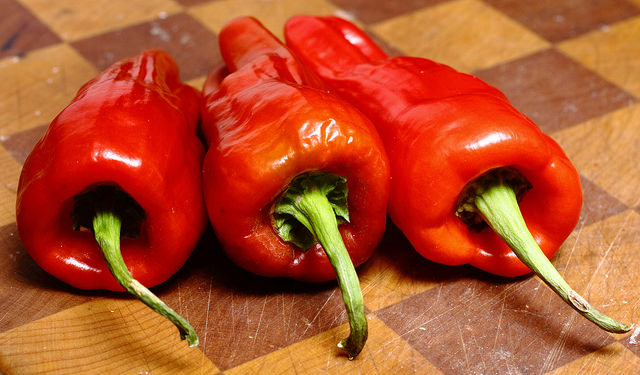
2. Red Bell Peppers: These sweet tasting vegetables come in different colors, ranging from light green to red. They contain a carotenoid called lycopene that protects our bodies against various cancers.
Fresh bell peppers, or if you are lucky Aleppo peppers are great immune boosters.
3. Cat’s Claw: A woody plant with hook like thorns found in South American rainforests that has long been used by natives there to treat health problems including arthritis, stomach ulcers, inflammation, dysentery, and fevers.
It also contains antioxidants and oxindole alkaloids enhancing the immune system’s capacity to engulf and destroy pathogens.
5. Ganoderma– This hard, bitter mushroom is also known as reishi. Ganoderma is used to promote health and longevity in traditional Chinese medicine.
Proponents claim that ganoderma can relieve fatigue, keep cholesterol in check, curb high blood pressure, tame inflammation, build stamina, and support the immune system.
6. Garlic – This spice has had a long history of medicinal value. In a recent study conducted by Dr. Ellen Tattelman, an assistant professor at the Albert Einstein College of Medicine of Yeshiva University, New York, it was found that garlic has cardiovascular, anti-microbial and antineoplastic properties.
Garlic is used almost daily as a spice in Mediterranean and Middle Eastern cuisine.
7. Ginger – This herb has been shown to reduce inflammation, cardiovascular conditions, blood clots and cholesterol. It is often used in Chinese medicine and is commonly used to treat various types of stomach problems, including motion sickness, morning sickness, colic, upset stomach, gas, diarrhea, nausea caused by cancer treatment, nausea and vomiting after surgery, as well as loss of appetite.
8. Ginseng – Another common herb in Chinese medicine. The most commonly studied variety is Panax ginseng and is used for improving thinking, concentration, memory and work efficiency, physical stamina, and athletic endurance.
It is also used in treating chronic fatigue syndrome (CFS), for boosting the immune system, and for fighting particular infections in a lung disease called cystic fibrosis. Its main active component, ginsenosides, has been proven to have anti-inflammatory and anti-cancer properties.
9. Gingko Biloba– Ginkgo has been used in traditional medicine to treat blood disorders and enhance memory. Scientific studies throughout the years have found evidence that supports these claims.
Gingko has also been found top help treat dementia (including Alzheimer’s disease) and poor circulation in the legs. It also may be good for improving memory in older adults. Laboratory studies have shown that ginkgo improves blood circulation by dilating blood vessels and reducing the stickiness of blood platelets. Gingko trees are very long living; often living up to 1,000 years.
10. Turmeric– This spice contains curcumin, which has notable antioxidant properties. It also has antibacterial, anti-inflammatory and stomach soothing benefits.
The good news about these beneficial vegetables and herbs is that they are available either naturally in our region or in whole food and health products stores and holistic medicine pharmacies. Using these products is an excellent way to commemorate Earth Day. And sadly, to help keep your immune system strong to beat viruses, some which may be deadly, like corona virus or COVID-19.
More on beneficial herbs and veggies for health and well being:
Framing climate-influenced migration as a threat is dangerous and counterproductive is author Gregory White
Around the time of the Copenhagen Summit in 2009, there was a sense that climate change was finally transitioning from something which only concerned hippy do-gooders to an issue that affected the entire international community. Everywhere you looked people were talking about climate change.
There was campaign after campaign, there were art exhibitions, documentaries, theatre productions and it felt like we may have been on the cusp of change (hindsight sadly tells us that we were not).
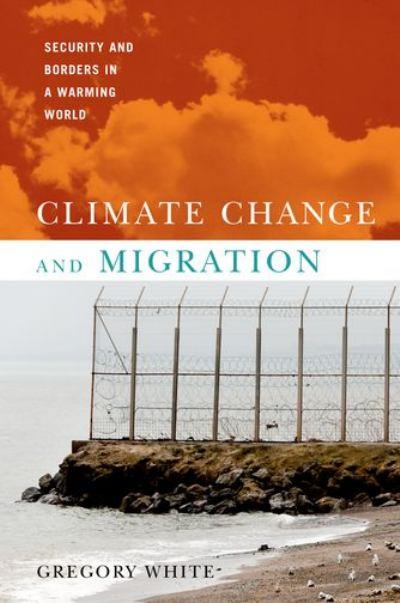
As Gregory White states in his book Climate change and migration: security and borders in a warming world, ‘securitizating’ climate-induced migration (CIM) is counter-productive as it helps justify more unnecessary migration controls. It also encourages rich nations to abandon any sense of ethical responsibility to those on the receiving end of their emissions: “As industrialized countries contribute the most to climate change through consumption and emissions, CIM [Climate-induced migration] constitutes an ethical dilemma that will require them to reconsider and revise the existing dialogue concerning migration.”
Just when thousands of expatriates were fleeing their Gulf homes during the global economic collapse four years ago, Nick Leech was moving in. He was one of the lucky ones, but that has more to do with his diverse talents than good luck.
Originally from the UK, Nick first trained as an architectural and design historian and studied at the Royal College of Art before doing another degree in landscape architecture. It is in this capacity that he got his first job in Abu Dhabi, where he also started tending his own garden for the first time.
Soon “Nick’s Garden” was born – a bi-weekly gardening column that appears on The National.
Most tourists who visit Oman’s Gulf coast are treated to pristine views and sparkling waters, but Ray Montoya, an American angler and art teacher living in Muskat, produces YouTube videos that show another side to the country. Using a small yellow kayak, the hapless eco-crusader travels along the nearly 1,000 miles of coast, frequently discovering animals trapped in discarded fishing nets and unfathomable piles of rubbish. Hit the jump to watch a video of one such turtle that would almost certainly have drowned if it hadn’t been for Ray and his handy snippers.
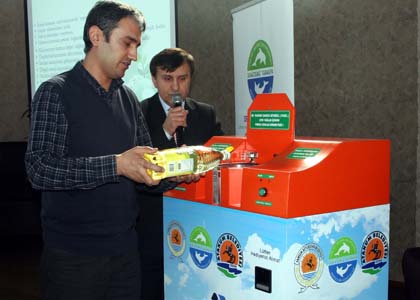
“Bring waste oil, take away money” reads this advertisement for BAYTOM, a machine that incentivizes Turks to recycle cooking oil into biodiesel.
In Turkish cities with BAYTOMs (Waste Vegetable Oil Collection Machines), residents can bring their used cooking oil outside and pour it into a machine that will measure its fat content and dispense a small gift: money, bus tokens, or coupons, for example. Licensed waste management companies come regularly to collect the oil and transport it to a plant where it can be recycled into biodiesel fuel.
The environment is politics and in the Middle East this is ever so stark, ravaged by internal socio-religio-political conflicts and international wars. Wars internally and externally are based on oppression, division, exclusion, land theft, and expropriation of the Middle East’s oil reserves. The Middle East is the globe’s oil capital. Those who want to own it are traditional colonial powers who will do anything and promise anything from political freedom to militarisation to democracy to get at it; it’s why war and conflict still proliferate in the region.
Born in an economic boom, kids in oil-rich Arab Gulf States use their silver spoons to up caloric intact.
Blame laziness, love of Western brands, or ample disposable income, but children across the Gulf region are getting fatter. Recent studies tag 20 percent of children in Dubai as overweight, and another 12% as obese. Their Gulf nations’ cousins in Saudi Arabia, Bahrain, Oman and Qatar are just as hefty.
The core lifestyle of the world’s urban children, zip code be damned, is numbingly similar. Conditioned living spaces and electronic entertainments encourage an increasingy sedentary lifestyle. Children in the Gulf are nothing like their nimble agrarian ancestors. Informal exercise is all but extinct. Internet-based social networking brings the playdate indoors. Besides, public parks and sports fields are hard to find in modern Gulf cities.
Why sweat outside with friends when you can sit in air-conditioned comfort and Skype and Facebook for hours? Have mom order in a pizza or a bag of cheeseburgers while you’re at it. You’re living the fatty-Emirati Dream.
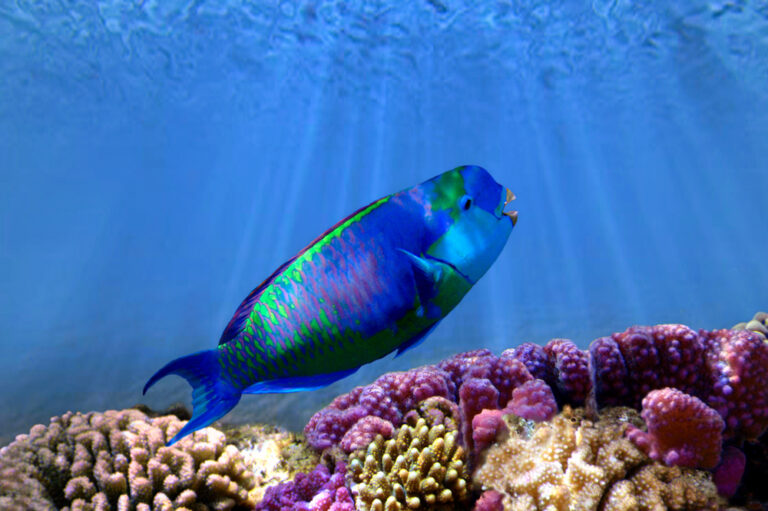
An archaic Saudia Arabian practice of trapping parrot fish in the Red Sea has to stop.
The Red Sea and the Gulf of Aden are a beautiful haven of marine and coastal biodiversity, created as a result of deep ocean rifting which began 70 million years ago and saw the separation of the Arabian plate from the African plate. Fortunately there is some movement amongst conservation biologists to protect this bioregion through the expansion of a carefully selected network of marine protected areas. Furthermore, legal frameworks such as the Jeddah Convention aim to establish a legally binding agreement which expresses the commitment and political will of parties (Djibouti, Yemen, Sudan, Saudi Arabia, Somalia, Egypt and Jordan) to tackle marine and coastal environmental issues through joint coordinated activities.
The basis for action is there, and so is the political will (at least on paper), nevertheless, several obstacles such as limited technical capacity, lack of data and scientific knowledge and limited funds make the process of formalizing agreements much harder. One other issue is tackling culturally sensitive practices.
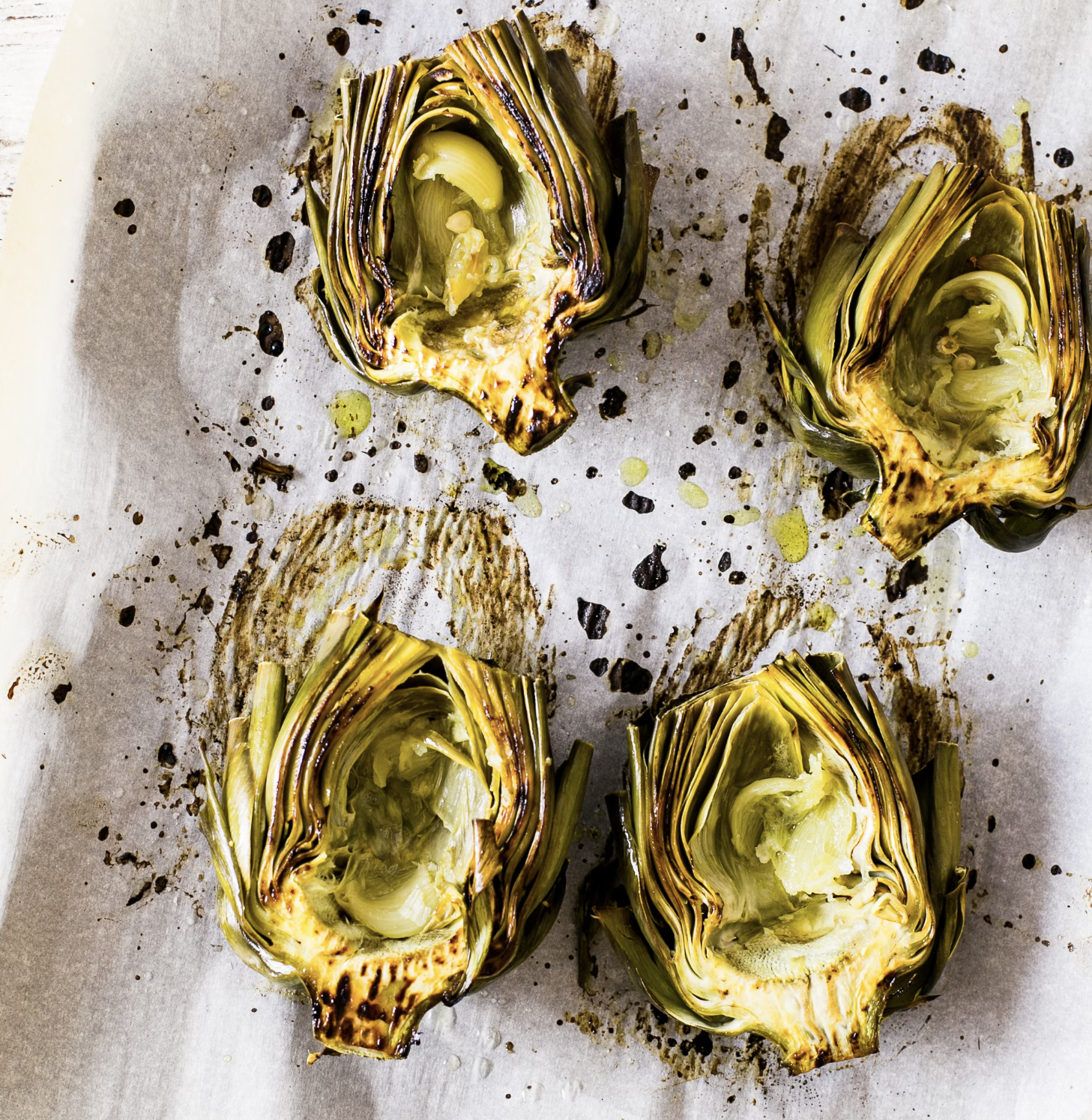
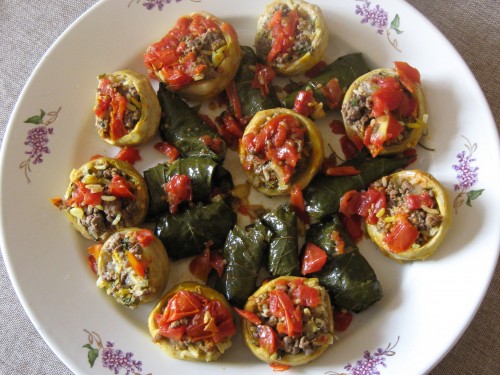
Celebrate springtime in the Middle East with these aromatic stuffed artichokes.
Fresh artichokes are all over Middle Eastern markets now. Lovers of the edible thistle enjoy scraping the steamed, seasoned leaves with their teeth and never mind getting melted butter or vinaigrette all over their fingers.
But there are many refined ways of filling artichokes, as we have noted before in our Moroccan stuffed artichoke hearts recipe. And Syrian cooks know just as much about stuffed artichokes as anyone else. In this recipe, the flavors of lamb and allspice enrich their delicate taste.
You may trim the artichokes of all their leaves and stuff the bare hearts, which is the traditional Syrian way, or pack the stuffing into the vegetables with leaves trimmed short and the whispy choke scraped out beforehand. Or buy frozen artichoke hearts and make your life easier.
Syrian Stuffed Artichokes
Ingredients:
1 kg. – 2 lbs artichoke hearts or 10 cleaned and trimmed fresh artichokes
250 grams – 1 lb. ground lamb
1 medium onion
1/4 cup chopped parsley leaves
1 tablespoon lemon juice
3 tablespoons olive oil
2 cups cold chicken stock
1 teaspoon corn starch
1/2 teaspoon ground allspice
1/2 teaspoon salt, and another 1/2 teaspoon
Pepper to taste
Method
Artichokes, one of the first vegetables known to mankind
Preheat the oven to 190° C – 400° F.
Chop the onion and sauté in olive oil over medium heat till golden.
Add the meat, stirring to break up lumps. Cook 5 minutes, stirring once in a while.
Add the allspice, 1/2 teaspoon salt, more pepper if liked, and the parsley.
Stuff the artichokes with the meat mixture. Place them close together in a baking pan.
Blend stock, cornstarch, 1/2 teaspoon salt, pepper, and lemon juice. Pour this mixture over the artichokes.
Cover and bake for 40 minutes. Remove the cover (it can be tin foil or baking paper) and bake a further 10 minutes.
Enjoy!
More Middle-Eastern artichoke recipes on Green Prophet:
Editor’s notes: the artichoke is one of the earliest vegetables known to man and it is native to the Eastern Mediterranean. The name comes from ardishok which means “earth thorn” in Arabic. It is called kinress in the Jewish Mishna, a word used in modern Arabic, according to Nature’s Wealth, a book on the healing plants based on the teachings of Rambam, a Jewish sage. According to the Rambam, artichoke can heal urinary stones, and it lowers blood pressure. It can help cardiac pain, depression, and it may be an aphrodisiac. They should be avoided if you have impaired kidneys.
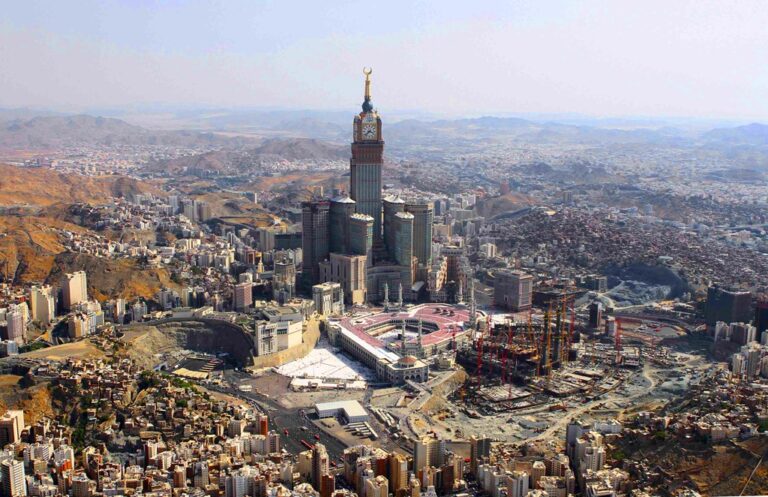
Despite having enough solar power to energize the planet for the next 20 centuries, Saudi Arabia has instead reaped the benefits of its oil reserves for decades. This wealth has spurred a spate of massive developments in Mecca, transforming a small desert hamlet into a thriving metropolis. But this may be a curse for Islam’s holiest city and the 6 million pilgrims who flock there each year.
Last August, the Kingdom unveiled a $21.3 billion plan to upgrade the Grand Mosque in Mecca to accommodate an additional 2.5 million pilgrims a year. 20 Percent of the demolition has been completed, and a new $1.8 billion railway to link all of the holy sites in Mecca is also underway. How does one tap into the divine amidst so much noise and distraction?
The last international climate change negotiation (COP17) took place in Durban in 2011 and the outcomes were pretty disappointing given the urgency of the matter in hand. Unsatisfactory outcomes aside, climate change negotiations have been providing momentous opportunities for NGOs, individuals and the private sector to engage and exchange ideas on solutions to climate change mitigation.
This year Qatar will host the UN climate change conference, COP18, in December and hopefully this will also be an opportunity for the Middle East and North Africa (MENA) to step up the game in climate change activism . However two important things need to happen to ensure all countries in the MENA benefit.
“I am the Lorax and I speak for the trees.” What would nature’s ambassador tell us? Children’s author Theodore Seuss Geisel (Dr. Seuss) used this question as inspiration for his classic ecological fable, The Lorax. His simple message is that when limited resources (such as truffula trees) are consumed without care, entire ecosystems (singing fish, brown barbaloots…) can vanish and paradise is lost.
This tragic tale was panned by some critics for being too apocalyptic and probably inappropriate for children. The 2012 movie loosely based on The Lorax is… well, it’s difficult to know where to begin. So let’s look back at the book and I’ll try to explain why I believe its message will resonate long after the movie is a forgotten tuft of Hollywood fluff.
The High Line Park built on a historic freight line in New York City (pictured below) is one of the most talked-about urban renewal programs in history. There is an entire website devoted to it, a special team maintains the verdant 23rd street lawn and another is responsible for removing ice and snow. This park has rules and bike racks and a printable map.
All future cities that incorporate train tracks into their urban parks are ill-fated to endure comparisons to NYC, and most likely, they will be judged inferior.
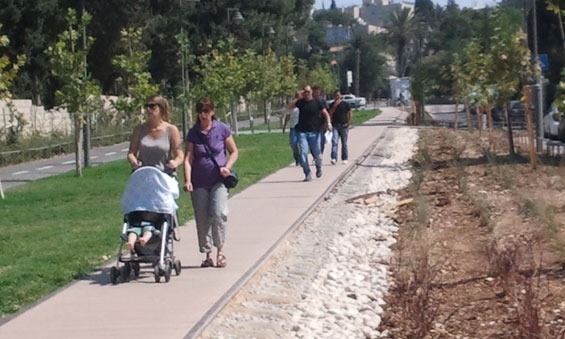
This includes Jerusalem and its humble Train Track Park. An idea conceived before the 2003 international design competition to transform the High Line was launched (and won by Diller Scofidio + Renfroon), Jerusalem may lack NYC’s amenities but not its vision.
The High Line is Born!
NYC’s newest park was born when locals rose up against a plan to demolish the freight tracks on Manhattan’s western fringe. Friends of the High Line subsequently formed in 1999 and have continued to oversee the now famous and highly coveted urban space since.
But what about the history of Jerusalem’s park? It developed as part of a scouting project for another park development, the Nahal Refa’im Park, according to Ha’aretz. Architect Yair Avigdor and Landscape Architect Shlmo Zeeri were looking for the park’s basin and discovered that it stood next to the Khan Train Station, which had closed in 1998.
So they (just the two of them without a pile of supporters to back them up) proposed a plan to the municipality to incorporate the area between the Germany Colony station to the Malkha station into the overall park plan. The 6km park plan was approved. But no fanfare and no international design competition ensued.
It was just Avigdor and Zeeri left to transform the space that was designed to link otherwise disjointed neighborhoods, according to the paper, all with a very tight budget.
So although there are some benches and light fixtures, along with a bicycle path and mini parks where green space butts up against urban space, this park has none of NYC’s finesse. Instead of preserving the existing rails and tracks with wood, concrete was used instead in order to reduce maintenance, and other short cuts are also visible.
Even so, it’s almost unfair to make the comparison between this and the High Line. What’s important is that a plan to turn what Zeeri called “the Junkyard of Jerusalem” into an accessible public space, albeit a neglected one, was followed through with the commitment of a small group of individuals and completed.
Better Place is not doing as well as everyone expected, with financial losses running in the millions.
The idea seemed flawless: battery-powered cars that could run on 100% electricity and could be recharged almost instantly by swapping batteries at special charging stations. But despite all the optimistic predictions, Better Place, the Israeli company that has been trying to build the world’s first operational infratructure for electric vehicles (EV), has been facing a series of obstacles in moving ahead with its technology.
Israel Corp., which holds 32% of the company’s shares, reported that Better Place lost over 1.5 billion NIS ($433 million) since 2009, 760 million NIS ($204 million) of which was lost over the course of 2011 alone, and deployment of battery recharging and swapping stations has been delayed in both Denmark in Israel from the scheduled date this April to the summer.




 Framing climate-influenced migration as a threat is dangerous and counterproductive is author Gregory White






 An archaic Saudia Arabian practice of trapping parrot fish in the Red Sea has to stop.

 The last international climate change negotiation