“In the midst of uncertain time, renewable energy remains consistent and steadfast in its expansion,” said Francesco La Camera, IRENA’s Director-General. “A more decentralised energy system, with a growing share of renewables and more market players, is structurally more resilient.”
Health insurance is a regulated financial product. Insurers operate under binding contracts, overseen by state insurance commissioners, that legally obligate them to pay claims meeting policy terms. Policyholders who believe a covered claim was wrongfully denied have legal recourse through state regulatory channels.
The New Zealand Merino Company, now rebranded as Zentera, has quietly removed the phrase “world’s leading ethical wool brand” from its website, a notable change that comes after a disturbing investigation by PETA Asia-Pacific into the company’s ZQ-certified wool supply chain, PETA reports to Green Prophet.
Somehow vegetables with short seasons excite the imagination and appetite more sharply than produce that’s available all year around. Good Middle Eastern cooks have many recipes for delicate fava beans, and this turmeric-fragrant soup is one.
“In the midst of uncertain time, renewable energy remains consistent and steadfast in its expansion,” said Francesco La Camera, IRENA’s Director-General. “A more decentralised energy system, with a growing share of renewables and more market players, is structurally more resilient.”
Health insurance is a regulated financial product. Insurers operate under binding contracts, overseen by state insurance commissioners, that legally obligate them to pay claims meeting policy terms. Policyholders who believe a covered claim was wrongfully denied have legal recourse through state regulatory channels.
The New Zealand Merino Company, now rebranded as Zentera, has quietly removed the phrase “world’s leading ethical wool brand” from its website, a notable change that comes after a disturbing investigation by PETA Asia-Pacific into the company’s ZQ-certified wool supply chain, PETA reports to Green Prophet.
Somehow vegetables with short seasons excite the imagination and appetite more sharply than produce that’s available all year around. Good Middle Eastern cooks have many recipes for delicate fava beans, and this turmeric-fragrant soup is one.
“In the midst of uncertain time, renewable energy remains consistent and steadfast in its expansion,” said Francesco La Camera, IRENA’s Director-General. “A more decentralised energy system, with a growing share of renewables and more market players, is structurally more resilient.”
Health insurance is a regulated financial product. Insurers operate under binding contracts, overseen by state insurance commissioners, that legally obligate them to pay claims meeting policy terms. Policyholders who believe a covered claim was wrongfully denied have legal recourse through state regulatory channels.
The New Zealand Merino Company, now rebranded as Zentera, has quietly removed the phrase “world’s leading ethical wool brand” from its website, a notable change that comes after a disturbing investigation by PETA Asia-Pacific into the company’s ZQ-certified wool supply chain, PETA reports to Green Prophet.
Somehow vegetables with short seasons excite the imagination and appetite more sharply than produce that’s available all year around. Good Middle Eastern cooks have many recipes for delicate fava beans, and this turmeric-fragrant soup is one.
“In the midst of uncertain time, renewable energy remains consistent and steadfast in its expansion,” said Francesco La Camera, IRENA’s Director-General. “A more decentralised energy system, with a growing share of renewables and more market players, is structurally more resilient.”
Health insurance is a regulated financial product. Insurers operate under binding contracts, overseen by state insurance commissioners, that legally obligate them to pay claims meeting policy terms. Policyholders who believe a covered claim was wrongfully denied have legal recourse through state regulatory channels.
The New Zealand Merino Company, now rebranded as Zentera, has quietly removed the phrase “world’s leading ethical wool brand” from its website, a notable change that comes after a disturbing investigation by PETA Asia-Pacific into the company’s ZQ-certified wool supply chain, PETA reports to Green Prophet.
Somehow vegetables with short seasons excite the imagination and appetite more sharply than produce that’s available all year around. Good Middle Eastern cooks have many recipes for delicate fava beans, and this turmeric-fragrant soup is one.
“In the midst of uncertain time, renewable energy remains consistent and steadfast in its expansion,” said Francesco La Camera, IRENA’s Director-General. “A more decentralised energy system, with a growing share of renewables and more market players, is structurally more resilient.”
Health insurance is a regulated financial product. Insurers operate under binding contracts, overseen by state insurance commissioners, that legally obligate them to pay claims meeting policy terms. Policyholders who believe a covered claim was wrongfully denied have legal recourse through state regulatory channels.
The New Zealand Merino Company, now rebranded as Zentera, has quietly removed the phrase “world’s leading ethical wool brand” from its website, a notable change that comes after a disturbing investigation by PETA Asia-Pacific into the company’s ZQ-certified wool supply chain, PETA reports to Green Prophet.
Somehow vegetables with short seasons excite the imagination and appetite more sharply than produce that’s available all year around. Good Middle Eastern cooks have many recipes for delicate fava beans, and this turmeric-fragrant soup is one.
“In the midst of uncertain time, renewable energy remains consistent and steadfast in its expansion,” said Francesco La Camera, IRENA’s Director-General. “A more decentralised energy system, with a growing share of renewables and more market players, is structurally more resilient.”
Health insurance is a regulated financial product. Insurers operate under binding contracts, overseen by state insurance commissioners, that legally obligate them to pay claims meeting policy terms. Policyholders who believe a covered claim was wrongfully denied have legal recourse through state regulatory channels.
The New Zealand Merino Company, now rebranded as Zentera, has quietly removed the phrase “world’s leading ethical wool brand” from its website, a notable change that comes after a disturbing investigation by PETA Asia-Pacific into the company’s ZQ-certified wool supply chain, PETA reports to Green Prophet.
Somehow vegetables with short seasons excite the imagination and appetite more sharply than produce that’s available all year around. Good Middle Eastern cooks have many recipes for delicate fava beans, and this turmeric-fragrant soup is one.
“In the midst of uncertain time, renewable energy remains consistent and steadfast in its expansion,” said Francesco La Camera, IRENA’s Director-General. “A more decentralised energy system, with a growing share of renewables and more market players, is structurally more resilient.”
Health insurance is a regulated financial product. Insurers operate under binding contracts, overseen by state insurance commissioners, that legally obligate them to pay claims meeting policy terms. Policyholders who believe a covered claim was wrongfully denied have legal recourse through state regulatory channels.
The New Zealand Merino Company, now rebranded as Zentera, has quietly removed the phrase “world’s leading ethical wool brand” from its website, a notable change that comes after a disturbing investigation by PETA Asia-Pacific into the company’s ZQ-certified wool supply chain, PETA reports to Green Prophet.
Somehow vegetables with short seasons excite the imagination and appetite more sharply than produce that’s available all year around. Good Middle Eastern cooks have many recipes for delicate fava beans, and this turmeric-fragrant soup is one.
“In the midst of uncertain time, renewable energy remains consistent and steadfast in its expansion,” said Francesco La Camera, IRENA’s Director-General. “A more decentralised energy system, with a growing share of renewables and more market players, is structurally more resilient.”
Health insurance is a regulated financial product. Insurers operate under binding contracts, overseen by state insurance commissioners, that legally obligate them to pay claims meeting policy terms. Policyholders who believe a covered claim was wrongfully denied have legal recourse through state regulatory channels.
The New Zealand Merino Company, now rebranded as Zentera, has quietly removed the phrase “world’s leading ethical wool brand” from its website, a notable change that comes after a disturbing investigation by PETA Asia-Pacific into the company’s ZQ-certified wool supply chain, PETA reports to Green Prophet.
Somehow vegetables with short seasons excite the imagination and appetite more sharply than produce that’s available all year around. Good Middle Eastern cooks have many recipes for delicate fava beans, and this turmeric-fragrant soup is one.
Picking olives the traditional wayis less damaging to the fruit
The annual olive harvest is here in the Middle East again. For people living in Mediterranean and Middle East olive producing countries, they can enjoy pickling their own olives due to the proliferation of olive trees in these locations. Here in Israel where I love, many private and public gardens and parks have olive trees growing in them; making olives available to anyone taking the time to pick them during the annual autumn olive season.
In a previous Green Prophet article about preserving olives, I explored how easy home picked olives are easy to pickle and are usually ready to eat after being stored in pickling brine for at least two to three months. After doing this for several years, I have found that one can experiment using various spices in their pickling ingredients that include rosemary, thyme, black peppercorns, cayenne peppers (to give the olives a “kick”) and bay leaves.
Scholarships included to this new 2-year high school study abroad program in Israel. Its founders are looking to fill a high quota of Arab students from the region starting 2014.
It will be the first of its kind in Israel: An international two-year boarding school focusing on what Israel knows best – water management, environment and social entrepreneurship. Offering full scholarships and open to 200 teens in grades 11 and 12 from around the world starting in the fall of 2014, this new non-profit high school, Eastern Mediterranean College (EMC), hopes to join the international network of the United World Colleges and has applied for their International Board’s approval.
Recently returned from a 30-year reunion in Canada where he studied at the Victoria campus in his teens, EMC founding volunteer CEO Oded Rose says his experience way back when influenced his life in a profound way, saying the experience can help write your papers.
He is hoping that such a school in Israel will not only open up young Arabs and international students to the diversity of Israel, but also will help expand the worldview of Israeli teens. Forty of the 200 allotted spaces are for Arabs from the West Bank, Jordan or other Israeli neighbor countries; another 40 are reserved for Israelis.
With architectural drafts already in the final stages, the EMC campus will be located at Kfar Yarok (Green Village) on the outskirts of Tel Aviv. It is a place where young art students studying film and visual arts can be seen mingling with colorful peacocks roaming freely around the campus.
A green and business focus
Until its own buildings can be completed, EMC students will stay in borrowed dorm space at Kfar Yarok, the Green Village. The plan calls for students of any background, with high academic merit and proven social action skills, to study in Israel for the final two years of high school.
Built on a program of standards set by the International Baccalaureate run out of Switzerland, the program will maintain extremely high standards, says Rose, and will include two special tracks.
One will be linked to Israel’s Arava School for Environmental Studies, focusing on desert ecology, and will explore geopolitical issues in water management as well as Israeli water technologies making the desert bloom. The idea is that students from other arid countries, such as Jordan, could greatly benefit from learning and transferring Israel’s know-how and technology to the increasingly dry region.
The second special track will tap into another Israeli specialty, startup businesses. “We plan to teach students how to write a business plan, specifically around social enterprises,” says Rose, who runs clean-tech company Flow Industries, which provides “green” plumbing solutions to municipal water companies, cement factories and the oil industry.
For green ambassadors in training
Rose is currently looking for donors and sponsors to help provide funding for campus buildings and to subsidize the annual budget of about $5 million. Anyone accepted to the school who cannot afford to pay will be given a full or partial scholarship so that finances will not bar participation.
“We’ll typically look for good academic stature. On the other side, we’ll look for community involvement and community leadership,” says Rose, a father of five. “At a young age we already see some kids demonstrating this. We also thought to include one’s readiness to live away from home in the selection process. It’s not easy, as I recall. For the first few months I really missed home.”
Rose got the chance to study at the college in Canada three decades ago after his neighbor, a professor at Israel’s Bar-Ilan University, told him about the program. Out of the 30 students who applied, Rose was sent to represent Israel and for two years lived on Vancouver Island in British Colombia, Canada.
“It influenced my future in so many ways,” Rose says. “It basically opened my eyes to the world and the fact that we are all human beings. We all lived in one country and were affected by the media there, not really knowing what’s going on in the rest of the world. Then when you can live in such a place and see hundreds of others just like you, but different in color, you realize that we can actually talk to each other.”
Rose looks forward to opening these kinds of international two-way doors in 2014.
“Hopefully, we will gain many new ambassadors for Israel from around the world,” he concludes.
The program is a good first step for any career in international diplomacy and a green MBA.
Israeli photojournalist turned independent animal rights activist Ofir Drori (who Karin interviewed in 2008) received the World Wildlife Fund (WWF) for Nature’s Duke of Edinburgh Conservation Medal tonight. This is one of the most coveted awards in wildlife conservation and awarding it to Drori, whose zero tolerance approach to illegal wildlife trafficking diverges from mainstream policies, sends a potent message that the community is willing to entertain a new approach to what has become a plague against Central and West Africa’s animal kingdom.
A bright and renewable future for Saudi Arabia? A shock announcement from the world’s largest oil producer
Following plans to transform Mecca into a solar city, an influential member of the Saudi Royal family has announced even more ambitious renewable energy plans for the country. Prince Turki Al Faisal Al Saud, founder of the King Faisal Foundation and one of the state’s top spokesmen, said he wants to the country to switch completely from fossil fuels to renewable energy. The prince admitted that the shift would not be complete in his lifetime (he is 67) but that it will happen.
The jury on the Stars of Science reality TV show proved that the “Shattel-Power” vertical wind turbine is not as efficient as its designer Mahmoud Shattel proclaimed it to be, but the 24 year old electrical engineer from Jordan still intends to find investors who will help him bring this clean energy concept to households all over the Hashemite kingdom.
Shattel’s vertical wind turbine was designed to generate electrical power from the wind at four times the efficiency rate of standard wind turbines, and to harvest energy from low wind speeds. And it’s only one meter high.
Fired by the taste of heritage beers, Lost Tribes Brew founders have developed beers and wines that resurrect traditional brews, which they claim identify some of Israel’s ten lost tribes.
Five childhood friends from New York – Itzkowitz, Allan Farago, Ari Smith, Andrew Septimus and Rabbi Harry Rozenberg – flew to Israel in 2009 seeking fresh ideas for beers to develop in their new microbrewery. There’s plenty of pleasurable research available in the yearly Beer Expo in Tel Aviv, where microbreweries and established breweries show off their suds to an appreciative public.
In the group’s researches, they came across historical beers which are still being brewed in the modest homes of Ethiopian and Indian immigrants. The brewers, mostly elders, are afraid that the traditional drinks will be neglected, then forgotten in the modern age. The American group was fascinated by these living liquid artifacts and developed beers based on them. So far, their resurrected recipes are a commercial success. (If you’re into DIY historical beer recipes, Karin has the White House honey beers recipes ready for you to try out at home.)
Everyone older than ten has likely experienced the exquisite agony and transformation of a broken heart. Which means that just about everyone has probably developed their own recipe for healing as well. Some people go on “retail therapy” sprees to sweeten the pain, others crawl up in a tiny ball on their bed and stay there for days, while others still look to nature for help.
This is what Jeff did, a Couchsurfer who met me in the Sierra Nevada mountains of southern Spain for a weekend of wet walking. I thought he was coming to my rescue because I was planning to hike alone, but when we started to talk, it emerged that Jeff’s heart was recently crushed and he needed a friendly distraction. Here are five ways that 18 miles of mountain hiking put him back on the path of happiness, and me too!
Researchers turn to high tech cameras to track sensitive animal populations in Jordan’s Dana Biosphere Nature Reserve.
Using cameras equipped with ultra-violet sensors, Jordan’s Royal Society for the Conservation of Nature (RSCN) measures animal population and distribution, including female to juvenile ratios, male versus female numbers, and specific patterns of migration through the Reserve. RSCN is dedicated to protection and enhancement of Jordan’s natural environment; part of that mandate is to record key data about the Kingdom’s native plant and animal species.
They deployed 12 devices throughout the park, capable of daytime and nighttime recording. The cameras, activated by vibrations of approaching mammals, begin to record images when the creatures come within 10 meters.
Key “animal paparazzi” points included water sources, valleys and known migration routes.
The cameras, which record in dual media (video and still photography), have verified excellent results from recent conservation practices. The images document a 2011 population of 450 ibex, up from an initial count of 15 almost twenty years ago when this reserve was established.
Tracking biodiversity in the Dana Biosphere
Dana Biosphere is home to about 40 mammal species including striped hyenas, rock rabbits, wolves, Asiatic jackals and rare species of fox.The technology documented increasing populations of Caracal, Rock Hyrax, the endangered Ibex, and the rarified Bland Ford Fox, which was believed to be extinct.
According to ecologist Malik Al-Awaiji, the reserve is home to over 200 bird species and 800 plant varieties, three of which are plant species never known to exist. These discoveries are named Rohia danaiansis, Macromeria danaiansis and Salin danaiansis. “Work is ongoing to determine their properties,” he told the Ghana News Agency.
Dana Biosphere conducts critical biological research and conservation while allowing a high level of public access. Perched on the edge of Wadi Dana, and open year-round, the guesthouse offers breathtaking views of the reserve. It contains nine bedrooms, most with private terraces, as well as facilities for courses and conferences.
Bird Watching in Jordan
The park covers 310 square kilometers and boasts spectacular natural highs and lows: mountains 1,600 meters above sea level and valley gorges 150 meters below. It extends from the top of the Jordan Rift Valley to the desert lowlands of Wadi Araba and famed for its bird watching and archeological sites.
The reserve is one of Jordan’s major eco-tourism destinations, recording 40,000 visits last year with associated revenue of $425,000. Unfortunately, reserve carrying costs run about $565,000 per year.
Reserve estate manager, Mahmoud Bdour, said that the United States Agency for International Development (USAID) is providing $2.5 million to renovate dilapidated guest infrastructure including its sewerage system. It also receives support from the World Bank and the United Nations Development Program.
“I am optimistic, the project will enhance visitation and generate the needed revenue to further development, when completed”, said Bdour.
Jordan is host to other reserves, namely, Shamary, Azraq Wetland, Rum, Mujib Biosphere, Ajloun, Dippen and the newest, the Al Yarmoole reserve.
“Fun is important for humanity and without it, we are greatly diminished'”- Grant Shilling on why surfing is important and holds the key for the Israeli and Palestinian conflict
During the 60 year conflict between Israel and Palestine, there have been some fairly ‘outside-the-box’ suggestions for resolving the hostilities. One of my all time favourites was Gaddafi’s suggestion that the two nations unite and rename the country ‘Isratine’ – part Israel and Palestine. However, an activist from Canada has come up with an equally mind-boggling suggestion.
Grant Shilling insists that surfing could be a successful peacemaker and bring Israelis and Palestinians together in friendship and peace. I know what you’re thinking because I’m thinking it too: surfing? Really? With all those opposing views and strong beliefs, surfing is going to change anything? Well, Grant says yes and whilst he’s under no illusion that this is a quick answer, he does believe “it is one small step toward the path to peace.”
I caught up with Grant Shilling to talk about his mission to deliver wetsuits to the Gaza Surfing Club and his book ‘Surfing with the Devil’.
Tell us a little about yourself and how your project to deliver wetsuits to Gaza came about.
I live on Vancouver Island, Canada and work as a writer, artist and street outreach worker. I have consistently involved myself in projects of sport and social change including art gallery installations and more relevant direct actions including: AIDS and sport, homeless soccer, long boarding and First Nation communities and many more.
This project was the result of this background and more specifically two factors: an increasing sense of hopelessness about the situation in the Middle East and an awareness of the Gaza Surf Club as a result of the actions of Dorian ‘Doc’ Paskowitz and the group Surfing for Peace.
From what I’ve read from your book, it’s clear that you have a real sense of the intractable nature of the conflict between the Israelis and Palestinians. What did you hope that delivering the wetsuits to the Gaza Surf Club would do?
Well on a practical level I could relate to the idea of an absence of equipment. The surf scene here on the west coast of Vancouver Island really just emerged in the ’80s and equipment was scarce and mainly available in the States. So on that level I simply wanted to see the people of Gaza surfing.
On a philosophical level I have a core belief that fun is an aspect that all of us need in this life and unfortunately don’t always get enough of. Naturally, given the horrific stress of living in Gaza and the Middle East with the constant threat of war or violence and the disruption of people’s lives, fun is often ignored. In my opinion nothing is more fun than surfing so if some people in Gaza were able to get to surf as a result of more equipment than they would be offered a welcome reprieve from the stress of their daily lives.
You say that at its core, Surfing with the Devil asks the question ‘can surfing be used as a grassroots peacemaker?’ You asked a wide range of people during your adventure [including Sama Wareh a young Syrian-American Muslim woman who surfs in a burkini; Rabbi ‘Shifty’ Shifren aka The Surfing Rabbi; Mike Ali a Muslim born in Jerusalem, Shaun Tomson, South African Jew and former World Surfing Champion and Dorian ‘Doc’ Paskowitz, 91, the father of Israeli surf ] but I guess what I want to know is what your answer is and whether that changed due to your journey?
The short answer is yes I do believe surfing can be used as a grassroots peacemaker. In any situation where you have people sharing a passion; arts, music, medicine anything, you are creating an opportunity for understanding and stripping away prejudices that preclude such opportunities. The biggest hurdle to getting people together is these existing prejudices and fears but once you are able to get passed them, good things happen.
I’d also like to add that I am no saint. I am full of the contradictions and flaws that all of us possess and that any of these processes involve. For instance in Surfing With the Devil I explored the less savoury aspect of localism in surfing.
This was to demonstrate that any ‘method’ or practice has its flaws as does its practitioners. It is part of what makes us human and that the peaceful path is for all saints, sinners and surfers.
You talk about the spiritually of surfing and how it can bring you closer to nature and a greater realization of our interconnectedness of everything. Is connecting to nature important to you to help resolve the Israeli-Palestinian conflict?
Interesting question. One of the things I noticed in surfing the Mediterranean is how you don’t get the overwhelming sense of wildlife that you do when you surf the west coast of Vancouver Island and its abundance of sea lions, whales, waterfowl etc.
The Med is alas, a bit dead. That said, surfing offers the unique experience of buoyancy that being in the water provides and the rush that catching the collective energy of a wave supplies. So I would suggest that nature is inherent to the act of surfing. As to your question I would say that in nature there is peace.
You talk about the fact that friendships don’t need politics but are friendships more powerful than politics? And in the Middle East, can they really change anything?
Yes I believe so. I feel that globally there is a growing disenfranchisement with the political process. That people are fed up with politicians and either the inherent corruption of their situation or the powerlessness to change things. People do have the power.
A major criticism of much of the co-existence work that occurs between Israelis and Palestinians is that it ignores the power inequalities between the two sides. It often makes empowered Israelis and Jews feel good without changing the dire situation of Palestinians. What would be your response to that?
First of all as someone who does street outreach work for my day job, if you are doing this kind of work to “feel good” you are doing it for the wrong reasons. Most of the time you are frustrated, disheartened and disappointed. It is not a “feel good” factor that keeps you going – and sometimes I’m not even sure what is! But I would say it is a sense of social justice.
All of these situations whether it be Jews and Palestinians, outreach worker and the homeless, involve an inscribed inequity – it is why the work (in the broadest sense) exists. What is important is to somehow shift the power or control. This is where sport and surfing are such great tools as they eliminate these inequities. One further thing I have always admired is Nadine Gordimer’s take on the apartheid system that existed in South Africa and I am paraphrasing: “Any system that enslaves one group of people enslaves all groups of people.”
Shilling with Doc.
The one important thing that you learnt from this experience and you would like to share with others?
Fun is an inherent human need and to ignore it or not have enough opportunities to experience it greatly diminishes us.
Any future projects you are working on that you’d like to share with us?
I am currently involved with a project I call Get on Board which is using longboarding (skateboards and surfboards) for outreach with First Nation Communities.
A few months ago together with three enthusiastic family kids I started a gardening experiment: growing fruits out of the seeds we collected from fruits we ate, just planting it in the backyard.
We used tomato, watermelon and melon seeds, the kids even made signs for each. Though all seeds sprouted, the watermelon seedling was first to die on us, followed surprisingly by the tomato, which managed to flower and grow one small fruit but stopped developing and died soon after.
The biggest success belongs to the melon, it kept growing and fast, flowering yellow and even bearing several fruits – one of the flowers which was pollinated by bees kept growing into this strange looking fruit.
MENA Geothermal has completed the largest geothermal heating and cooling system in the Middle East and North Africa. Completed in August, 2012, the new and deeply clean energy system at the American University of Madaba (AUM) in Jordan has a total cooling load of 1680 kW and a heating load of 1350 kW, which is enough energy to power both the College of Science and the College of Business.
“It reduces CO2 emissions by 223,638 kg CO2/yr or 47% compared with conventional chiller/LPG boiler cooling and heating systems,” the company’s President and Founder Khaled Al Sabawi told Green Prophet, and the project was constructed using 100% local labor and Palestinian engineering and support staff.
You can get vending machines for the strangest things in the Arab Gulf – even for gold bars. But thinking in a greener direction, the United Arab Emirates is the second country in the world to adopt light bulb and used battery recycling machines to the public. Five reverse vending machines are being set up in Sharjah this week. Used light bulbs and batteries are considered hazardous waste, though just a drop in the bucket of electronic related waste. But bulbs and batteries do contribute to the build up of dangerous levels of mercury when these chemicals seep into the ground.
The city of Sharjah already employs vending machines for plastic bottle recycling and medical wastes through an organization called Wakaya, and the city’s environment agency is planning to award prizes to people for their recycling initiatives.
New opportunity opens for the hearing-disabled in Gaza.
About 1 percent of Gaza’s 1.6 million people suffer from total or near-total deafness. Their education is limited to the 9th grade. They must contend with a popular notion that deafness equals mental disability.
Calling all media professionals in Palestine or Jordan: increase your eco-broadcast effectiveness by applying for some hands-on training by top media pros.
The British Broadcasting Corporation (BBC) is leading a series of workshops focused on journalism, new media and management for media professionals working in Jordan and the Palestinian Authority.
The workshops are part of the European Union (EU)-funded Media Neighborhood Project, a three-year training program for journalists, editors and managers from broadcast, print and digital media. It aims to strengthen journalistic skills in the areas of media independence and online media; and improve the reporting of EU social, economic and political policies within the Middle East, Eastern Europe and Caucasus. APPLY NOW>
Applicants must select one of three workshops available in each country:
Family circumstance and curiosity led boutique and natural perfumer Ayala Moriel from the city of Tel Aviv to the other end of the world on the west coast of Canada. After landing in Vancouver in her early 20s, her sense for Middle Eastern scents helped her create a unique line of natural perfumes for women and men.
Now 36, and considering a move back to Israel, Moriel mainly relies on electronic communication to help her develop custom-made scents from exotic ingredients that evoke the Arab market in the Old City of Jerusalem, or the verdant valleys that lead to the Mediterranean Sea from Israel’s Galilee. A consultation with her artisanal perfume house can start with an online questionnaire, and even a phone interview or personal meeting in Vancouver.
Moriel has also created about 50 signature scents with names like Zohar, Sahlab and Finjan, which I have tested and loved, and is working with companies to help create a commercial line of fragrances to be repackaged under other brands for products such as natural cleaning supplies.
Safe, natural ingredients
Moriel’s perfumes do not contain synthetic musk or odor-enhancing chemicals.
Though aware of the allergenic or toxic effects of synthetic perfumes, Moriel stays out of the politics of this debate in the perfume industry by saying that she works with only natural substances for aesthetic reasons: Natural perfumes have hues and layers much more resonant and complex than synthetic big-name brands at airport duty-free shops and American department stores, she says.
Living between the juxtaposed cultures of Jewish hippies, Druze villagers and Arab farmers helped define Moriel as the exotic, all-natural perfumer she is today.
Born in 1976 in Montreal, at the age of three she immigrated to Israel with her mother and stepfather. They helped found the alternative ecological village Klil, in Israel’s north.
Moriel’s products are favored by established, over-30 women.
“It was like heaven for a little girl because we had so much freedom and loved the nature and flowers around us,” she tells Green Prophet. For a few years, her family lived without electricity.
In her early 20s, she and her husband and baby went to look for new opportunities –– and Moriel’s birth father –– back in Canada. It would prove to be a difficult period in her life.
After a separation that left her alone with her autistic daughter in Vancouver, Moriel turned to burning incense to help her relieve stress and anxiety.
Enjoying it so much, Moriel decided to try making her own incense, but it did not live up to her expectations, smelling like a lit marijuana cigarette. Why not create scents that don’t need to be burned, she reasoned? Her unique brand, Ayala Moriel Parfums, was hatched. That was about 10 years ago.
With orange blossoms as compass
Always looking to her Middle Eastern home for inspiration, this year she returns directly to her Jewish roots by launching a new perfume called Etrog, which distills the hauntingly sweet smell of the citron, an aromatic citrus fruit used as a symbol in the fall Jewish holiday of Succoth.
Citron, or etrog. Warty but with the smell of heaven.
Zangvil is one of her signature scents.
Before committing to a large order of Etrog, or any other scent for that matter, for about $50 Moriel will send a broad sample of scents in the mail –– each bottle containing at least a week’s worth of perfume. Customers can then work with Moriel to choose the right scent.
With winter coming, her perfumes offer an exotic pick-me-up, she says. The definitive lack of scents in chilly Canada pushes Moriel to keep surrounding herself with rich aromas formed in her early memories. She says that the warm, humid climate in Israel contains more fragrances than colder countries, and besides coming to see her growing family in Israel every year she is drawn to the odors.
“I am sensitive to the smells in Vancouver now and can pick up the cherry and linden blossoms. But it’s really the Middle Eastern heat that brings out the best in plants and flowers,” she says.
“And in the spring … there are orange blossoms in full bloom. I try to time my trips back to Israel around this time.”

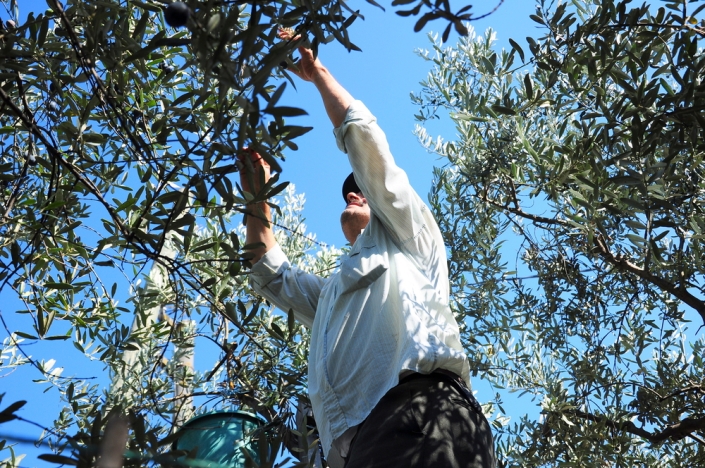 Picking olives the traditional way is less damaging to the fruit









 A few months ago together with three enthusiastic family kids I started a gardening experiment: growing fruits out of the seeds we collected from fruits we ate, just planting it in the backyard.








.jpg)