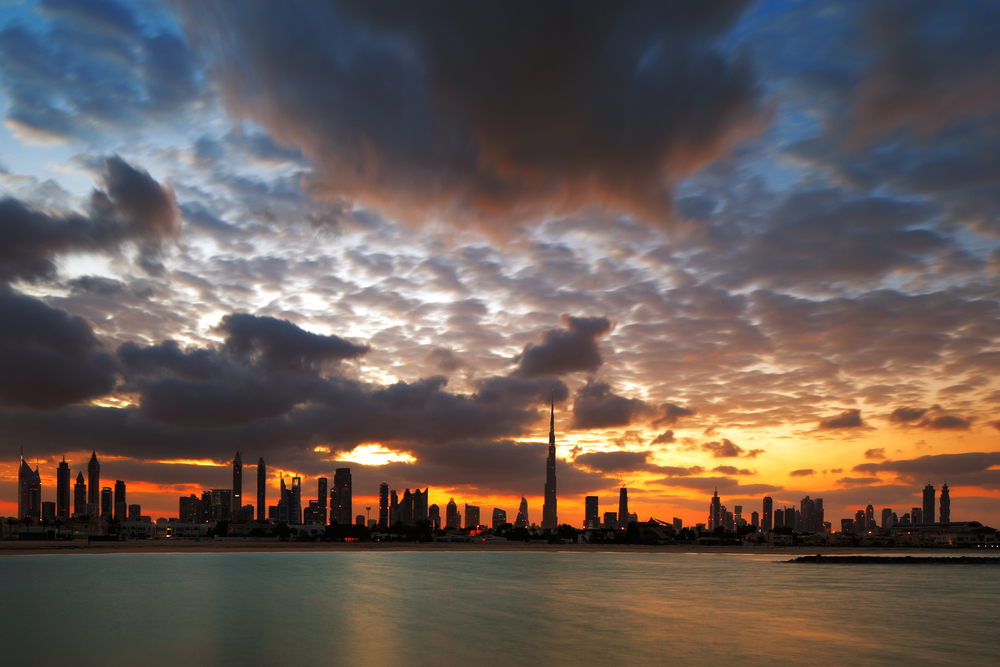
 Last Friday, a ferocious desert rainstorm blew into Dubai swallowing up the city and making the world’s tallest building – the Burj Khalifa – disappear! Video below!
Forget Godzilla! We see Dubai storm swallow mile-high Burj Khalifa [video]
![Forget Godzilla! We see Dubai storm swallow mile-high Burj Khalifa [video]](https://www.greenprophet.com/wp-content/uploads/Burj-Khalifa-Duststorm-768x512.jpg "Forget Godzilla! We see Dubai storm swallow mile-high Burj Khalifa [video]")
Cyclists “go Dutch” and 100+ historic bikes in Israel this week
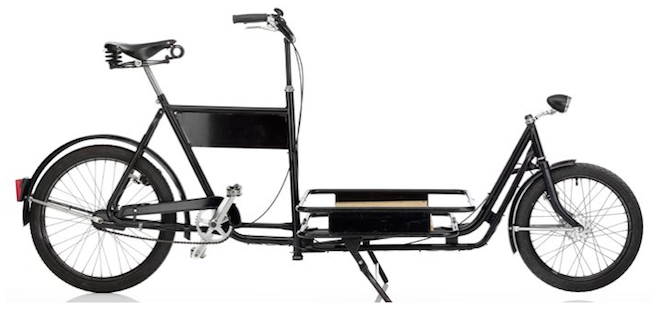
Nobody knows more about bicycles than the Dutch, but Israelis will have a chance to glean some design and urban planning wisdom from the waterlogged nation next week at the “Going Dutch” conference established by their Prime Minister and (the much more fit) Dutch Prime Minister Mark Rutte.
Golfing at the Egyptian Pyramids. What would Pharaoh think?

 A new golf course is being built in the shadow of the Egyptian pyramids, the plans for its fairways and greens were recently unveiled by Thomson Perrett & Lobb, an architectural firm specializing in course design.
It’s not the first links in Cairo, nor the first course near the Cheops, but Insha’allah that Egyptian environmentalists will make it the last!
The game of golf isn’t quite as old as the pyramids, but golfing near the Great Pyramid of Giza has deep roots (unlike new gardens to be planted in the area).

Jordan’s golf green is brown
A favorite pastime in the British Isles where climate ensures steady growth of thick grasses, the sport migrated to the Middle East where it was played largely on sand flats and putting surfaces called “browns”. (Read about Jordan’s only golf course – also naturally landscaped with chipping “browns” – link here.)
 Note the sportswoman above, teeing off back in 1938 on sand and desert scrub. They had it right back then, adopting the game to the place they played it. Today, there are at least seven places to play golf in Cairo, the most picturesque being the Mena House club which sits about 700 meters from the pyramid’s base (see lead image and again, below – the green fields at the top of the photo shows the Mena House course).
Not one concedes to its address, each more artificially verdant than the next.

This area is desert, inhospitable to golf-course greenery. Everything planted requires copious amounts of irrigation, and growth chemical, weed-killer and pesticides. This is a water-starved nation in continual battle with African nations over water rights – how inappropriate is it to squander limited resources to maintain climate-incompatible recreation?
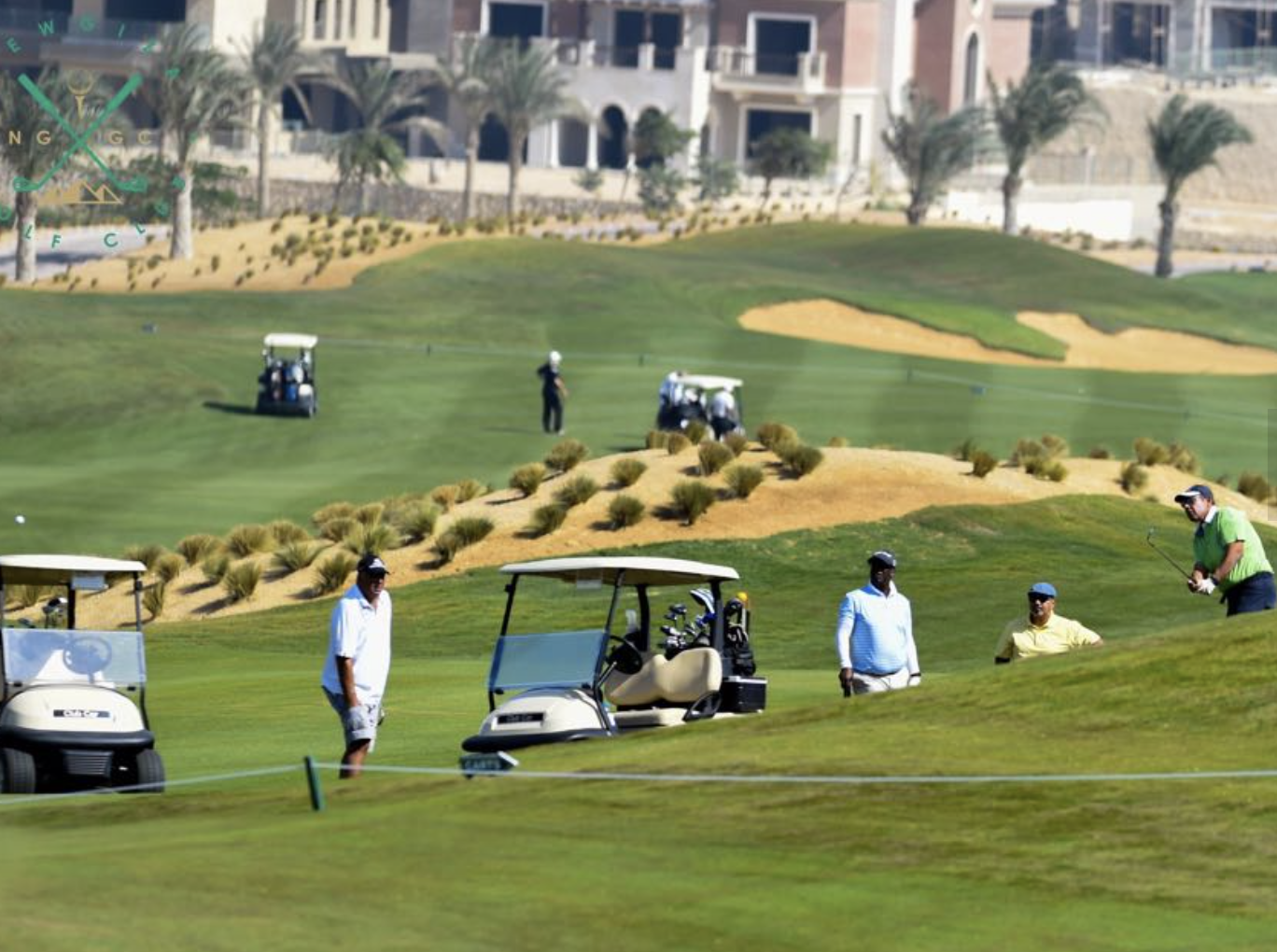
In fairness, golf is just one part of the 1,500 acre New Giza development which will also include hotels, a hospital, a university, sports club, and mixed-use areas with restaurants, shopping and offices. Almost 6,000 residential villas and apartments will be built in 10 new “neighborhoods”, each surrounded by parks and lakes. The amount of water used to support those functions will dwarf the amount the golf course will drink.

“With so many golf developments having been put on hold over the past year, it is a credit to the developers and everyone involved with New Giza that the project is moving forward,” said principal Tim Lobb. The project had kicked off in 2010, but financial restraints and political unrest sent it into hibernation.
“The site for the golf course is part of one of the most dramatic landscapes we have worked on, with incredible hilltop views to the pyramids and 50-meter-high cliffs, which have been incorporated into the golf course design.”
If only there was a push for innovation in course design; adapt the sport to local micro-climate and terrain. Create a truly unique touristic destination that screamed “Cairo” and not “St. Andrews” or “Pebble Beach”. But no need to get my panties in a twist. Because…. if NASA has it right, the new vacation recreation for the whole of the Nile Delta may soon be scuba.
10 refugee shelters we hate to love
Refugees like those who have fled Syria or Sudan or… spend on average twelve years in a temporary home, which got us thinking: what makes a good shelter? With climate change creating more refugees, the answer isn’t simple:
A robust, durable structure may be costly and hard to ship, while tents that are easy to ship en masse can be shredded in rough weather. And we need to think about the ecological aspect. Join us as we weigh the pros and cons of 10 refugee shelters:
In our analysis of different refugee shelters, we have included structures that have already been used first, and then added a few interesting concepts at the end. While the latter half have yet to be proven in the “real world,” it’s worth thinking about ways to improve existing shelters in order to ensure that refugees have the best quality of life possible. They deserve to have a home, even if it is temporary, that allows them to rebuild their lives.
1. IKEA’s solar-powered flatpack prefab refugee shelter
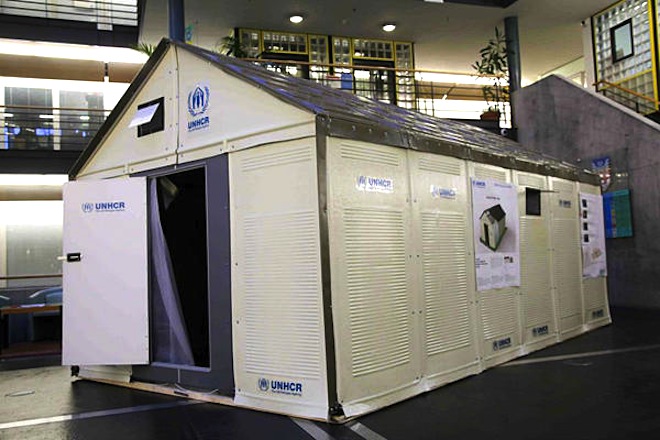
IKEA teamed up with the UNHCR to develop a solar-powered flatpack shelter that could be easily deployed to refugee camps or scenes of natural disasters. These are durable and provide ample security, as well as electricity that allow children to learn after dark and their parents to work.
Once in mass production, they should only cost $1,000 each, they house five people, and they only weigh 100kg. Downside? The shelters are only designed to last a few years (though that is common in refugee housing, which is not supposed to be a permanent solution, and also common in IKEA’s reason for being!) and aesthetically they aren’t so pleasing.
2. Stackable Exo emergency refugee shelters
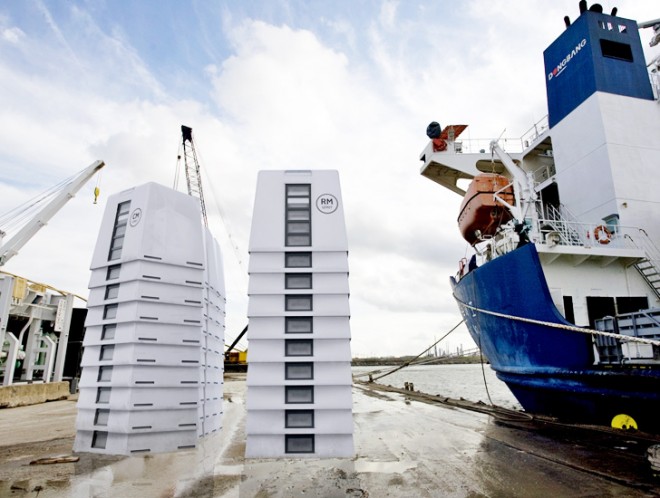
That they are stackable (like styrofoam cups, their inspiration) comprise the main benefit of Reaction Housing’s Exo emergency shelters because that allows for easy transportation. They are also solar-powered and insulated, and they are secure, which is a huge must in disaster situations.
Made of aircraft-grade aluminum, they are durable, which means they should last, and they can be reused. The main downside to this design is size. Albeit just 80 square feet, they can fit up to four people in bunk beds, but they don’t allow for much else. Plus, they are currently very costly.
3. UNHCR’s lightweight, temporary tent shelters

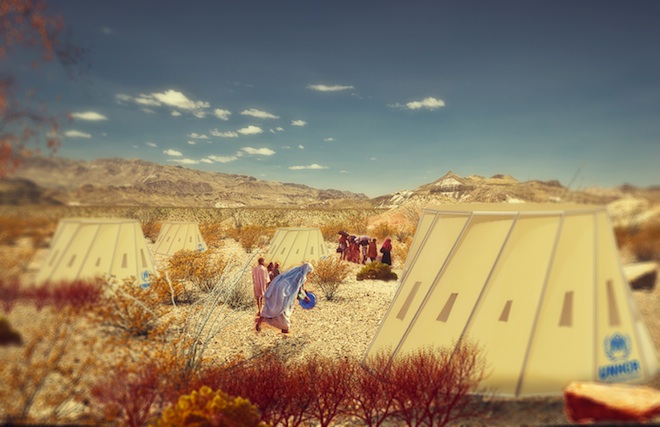
I’ve included the two kinds of shelters that are most commonly deployed in this list in order to demonstrate what is actually practical in the field. The UN refugee agency uses two kinds of refugee structures and this is the more lightweight, temporary option.
While cheap and easy to ship en masse, as you can see above, they offer very little comfort and are easily destroyed. These are very basic shelters that simply put some space between refugees and the elements.
Trouble is, with more than 40 million refugees in the world and money scarce, aid agencies can hardly be expected to procure five star housing or glamping. Even so, efforts are constantly made to rethink refugee housing design – as evidenced by the IKEA prefab.
4. UNHCR’s canvas tents

These canvas tents are designed to last quite a bit longer than the emergency refugee shelters and are the most common variety deployed in refugee camps. This particular image was taken at the Dadaab camp in Kenya.
At 4×4 meters, they provide more space than the lightweight shelters; also, given that they are made from 50 percent cotton and 50 percent polyester canvas, they are both more durable and waterproof. But they aren’t very livable, have no partitions, no electricity. UNHCR pays manufacturers in India and Pakistan about $195 for one of these.
5. Nader Khalili’s buildings fit for space

While not commonly used, Nader Khalili’s earth buildings, which were originally designed with NASA to be used in space make great emergency housing. We love Nader, as he thinks about the soul elements of the person in these structures.
Constructed with sacks of earth stacked on top of one another in a circular plan and then covered in earth. These shelters rely on local materials, local labor, are quick and easy to construct and they are literally dirt cheap. These may not be the most suitable solution in tropical climates however – not because they won’t be cool, because they are beautifully insulated, but because it might be hard to find dry soil with which to fill them.
6. Clean Hub refugee shelter
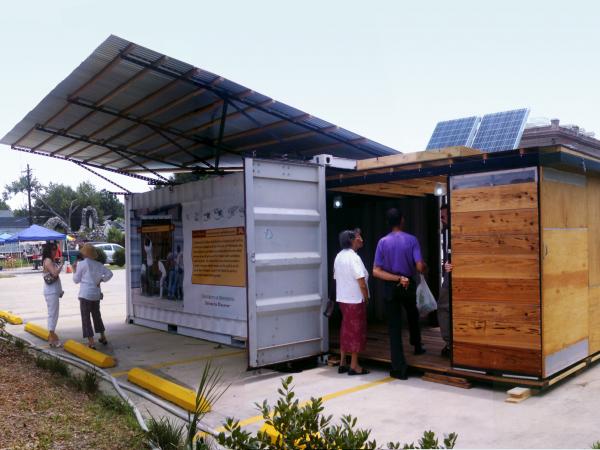
First used in New Orleans after Hurricane Katrina threw the city into absolute mayhem, the Clean Hub refugee shelter (link to organization is no longer working as of Oct., 2019) is built in part from a repurposed shipping container. At 160 square foot, the hub is a portable, self-sustaining source of clean water, electricity and sanitation, and it can be fabricated and shipped anywhere in the world within days.
But it’s very costly at $15,000. Unless they are mass produced so that the price comes right down, this is not a sustainable solution. Maybe take this defunct solution as a model on how to do it better.
7. Ex-Container for refugees
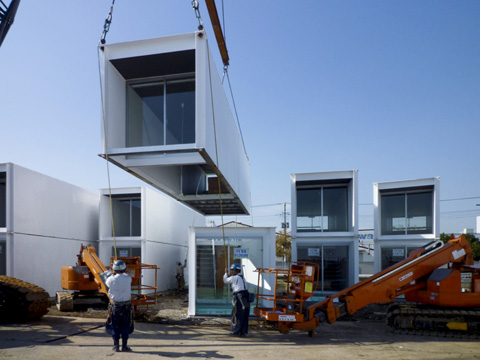
After the earthquake and tsunami hit Japan, local architects designed the Ex-Container, a double story prefabricated tiny home modeled after a 20 foot shipping container. They are rugged, and have a clean, beautiful interior. Unfortunately, the government rejected the company’s efforts to have them widely distributed; seems like another firm won the bid. It is unclear how much these costs.
And well, there are so many problems with container housing over all – read our in-house architect’s take on how terrible containers (cargotecture!) are for the environment. Time to fall out of love with the solution.
Certainly they are cheaper to build than the Clean Hub, but probably not as cheap or as convenient as IKEA’s flatpack homes.
8. Collapsible woven refugee shelters powered by the sun
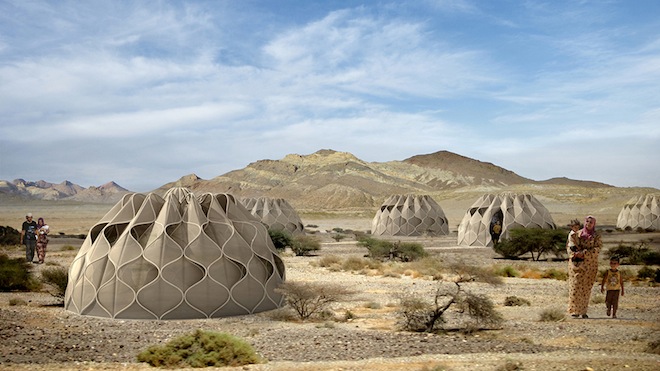
The first of our conceptual designs, this collapsible woven shelter designed by Abeer Seikaly went viral. Portable and clad in a solar skin that generates electricity, this shelter also harvests and drains rainwater. Designed to give refugees a sense of ownership and dignity in addition to security and self-sufficiency, it is super lightweight.
On the downside, this design might be complicated, which could be a barrier to widespread development, and the solar skin could really amp up costs.
9. Shapeshifting shelter for refugees made by AI
Yahya Ibraheem from Jordan submitted this design Shapeshifting shelter to us. She wrote her thesis about how parametric modeling can be used to improve refugee shelters, and in so doing, generated a few really nice features that make a lot of sense. Parametric modelling uses the computer to design objects or systems that model component attributes with real world behaviour.
This refugee tent can be customized to fit different sized families and different climate conditions and the interior can be partitioned to make different rooms, such as bedrooms, bathrooms or kitchens.
Still very much in its infancy stage (Ibraheem has yet to address the materials that might be used or what it might cost to produce this design), it is unlikely to be used in real-world applications, but it does make some very serious thought breakthroughs that could be useful to aid agencies.
10. Life Box for refugee shelter
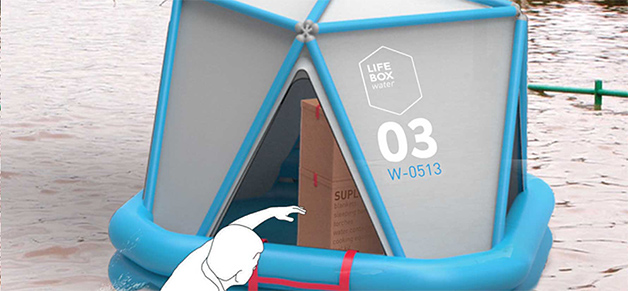
We really love the idea of the Life Box in part because it is suits different needs in different situations. There are three kinds – ‘air’, ‘land’ and ‘water,’ and just like it sounds, they all come right out of a box.
The ‘air’ type refugee box is used for disaster areas that can be only reached by aircraft, and the outer layer is used as parachute during airdropping.
The ‘land’ type refugee box can be used in areas that are reachable by road, but its outer layer is placed inside the box.
The ‘water’ life box is designed specifically for flood-affected areas, and can be used on land and water. The Life Box has won a Red Dot Design award two years running and it’s easy to see why.
In addition to being easy to ship, lightweight, the four-person shelter even contains provisions! It’s a great short term solution, but it wouldn’t be great to live in this for more than a couple of days.
The best reason for growing rhubarb that we’ve ever heard
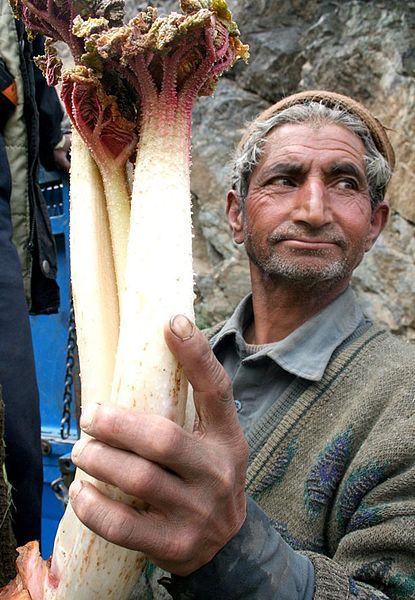
While we contemplate whether GMO engineers can free our world from its glaring lack of light emitting houseplants and radiant pigs, we overlook far more amazing secrets of nature which make our best bio-science minds look like rank amateurs. The humble rhubarb plant is one such example.
Stylin’ gel wristbands sniff out chemicals killing your body
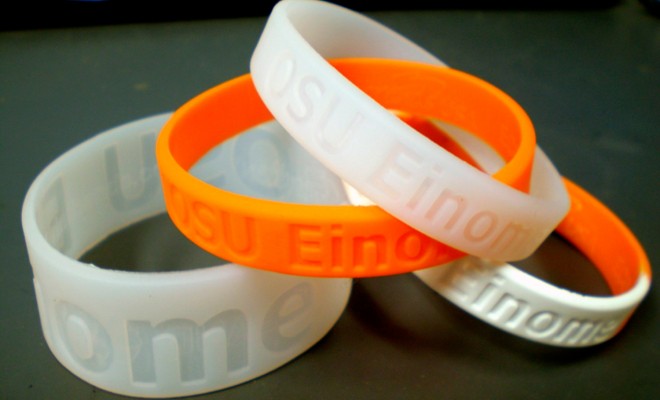
Pack away the clunky radon-detectors and carbon monoxide alarms! Silicone wristbands have emerged as the simplest of environmental warning devices – cheap to manufacture and damn stylin’ too. Not quite Fitbit –– Pop on some plastic bling and know what exactly you’re breathing!
Fatwa saves tigers! Hunting rare creatures, dear Muslims, is now Haram

 Could a fatwa, a religious Muslim order, save a tiger? Watch and see, because the Indonesian Council of Clerics (ICC), the country’s highest Islamic body, has just proclaimed that hunting endangered animals is haram!
How green is your abaya?


Designers from around the world will parade their latest collections in Abu Dhabi’s first-ever Eco Fashion Show, a five-day event featuring couture-with-a-conscience this April.
Shapeshifting shelters for refugees in hot and cold climates
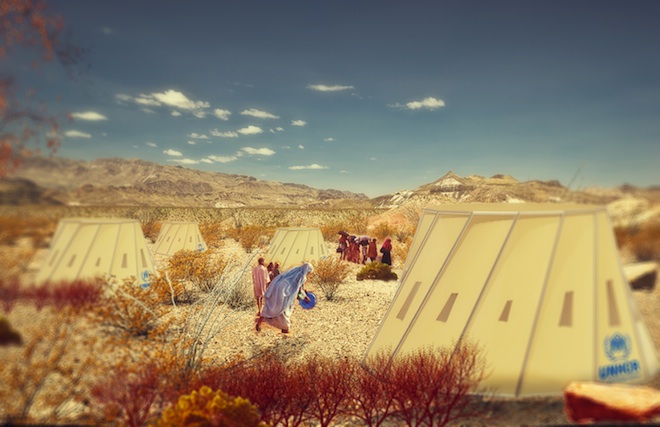
With roughly 600 Syrian refugees crossing into Jordan every day, it’s no surprise that local architects are designing various housing solutions for the devastating influx. Abeer Seikaly’s collapsible woven shelter is lightweight and mobile, while Yahya Ibraheem’s shapeshifting shelters can be customized to fit a suite of climate conditions.
Is fruit juice shortening your life?

Ah…a cold glass of orange juice, first thing in the morning. Gives you energy, vitamin C and zest to start the day. Right? Is that glass of juice really good for you?
Maybe. What’s for sure is that juice gives you lots and lots of sugar. To start with, the vitamin C content in orange juice is over-rated. Cup for cup, broccoli, kale and red bell peppers have more vitamin C. And when you eat those vegetables, you’re not getting a heavy dose of sugar that goes straight into your bloodstream. Which is what you get when you drink juice. (You can make your own juice JuicersPlusBlenders.com anytime!)
According to American obesity expert Robert Lustig and author of Fat Chance: The Bitter Truth about Sugar, juice is pretty much just sugar. (See our post with a video interview of Dr. Lustig here) Without fruit fiber, which slows down the body’s absorption of fructose, that sugar goes directly into the bloodstream, stopping at an overloaded liver. It increases blood sugar levels as soda does, and like soda, puts weight on you.
Another danger lurking in the sweet fluid is inflammation of the arteries and joints.Sudden exposure to the acidic sugars in juice may irritate and inflame arteries, leading to chronic arterial disease. My herbology teacher taught the class that people with arthritis should avoid orange and grapefruit juice because citrus causes joint inflammation. The only exception is lemon juice, which is actually beneficial to sore joints. But don’t stir spoonfuls of sugar into your lemonade – plain cold water with the juice of half a lemon is tasty and refreshing all by itself.
Freshly-squeezed juice is naturally better than the kind that comes in cartons, bottles or cans. Those have been pasteurised, which is necessary for safety in large-scale production, but destroys the fruit’s beneficial enzymes, vitamins and minerals.
Take a close look at the photo at the top of this post. To get a large glass of juice, how many oranges must you squeeze? Eating one orange fills you up and gives you a similar satisfaction to drinking a glass containing the juice – and sugar – of four oranges. So what’s the smarter choice?
Lustig’s advice is simple: eat your fruit, don’t drink it. But if you just can’t get your day started without juice, squeeze your own. Add back some of the pulp that remains from juicing. Drink only a small glass, after having eaten breakfast.
Most of us don’t drink enough water anyway. Now’s the time to consciously fill up our glasses with H2O.
More on choices we make with our drinks:
Ten months, 7000 miles of earth, a bike, and a Tunisian passport

In 2010 Arafet Ben Marzou, like an increasing number of Tunisians, began to reach his personal limits of frustration when he saw his home country digress towards a political, religious and economic system that was draining Tunisians from their liberty, thoughts and creativity.
DIY chocolate fruit-nut clusters for Purim baskets
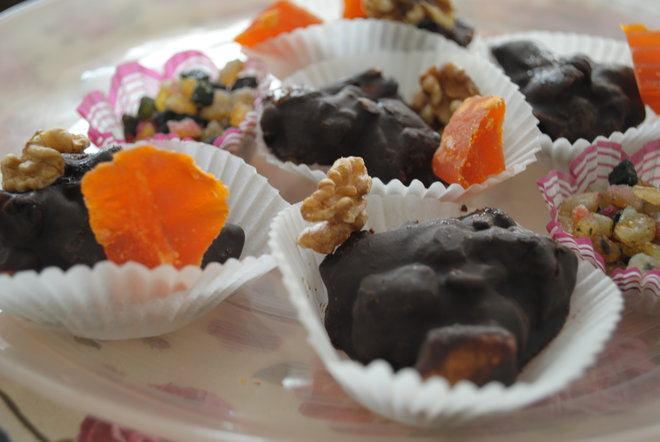
The Jewish holiday of Purim 2018 begins this coming Wednesday night, the 28th of February, and continues through Thursday the 29th. In Jerusalem and other ancient walled cities, the holiday is called Shushan Purim and occurs on Thursday night, the 1st of March, through Friday.
Dubai’s huge green mosque polishing off for eco-Muslim masses

Construction of the first eco-friendly mosque in the United Arab Emirates (UAE) is nearly complete and Tayeb Al Rais, secretary-general of the Awqaf and Minors Affairs Foundation said the green mosque will soon open its doors to worshipers.
Tel Aviv hosts first-for-world Vegan Congress, without the blood

Veganism has gone viral in Israel – the number of devotees doubling in the past two years! With over 2% of the population off meat and dairy, it’s perfect timing for animal rights activists to join up with no-animal-product eaters at an inaugural congress of the vegan movement, held last Friday in Tel Aviv.