Research from the Wildlife Conservation Society (WCS) and the University of Queensland, published in Ocean & Coastal Management, found that nearly three out of four marine protected areas (MPAs) worldwide are exposed to sewage pollution.
At a time when climate anxiety can feel abstract and overwhelming, and being Jewish something people may need to hide in big cities, Adamah Los Angeles is trying something different: turning Jewish values into local climate action with dirt-under-the-fingernails practicality.
For families with kids, pets, or anyone trying to build a cleaner outdoor space, removing old astroturf is one of the simplest ways to reduce unnecessary exposure to plastics and heat. Some past studies suggest that if kids have played on these surfaces you need to wash their hands.
Artificial turf, the green plastic stuff that is supposed to look like grass, was sold to many home-owners as a clever compromise: a green-looking surface that makes you feel homey, but which needs no mowing. It survives heavy use, and in dry places like Middle East deserts, and in California or Texas, it can replace thirsty lawns. But it is toxic.
“In the midst of uncertain time, renewable energy remains consistent and steadfast in its expansion,” said Francesco La Camera, IRENA’s Director-General. “A more decentralised energy system, with a growing share of renewables and more market players, is structurally more resilient.”
Research from the Wildlife Conservation Society (WCS) and the University of Queensland, published in Ocean & Coastal Management, found that nearly three out of four marine protected areas (MPAs) worldwide are exposed to sewage pollution.
At a time when climate anxiety can feel abstract and overwhelming, and being Jewish something people may need to hide in big cities, Adamah Los Angeles is trying something different: turning Jewish values into local climate action with dirt-under-the-fingernails practicality.
For families with kids, pets, or anyone trying to build a cleaner outdoor space, removing old astroturf is one of the simplest ways to reduce unnecessary exposure to plastics and heat. Some past studies suggest that if kids have played on these surfaces you need to wash their hands.
Artificial turf, the green plastic stuff that is supposed to look like grass, was sold to many home-owners as a clever compromise: a green-looking surface that makes you feel homey, but which needs no mowing. It survives heavy use, and in dry places like Middle East deserts, and in California or Texas, it can replace thirsty lawns. But it is toxic.
“In the midst of uncertain time, renewable energy remains consistent and steadfast in its expansion,” said Francesco La Camera, IRENA’s Director-General. “A more decentralised energy system, with a growing share of renewables and more market players, is structurally more resilient.”
Research from the Wildlife Conservation Society (WCS) and the University of Queensland, published in Ocean & Coastal Management, found that nearly three out of four marine protected areas (MPAs) worldwide are exposed to sewage pollution.
At a time when climate anxiety can feel abstract and overwhelming, and being Jewish something people may need to hide in big cities, Adamah Los Angeles is trying something different: turning Jewish values into local climate action with dirt-under-the-fingernails practicality.
For families with kids, pets, or anyone trying to build a cleaner outdoor space, removing old astroturf is one of the simplest ways to reduce unnecessary exposure to plastics and heat. Some past studies suggest that if kids have played on these surfaces you need to wash their hands.
Artificial turf, the green plastic stuff that is supposed to look like grass, was sold to many home-owners as a clever compromise: a green-looking surface that makes you feel homey, but which needs no mowing. It survives heavy use, and in dry places like Middle East deserts, and in California or Texas, it can replace thirsty lawns. But it is toxic.
“In the midst of uncertain time, renewable energy remains consistent and steadfast in its expansion,” said Francesco La Camera, IRENA’s Director-General. “A more decentralised energy system, with a growing share of renewables and more market players, is structurally more resilient.”
Research from the Wildlife Conservation Society (WCS) and the University of Queensland, published in Ocean & Coastal Management, found that nearly three out of four marine protected areas (MPAs) worldwide are exposed to sewage pollution.
At a time when climate anxiety can feel abstract and overwhelming, and being Jewish something people may need to hide in big cities, Adamah Los Angeles is trying something different: turning Jewish values into local climate action with dirt-under-the-fingernails practicality.
For families with kids, pets, or anyone trying to build a cleaner outdoor space, removing old astroturf is one of the simplest ways to reduce unnecessary exposure to plastics and heat. Some past studies suggest that if kids have played on these surfaces you need to wash their hands.
Artificial turf, the green plastic stuff that is supposed to look like grass, was sold to many home-owners as a clever compromise: a green-looking surface that makes you feel homey, but which needs no mowing. It survives heavy use, and in dry places like Middle East deserts, and in California or Texas, it can replace thirsty lawns. But it is toxic.
“In the midst of uncertain time, renewable energy remains consistent and steadfast in its expansion,” said Francesco La Camera, IRENA’s Director-General. “A more decentralised energy system, with a growing share of renewables and more market players, is structurally more resilient.”
Research from the Wildlife Conservation Society (WCS) and the University of Queensland, published in Ocean & Coastal Management, found that nearly three out of four marine protected areas (MPAs) worldwide are exposed to sewage pollution.
At a time when climate anxiety can feel abstract and overwhelming, and being Jewish something people may need to hide in big cities, Adamah Los Angeles is trying something different: turning Jewish values into local climate action with dirt-under-the-fingernails practicality.
For families with kids, pets, or anyone trying to build a cleaner outdoor space, removing old astroturf is one of the simplest ways to reduce unnecessary exposure to plastics and heat. Some past studies suggest that if kids have played on these surfaces you need to wash their hands.
Artificial turf, the green plastic stuff that is supposed to look like grass, was sold to many home-owners as a clever compromise: a green-looking surface that makes you feel homey, but which needs no mowing. It survives heavy use, and in dry places like Middle East deserts, and in California or Texas, it can replace thirsty lawns. But it is toxic.
“In the midst of uncertain time, renewable energy remains consistent and steadfast in its expansion,” said Francesco La Camera, IRENA’s Director-General. “A more decentralised energy system, with a growing share of renewables and more market players, is structurally more resilient.”
Research from the Wildlife Conservation Society (WCS) and the University of Queensland, published in Ocean & Coastal Management, found that nearly three out of four marine protected areas (MPAs) worldwide are exposed to sewage pollution.
At a time when climate anxiety can feel abstract and overwhelming, and being Jewish something people may need to hide in big cities, Adamah Los Angeles is trying something different: turning Jewish values into local climate action with dirt-under-the-fingernails practicality.
For families with kids, pets, or anyone trying to build a cleaner outdoor space, removing old astroturf is one of the simplest ways to reduce unnecessary exposure to plastics and heat. Some past studies suggest that if kids have played on these surfaces you need to wash their hands.
Artificial turf, the green plastic stuff that is supposed to look like grass, was sold to many home-owners as a clever compromise: a green-looking surface that makes you feel homey, but which needs no mowing. It survives heavy use, and in dry places like Middle East deserts, and in California or Texas, it can replace thirsty lawns. But it is toxic.
“In the midst of uncertain time, renewable energy remains consistent and steadfast in its expansion,” said Francesco La Camera, IRENA’s Director-General. “A more decentralised energy system, with a growing share of renewables and more market players, is structurally more resilient.”
Research from the Wildlife Conservation Society (WCS) and the University of Queensland, published in Ocean & Coastal Management, found that nearly three out of four marine protected areas (MPAs) worldwide are exposed to sewage pollution.
At a time when climate anxiety can feel abstract and overwhelming, and being Jewish something people may need to hide in big cities, Adamah Los Angeles is trying something different: turning Jewish values into local climate action with dirt-under-the-fingernails practicality.
For families with kids, pets, or anyone trying to build a cleaner outdoor space, removing old astroturf is one of the simplest ways to reduce unnecessary exposure to plastics and heat. Some past studies suggest that if kids have played on these surfaces you need to wash their hands.
Artificial turf, the green plastic stuff that is supposed to look like grass, was sold to many home-owners as a clever compromise: a green-looking surface that makes you feel homey, but which needs no mowing. It survives heavy use, and in dry places like Middle East deserts, and in California or Texas, it can replace thirsty lawns. But it is toxic.
“In the midst of uncertain time, renewable energy remains consistent and steadfast in its expansion,” said Francesco La Camera, IRENA’s Director-General. “A more decentralised energy system, with a growing share of renewables and more market players, is structurally more resilient.”
Research from the Wildlife Conservation Society (WCS) and the University of Queensland, published in Ocean & Coastal Management, found that nearly three out of four marine protected areas (MPAs) worldwide are exposed to sewage pollution.
At a time when climate anxiety can feel abstract and overwhelming, and being Jewish something people may need to hide in big cities, Adamah Los Angeles is trying something different: turning Jewish values into local climate action with dirt-under-the-fingernails practicality.
For families with kids, pets, or anyone trying to build a cleaner outdoor space, removing old astroturf is one of the simplest ways to reduce unnecessary exposure to plastics and heat. Some past studies suggest that if kids have played on these surfaces you need to wash their hands.
Artificial turf, the green plastic stuff that is supposed to look like grass, was sold to many home-owners as a clever compromise: a green-looking surface that makes you feel homey, but which needs no mowing. It survives heavy use, and in dry places like Middle East deserts, and in California or Texas, it can replace thirsty lawns. But it is toxic.
“In the midst of uncertain time, renewable energy remains consistent and steadfast in its expansion,” said Francesco La Camera, IRENA’s Director-General. “A more decentralised energy system, with a growing share of renewables and more market players, is structurally more resilient.”
ما لبث هارفي أن حول ضواحي تكساس الساحلية إلى خرائب تجري من فوقها الفياضانات حتى تبعته إرما و هي تجوس خلال جزر الكاريبي، مقطعة بذلك كل ما في طريقها إربا إربا. تلك الأعاصير الفتاكة لم تكن حكرا على حوض الأطلسي فقط، بل كان للفليبين و تايوان و سواحل الصين و اليابان و غيرهم من جيران الهادي نصيب من الدمار
و في خضم المعمعة، تتجه أصابع الاتهام إلى الارتفاع المُلفت في درجات حرارة المحيطين الأطلسي و الهادي على حد سواء، و اللذان بدورهما كانا السبب في ذوبان جليد القطب الشمالي بوتيرة أسرع مما كنا نخشى، معلنين بذلك بدء الزلزال المناخي على سبيلين المعنى و الحرف
طبعا، تلك المخاوف بشأن غضب الطبيعة الناتج من الاحتباس الحراري ليست بالشيئ الجديد، فقد نُشرت دراسات مفصلة لا تُعد و لا تُحصى عن تلك الظاهرة و كل ما يخصها من أسباب و نتائج و علاجات. أما على الصعيد الفني، فصُورت أفلام و وثائقيات كثيرة لتنبه الرأي العام عن ما تكمنه الطبيعة من كوارث إن هي اختل توازنها المُقدر ربانيا. أحد تلك الأفلام (الحريق القادم) كان قد عُرض في العام 1993، و كانت أحداثه تدور في مستقبل مرعب، 2017 على وجه التحديد، حين تمكنت الأعاصير المتوحشة من الكاريبي و خليج المكسيك، و تمكنت حرائق الغابات من كاليفورنيا، و تمكن الجفاف من الولايات الأمريكية المتجاورة
و لم تشأ الأقدار إلا أن تصدق النبوءة: فها هم هارفي و إرما و كاتيا و خوزيه يولدون من رحم حوض الأطلسي ليعيثوا فسادا في سواحل الأمريكية شرقا، و ها هي الحرائق تلتهم غاباتها غربا. و لم ينس الجفاف، فوق كل ذلك، أن يحل ضيفا ثقيلا في مناطق عدة في الغرب و الجنوب الغربي
أما الشرق الأوسط، فتلك رواية أُخرى: في السنتين الماضيتين، و بحسب ناسا، عانى الشرق الأوسط من أشرس جفاف مر به على مدى تسعمئة سنة خلت
It’s hard to believe that in 2017 women in Saudi Arabia are not allowed to drive. Shwaya, shwaya! Saudi Arabia announced this week that it would allow women to drive, ending a long-term approach that’s shown the world how oppressed women can be in the Middle East.
We’ve learned from jokers on YouTube about how hard it is for women, and beyond giving them low morale, not being able to drive restricts women to where they can work, who they can be friends with and when they can go shopping. They currently need a male escort, a guy from the family or a paid chauffeur to drive them around.
The driving ban has damaged the way the world looks at Saudi Arabia (duh!), and the country hopes that the world will look at it more favorably. Locally, women will now be able to come and go as they please and be free from spending large parts of their salaries on drivers. With all that extra money and freedom, we wonder what Saudi women will want?
“It is amazing,” said Fawziah al-Bakr, a Saudi university professor who was among 47 women who participated in the kingdom’s first protest against the ban — in 1990. After driving around the Saudi capital, Riyadh, the women were arrested and some lost their jobs, she told the New York Times. “Since that day, Saudi women have been asking for the right to drive, and finally it arrived,” she told the Times by phone. “We have been waiting for a very long time.”
Everyone knows that water is Earth’s greatest natural resource. We literally could not live without it. According to the U.S. Geological Survey, water covers about 71 percent of the earth’s surface, with our oceans holding about 96.5 percent of it. The other 3.5 percent of surface water is the fresh water in rivers, streams, lakes, and swamps. But there’s additional water in the air, underground, and trapped in icecaps and glaciers. There’s also water in the soil, in aquifers, and in all living things.
Despite all this water, however, vast numbers of people live in areas of the world where water is very scarce. It is estimated that 78.3 million people worldwide do not have access to clean water. In the United States, droughts are common occurrences throughout the country. The Desert Southwest goes to extraordinary lengths to obtain sufficient water to meet the needs of its populations.
The Cadiz water project is the latest example. Located in Cadiz, CA, in the Mojave Desert about 80 miles from Barstow, this project will recover over 50,000 acre-feet of groundwater before it evaporates, creating a new water supply sufficient to service 100,000 Southern California families each year for the next 50 years.
Water Usage and Energy Usage
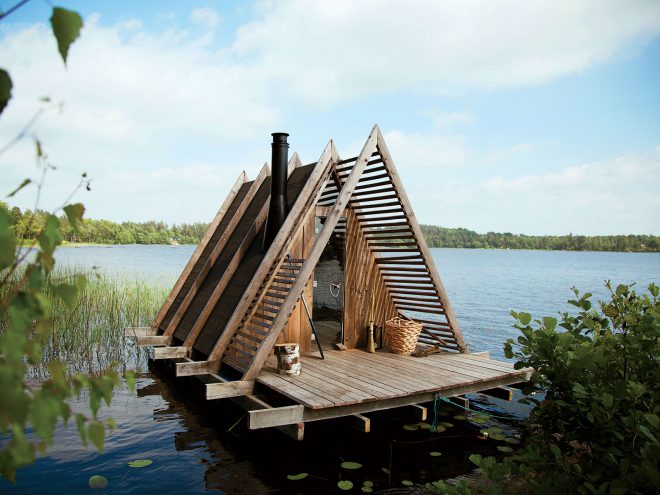
Growing numbers of Americans are making a conscious effort these days to use less energy. You can see many people opting for awesome and sensual wood fired hot tubs. Wood firing the Swedish way means taking the time to chop the wood, collect it. Start a fire. If the trees come from your property you can replace them and you can be carbon neutral. Or maybe even try a wood fired sauna like the folks at Stedsans in Sweden.
Wood fired floating sauna in Sweden. It’s a camp/resort run by sustainable chef types.
Most people, however, think of energy consumption as electricity, gas, oil, etc. They seldom think of energy in terms of water consumption. Water usage and energy usage, nevertheless, go hand and hand. Consider the following facts:
Electricity, gas, or propane heats the water you use for baths, showers, dishwashers, and clothes washers.
Your water company uses energy to purify your water, pump it to your house, and dispose of your sewage.
If you live in a rural area with your own well and disposal system, you’re paying directly for your energy consumption to run them.
According to the U.S. Energy Information Administration, Americans use 231 billion kilowatt hours of electricity each year directly related to their water consumption. It breaks down as follows:
Water heating – 134 billion kWh
Clothes dryers – 61 billion kWh
Dishwashers – 28 billion kWh
Clothes washers – 8 billion kWh
Obviously, reducing your water consumption also will reduce your energy bills. Here are some ideas and tips for accomplishing both.
Reducing Water Consumption in Your Kitchen
Keep a pitcher or jug of water in your refrigerator. You won’t have to let tap water run down the drain every time you want a drink in order to get it cold. Wash fresh fruit and vegetables in a plastic dishpan or big cooking pan rather than under running water.
Don’t run your dishwasher until you have a full load. Consider buying a pressure cooker. It saves both time and water and your food will taste better and retain more of its nutrients. Defrost frozen foods in the microwave, not under hot running water. Always make sure your faucet is completely turned off when you’re finished using it; replace it if it starts leaking.
Reducing Water Consumption in Your Bathroom
After wetting your toothbrush, turn off the water while you’re brushing your teeth. Turn it back on when you’re ready to rinse your mouth. As with your kitchen faucet, make sure your bathroom faucet is completely turned off when you’re finished using it and replace it if it starts to leak.
Buy a low-flow toilet or modify your existing toilet with a reasonably simple DIY project. Check to see that your toilet filling system is working properly and not overfilling your toilet bowl, causing it to send excess water gurgling down the drain.
Plug the bathtub before you start filling it. Use the cold water that comes in at first to offset the really hot water that will start to flow in. Buy a low-flow showerhead. Better yet, consider a rain shower head.
Reducing Water Consumption Outdoors
Reducing Water Consumption Outdoors
Consider installing a rain barrel to catch rain for your lawn and/or garden. Weed your garden frequently; don’t waste water on weeds! Mulch your plants to help retain moisture in the soil. Install a drip irrigation system to water your plants and flowers rather than using a garden hose. If you must water with a hose, attach sprinklers for garden use and don’t do it mid-day. It’s not good for your plants and you’ll lose too much water to evaporation. There are loads of inventions that help you reduce water use on your garden. You can find some at your local gardening shop.
Speaking of saving water: cover your pool and/or hot tub anytime they’re not in use. It’s surprising how much water evaporates from such large surfaces. Install a timer on your lawn sprinkler system and make sure your sprinklers are positioned properly so they’re watering only your lawn, not your driveway or the street. Also, make sure your outdoor water connections and hoses aren’t leaking.
Choose grass seed that is appropriate to the climate where you live. If it’s an arid region, look for seed that is drought tolerant. If you live in the Desert Southwest, consider desert landscaping rather than a green lawn.
Americans use over 275 billion gallons of surface water and over 80 billion gallons of groundwater per day. Reducing your water consumption not only will reduce your energy bills, but also will conserve Earth’s most precious natural resource.
The restaurant business is loaded with opportunities for cooperating with Mother Nature and with the goals of a modern, green society. From training a staff to choosing a menu, in style and substance, globally conscious restaurant owners can find ways to help them sleep well at night.
1.Cleanliness
Keeping a restaurant going requires a dedication to cleanliness, for which many restaurant managers and owners reach for the first cleaning products they find. This often means commercial cleaning projects that contain questionable chemical compounds that you wouldn’t want in your home, let alone in a business that caters to an enlightened, planet-friendly clientele.
Of course, if you want to go green with your cleaning products, your local health board or the state’s own regulations might have something to say about that. Water alone will not take care of unhealthy bacteria or other dangerous pathogens. On the other hand, you will want to use cleaning products that really work. Call your local health board for recommendations in this area.
2. Training Workers
Certainly, health departments in various states consider their role to be one of helping businesses keep a clean and health establishment, not shutting health code violators. Out west, the California food handlers card attests to the state’s dedication to helping train workers in keeping restaurants clean and handling food properly. Yes, organic often implies a relaxed atmosphere when it comes to food presentation, but that doesn’t guarantee healthy practices, something your state regulators will certainly remind you if they need to. You can also train your workers how to compost or give away food that is not eaten by the end of the day.
3. A Green Menu
The greatest impact a restaurant can have is in what the owner puts on the menu. Choosing your local suppliers has a direct impact on the green economy and offers a method in which one business can have a lateral impact on their industry. Supporting certified organic farmers who avoid abusing the planet with pesticides, herbicides, antibiotics, poor land management and pledge humane treatment of their animals allows these small farmers to survive and even thrive, allowing them to prosper and grow.
One organic farmer doing well is a signal to the farming community that green practices not only make planetary sense but economic sense. It allows the organic community to participate in the marketplace.
You could even start an organic meal preparation program that uses seasonal produce and sets a clear schedule for pickups and deliveries. Many kitchens test a delivery model that integrates meal prep business ecommerce into their website ordering flow to minimize waste and predict demand. That approach helps you track portions, forecast ingredients, and keep the menu aligned with what nearby farms can supply.
Using organic suppliers also supports the local economy simply because crops sprayed with pesticides and treated with preservatives can travel father as these practices increase a product’s shelf life. In contrast, organic farmers tend to prefer local markets, so they can sell their fresh, vulnerable products in markets that appreciate local means fresh and this means healthier foods untreated by preservatives.
In this manner, a restaurant that uses green suppliers makes enormous use of its buying power. They support local producers who are kind to the planet earth and makes use of fresh, local foods that go quickly to their customers. A healthy planet and healthy customers mean that green menus influence the world well beyond their own cash registered.
4. Education
Beyond the complex and rewarding practices of running a restaurant that works within a “green” framework, restaurant owners can seize the opportunity they have to educate their customers and their would-be customers along the way.
Often, local newspapers run articles on new businesses that open in their neighborhoods and this is just one opportunity to educate the public on the benefits of a green restaurant. Start by reminding the public about the health benefits of eating simple, fresh, green, local, untreated foods and go from there. Remind them that you are supporting the local economy in ways that a national fast-food franchise is not. Remind them that your advertising dollars start local and stay local – while national chains rely on corporate advertising in which the local economy is unlikely to benefit.
5. A Living Wage
Lastly, a “green” restaurant implies a connection to the planet, but it also implies a connection to the local community and to human beings. That implies you will pay your workers a living wage. There’s no point in running a proud, healthy, green restaurant and relying on cutthroat wages for your staff.
Check with your local banks to find out if there is an established living wage in your community. Then figure out ways in which you can guarantee your staff goes home with enough money to support themselves and their families. Again, there is no point in bragging about your green business if your dishwashers cannot afford childcare or your waitresses cannot afford new shoes. If you look to countries like Switzerland the cost of food at grocery stores is not that high, but to eat out you will pay a fortune. Why? Because servers earn a good hourly wage for their services. Think about it.
With these tips, your restaurant can become truly eco-friendly. From the food you serve to the impact you have on your community, being a green, organic restaurant is more than just a trend.
They were found in a 4000 year old tomb. Begging the question – why a jar of decapitated toads? What strange customs did our ancestors practice? According to archaeologists who uncovered the recent finding, the frogs were part of ancient funeral practices.
Researchers say these fascinating findings from an Israel Antiquities Authority excavation near the Jerusalem Biblical Zoo shed light on burial customs in the Canaanite period – the Middle Bronze Age. The archaeological excavation yielded the remains of at least nine toads, and evidence of the cultivation of date palms and myrtle in the area.
According to the excavation directors on behalf of the Israel Antiquities Authority, Shua Kisilevitz and Zohar Turgeman-Yaffe: “This section of the Nahal Repha’im basin was fertile ground for settlement throughout time, especially during the Canaanite period. In recent years excavations in the area have uncovered two settlement sites, two temples and a number of cemeteries, which provide new insight into the life of the local population at that time.”
According to Kisilevitz and Turgeman-Yaffe: “For an archaeologist, finding tombs that were intentionally sealed in antiquity is a priceless treasure, because they are a time capsule that allows us to encounter objects almost just as they were originally left. At that time, it was customary to bury the dead with offerings that constituted a kind of “burial kit,” which, it was believed, would serve the deceased in the afterworld. When we removed the stone that blocked the tomb opening, we were excited to discover intact bowls and jars.
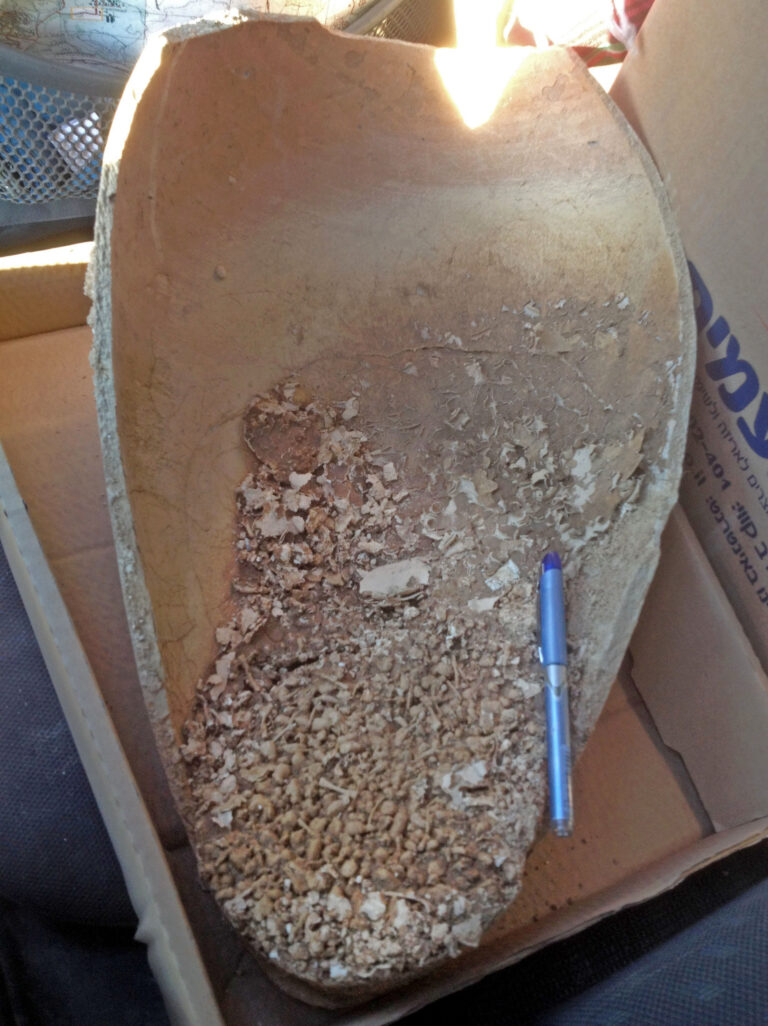
“In one of the jars, to our surprise, we found a heap of small bones. The study of the bones, by Dr. Lior Weisbrod of the University of Haifa, revealed at least nine toads. Interestingly, they had been decapitated.”
Another intriguing finding came to light through analysis of sediments collected from the clay jars and examined under a microscope. The examination, by Dr. Dafna Langgut of Tel Aviv University, revealed that shortly before the vessels were placed in the tomb, they came into contact with various plants including date palms and myrtle bushes.
This fact is interesting because this is not the natural habitat for those species, and they therefore seem to have been planted here intentionally. According to Dr. Langgut, in this period the date palm symbolized fertility and rejuvenation, which could explain why the ancients cultivated the trees in this environment, where they do not grow naturally. According to the scholars, these plants may have been part of an orchard planted in an area where funeral rituals were held, during which offerings of food and objects were made to the deceased. The scholars surmise that the jar with the headless toads was among these offerings.
The research will be presented for the first time on Thursday, October 18, at the conference “New Studies in the Archaeology of Jerusalem and its Region,” open to the public, at the Hebrew University of Jerusalem.
Going green is the latest business tends that paving the way for a corporate and social change. A green workplace and green business operations have numerous benefits for business owners. Using green strategies in your business can improve efficiencies, save you money, reduce waste and build your public image. Both large corporates and small businesses can convert their existing operations into entities that support sustainable use of resources wherever possible. Here are five benefits of implementing green strategies in your business.
#1 Save Money and Reduce Waste
Improve the overall operating efficiency of your business by going green. You can trim out excessive and unnecessary overheads and costs by turning to green practices. Creating a paperless environment is an example of a green practice that eliminates waste. Instead of paper records that take up space, or the need to print documents, all of your customer information and business forms are stored in the cloud and not on paper.
The money that you spend on implementing a paperless CRM solution will pay for itself. Use sustainable suppliers for ink cartridge refills, instead of throwing the entire cartridge away, offer employees car allowances for hybrid vehicles, and set up your business to run on a solar energy system, rather than the electrical grid.
#2 A Green Workplace
Running and maintaining your business location requires the use of cleaning products that are harmful to your environment. Do an audit of all of your suppliers and change any that do not offer environmentally-friendly cleaning products. Keep your offices clean but don’t harm the environment while you are doing it. Remember to recycle any waste that is generated by your company and dispose of all organic waste in accordance with environmental regulations and procedures.
#3 Positive Public Image
We live in the twenty-first century, and business needs to provide leadership to the communities it serves. Take the high-road and set the initiative by going green. The public will see your company as an environmentally responsible entity that cares about the environment that it operates in and serves. While image should not be the primary motivating factor to go green, it’s interesting to note that companies that do make the change, experience higher profits and better user engagement from their target markets.
#4 Take Advantage of Tax Breaks
State and federal laws on emissions have presented companies with challenges that they will need to overcome in reducing their carbon footprint. Companies such as General Electric and FedEx have instituted programs and green technologies that reduce their emissions and allow them to meet compliance with the state regulations.
Incentives and tax rebates are also available at state level. In certain states, such as Florida, companies that produce and sell renewable electricity to the local communities are offered tax breaks on their operations. All businesses in the state of Florida are also exempt from sales tax related to the purchase and maintenance of renewable and sustainable energy systems and technologies. The IRS will allow deductions on hybrid green vehicles and other expenses that are related to environmentally-friendly business practices.
Tax rebates are also available for corporate responsibility programs that have an environmental initiative. This program allows corporates to give back to the community and receive a reward for creating a positive social impact for change.
#5 Create Sustainability
landscape with beautiful sunset and dry field
The ultimate goal of implementing a green business strategy is not to improve profits or take advantage of tax breaks. The primary objective of a green business initiative is to create a sustainable environment that is conducive to growth and efficient management of natural resources for the future. Climate change is affecting living conditions all around the world. By standing up and claiming responsibility, companies can make the changes they need to operate effectively and efficiently while reducing the impact they make on the environment.
The Final Thought
Going green with your business has numerous advantages for your financial health and your public image. Financial institutions are also likely to provide capital to companies that support an environmentally friendly initiative, making funding a green tech company easier than a traditional business model. Research into grants and government incentives available in your industry. Learn how you can take advantage of government programs to help your company make the change to a green future.
Smart business owners know that the customer must be treated with the best care. This doesn’t matter if you run a regular business or one with sustainable goals in mind. This philosophy should apply from the initial contact to the design of the product or service to the final sale. The best interactions usually elicit a sincere show of appreciation from client. This fact means that quality service has been rendered. A customer may end up requesting to speak to a supervisor to give a compliment about a customer service representative. A company can help to ensure that workers are providing the same level of service to all customers by using the right tools to make interactions uniform.
Train All Workers To Provide The Same Level Of Customer Care
Salesforce provides a great Customer Relationship Management (CRM) software tool that assists business owners with keeping customer care at a consistent level. An executive can specify that a set script is used during each call to the company. Trainers can also teach new workers skills to effectively navigate the software. Employees will use the same materials on each call. A consistent level of customer care starts with a well-trained worker. Employees will have the confidence to handle all types of calls to the business.
Capture Important Information During Each Contact
A company establishes their core values via the treatment of the client. A customer may become frustrated when they must give the same demographic information on each call. The Salesforce system allows the customer service representative to capture data into the computer during the first contact with the client’s permission. The business owner may also choose to integrate telephone technology that identifies callers based on phone numbers previously used to contact the call center. Demographic data capture will help establish smoother follow-up calls. The information also assists the business with providing quality customer care during a follow-up.
Increase Sales with Quality Follow-up Customer Service
The ability to contact customers will begin with the first call. Customer service representatives should ask permission to contact clients about new products or to verify their satisfaction level with a previous call. The software has fields for workers to leave notes about the call. An account may also be designated as verified to callback. Some customers may decline this follow-up option. Scripting can also be included in the system to help guide a representative to getting a positive response to a follow-up question. The sale may end up being closed during a second or third contact call.
Use A Versatile Solution to Assist Clients
A mobile solution will give field representatives the tools that are needed to effectively close sales. Employees can track sales activity via a mobile device while going to different appointments. This data helps to prevent unnecessary calls to clients who have recently purchased a product or service. Customer Relationship Management software must also be flexible enough for a business to tailor it to their requirements. Field workers can excel at their job with a quality software product. A versatile software solution will help to define a great relationship with the customer. Global businesses are built by cultivating successful relationships with targeted clients.
Honey is a magical elixir. Mystical even. And our love for it goes way back to the earliest signs of advanced civilization. Archeologists have found pots of it in ancient tombs in Egypt placed there as a gift to the gods because it was so loved.
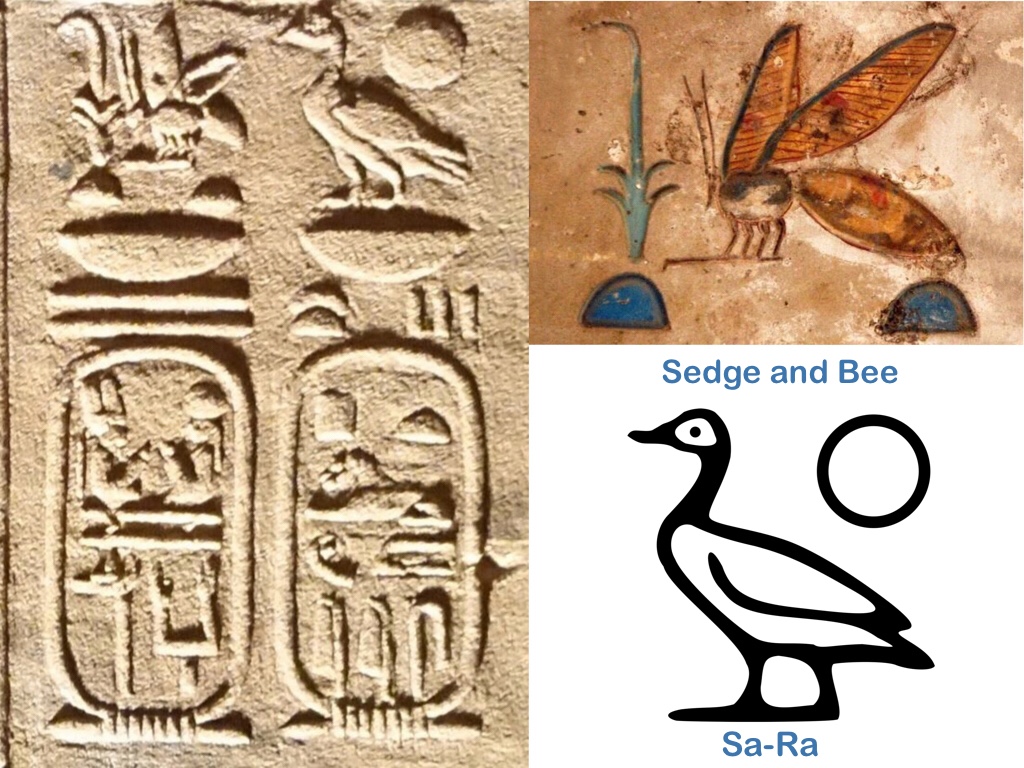
The ruler of Egypt was called the “S/He of the Sedge and Bee” – The sedge was the symbol for Lower Egypt, while the bee stood for Upper Egypt.
Honey experts and beekeepers I’ve met say that honey can last forever, well at least 3,000 years –– the world’s oldest sample, which is still perfectly fine for us to eat.
So there is no doubt that with news of honey health benefits as a natural immune system protector in your tea, and as a great energy source –– that we have learned to love and revere our honey, seeking out new flower blossom flavors, sources, stories and recipes we can share.
What’s clear is that we love honey. Agreed? Then it seems almost inconceivable, evil even, that the world’s honeybees are facing a massive breakdown, with hive die-offs left, right and center from Bee Colony Collapse Disorder. Everywhere we turn we face another disaster story –– and companies trying to profit from fixing it. Plenty of articles can be found online about how without the bees as major pollinators our food system would collapse.
But is this the whole story? That we’ve messed up our planet, and because of neonics and climate change and our voracious appetite, bees are kicking the bucket?
This summer I visited a couple of bee farms. One conventional, and one very much out of the ordinary – in a good way (jump to PieBird if you are from the BuzzFeed era and can’t read more than this). First, I took my kids to Board’s Honeybee Farm in Ontario where we learned about how they are working with local farmers to keep the fields and bees healthy. But the bees they are raising are not local. They are imports from Italy. And they need to be replenished regularly, especially after the winter.
They even had stickers advertising Flow Hives, those automatic honey collector hives, making it super easy for anyone to be a beekeeper. The Boards are good people who give to the community, and they make great honey and honey products, and we buy them all the time.
While I’d done their tour out of the old school bus before (always time to update my bee know-how), this time I was listening harder and asking more questions and learned something not talked about much: that the biggest “bee” pollinators on our planet are not the honeybees, but another group of bees entirely and they are called solitary bees. These are bees who do not build hives. Some 70% of them live in holes in the ground. Others find way to burrow into small protective spaces. A way to save them is by leaving parts of your lawns un-mowed, building nests for them, and by planting wildflowers that they love.
For instance, a single red mason bee solitary bee is equivalent to 120 worker honeybees in the pollination power it provides. This was news to me. And why isn’t this story getting out?
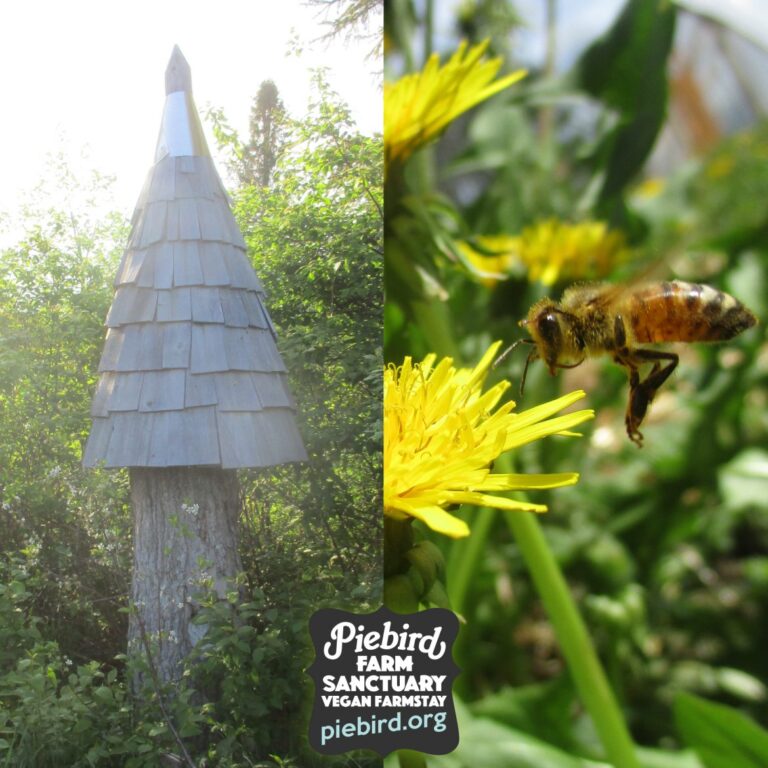
“Our love for honey has led to us wanting to save the thing we are exploiting,” are words I was told by my new and dear friend Yan, part of an extraordinary couple to Sherry Milford, both living in Nipissing, Ontario. There they run an animal sanctuary and vegan farmstay + bed and breakfast called PieBird, and among the goats they comb, and chickens and ducks they tend to (without eating their eggs), they run a honeybee sanctuary.
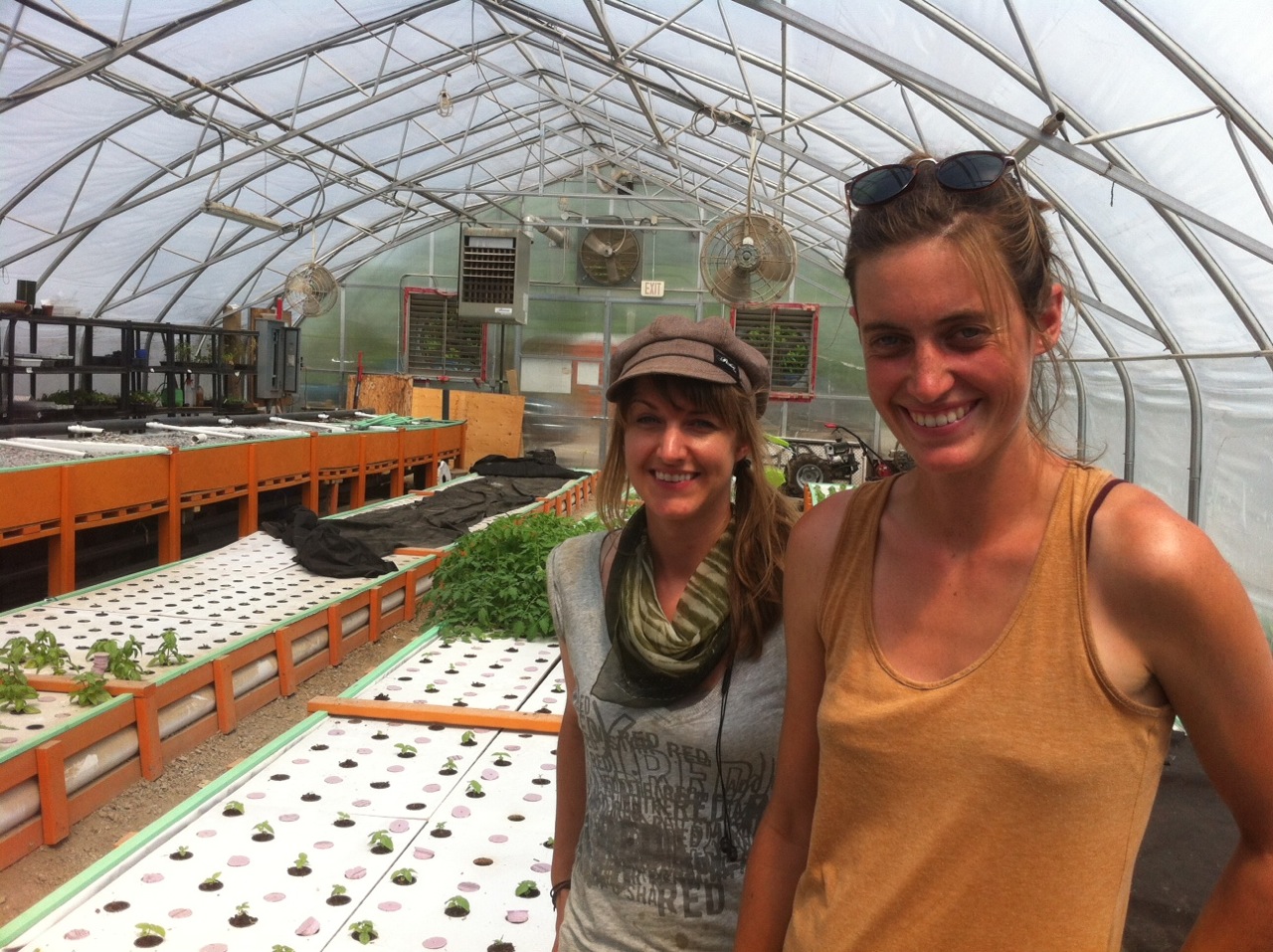
Yan builds greenhouses that you can buy. He flat packs and ships.
It’s a sanctuary for honeybees, where the bees are allowed to do their thing, where the queens can come and go as they like, and no-one but the baby bees are eating the honey. I’ve known for years that vegans don’t eat honey, an idea that sounded absurd until I talked with Yan.
“Humans can learn a lot from our bee friends,” he tells me. See him in the video below.
I urge you to support the honeybees by supporting people like Yan and Sherry at PieBird. They offer sanctuary to honeybees, but more importantly they are an essential voice for the bees. Together, they live a life of a legend, while operating their small paradise about 4 hours north of Toronto. Sherry and Yan walk the walk, and talk the talk.
A video that I love about them from a few years back:
https://www.youtube.com/watch?v=0p3ce16_mzU
WHAT CAN YOU DO TO SAVE HONEYBEES?
Sponsor a hive, of course, or some other animals via [email protected]. And if you can’t support their important mission with your cash, share this story and support some solitary bees. Over on GrowWild in the UK, you can learn how to create habitat for solitary bees, like the one pictured below. It’s a great project to start in cities and obviously for kids, while you teach them about the bees.
I am not suggesting that we all stop eating honey today to protect honeybees for tomorrow. I am not that radical, though I am inclined to become a vegan only until I remember how much I love cheese. But maybe as we eat it, on holidays or whenever, remember that when it comes to cheese, meat or eggs — there are animals who are serving us. And that most industries are not protecting the welfare of the animals they exploit. Find honey that’s been gathered and prepared with some ethics in mind, preferably not the big supermarket pasteurized honey. Not sure? Take our honey test here.
We’ve all heard about the crazy Middle East driver right? Or the drifters in Saudi Arabia that purposefully steer into crowds for thrills? Middle East driving is bad. And fatal, killing more people than the ongoing conflicts. New study suggests more can be done at work to keep drivers safe: The more one conflicts with their colleagues, the greater the risk that they will drive unsafely, according to the University of Haifa:
Drivers who develop negative relationships may suffer from various covert and overt reactions, communications obstacles, limited access to information, and a lack of social influence promoting safety. Accordingly, they will find it harder to model safe behaviors, the researchers explain.
Traffic accidents at work account for 14% of all injuries in road accidents in Israel, and 90 to 95% of these accidents are caused by human error. Numerous studies have been undertaken to examine wreckless behavior by drivers, focusing on demographic characteristics such as sex, age, personality, and psychological condition. In the current study, published in Accident Analysis and Prevention Journal, doctorate student Renana Arizon-Peretz and Prof. Gil Luria of the Department of Human Services at the University of Haifa sought to examine for the first time whether relations in the workplace influence driving.
The study included 83 professional drivers and 30 assistant drivers who belong to four industrial organizations in Israel. The drivers’ average age was 39, with average seniority of 6½ years at work and seven years as drivers. Unsafe driving behaviors were measured using a special technological system called IVDR, which provides an objective measurement of the driver’s behavior by means of a computer and sensors installed in the vehicle.
The results of the study show that the more central the drivers’ position within the network of negative team relationships – in other words, the more they tend to engage in negative interactions with their peers – the greater their tendency to drive unsafely, by comparison to drivers located at the margins of these networks. Conversely, the more central the drivers’ position within the network of work friendships (the more friendships they have with their peers), the lower the tendency to drive unsafely.
Drifting in Saudi Arabia at 200km/hour. Solution? Get a decent job punks!
“In reality, individuals sometimes develop conflicted relationships with some work colleagues, and close friendships with others,” the researchers added. “In these instances, we found that the positive relationships compensate for the negative ones, thereby moderating the link to unsafe behavior.”
The researchers explain that much of the information about safety hazards is exchanged between peers during informal conversations over a coffee in the kitchenette, during a telephone conversation, or simply during chats in the corridor. “When you are close to someone, you’ll tell them about problems you encountered or heard about from other colleagues. In that way, you help them avoid or cope with the risks. Conversely, if you are in a conflict with someone, you might even deliberately choose not to share vital information with them, in order to make it harder for them to cope with a potential danger.”
“Managements of organizations should attach importance to drivers’ social abilities during staff recruitment. It is also important to diagnose the informal relationships in the team, address problematic relationships, and develop friendship networks between teams. Such actions can help reduce the rate of traffic accidents at work,” the researchers concluded.
For anyone who has been following my summer adventures –– this year I spent 6 weeks in the middle of the bush, on 200 acres –– you’ll also know how gnarly the bugs have been this winter. It’s been extra wet, then extra warm. When we had good days the doors and screens stayed shut. But on those bad days where we forget, and it got too hot, everyone in the house suffered – from the bugs!
The natural choice would be for me to go online, if I can connect to the Internet in the bush (not always possible!), and concoct some natural formula myself. With no time for experimentation or risk, thankfully EcoRaider contacted me this summer wanting to help me with my plight.
The company based in the US carries a natural bug spray against bed bugs, and it’s for that which the company may be better known. My step-son in Brooklyn has faced the annoying effects of bed bugs, once when he was away and had a border staying at his house. It’s not fun decontaminating your house with toxins you later need to live with.
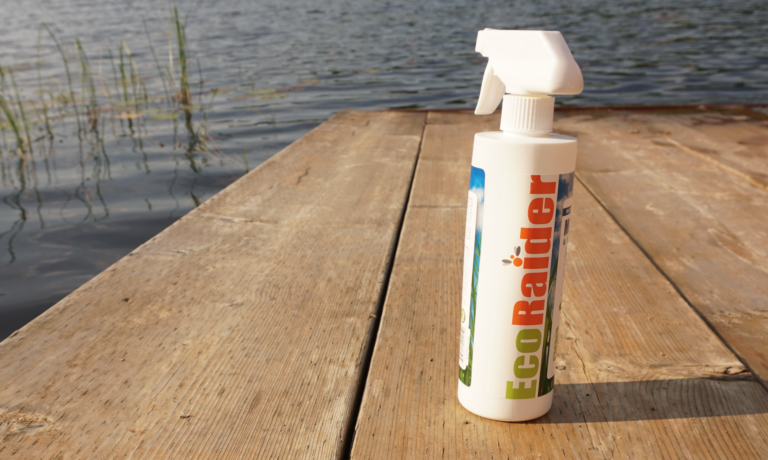
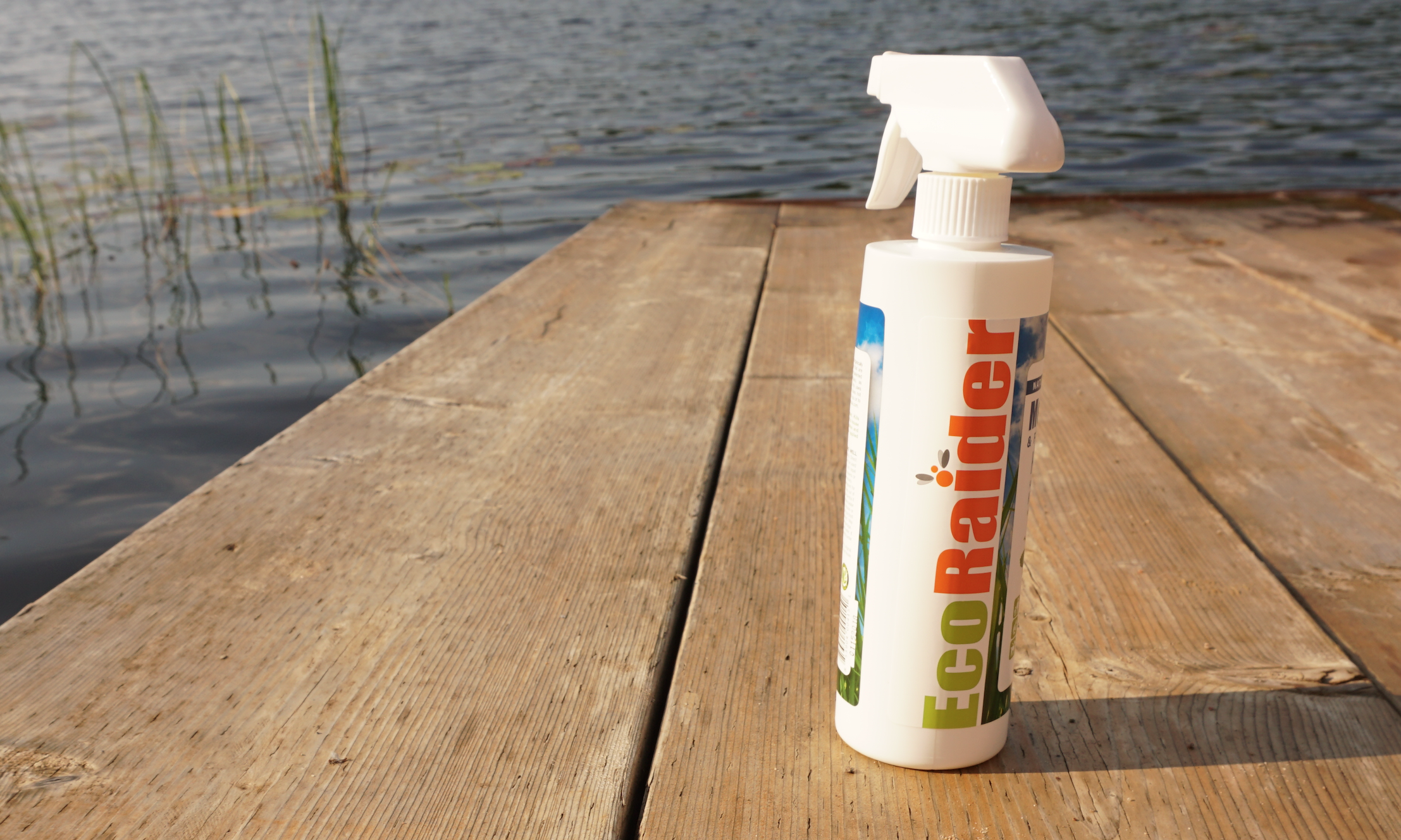
But for me Ecoraider was to be used as a mosquito repellent. Made from natural materials such as citronella, I sprayed it around the door frames of the bedrooms of our old cabin. So many of the windows have broken or torn screens, or wide spaces below the doors. It’s virtually impossible to keep the bugs away. It’s challenging for me because I have two little kids and their sweet tasting blood is a first for when the bugs come to town.
Because the summer in the north this year was humid and hot, I couldn’t keep the windows closed at night. In need of repairs, our window screens suffered –– and so did we –– from the bugs getting in. So I sprayed the Ecoraider all over them too. It compensated for where we lacked.
It seemed to work well just before bed, creating what I call an aura of protection in the upper rooms, when we needed it for sleep. I can’t keep kids sleeping comfortably under a mosquito net because they toss and turn too much, so the Ecoraider was a good option when I didn’t want to put materials on their body (the kids usually say no anyhow, no matter how natural) and for when I don’t want to burn candles. The house is an old wooden homestead so the fewer flames I need to light in the middle of nowhere, the better.
I also took the product to my friend Cathy’s lodge. She has a 10,000 square foot lodge, very open concept with doors and windows open all day. There was no way to protect any room from the rapid bugs this summer… so again, at night before bed, before the bugs could “fly” the stairs and find us, I sprayed an aura of the bug spray at the top of the stairs, on the floor by the top of the stairs, and all around the frames of the bedroom doors.
The kids still had some bug bites on their cheeks in the morning, but I believe the spray helped us in those crucial first hours while falling asleep. It’s like Chinese water torture, anyone knows – if you are trying to sleep with a mosquito buzzing around your head. Apparently you can spray the stuff on mosquito breeding grounds as well. For us, this summer the whole forest was bug territory, but inside the spray saved the day.
Flying Spark, a new insect-protein producer, will join the first “IKEA Bootcamp” startup accelerator. The launch of this unique boot camp generated more than 1,200 applications from 86 different countries, but just 10 start-ups will join the IKEA product development center in Sweden next week.
Flying Spark is a new food-tech company focused on all-natural protein extracted from the Mediterranean fruit fly for human consumption. This safe, sustainable ingredient is high in protein, calcium, iron and potassium and, unlike meat, it is odorless and virtually cholesterol-free.
“We are excited to join the IKEA accelerator and to have the opportunity to learn how to work with a giant retailer like IKEA,” says Eran Gronich, co-founder & CEO of Flying Spark. “This will completely enhance our product development and how we progress. IKEA will mentor and work with our team toward eventually collaboration between the companies to develop a product and hopefully to launch it at IKEA’s restaurants.”
In just one more generation, the world population will surpass 9 billion, with about half suffering from inadequate nutrition. One of the primary reasons IKEA chose Flying Spark is because of the mission of co-founders Eran Gronich and Yoram Yerushalmi: to create a high-quality protein ingredient packed with essential minerals, raised and harvested according to sustainable principles. Fruit fly farming requires minimal water and almost no land. The flies harvest themselves with no human intervention, which allows for clean farming. “This constitutes a forward-thinking and innovative way to help the world redress hunger and malnutrition,” states Gronich.
The idea behind IKEA’s collaborative boot camp effort is what the company calls, “Co-creating a better, everyday life.” The mission is to encourage start-ups that are working to solve some of the world’s most pressing problems. IKEA owns and operates 389 stores in 48 countries. Its income from foods last year was an estimated €2 billion.
From a small base of product launches tracked, the use (by CAGR) of edible insects grew more than 58% from 2011 to 2015, according to global research group Innova Market Insights. Overall, most products are in the cereal/energy bars category (32%) but 12% are in meat-substitute products. Cricket is the most commonly used insect, found in 56% of products tracked, typically in whole form or as a flour. 54% of products tracked feature the claim “high/source of protein.”
“Millennials want to create a more sustainable world, to make it a better place for all of us, and they are willing to add insect flour to their food to help achieve this goal, notes Gronich.”
The high demand for sustainable protein, combined with innovative technology, has driven strong support for Flying Spark. The company has raised $1 million with the help of the Israel Innovation Authority and The Kitchen, a food-tech incubator sponsored by the Strauss Group (one of the largest food conglomerates in Israel). Over the last 12 months, Flying SpArk has made significant inroads toward building the infrastructure and technologies integral to developing its products.
The oldest evidence of food storage rituals has been found by researchers from the University of Haifa and the German Archaeological Institute in Berlin during excavations at the prehistoric site of Tel Tsaf, in Israel. An unusual pottery vessel illuminates how people climbed social statuses fast.
The vessel, which is over 7,000 years old, reveals for the first time the ritual and political significance of large scale food storage in the Ancient Near East.
Tel Tsaf provides first hand evidence of the early connection between food storage on a large scale and the observance of a ritual associated with the successful storage and preservation of agricultural yields,” explains Prof. Danny Rosenberg of the Zinman Institute of Archaeology at the University of Haifa, who heads the research project at Tel Tsaf together with Dr. Florian Klimscha from the German Archaeological Institute in Berlin.
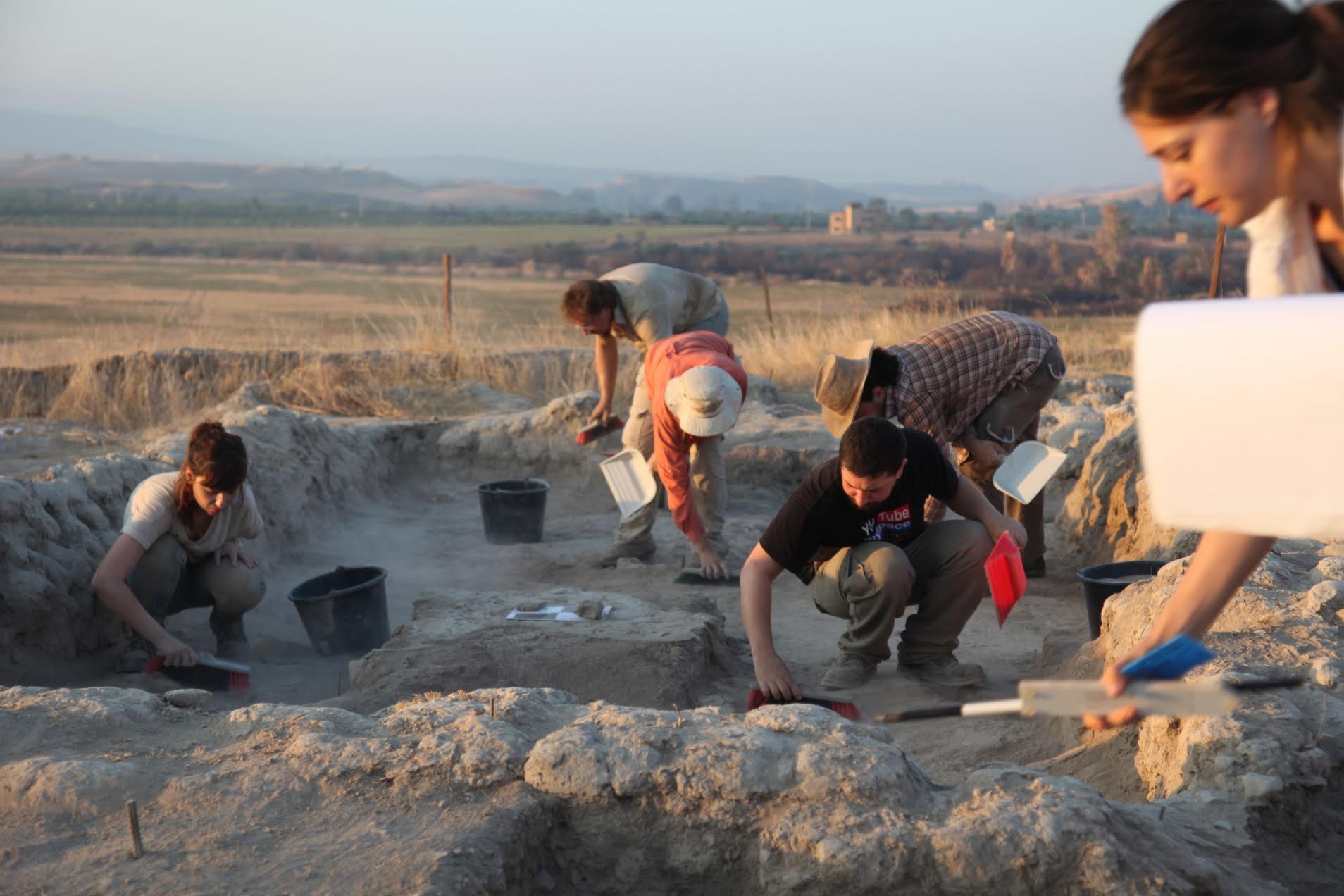
Tel Tsaf archeological site is located in the Jordan Valley, at the Jordan River and Israel’s border with the Kingdom of Jordan. The site was first documented in the late 1940s and has been excavated since the late 1970s, and later in 2004-2007. Since 2013, Rosenberg and Klimscha lead a multidisciplinary project at the site, one that focuses on the site’s economy and its ancient environment, with the assistance of an international team of experts and the use of advanced scientific methods.
Of the unique findings at Tel Tsaf, notable are the numerous silos used for large-scale grain storage, found in the courtyards of the buildings. The silos are evidence of the storage of food on a scale not previously documented at sites from this period. “The wish and ability to store food certainly constitutes an important step in the transition of humans to societies characterized by more complex social organization. It also seems that Tel Tsaf’s location near a major water source such as the Jordan River is no coincidence, considering the site’s potential to accumulate such a large amount of crops,” the researchers noted.
“The significance of storage for development of complex societies is evident by later testimonies from our own region, but even more so from Mesopotamia and Egypt, where complex, pre-state and state level societies emerged and engaged in the intensive storage of food, as an essential condition for the development of a social hierarchy. However, with the exception of Tel Tsaf, we have not yet found evidence of mass food storage in the region from 7,500 – 6,500 years ago in our region.”
Prof. Rosenberg explains that there has been a debate among researchers for many years concerning the early emergence of societies characterized by social and economic elites – a phenomenon that is frequently associated in our region with the Bronze Age. However, no evidence has previously been found showing that large-scale food storage in earlier societies was accompanied by social or ritual acts intended to ensure the successful storage and distribution of produce.
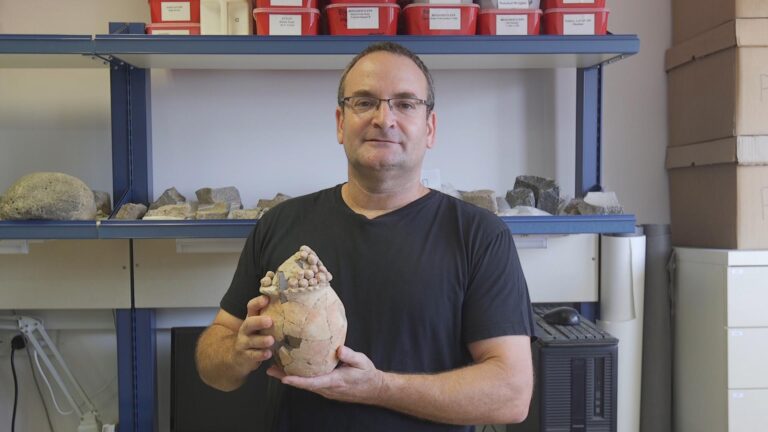
During the excavation season at Tel Tsaf two years ago, researchers found numerous pottery shards in a room situated in the center of a cluster of silos and cooking installations. The fragments appeared to belong to a single vessel. After painstaking work, they managed to reassemble the fragments, and were surprised to find a unique miniature vessel with a height of around 20 centimeters and a small window-like aperture on its side. “All the pottery vessels we are familiar with from this period have an opening on the top, facing up, just like most pots and cups in any modern kitchen. But this vessel is dome shaped, closed on the top, and covered with red-painted clay balls, whose significance is unclear to us,” Prof. Rosenberg notes.
The researchers believe that the vessel is actually a model of the silos themselves: “This vessel is not “functional” and was found in a building that was used for intensive storage, on the floor, in a room surrounded by numerous silos similar to those we are familiar with from archeological and ethnographic records from various parts of the world. We can hypothesize that this vessel was associated in some way with the silos, and particularly with the act of storage. From later evidence, we know that humans created vessels symbolizing larger storage structures, and indeed pottery vessels similar to this one, though larger, appear a few centuries later in our own region, used for secondary burial.
The size and characteristics of this vessel, together with the archeological context in which it was found, reinforce our assumption that this vessel symbolized the silos and was probably used in a ritual setting, perhaps as part of the ceremonies that preceded the placement of grains of wheat and barley in the silos, or their removal from storage,” the researcher explained.
The connection between the growth of food storage capacity and the human cycle of life and death is well known to researchers from various sources, including later findings from the Ancient Near East. “Tel Tsaf offers a glimpse into a unique time capsule, with excellent preservation of organic remains and other archaeological findings that reflect a thriving community practicing long-distance trade. Putting together all these findings, the picture reveals an increasingly strong connection between ritual and intense food storage and consumption.
We believe that the economic prosperity reflected by the astonishing findings from Tel Tsaf was accompanied by notable changes in the way the community of Tel Tsaf organized itself, and by rituals and ceremonies that were practiced in order to ensure that this prosperity will last. The model silo found in Tel Tsaf would seem to be one of the best examples of the connection between the wish to store large amounts of agricultural crops in order to gain social and economic advantage and rituals aimed to sustain and ensure economic prosperity” Rosenberg and Klimscha concluded.
Fermenting is all the rage, from lemons, to bread to pickles. It’s good for gut health, the immune system and your soul. A new study from Asia finds that compounds in a fermented fish paste used as a condiment in Indonesia efficiently inhibit an enzyme involved in cholesterol synthesis, which can help reduce bad cholesterol.
It might sound and smell disgusting to a western palate, but researchers from Sriwijaya University in Indonesia tested the effects of various peptides filtered out of bekasam, a fermented fish paste used in Indonesian cooking, on the enzyme HMG-CoA reductase. They found two peptides inhibited the enzyme.
HMG-CoA reductase catalyzes the conversion of HMG-CoA to mevalonic acid, a necessary step in cholesterol synthesis in the body. Previous studies have reported that some fermented fish products can block this enzyme’s activity.
The team prepared bekasam from carp fish that was gutted, washed and soaked in a culture of the bacterium Lactobacillus acidophilus for 30 minutes. The fish were then removed from the culture, mixed with salt and rice, and fermented for seven days. An extract was derived from the resulting bekasam by mixing it with distilled water, centrifuging it, and then filtering it through a tiny membrane. The filtrates were separated according to their molecular size.
A bioactive compound known as lovastatin, found in high concentrations in the extract, successfully inhibited HMG-CoA reductase in an experiment designed to test the enzyme’s activity. Another peptide with a larger molecular weight was also found to inhibit HMG-CoA reductase with high efficiency.
During the fermentation process, bacteria help break down proteins into peptides and amino acids. “The use of Lactobacillus acidophilus as a starter culture in the fermentation of bekasam increases the bioactive compounds of HMG-CoA reductase inhibitors,” write the researchers in their study.
The team next plans to develop a cholesterol-lowering supplement from bekasam, says Rinto of Sriwijaya University’s fisheries technology program, who co-authored the study.
Raven Littleone is my new best friend. To some I call her my half-guru (her partner Peter being the other half), or my mentor. She and Peter Steel, also known as Grampa Gnome, live in the middle of the forest, off the grid using solar power, and wood, and somewhere in a remote part of Ontario, Canada in a region called Nipissing. Up until now, this sounds a bit like a nuts story. But Raven and Peter are living a perfectly balanced and normal life in rural Ontario, with 2 dogs and 2 cats, where they steward the land and precious water around them.
While they don’t have a lot of company, if you come to visit, it is likely Raven will offer you one of her cookies and a big glass of spring water, they call Living Water. Peter will cover you in glitter. You can’t escape it. There is something so regular and good about Raven’s cookies, and don’t think for a second that Raven is like a grandmother or anything like that baking you cookies to make you feel cosy.
Yes she’s a nurturer, but she’s our contemporary. One of us. We are ageless. But we like to eat well, and with her cookies you get a nice snack or breakfast if you are on the run in the city, and even if you are in the middle of the forest or desert meditating. Forget about Soylent. Eat real food cooked by loving hands, your own or by someone who loves you.
After baking her cookies for the first time, and then taking a bite, I felt my spine align. Good things were happening in my body, and I listened to them. Can you prove it scientifically that Raven’s cookies are the bomb? Who cares. Read the ingredients below and make your own call.
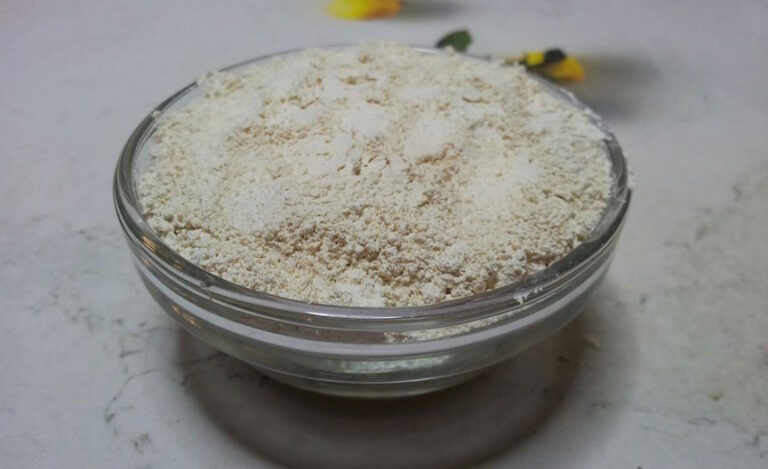
Raven forages for mushrooms and greens and whatever her forest offers. That’s part of what makes replicating her magical cookie recipe so difficult. But even without her concoction of wild greens and mushroom flour, I still managed to make a pretty delectable cookie.
This is going to be a recipe I take with me to old age, tfu tfu tfu as we say in the Middle East. This is one that I have already printed out and stuck into a place for keeping things worth keeping. Normally I experiment when I bake, and the results aren’t always palatable. This week when I told my husband B that I had made Raven’s cookies he asked me if they tasted like falafel, because indeed the last batch of cookies I made (for a local mini-Burning Man a couple of weeks ago) tasted like falafel. I’d tried to use as little sugar as possible, by using a bit of silan, which turned out to be 50% sugar anyway, and they came out sort of bleh.
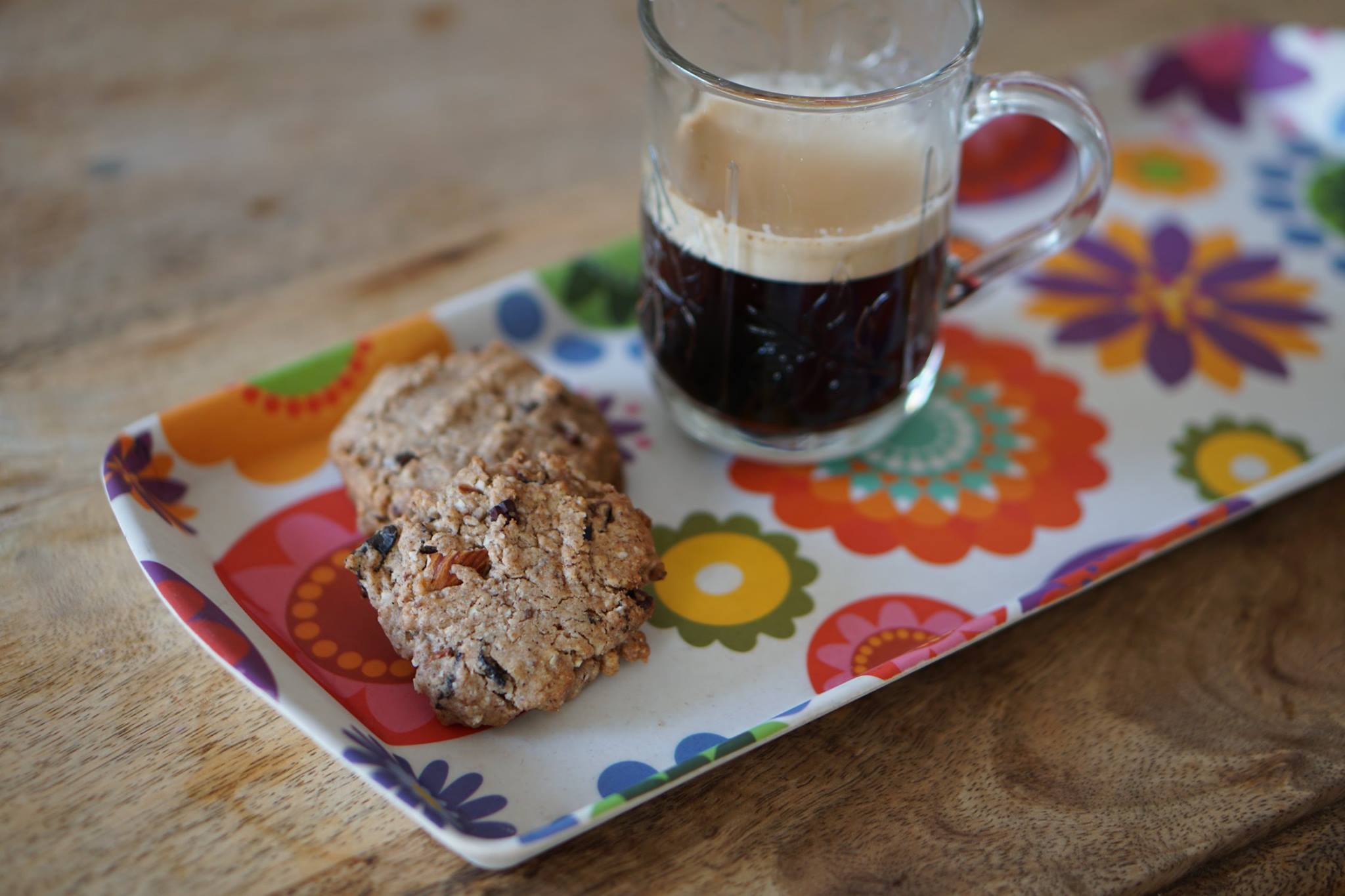
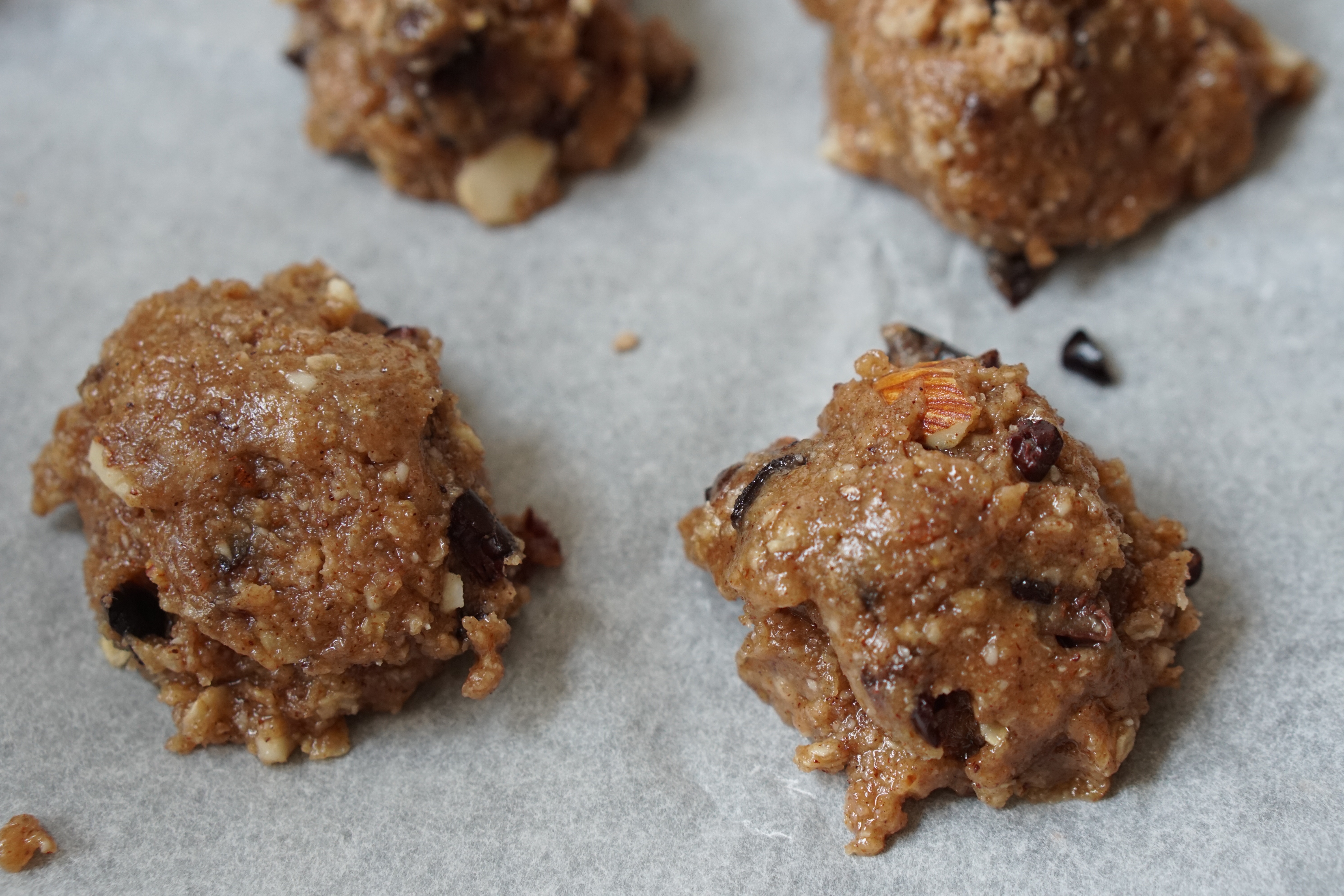
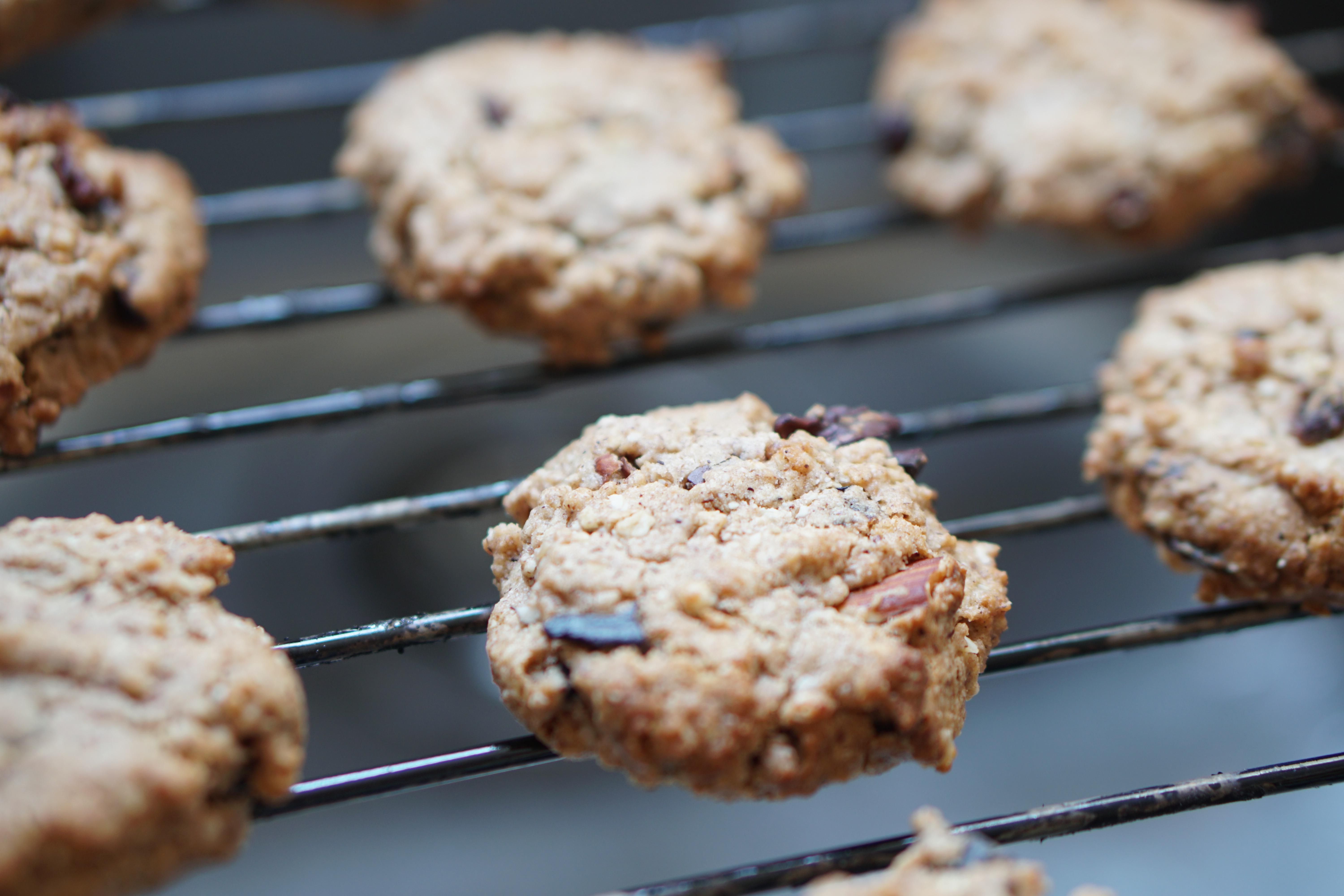
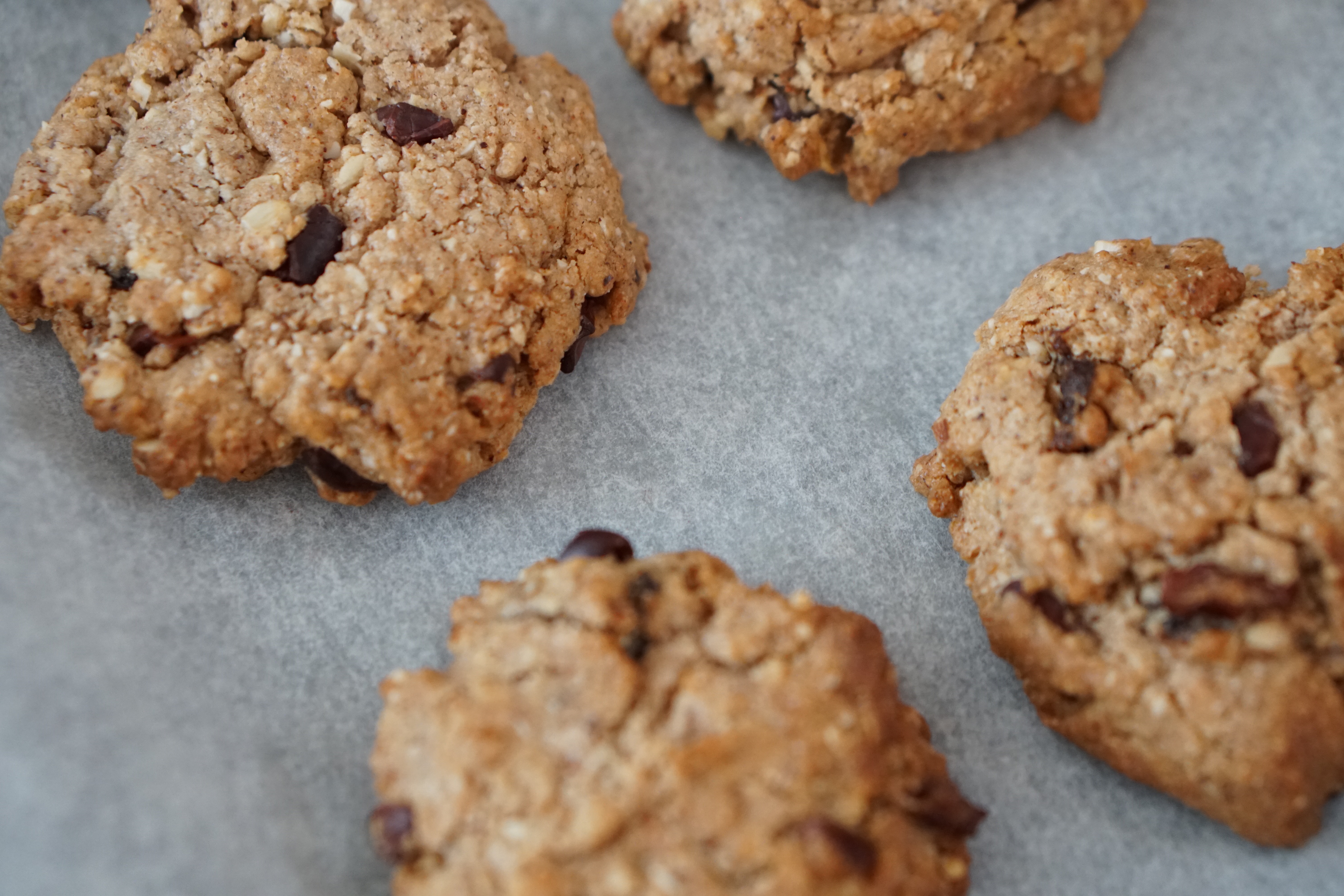
But Raven’s cookies taste buttery, crunchy, and with the cacao nibs, and toasted bits of almonds poking out, as sensually satisfying as a cookie can taste. Let’s do this. Bake with me. This recipe is for 15 cookies. Raven says she usually doubles it, as I did, and it makes about 26 to 30 depending on how you scoop it.
INGREDIENTS FOR RAVEN’S COOKIES – makes 15 cookies
(double this recipe to get 30 or so cookies)
1 cup almonds
1 cup oats or buckwheat
1 cup spelt flour
2 tbsp green powder (in-season dried plants like nettle & mix together to make green powder + dry wild mushrooms & powder.) *recipe turns out fine without this
1 tsp cinnamon
½ tsp sea salt or kelp
1 tsp liquid vanilla
½ cup maple syrup
½ cup almond oil or sunflower oil
¼ cup of cacao nibs
¼ cup of dried fruit (dates, prunes, tiny raisins, sundried tomatoes, currants…)
METHOD
Chop almonds + grind oats into flour using a mixer, blender, or processor (I use a Vitamix), but Raven uses a hand grinder.
In large bowl add spelt flour, almond/oat mixture and the rest of the dry ingredients.
Quickly add the wet ingredients. Raven suggests losing less maple syrup (like 1/3 of a cup) and then add more if you need more wetness.
Mix together.
Add cacao nibs, and chop up dried fruit into sizes that match your nibs. Stir into mixture.
Scoop 2 tbsp of cookie dough onto oiled cookie sheet. Or use parchment paper. Raven says you can drop jam into the center of the cookie.
Cook at 350 degrees (about 175C) for 12 to 15 minutes. About halfway through the baking process, open the oven and flatten the cookies with the back of a wooden spatula to get some of the air out of them. When toasted to your liking, take them out and let them sit on the counter on the cookie sheet without touching. No touching or they will break apart. These cookies aren’t glued together with eggs or a lot of gluten so hang on a bit so they settle. When cooler to the touch transfer your cookies to a rack to cool completely. Once cool put ‘em in a jar. They won’t last long.
Raven serves them with a large spoon of homemade ghee (see ghee below). Can I say, pure heaven?
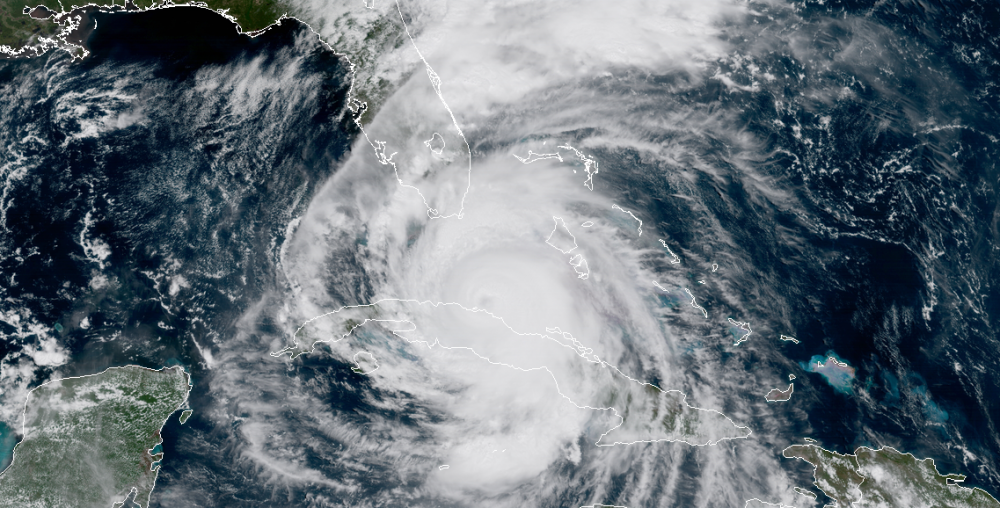
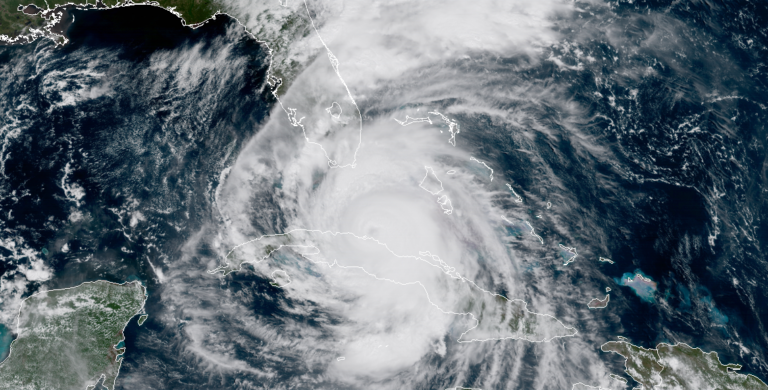
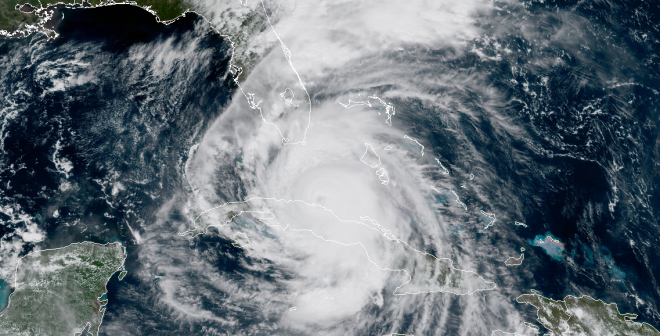
The full effects of Hurricane Irma have still to be realized; as this monster storm has already left a trail of unprecidented devistation in the Caribbean with small island communities being almost totally damaged. Huge “super typhoons” in the Pacific ocean basin have recently caused similar mayhem in the Philippines, Taiwan, coastal China and Japan. With all of this in mind, and particularly following Hurricane Harvey, which caused massive damage and flooding in coastal Texas areas, are these storms being fueled by global warming?
The answer appears to focus on the fact that the waters of both the Atlantic and Pacific ocean basins are simply warming up. This increase in sea water temperatures is causing Arctic ice to melt even more rapidly than previously thought; and as a result, is literally rocking world weather.
Concerns about the effects of global warming on world weather patterns are not anything new. Numerous scientific articles as well as “doomsday prophecy” movies about this subject have been around for some time now. One good example of a futuristic world ravaged by global warming was an American television film entitled The Fire Next Time, first screened in April, 1993.
The two part TV movie portrayed an American landscape in the year 2017 plagued by ozone depletion and global warming.
What brings this message home is that we are now in the year 2017, with much of what was prophesied in 1993 now becoming reality.
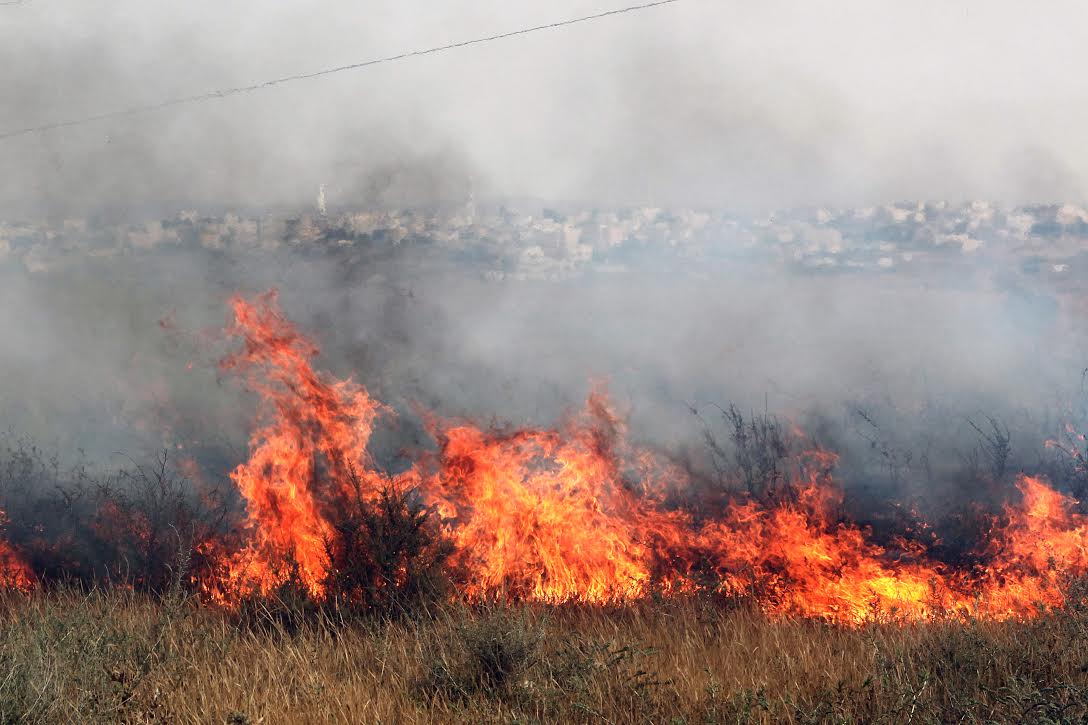
Already, four hurricanes: Harvey, Irma, Katia and Jose have now been formed in the Atlantic Basin in the past month alone, with three of them now active. Jose, a Category 3 storm, is coming close on the heels of Irma, with its final path and destruction still to be determined. A massive brush wildfire is still burning in California’s Los Angeles area, with a state of emergency being declared for 3 LA area counties.
On top of all this, large areas of the American west and southwest are still under critical drought conditions. Taking all of this into mind, is the current state of global warming and climate change that much different than that predicted back in 1993?
Or maybe our new knowledge and fear of these events are due to social media?
Other parts of the world, including Spain, Portugal, and many locations in the Mediterranean basin are now experiencing severe drought conditions with much of the Middle East suffering the “worst drought in 900 years”, according to NASA .
The Fire Next Time? It really appears to be happening now.