Health insurance is a regulated financial product. Insurers operate under binding contracts, overseen by state insurance commissioners, that legally obligate them to pay claims meeting policy terms. Policyholders who believe a covered claim was wrongfully denied have legal recourse through state regulatory channels.
The New Zealand Merino Company, now rebranded as Zentera, has quietly removed the phrase “world’s leading ethical wool brand” from its website, a notable change that comes after a disturbing investigation by PETA Asia-Pacific into the company’s ZQ-certified wool supply chain, PETA reports to Green Prophet.
Somehow vegetables with short seasons excite the imagination and appetite more sharply than produce that’s available all year around. Good Middle Eastern cooks have many recipes for delicate fava beans, and this turmeric-fragrant soup is one.
Health insurance is a regulated financial product. Insurers operate under binding contracts, overseen by state insurance commissioners, that legally obligate them to pay claims meeting policy terms. Policyholders who believe a covered claim was wrongfully denied have legal recourse through state regulatory channels.
The New Zealand Merino Company, now rebranded as Zentera, has quietly removed the phrase “world’s leading ethical wool brand” from its website, a notable change that comes after a disturbing investigation by PETA Asia-Pacific into the company’s ZQ-certified wool supply chain, PETA reports to Green Prophet.
Somehow vegetables with short seasons excite the imagination and appetite more sharply than produce that’s available all year around. Good Middle Eastern cooks have many recipes for delicate fava beans, and this turmeric-fragrant soup is one.
Health insurance is a regulated financial product. Insurers operate under binding contracts, overseen by state insurance commissioners, that legally obligate them to pay claims meeting policy terms. Policyholders who believe a covered claim was wrongfully denied have legal recourse through state regulatory channels.
The New Zealand Merino Company, now rebranded as Zentera, has quietly removed the phrase “world’s leading ethical wool brand” from its website, a notable change that comes after a disturbing investigation by PETA Asia-Pacific into the company’s ZQ-certified wool supply chain, PETA reports to Green Prophet.
Somehow vegetables with short seasons excite the imagination and appetite more sharply than produce that’s available all year around. Good Middle Eastern cooks have many recipes for delicate fava beans, and this turmeric-fragrant soup is one.
Health insurance is a regulated financial product. Insurers operate under binding contracts, overseen by state insurance commissioners, that legally obligate them to pay claims meeting policy terms. Policyholders who believe a covered claim was wrongfully denied have legal recourse through state regulatory channels.
The New Zealand Merino Company, now rebranded as Zentera, has quietly removed the phrase “world’s leading ethical wool brand” from its website, a notable change that comes after a disturbing investigation by PETA Asia-Pacific into the company’s ZQ-certified wool supply chain, PETA reports to Green Prophet.
Somehow vegetables with short seasons excite the imagination and appetite more sharply than produce that’s available all year around. Good Middle Eastern cooks have many recipes for delicate fava beans, and this turmeric-fragrant soup is one.
Health insurance is a regulated financial product. Insurers operate under binding contracts, overseen by state insurance commissioners, that legally obligate them to pay claims meeting policy terms. Policyholders who believe a covered claim was wrongfully denied have legal recourse through state regulatory channels.
The New Zealand Merino Company, now rebranded as Zentera, has quietly removed the phrase “world’s leading ethical wool brand” from its website, a notable change that comes after a disturbing investigation by PETA Asia-Pacific into the company’s ZQ-certified wool supply chain, PETA reports to Green Prophet.
Somehow vegetables with short seasons excite the imagination and appetite more sharply than produce that’s available all year around. Good Middle Eastern cooks have many recipes for delicate fava beans, and this turmeric-fragrant soup is one.
Health insurance is a regulated financial product. Insurers operate under binding contracts, overseen by state insurance commissioners, that legally obligate them to pay claims meeting policy terms. Policyholders who believe a covered claim was wrongfully denied have legal recourse through state regulatory channels.
The New Zealand Merino Company, now rebranded as Zentera, has quietly removed the phrase “world’s leading ethical wool brand” from its website, a notable change that comes after a disturbing investigation by PETA Asia-Pacific into the company’s ZQ-certified wool supply chain, PETA reports to Green Prophet.
Somehow vegetables with short seasons excite the imagination and appetite more sharply than produce that’s available all year around. Good Middle Eastern cooks have many recipes for delicate fava beans, and this turmeric-fragrant soup is one.
Health insurance is a regulated financial product. Insurers operate under binding contracts, overseen by state insurance commissioners, that legally obligate them to pay claims meeting policy terms. Policyholders who believe a covered claim was wrongfully denied have legal recourse through state regulatory channels.
The New Zealand Merino Company, now rebranded as Zentera, has quietly removed the phrase “world’s leading ethical wool brand” from its website, a notable change that comes after a disturbing investigation by PETA Asia-Pacific into the company’s ZQ-certified wool supply chain, PETA reports to Green Prophet.
Somehow vegetables with short seasons excite the imagination and appetite more sharply than produce that’s available all year around. Good Middle Eastern cooks have many recipes for delicate fava beans, and this turmeric-fragrant soup is one.
Health insurance is a regulated financial product. Insurers operate under binding contracts, overseen by state insurance commissioners, that legally obligate them to pay claims meeting policy terms. Policyholders who believe a covered claim was wrongfully denied have legal recourse through state regulatory channels.
The New Zealand Merino Company, now rebranded as Zentera, has quietly removed the phrase “world’s leading ethical wool brand” from its website, a notable change that comes after a disturbing investigation by PETA Asia-Pacific into the company’s ZQ-certified wool supply chain, PETA reports to Green Prophet.
Somehow vegetables with short seasons excite the imagination and appetite more sharply than produce that’s available all year around. Good Middle Eastern cooks have many recipes for delicate fava beans, and this turmeric-fragrant soup is one.
Algae as superfood? Countries like Japan have already known for years about the possibilities of using algae as a nutritious food product, as any sushi fancier will attest to. Growing algae to feed the world’s hungry may soon become a viable reality as some forms of algae likespirulina, actually a form of cyanobacteriaand up to now much more expensive to produce as a food source.
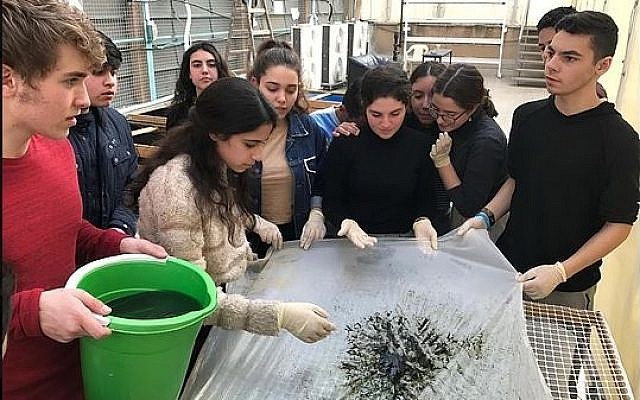
This cost factor may now be reduced significantly due to a project being conducted by high school students at Israel’s Gymnasia Herzliya in Tel Aviv. The school program actually began back in 2013 when the high school students began experimenting with growing the algae in plastic bottles in what they referred to as the Algeed Superfood Project.
Spirulina has been found to contain as much as 70% protein and as such can be a tremendous help to feeding countries such as those in Africa whose large populations suffer from high levels of malnutrition. Since its original inception, the Tel Aviv high school project has expanded to actual involvement with African countries like Rwanda and the Democratic Republic of the Congo.
“The idea is to find a low cost nutrition solution to feed the world’s hungry,” says Ben Berger, the project head. Congolese Agricultural representatives recently visited the high school, whose students took on the project six years ago to find a way to reduce significantly the cost of producing the highly nutritious algae at a lower cost than had been done up to now when spirulina was mostly sold in health foods stores at a much higher cost. Spirulina in its natural state, usually looks like the photo below:
Dr. Zeev Degani, the school principal, is very happy that the project is taking place at his school which has expanded it to the point where some of the students have actually visited African locations to see the progress being made to produce the algae there. The Gymnasia Herzliya students have developed a way to grow the algae in plastic drink bottles, an item that is plentiful all over Africa and usually discarded in trash dumps. The program was aired recently on Israel’s Channel 13 news program.
Beginning originally on South Africa, the project is also being tried in Rwanda, Ethiopia, Kenya and the Democratic Republic of Congo, where more than 1.5 million children suffer from various forms of malnutrition. “Instead of being dependent on aid programs, which usually end after a period of time, why not focus on something that will enable countries to provide their own nutrition solutions?” said a representative of the Lwiro Research Center of Natural Sciences in the Dem. Republic of the Congo.
With the stunning Spanish sunshine and a rich culture to explore, Spain is a fantastic destination for a family holiday. Yet its theme parks can lift your holiday from good to great.
So, when you’re browsing for spacious villas in Spain that are large enough for the whole family, find the nearest family-friendly theme park to you with this list.
PortAventura, Mainland Spain
PortAventura is one of the most famous theme parks in Spain, bringing in approximately five million visitors a year. Within walking distance from Salou on the Spanish Mainland and only around an hour’s drive from Barcelona, PortAventura is a popular day out for the whole family. Nearly 300 acres in size, the huge park is split up into six themed areas. Enjoy the laid-back atmosphere in Mediterrania, where you can ride on a steam train, or set sail through the park to the Imperial China world.
In China, the atmosphere is more upbeat with iconic roller coasters such as the Dragon Khan with its 8 loops and speeds of up to 110 km/h. Scaling 76 metres tall, Shambhala is also here and is the tallest roller coaster in the whole of the park.
Next to PortAventura are two other great theme parks, Ferrari Land and PortAventura Caribe Aquatic Park. With water rapids, slides, an indoor splash pool and a large wave pool, the Aquatic Park is perfect for cooling off on sunny afternoons. Ferrari Land was inspired by the Italian car and offers not only rides and roller coasters but unique F1 racing experiences in their immersive 4D cinema.
Siam Park, Tenerife
With waterslides, rides and rapids, visit the popular Siam Park in the Costa Adeje resort in Tenerife. The park was voted last year as the best water park in Europe in TripAdvisor’s Traveler Choice Awards and it doesn’t disappoint. Its main attraction is the plummeting Tower of Power. With a knee-trembling 28m drop, the Tower of Power is not for the faint-hearted.
The whole family can experience the epic Vulcano – with four-person rafts taking you through dark tunnels. Or pair up and ride The Gigante as you navigate through the twists and turns backwards.
Unleash your competitive side and race down the Naga Racer slides or relax on the Lazy River and enjoy the Thai inspired setting. With a wave pool and slides suitable for all ages, the whole family can feel the excitement together.
Oasys MiniHollywood, Almeria
For a theme park with a twist, visit Oasys MiniHollywood. Set in the vast Tabernas desert, venture to Almeria in southeast Spain to discover this attraction. Enjoy an action-packed afternoon in the wild west on this classic movie set, which was the location for many spaghetti western films in the 60s and 70s. Visit the interactive prop museums, stroll around the cactus gardens and get involved in the western shows. With Can Can dance shows in the saloon, a themed pool area and a small zoo, there’s a lot to explore here.
Terra Mitcha, Benidorm
A theme park with a historical twist, take the family to Terra Mitcha in Benidorm to enjoy a world where five ancient civilisations meet. The park has five distinct areas: Egypt, Rome, Greece, Iberia and The Islands with themed roller coasters, rides and slides to discover. In ancient Greece, immerse yourself in the avant-garde world with a 5D cinema that’s set in an authentic Parthenon. Or, if you’re feeling brave, ride the Magnus Colossus roller coaster.
In Egypt, ride in a Pharaoh’s sarcophagus through the twists and turns before you plummet 20 metres in this epic water rapid ride. Enjoy the bubbling hot tubs and fountains in the Nile River and, for something downbeat, sail from the shores of Egypt to Iberia to take in the seafaring landscape.
A 5,000 year old brew is resurrected using yeast pulled from ancient Egyptian pottery. Researchers say: “Now know what Philistine and Egyptian beers tasted like.”
What kind of beer did Pharaoh drink?In ancient times, beer was an important ingredient in people’s daily diet. Great powers were attributed to beer in the ancient world, particularly for religious worship and healing properties.
Israeli researchers examined the colonies of yeast that formed and settled in ancient pottery from Egypt. Ultimately, they were able to use resurrect this yeast to create a high-quality beer approximately 5,000 years old.
Many cooks were invited into the scientific “beer kitchen” to isolate the yeast specimens from the ancient debris and to create a beer with it. First the scientists reached out to vintners at Kadma Winery. This winery still produces wine in clay vessels, proving that yeast may be safely removed from pottery, even if it had lain dormant in the sun for years.
The yeast was then photographed by Dr. Tziona Ben-Gedalya at the Judaea Region Research and Development Center. Following her initial examination, the team reached out to archaeologists Dr. Yitzhak Paz from the Israel Antiquities Authority (IAI), Professor Aren Maeir at Bar Ilan University and Professors Yuval Gadot and Oded Lipschits from Tel Aviv University.
These archaeologists gave them shards of pottery that had been used as beer and mead (honey wine) jugs back in ancient times—and miraculously, still had yeast specimens stuck inside. These jars date back to the reign of Egyptian Pharaoh Narmer (roughly 3000 BCE), to Aramean King Hazael (800 BCE) and to Prophet Nehemiah (400 BCE) who, according to the bible, governed Judea under Persian rule.
The researchers, with the help of HUJI student Tzemach Aouizerat, cleaned and sequenced the full genome of each yeast specimen and turned them over to Dr. Amir Szitenberg at the Dead Sea-Arava Science Center for analysis. Szitenberg found that these 5,000-year yeast cultures are similar to those used in traditional African brews, such as the Ethiopian honey wine tej, and to modern beer yeast.
Now it was time to recreate the ancient brew. Local Israeli beer expert Itai Gutman helped the scientists make the beer and the brew was sampled by Ariel University’s Dr. Elyashiv Drori, as well as by certified tasters from the International Beer Judge Certification Program (BJCP), under the direction of brewer and Biratenu owner Shmuel Nakai. The testers gave the beer a thumbs up, deeming it high-quality and safe for consumption.
Dr. Ronen Hazan, Hebrew University-Hadassah School of Dental Medicine: “The greatest wonder here is that the yeast colonies survived within the vessel for thousands of years—just waiting to be excavated and grown. This ancient yeast allowed us to create beer that lets us know what ancient Philistine and Egyptian beer tasted like. By the way, the beer isn’t bad.
“Aside from the gimmick of drinking beer from the time of King Pharaoh, this research is extremely important to the field of experimental archaeology—a field that seeks to reconstruct the past. Our research offers new tools to examine ancient methods, and enables us to taste the flavors of the past.”
Dr. Yitzchak Paz, Israel Antiquities Authority: “We are talking about a real breakthrough here. This is the first time we succeeded in producing ancient alcohol from ancient yeast. In other words, from the original substances from which alcohol was produced. This has never been done before.”
Prof. Yuval Gadot, Tel Aviv University’s Department of Archaeology and Ancient Near Eastern Cultures: “We dug at Ramat Rachel, the largest Persian site in the Judaean kingdom, and found a large concentration of jugs with the letters J, H, D – Yahud – written on them. In a royal site like Ramat Rachel it makes sense that alcohol would be consumed at the home of the Persian governor.”
Prof. Aren Maeir, Bar-Ilan University’s Department of Land of Israel Studies and Archaeology: “These findings paint a portrait that supports the biblical image of drunken Philistines.”
Israel’s recent Passover holiday period, which also included opening season visits to beaches and various picnic sites, is still being dealt with by national park and forestry employees long after holiday goers returned home. Whether it be national forests, rivers and beaches, or city public parks, the amount of trash and food waste left behind is staggering, to say the least.
Employees of the Israel Nature and Parks Authority , in charge of watching over forest lands and national parks, estimate that as of Sunday, April 28, more than 700 tons of trash is still “onsite” and not yet been picked up from locations where holiday goers visited during the 8-day holiday.
According to Channel 12 News reporter Guy Veron, literally tons of waste items of all types are still being picked up from these sites in an ongoing operation that is expected to take several days to complete. Environmentalists dealing with the problem of picnic trash left in these locations, including the country’s beach fronts, point out that much of the problem is simply a lack of education in environmental issues the country faces, along with a sheer disregard for protecting Israel’s fragile environment.
Although trash bins and dumpster containers are often available to put the trash in, many holiday goers simply do not use them; often leaving their trash on the ground or on beach areas where they spent their holiday time.
Spokesperson for the environmental organization Zalul say that litter by beachfront visitors is a constant problem; especially on weekends and holidays. As much of the beach litter includes throwaway plastic bags, bottles, straws and dishes, some of it gets washed out to sea, resulting in a danger to marine life.
“The Mediterranean Sea contains so much “micro-plastic” waste that literally all fish and other marine animals, including birds, have these waste particles inside their stomachs, resulting in eventual death for many of them,” a Zalul spokesperson once told me.
It is a shame that environmental awareness is not taught more in the schools. Parents pass their lack of environmental knowledge and concern on to their children, who continue their parent’s bad habits in respect of concern for the country’s natural resources. Protecting the environment should be considered an important school subject, since the country’s future depends on it.
In fact, the wolves have so much lost their fear of humans that they are often seen coming into Golan Heights towns and settlements to raid garbage bins in search of food. They are also something to be feared due to the risk of spreading rabies and other diseases as well as the danger of their snatching domestic animals and even small children from campsites as part of their food search.
Golan Heights wolves are larger than a smaller cousin Canis Lupis Arab, that lives in Israel’s southern desert region and stand around 26 inches (65 cm) high and weighing around 45 pounds (20.5 kg) fully grown. Golan wolves weigh around 70 pounds (32 kg) when fully grown. Despite being larger, Golan wolves are often found living happily in minefields that are still considered as unsafe for humans to enter into.
Although the wolves are a protected species, the Israeli government has been paying a bounty of NS 2,000 or $500 for each one that strays out of its protected “conflict” area. Farmers complain that they lose at least 200 cattle and sheep annually to these predators, whose light weight prevents them from exploding still lethal mines. Wolves are the largest predators in their Golan habitat; and normally prey on animals such as gazelles, wild pigs and small mammals like rabbits and hyrax (a small rodent-like animal that is actually related to elephants). But hoofed livestock are often on their dinner menus as well; especially when wild game is scarce.
Besides occasionally shooting them, other measures such as illegal poisoning are used to control the wolf population. Nature authority staff members are trying to find ways to keep the wolves under control without having to resort to killing them. Being highly intelligent and having lost much of their fear of man, their only real enemy, the conflict between man and wolf appears to be an ongoing problem, with a viable solution still to be found.
Read more on endangered wolves and other animal species:
Flux developed Eddy, a robot developed out of Israeli military tech. The idea is to feed the world, using hydroponics.
According to the United Nations, Food security is one of the primary human rights. We all cannot live without food and thus, agriculture is the most important sector in the world. A failing agricultural system results in hunger and famine with the possibility of death. This means that we have to strive to protect and develop this field if we want to survive.
Technology has become a key pillar in ensuring increased productivity and sustainable food security. With automation recently changing how we carry out agriculture, industrial robots have had a great impact on the field. Some of the impacts include:
1. Increased Productivity.
Robots by design, programmed to process commands and tasks way faster than the human mind can. This allows them to complete tasks that would take farmers and workers days, in a few hours if not minutes. This allows Food processing companies to process more products thus delivering adequate products to be available in the market.
When robots are utilized in the harvesting, planting or even milking of dairy animals, they are able to complete these tasks much faster compared to the human workers. This ensures more productivity on the farm and the factories.
2. Reduced employee Injuries.
Whether you are working at the factory, farm or even the ranch, accidental injuries are almost unavoidable due to some of the working conditions. However, automation has allowed for robots to be deployed in some of the risky and dangerous working areas thus freeing the workers to be retrained in other important tasks in the industry.
The introduction of Cobots has eliminated the risk of injuries caused by traditional robots and thus allowing workers to enjoy a safe and enjoyable working environment with some of the Cobots working as assistants during difficult tasks.
3. More room for Innovations and Ideas.
With the robots taking over some of the most mundane and repetitive tasks, the workers are relieved of these tasks and get the chance to learn and practice more demanding tasks in the industry. This environment allows them to come up with new ideas and innovations that will increase the industries’ efficiency and productivity.
The collaboration between these Industrial robots and farmers has allowed them to come up with modern ways of farming that have increased their total output and thus resulted in increased food production.
4. Consistency in Production.
Having been programmed to conduct tasks with the highest degree of accuracy, Industrial robots are able to deliver products of the same quality irrespective of the time they have been running. Unlike human workers whose quality of work depends on the state of their bodies, robots are able to work 24/7 without tiring while maintaining the same quality.
This allows the farmers to be consistent in the amount and quality of goods they produce and also allows the industries to meet deadlines set by the management and also satisfy the demand in the market during the busy seasons.
5. Reduced Production Costs.
Despite the industrial robots for sale being quite expensive, they have a very fast payback period. By working for 24 hours each day of the year, the robots are bound to pay back your money in less than three months and thus ensuring the farmers and industries gain profits.
The robots are also quite easy to maintain and thus do not require regular repair costs besides electrical charging. By reducing the time it takes workers to complete tasks and minimizing the number of waste materials from production, the industries are able to produce more products with less raw materials.
Conclusion.
The impact Industrial robots have had on the Food and Agriculture sector goes beyond the above stated. More jobs have been created; production time reduced, better services delivery established to customers among many other benefits. This implies that if more farmers and food processing industries adopt the Industrial robots, the problem of security will be a thing of the past!
Companies are always on the lookout for new ways to promote products and services. While a majority of marketing is happening online these days, traditional methods of marketing, including promo materials and branded gifts, are still an important part of any successful modern marketing plan. The downside of creating promo materials and branded gifts is that they, unfortunately, end up in the trash and create a lot of waste. For this reason, we’re sharing four sustainable ways to promote your business, and have also included some eco-friendly gift ideas that employees and clients would actually use and love.
Tote Bags
We all know the feeling: you’re standing in the checkout aisle when the cashier asks if you would like a plastic bag. Your heart drops at the question, knowing that you forgot your reusable bags at home again. Although it might not seem like a big deal at the time, doing your part by using recyclable bags makes a big difference. Over four trillion plastic bags are used worldwide annually and only one percent of plastic bags are returned for recycling, according to earthday.org. Gifting your clients and employees with branded tote bags to keep at their desks or in their cars will encourage them to ditch the single-use plastic bags for good.
Car Decals
While walking, biking and taking public transportation are by far the most sustainable methods of getting around, if driving a car or truck is an imperative part of running your business, be sure to make the most of it. Maximize your vehicle’s potential by using it as an effective advertising tool to help build brand eco-awareness. Create custom car decals that include your logo and contact information that will catch the attention of anyone that sees your vehicle on the street. Ultimately, having a car decal that successfully promotes your business could mean that you can eliminate other methods of marketing that may be more harmful to the environment, such as mailing out paper flyers.
As a side note – car decals can be useful if you damage your car’s paint and don’t care to lay out a lot of money on repairs. Decals, like the old Sticky Stains design project to cover stains with humorous illustrations can patch up the problem and make your ride a little more “you”. I did this one after getting side-swiped. A few hundred dollars in decals saved me a fortune in a paint job.
Reusable Metal Straw with Case
There’s a good reason why plastic straws have been the subject of public scrutiny in recent years. Approximately 80 percent of all litter in the world’s oceans is made up of plastic, the United Nations reports. Since plastic straws are frequently found in coastline cleanups and are one of the most common and typically unnecessary types of single-use plastics, swapping plastic straws for metal ones is a no-brainer. Promoting your business on a reusable metal straw and case shows that your company is eco-conscious and forward-thinking, as it’s clear that you’re participating in the global mission of creating a more sustainable future. The problem is that metal straws really haven’t taken off. No one carries them in their purse, or are we wrong? And are straws just aiming to put a bandaid on a bleeding wound? Let us know what you think.
Customized Stickers or Magnets
If you work in a coworking space or in an office building with multiple tenants, little gifts are always a much-appreciated token of goodwill when introducing yourself to your new neighbors. Custom stickers and magnets are affordable options for promoting your business. Custom stickers or magnets that contain your company logo and a list of best practices regarding recycling and composting is a practical way to promote your business. At the same time, it gently reminds others about the importance of sorting things before throwing them away.
Green office buildings improve the environment and employee health. For these reasons, more business owners like yourself are learning how to design a green office building. However, a lot of design details goes into the planning process of a successful building project. In order to decrease energy consumption and reap all of the benefits of a green office building, you must consider numerous factors. Fortunately, these factors can be easily implemented into your design. In this post, you will learn how to design a green office building for a better working environment.
Determine The Building’s Size And Shape
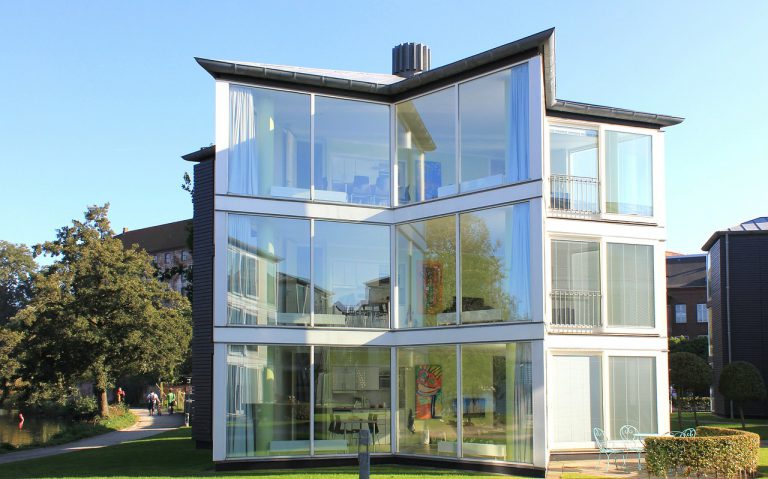
To begin learning how to design a green office building, you need to carefully consider the best sizes and shapes. Many business owners trying to build their own office buildings assume bigger is better. When it comes to green office buildings, this is not the case. Smaller is more efficient for your purposes. More complex shapes may also be more efficient. For example, Israel is home to the country’s first LEED platinum building, which has its own unique shape. Sketch, or have your architect sketch, various non-traditional building shapes that limit artificial usage. Once you have established the best size and shape for your building, you can move onto the next step in the designing process.
Introduce Green Materials
Continue the designing process by determining which materials are green and which are less efficient. Business owners who have successfully designed green office buildings use refurbished, recycled, and reclaimed materials. Some also use sustainable materials. At first glance, these products do not sound very safe to build with. However, the highest quality recycled, refurbished, reclaimed, and sustainable materials are reliable. Use environmentally friendly materials to design a green office building.
Rely On Natural Lighting
Another component to consider when learning how to design a green office building is natural light. The greenest office buildings rely on natural light and use little-to-no artificial light. To maximize natural lighting, include as many windows as you can in your office building. When the sun is shining, lights will be unnecessary. Put Ethernet-powered LED connected lighting in for employees working after dark. Such lighting can even be controlled from smartphones, which increases the chances of employees remembering to turn off the lights before leaving. Furthermore, you can automate facilities so that no electricity is wasted when there is nobody around. Using windows and automation, rely mostly on natural light to design a green office building successfully.
Limit Indoor Pollutants
The most efficient green office buildings limit indoor pollutants. In the middle east, there is more than enough air quality and pollution issues to handle outdoors. When designing for indoors, this is one factor that improves your employees’ health conditions. In non-green office buildings, employees breathe in low quality air that is filled with tons of harmful pollutants. To weaken pollutants that consume the air you and your employees breathe in, establish quality ventilation to filter the air. As a result, your employees’ cognitive performance will improve. Higher quality indoor air boosts employees’ decision-making skills, which enhances your company’s performance. Determine ways to lower indoor pollutants when designing a green office building.
Implement A Dual Plumbing System
Additionally, implement a dual plumbing system to design a green office building. Most office buildings overuse water daily. If every employee in a high occupancy building washes their hands on a daily basis, water usage skyrockets. To maximize water efficiency, use a dual plumbing system. This type of system recycles greywater for toilet use and, therefore, wastes less of the water you and your employees use. Even the largest office buildings can lower their water usage on a daily basis. Office buildings also use low-water use toilets and faucets to further enhance their water-saving processes. Utilize all of the above to design a water efficient green office building.
Whether you want to learn how to design a green office building for the well-being of the environment or your employees, you need to understand the best ways to design one. Firstly, create a smaller building design and consider non-traditional shapes that are more efficient. Opt for green materials such as refurbished and recycled products. Primarily rely on natural light and use Ethernet-powered LED connected lighting when artificial light is necessary. Develop a filtering system to reduce pollutants in the air. Finally, implement a dual plumbing system to make your building more water efficient. Now, you know how ot design a green office building.
When you start from scratch you can build your dreams fresh and not deal with the old toxic paint and plumbing from owners of the past.
In today’s market, home buyers have different options for buying a new home, like a reclaim or a resale. There are a number of possibilities from which they can choose what type of house do they need for them and their family.
Also, there are a number of benefits for the “new homeowners” that will let them save a great amount of money rather than buying an old house and then spending their money on renovation.
Home Warranties
In a newly built home the warranties are started from the closing date of the home. Usually, appliances have a 1-year warranty from builders and manufacturers of these appliances often extend warranties for their separate appliances included to it.
The thought of having a new home where everything is warranted for at least 20 years for appliances such as roofing or structural systems is definitely appealing for the most home buyers. If you have a warranty that covers your appliances, you are protected against defects in the home after purchase.
Customization
When you decide to buy a new home, you can always have the choice to customize your flooring, paint colors, appliances and other design elements and create a look for your home that depicts your eco-lifestyle.
Most home builders let the buyers take part in the process of designing their property, that will help them in creating a living space that is tailored to the taste of the home buyer.
Why energy efficient homes are more ecological
Newly built houses tend to use energy more efficiently in two ways, first of all, they have a tighter-sealed building envelope which lets you prevent your air conditioning i.e. cool in the summer, warm in the winter. This is a huge cost saving for the buyer who is buying a newly built home. But buying an older home might make more sense if you want land for the kids to play and avoid spending your free time looking for parks in the city when nature can be your babysitter and kids best friend.
Green appliances lower energy bills
The more mechanics of energy-efficient for the house also help lower the bills for new home buyers says an expert. Newly built houses often have green appliances and systems like refrigerators, air conditioning units, water heater, furnaces, efficiency stoves or washing machines that many old houses may not have in them.
Current homeowners can always get their property or buy higher-efficiency appliances, but in doing so requires a potentially important expense.
Green homes need fewer repairs
When buying a new house buyer will not have to spend much on repairs. There will be fewer repairs. While opting for a resale house there can be few things like appliances or carpets etc. to update the house that can incur a great amount of money to replace or repair.
Financing for sustainable homes
New house buyers are able to take the benefit of mortgage financing perks that may be available through their builder. New home buyers have their own preferences regarding lenders that may offer benefits such as closing costs or paying points and buy down certain prices for you. Re-sale home seller is basically not going to do it for the buyer.
You may also be drawn to the newly built home for some not so obvious reasons:
Building a Community Together: A fresh community is one of the benefits for the newly built homes. When families shift to a subclass at the same time, mostly long-lasting friendship bonds are formed immediately. No one is the new child on the block and most home builders organize parties for the blocks newly developed to help the owners meet each other and get in touch.
Amenities: Mostly, old societies do not offer amenities. Buying a newly built home in today’s societies may bring many interesting amenities such as tennis, lakes, swimming pools, walking trails, clubhouses, courts and community areas that let the new homeowner get lasting bonds from their neighbors.
New Open Floor Plans: Mostly, new home communities lack the open floor plans that are great for entertainment. Open floor plans include kitchens that are open for the rooms and entertainment becomes a breeze in these amazing open plans.
More Advanced Wiring: A few years back, builders lacked the concept of the electronic age that is today’s consumer. When you buy a newly built house it is possible to adjust advanced technology for TV, internet and mobile phones. Wiring can be done to meet the needs of the individual homeowner.
Newly built homes can offer fewer hassles, increased customization, and higher efficiency and you will not have to spend extra money on the repair or rebuild.
It’s time to decide: Find your ideal home and start building your future. Do not forget that your choice will be crucial for the welfare of your family, so take into account this information so that the purchase of your property is everything you expected.
Water. Homes in the United States and Canada are being sold without a promise that you will have access to clean water. As droughts rise in areas like California and Texas, homeowners are getting stuck with homes that no longer access water. A home with a healthy well is better than relying on infrastructure and conditions that are up to third parties.
Wind, rain and industrial farming techniques accelerates soil erosion and can be mitigated before the world faces calamitous losses in terms of agricultural yields and critical ecosystem functions.
“The negative impacts of soil erosion are ever more evident and the need to work jointly ever more urgent,” FAO Deputy Director-General, Climate and Natural Resources, Maria Helena Semedo, said today while opening a three-day symposium focusing on enhancing how the world measures and manages soil erosion as well as its economic costs.
“We have solutions,” she said. “Preventing soil erosion through education, advocacy and concrete actions in the field are the best way to maintain healthy soils and help achieve the Sustainable Development Goals.”
Today the equivalent of one soccer pitch of soil is eroded every five seconds, and the planet is on a path that could lead to the degradation of more than 90 percent of all the Earth’s soils by 2050, Semedo said. Erosion, triggered by intensive agriculture, tillage, mono-cropping, overgrazing, urban sprawl, deforestation and industrial and mining activities, all contribute to accelerating soil erosion, which can result in crop yield losses of up to 50 percent, she added.
As organic carbon particles are the most vulnerable to being washed or blown away, erosion also reduces soil’s potential to help mitigate and adapt to climate change, triggering a “vicious cycle” in which extreme weather events and soil erosion reinforce each other, Semedo said.
The Global Symposium on Soil Erosion is co-organized by FAO, the Global Soil Partnership, the Intergovernmental Technical Panel on Soils, the UN Convention to Combat Desertification and a joint programme run by FAO with the International Atomic Energy Association to develop uses for nuclear techniques for food and agriculture.
Amid 20 sessions and more than 100 presentations, speakers include scientists, academic experts, farmers, government officials and even an astronaut describing soil erosion from space.
The 100-page book, with Dan Pennock, professor at Canada’s University of Saskatchewan as its lead author, takes stock of the current state of knowledge regarding soil erosion. More research has been published on the topic in the past three years than in the entire 20th century.
While knowledge of how soil erosion occurs and how to control it is firmly established, more research is needed on how to measure soil loss rates and budget for measures to reduce them – remain under debate. Indeed, there is disagreement over whether erosion turns soil into a source or sink for carbon emissions, as well as rival formulas to assess the relationship between the size of raindrop splashes and the likelihood that they detach soil particles and remove them from the landscape.
Still, evidence is clear that soil erosion rates on conventionally ploughed agricultural land or intensively grazed pasturelands are notably greater than erosion under native vegetation – and much higher than soil formation rates – implying that we are depleting a non-renewable resource.
Vegetation cover – including shrubs, trees, resistant grasses, cover crops and stubble -can reduce wind erosion by more than 80 percent and also enhance water absorption capacity, mitigating soil compaction and impeding the creation of rills and gulleys that impede agricultural work. Reduced or no-till practices are also effective, especially in drier regions.
For many farmers, erosion-control measures take a long time to bear fruit. Indeed, terracing, a capital-intensive and highly effective approach practiced for thousands of years, today is prone to failure due to poor management and design as well as abandonment, which is widespread in almost all regions where they are found, making natural solutions a logical tool for soil governance.
At the same time, many of erosion’s impacts occur far from the source, as demonstrated by agrochemical runoff that can pollute and eutrophize water sources downstream, which further raises the importance of considering soil erosion control as an issue warranting tangible public support.
Among the planned outcomes of the symposium are the identification of “global hotspots” warranting priority actions in soil management, a data base on the best erosion control practices, and more consensus on how to carry out cost-benefit analyses of prospective interventions to prevent, remediate and mitigate soil erosion.
While the Impossible Burger is taking on the world of beef Whoppers by storm and sorts of vegetable or insect-derived solutions are cropping up to give vegans and our future selves an alternative to meat, an Israeli company has just secured $12 million to grow real beef in the lab. Like Evogene which is growing tiny plants to hybridize them faster, Aleph is still only growing steaks big enough for Lilliputians but with the right R&D the company hopes to scale.
It’s been about five years since we heard about the first lab-grown hamburger. Since researchers have been able to dramatically improve upon the process of growing meat. What they haven’t been able to do well is to copy the texture and structure of the specific cuts you’d find at a butcher, like a steak.
This is what Aleph claims to have done. The company managed this using a bio-engineering platform from theTechnion – Israel Institute of Technology. The steak in the video below took a few weeks to grow and it cost about $50.
Aleph Farms is co-founded by The Kitchen Hub. Among the investors in a new $12 million round is VisVires New Protein (VVNP), Singapore; with Cargill, USA; and M-Industry – the industrial group of Migros, Switzerland, as new investors. Existing investors also joining this round include Strauss Group, Israel; Peregrine Ventures, Israel; CPT Capital, UK; Jesselson investments, Israel; New Crop Capital, USA and Technion Investment Opportunity Fund, Israel.
Aleph Farms’ unique non-GMO technology, co-developed with Professor Shulamit Levenberg of the Technion – Israel Institute of Technology, relies on a natural process occurring in cows to regenerate and build muscle tissues.
The company discovered a way to isolate the cells responsible for that process and grow them outside of the animal to form the same muscle tissue typical to steaks. Consumers are not willing to compromise on taste, which is the driving force behind this startup’s goal to create, juicy, delicious steaks without harm to animals or the environment.
The injection of capital will allow Aleph Farms to accelerate product development of its slaughter-free meat and to transform Aleph’s prototype (released last December) into a commercial product. Its cultured meat will grow in large, clean bio-farm facilities similar to a dairy facility.
“This round has been highly successful and includes diverse food companies and VCs from multiple regions around the world,” says Matthieu Vermersch, Founder and Managing Partner of VisVires New Protein. “This is a vote of confidence in Aleph Farms’ leading 3D technology and its capabilities for growing real beef steaks. Strategic partners from the food industry are important because we need to build a sustainable ecosystem for cultured meat.”
Key concerns of the meat industry and regulators include sustainability of meat production, antibiotics resistance, and food-borne illnesses. Aleph Farms and other cell-based meat startups are providing new tools to address those challenges and to feed the growing world population without harming any animals.
“We will be part of the long-term solution,” declares Didier Toubia, Co-Founder and CEO of Aleph Farms. “We intend to lead an open dialog with farmers and food and feed producers. In addition, we continue to work closely with the regulatorsto ensure our products will be completely safe, healthy and properly labelled. We welcome the collaboration with the USDA and FDA as an opportunity to promote transparency and build trust with all stakeholders.”
Die-hard environmentalists may not be for this solution and will suggest we just cut back on our appetite for meat. That if we want to eat healthfully and heartily (and biodynamically!) we should raise our own meat from farm to table, eat all parts, or be brave like my girlfriends Kari and Raven; and friends Randy and Dave in Northern, Ontario and just hunt for our own food. Simply to stay away from anything engineered in any way, including complicated vegan cheeses and what have you.
According to Jewish Law hunting is not permitted so kosher meat, might need to evolve into the lab. Who knows.
I feel growing meat in a lab is much like growing food using hydroponics. It’s a good solution for the interim (as we flail and people starve in some parts of the world) but where we are going is to regenerative, biodynamic agriculture where are parts feed into the whole.
Helping the environment is something that many people would love to do. However, some people don’t feel they have the time or knowledge to get involved with environmental issues but it is actually very simple to make small changes in your life that can help to benefit the environment.
By making some simple changes at home, you can help to do your part when it comes to the environment, but you can also look forward to a range of other benefits. For example, some of these changes can help you to save money, which means that you can reduce the cost of your electric bill as well as help the environment. In this article, you will be able to see what type of changes you can make when it comes to your home and habits.
Some of the Actions You Should Take
So, what are some steps you should take if you want to do your part and save money? Well, one thing you need to do is keep an eye on your energy usage, as this can have a damaging effect on the environment as well as on your finances. If you want to reduce energy usage and cut the amount you have to pay out to your energy company, there are various steps you can take. For instance, you can use energy-saving bulbs, make sure you turn lights off when you are not using the room, invest in energy-efficient appliances and heating, and make sure your home is properly insulated.
Another thing you should do is look at your car usage and see whether you can reduce the amount you drive your vehicle. There may be some cases where you have to drive which is understandable, not everybody lives close enough to walk or bike to work. However, whenever it may be possible to forget about using the car and walk to where you need to go you can cut back on your carbon footprint by doing so. This could be the local shops, the park, visiting friends that do not live too far, and more. All of this will enable you to reduce the amount of money you spend on gas while also helping to reduce emissions released from your vehicle.
Water wastage is another common thing that is seen in households and this is something that you can address with ease and convenience. For instance, by only filling the kettle as much as you need to, you can reduce water usage and avoid wasting electricity by having to boil the kettle for longer. Making sure you turn off the taps while brushing your teeth can also help. Even little things such asfixing dripping taps can help to make a difference.
As you can see, there are various ways in which you can reduce your carbon footprint by making some small changes when it comes to your home and habits. You can then enjoy knowing that you are contributing your part in a worthy cause.
A new cannabis subsidiary of leading gene company working for companies like Monsanto and Bayer, will focus on creating higher quality cannabis plants, initially for PTSD, severe chronic pain and cancer
Cannabis is one of those new markets where everyone and his brother is racing in to make a quick buck. About 500 cannabis-related companies are listed on exchanges in countries like Canada, yet only a handful of those companies are involved in serious biotech endeavors or research. The rest of them, about 90% of those companies are selling recreational products with claims and products that lack medical or scientific backing.
Are they worth investing in? Only if you are willing to take big risks. In the early days crypto investors made millions, but the market went bust last year and well? There is still so much uncertainty there. My friends who were investing in cannabis Canada say it’s too late. The best opportunities are over. But can that be true in a very, very new market just starting to play out? Of course not. But I want to help you see a bit about where I think things are going from my perspective as both Israeli and Canadian writing on pharma/biotech and agtech for 20 years.
Canada is recreationally legal when it comes to cannabis, yet still you will have a hard time getting cannabis at a hospital or clinic there. I know, I tried when my dad was dying from cancer last fall. Yeah people are hotboxing in their cars all over the place and smoking their faces off anywhere you go (it’s legal!!!), but if you want pain relief from cancerous tumors or arthritis, good luck. You might get your hands on some “weed” through a clinic, but you will never figure out how the product, dosing and strain will make sense with your body and condition unless you have an expert by your side and are willing to experiment. I was there, with the world’s biggest expert in my pocket and it was a complete disaster. Only a handful of people in the world have experience and advice I would touch and even with that it’s still trial and error.
The medical establishment in Canada, well those who run it, are still leery of how the research angle will play out with federal and institutional funding that they aren’t investing in medical cannabis research yet. For similar reasons in the United States too. That’s why interest in cannabis has piqued so much in Israel where researchers have been studying the compounds and effects of the plant since the 60s. I was one of the first to write about Professor Raphael Mechoulam, who discovered and isolated THC and CBD decades ago. Yet Americans and Canadians with financing are saying, let’s start a company, let’s bring the money and rely on Israeli research — in medical or agriculture – to base our claims. Because let’s face it, without IP or patents or both, you don’t have much. Cannabis is easy to grow and easy to get your hands on. Where the money is exactly what Evogene, an Israeli company is about to do.
So if you aren’t going to get your hands into biomedical research in pharma or drug delivery devices and you aren’t going to be creating technologies for growing (like flux) or technologies for growing ideal strains like Evogene which I am going to talk about below, better put your money into software (SAAS), the kind of software that has helped other industries grow.
One company I am excited about from Israel that I think might be worth investing in is Evogene ((NASDAQ: EVGN) (TASE: EVGN). The company is long established as a genomics company that has worked with the largest agriculture and chemical companies in the world.
Evogene is an Israeli seed company that uses research and development to improve crop performance. The company uses plant genomics and biotechnology to create plants and biofuels that carry desirable traits such as resistance to stress or pests. Evogene is transferring genes between plants from the same family rather using transgenics, or GMOs. Seed giant Monsanto has a stake in the company now traded on the New York Stock Exchange.
One of their inventions is a mini plant, a Lilliput plant, that let’s them grow tomato plants quicker so they can cycle through desirable plant qualities faster, and weed out what they don’t want.
Evogene is taking the knowledge accumulated from modern genome research with classical farming methods, such as crossbreeding, which is used to improve the positive qualities of plants. If, for example, a particular plant thrives on salty water, this property can be enhanced by breeding this trait so that it will grow in salty soil, like that of Israel’s Negev Desert.
The same approach can be taken to cannabis. And last month it announced it will open a new subsidiary called Canonic to develop next generation medical cannabis products. Evogene issued a report that it has been evaluating the medical cannabis field for more than a year, including market evaluation, obtaining governmental approvals for its research program and the establishment of a research facility, technology assessment and initial product line planning.
Canonic’s initial activities will focus on creating improved cannabis varieties by addressing the current developmental roadblocks of yield, stability and specific metabolite composition. These development efforts will be based on the utilization of Evogene’s big data software platform, which has in the past demonstrated success in addressing similar objectives for other crops.
Evogene says that they are looking at $13 billion cannabis market, which is expected to grow to $24 billion by 2025. Although the cannabis market is growing rapidly, it is well recognized that next generation products will need to address the current limitations of:
(i) low metabolite yield – causing high costs for patients
(ii) low variety stability – causing inconsistent products that have become unreliable as a medical treatment and
(iii) uncertainty in connecting cannabis metabolite profile to specific medical indications.
Evogene is uniquely positioned to provide a significant competitive advantage in the resolution of these development roadblocks through its software platform and its recognized capabilities as a leader in the area of plant genomics.
These products have been developed and utilized for more than a decade through multiple collaborations with world leading agritech companies such as BASF, Bayer, and Monsanto focusing on crop improvement via plant genomics and are now expected to allow Evogene’s newly established subsidiary, Canonic, to not only meet the challenges but also to accelerate the product development process through its predictive science driven approach.
Does this mean the big ag companies will dive into cannabis through Evogene? We can only hint so much.
Canonic’s current business aims to go in this direction creating three main product types, through a non-GMO approach:
(i) high metabolite yield cannabis varieties
(ii) stable varieties with consistent metabolite performance and
(iii) cannabis varieties with a unique metabolite profile tailored to specific medical indications. The indications that the company will currently address are: post-traumatic stress disorder (PTSD), severe chronic pain and cancer.
Dr. Arnon Heyman is the new Canonic CEO.
“The field of medical cannabis fits perfectly within both our plant genomics activities and our human therapeutics activities. We have been evaluating this field and our relevant competitive advantages for over a year, and now, with the establishment of Canonic, we expect the new company to advance rapidly in executing its mission of developing next generation medical cannabis products and to create substantial value in a relatively short time,” said Ofer Haviv, Evogene President and CEO in a public statement issued to the press.
“This expectation is based largely on Evogene’s capabilities in plant genomics and computational know-how that will allow Canonic to uniquely address the major challenges in this large and rapidly growing field,” he added.
What we like about Canonic is that Evogene is already established in the market and it seems to be quietly helping the large ag players step into this potential megabusiness of cannabis with sound data and serious science behind it. That’s investable.
Want to read more about Israeli cannabis companies you can invest in?
Oman is known as a hidden gem in the Arabian Peninsula, a beautiful and very safe place to travel to. It’s also pretty easy to get here so add this spectacular place in your travel bucket list. Usually, it’s overlooked because most tourists head to glamorous Dubai or glitzy Abu Dhabi. Because of that, it tends to be rather peaceful. The best part is that Oman has preserved its heritage and ethnic values so well that it gives us a chance to experience the Arabic Kingdom without any distortions caused by modernization and excessive luxury.
My own trip to Oman
I was actually visiting Dubai when I heard about how beautiful Oman was. Just the pictures I saw online made me decide to head over there. It’s like an Arabian Oasis straight out of some Arabian fairy tales. The historic touch as well as the naturally beautiful spots, all of it made my trip there quite adventurous. My visit was short though so after some time I managed to find discounted flights going to Oman and then took my sweet time exploring it.
Safety and ease of travel
It’s a great place for first-time travellers to get used to the Arabian culture without getting overwhelmed. Compared to other Middle-Eastern countries, it’s a humble place that still retains its traditional charm. However, keep in mind that it’s a wealthy country thanks to all the oil reserves so if you’re used to travelling in luxury, there are high-end facilities and hotels available. The transport network is also very good allowing to get around easily.
Safety wise, you can relax because Oman is probably the safest country in all of Middle-East. Locals here also speak a bit of English and there are many immigrants a well so communicating with them isn’t all that hard either.
When to visit?
Since it’s located on the Arabian Peninsula, you can expect sweltering hot summers with pleasant winters. So I Suggest you visit here in colder months because all the natural beauty can be experienced outdoors. However, check weather forecasts because this place is prone to flash floods. Winter also tends to be a wet time to be careful on the more mountainous areas.
Where to stay?
There is a wide range of places, suitable for most budgets in Muscat, but outside the capital, there are hardly any good places. You’re most likely to find ridiculously pricey hotels outside the capital so try to stay in the bigger city and go for day trips in order to explore about. You can look up different districts though, and choose the one that suits you.
Omani food
Since it lies along ancient spice-trade routes, Omani cuisine comprises of Persian, North African, Indian and Arabic flavours. The fragrant dishes, as well as the traditional desserts soaked in honey or rosewater, are simply delicious. However, you’ll be disappointed to know that the few choices for authentic food are pretty expensive so you’ll have to stick to fast food in food courts or chain restaurants. There are old rustic looking eateries but don’t get your hopes up.
Best places to see
Muttrah Souq
A local traditional market located in Muscat. It’s a great place to buy traditional Omani items. And even if you don’t wish to buy anything, simply check it out. The cacophony of colours and the lively atmosphere will put you in a good mood. It’s a great place to take pictures at since the traditional metal pots and kettles along with the dull yet colourful lights, makes for a great picture background.
Beaches in Musandam
If you wish to relax at beautiful sandy beaches then head to the far northern side of Oman, to Musandam. It happens to be surrounded by the Gulf of Oman and the Arabian Gulf hence you can find many beautiful beaches here. While some may be crowded due to their popularity, you can find rather isolated beaches for a peaceful time. Make sure you only go in the evening or during winter time otherwise you’ll get nasty sunburns.
Wadi Bani Khalid
This little patch of natural beauty is an absolute must-see. Located in the Al Sharqiyah Region, it has many water pools and springs that keep the water flowing in the valley all year round. If you’ve ever seen an Arabic themed painting with a small blue water body surrounded by date trees, then this place is probably the inspiration for that. There are also small villages scattered about as well as colourful plantation and red rock formation. One of the most picturesque places one can visit in Oman.
Forts and castles
Oman has a very rich heritage and you can find out more about them by visiting the many well-preserved forts and castles around. I suppose if you happen to like exploring historical places then this place is perfect for you. The country also has respect for its culture and tradition which is apparent from these old buildings. You can find a fort in most corners so look up online and make sure you explore at least a few of them on your visit there. Some of the more popular ones are Nakhal Fort, Nizwa Fort, Jibreen Castle, Al Hazm Fort, and Al Rustaq Fort so you can visit one of them to get started.
Salalah
Another beautiful city located in the Dhofar Region in southern Oman that’s a very tranquil place. It’s most popular for hosting the Khareef Festival, which lasts from July to September every year. It makes the whole city seem lush green with different plants and palm trees spread about as well as lovely weather. It’s simply a beautiful natural escape with gentle rains and vibrant greenery.
Bimmah Sinkhole
Also known as Dabab sinkhole, it’s located in eastern Oman near Muscat. It was naturally formed when the lower layers of lime-stones dissolved away over time causing the upper surface to collapse creating this big hole. It’s a very beautiful place though with crystalline turquoise water surrounded by a huge rock formation. Stains haven be built so you can get up close to the water safely. A great tranquil place to relax at for a while.
Are you someone that your friends and family label as a “tree-hugger?” If so, wear the title as a badge of honor. There’s nothing wrong with loving the planet you live on and want to make it a better place environmentally. Whether you go around picking up trash a couple of times per month or ride a bike instead of driving a car, your contribution to the environment does make a difference.
There’s all kinds of reasons to embrace a greener lifestyle. People tend to think that living green only applies in their home or the area in which you live… Living green can be incorporated in all aspects of your life, even when you travel!
Now, traveling does do harm on the environment but the world of travel is something that’s not going away. We, as humans, crave seeing different worlds, learning different languages, and eating the authentic cuisines that we can’t get anywhere except the actual country.
Although we can’t really make flying less damaging on the environment, we can reduce the impact of our travels by planning them carefully and conscientiously. In fact, the Global Sustainable Tourism Council (GSTC) stated that 2017 would be the year of sustainable travel and has actually set standards that are being recognized as standards for hotels and tour operators.
If you want to fulfill your passion for travel and learn how to become a responsible traveler, yet not leave a damaging mark on the environment, take a look at how you can make the world a better place by avoiding these eco-traveling mistakes.
Eco-Travel Mistake #1: Not Working From Home
In order to travel you need to have money, right? Of course, so how do most people make money? By getting up and traveling to their job. This might sound a little silly to some people but a survey was conducted in 2015 that revealed that traveling (commuting) made up 5% of global carbon emissions. Working from home cuts down on carbon emissions from commuting back and forth to work.
A lot of people are starting their own business giving themselves the freedom to work a flexible schedule. What this essentially means is that you’ll be able to work as little or as much as you want, all without needing to leave your home. You’ll be able to help the environment and make money while doing it, to fund your sustainable trip!
Eco-Travel Mistake #2: Littering
Littering isn’t cool whether you’re in your hometown or in a foreign country. A lot of people have no idea just how damaging throwing a plastic bag on the ground can be. According to the United States Environmental Protection Agency (EPA), out of all the trash in the world, trash made from plastic has the greatest damaging effect on the environment.
Plastic trash has the potential to do serious damage to not only the environment but can also be harmful to humans and wildlife. We see plastic pollution every day too. You’ve seen plastic bottles floating in just about any body of water and the worst part is seeing wildlife getting caught up and tangled in those plastic soda separators.
These are just a few ways that trash impacts the environment. When you’re out on your travels, do your best to put your trash in the appropriate receptacles… just because you might be traveling for a vacation, that doesn’t mean that you eco-friendly habits have to go on vacation too.
Eco-Travel Mistake #3: Wasting of Any Kind
As a child, when your parents would prepare a meal for you and you don’t “clean your plate,” would they ever tell you something like “You need to eat all of your food because there are kids in Africa starving.” Parents would say this as a guilt trip to get you to eat all your food because there are indeed kids all over the world starving… even kids in your own neighborhood that don’t have the privilege to enjoy a filling meal on a daily basis.
When traveling abroad, wasting of any kind is unacceptable and a big no-no! If you can avoid it at all costs, do so. The key in this scenario is to be conscientious of what you’re using and how much of it you actually need. For instance, if you’re traveling to a destination that has a major shortage of water, you need to be very aware of how much water you’re using.
Wasting isn’t just limited to food and water either during your travels. Take a look at other ways we hurt the environment by wasting.
Leaving the lights on when you’re not using them.
Leaving on the air conditioner in your hotel room when you don’t need it.
Buying bottled waters when your hotel offers refillable water.
Leaving appliance plugged in when you’re not using them (hairdryer/coffee maker).
Eco-Travel Mistake #4: Disturbing Wildlife
For those people who love traveling and everything associated with travel, including wildlife, it’s important that you practice major restraint in your responsible traveler efforts. We all love seeing those cute or majestic animals we see on our travels and to be able to get a close-up picture with them is a travel blogger’s dream. It’s not only a dream for travel bloggers either… it’s a dream for travelers in general.
Imagine being able to show all your family and friends on Facebook and Instagram just how close you were able to get to an elephant on your safari adventure. There are not enough “likes” and “shares” in the world worth putting your life in danger like that, especially without the direction of a certified tour guide that deems it appropriate to do so.
Although there are certain destinations and locations where it’s not uncommon for bears and mountain lions to show up in your back yard or go for a swim in your pool, that doesn’t mean that you have the right to go exploring in their habitats on your own. This is a situation where you have to use your better judgment and think smart… thinking smart is a huge part of being a responsible traveler, so apply this logic in all of your responsible traveling adventures.