Recurring tasks have a way of getting away from you quickly and there’s no task more demanding than grocery planning. However, the prospect of planning out meals can be overwhelming, but the cost of not doing it is steep.
Food waste is an unfortunate reality of modern convenience and packed schedules, but it’s an unnecessary outcome with lasting impact. Waste costs families hundreds of dollars annually, diverting dollars otherwise used wisely. Learn how to plan meals and grocery shopping strategically to save money and create sustainable food habits for life.
1. Purposeful Planning Gives Each Ingredient a Job
Look at meal planning like you would a game plan — every ingredient plays a role. A bunch of green onions accents a salad one day and brings fried rice together the next.
Plot your meal plan to account for the entirety of your food purchase. Items that come pre-packaged may contain more than you need for a dish. Take this into account when you plan and collect a group of dishes using the same key ingredients.
Healthy meal kits make this strategy easy as they include the exact amount of everything to make meals. Packaged with pre-measured ingredients reduces food waste and saves time washing, cutting, and measuring. Choose meal kits for easy, delicious meals for stress-free planning and mealtimes where nothing is wasted.
2. Multipurpose Ingredients Flex for Real Life
Sometimes, what you’d planned for dinner just doesn’t sound appealing come mealtimes. Other times, your original plan gets sabotaged by life. That’s why it’s smart to plan meals with multipurpose ingredients that can flex.
Shop for ingredients that require only arranging for the busiest of nights. A head of iceberg lends itself to lettuce wraps, a nutrient-dense salad, or extra crunch for a sandwich.
Frozen chicken chunks crisp to perfection in an air fryer and work for the whole family. Dunked in dips for kids or tossed into a salad or wrap, frozen chicken can save dinner.
3. Post-Shopping Storage Extends Freshness
There’s no denying that throwing groceries in the fridge and moving on is easier than the alternatives. However, taking the time to properly store your haul makes all the difference for their longevity.
Pay attention to social media hacks that promise fresher berries — a quick wash with water and vinegar retains moisture and keeps mushiness at bay. Place herbs in a jar of shallow water and cover them with a new disposable shower cap. This approach retains optimal humidity levels that’ll keep your parsley perky and cilantro crisp.
Split packages of chicken into meal-sized portions to make prep easy and avoid package leakage. Trim cuts for your meals while you’re at it, cutting strips for tacos or splitting breasts for chicken Parmesan. Working ahead now will save time throughout the week, dirty fewer dishes, and reduce meal planning stress.
4. No-Prep Foods Make Snacking Easy and Fresh
Reduce the friction between you and your next snack to keep hangry feelings at bay. Toasted nuts, fresh fruit, and cheese sticks are easy snacks and provide quick energy.
These and other no-prep options help them get used well before their expiration. Shelf-stable nuts, prepackaged beef sticks, and dried fruit last for months. Monitor shelf-stable and pantry items’ expiration dates and rotate them to avoid spoilage.
Wash and cut next-day vegetable snacks while you prepare dinners to maintain crispness. Rinse and store in individual bags for easy access. If you have extra carrots at the end of the week, use them in a salad, soup, or freeze them.
5. Stock Freezable Favorites and Eliminate Waste
Include several freezer-friendly foods in your weekly ingredient list to adjust meal planning on the fly. Peppers, onions, carrots, and celery are key players in many meals and perform well frozen, too. Stash extras after cleaning, cutting, and packaging in freezer-safe storage.
Elevate your food’s flavors and even further reduce waste with thoughtful scrap saving. Tops of carrots, ends of onions, and dregs of celery can be bagged and frozen for future use. Simmer these scraps along with other fridge castaways for a flavorful broth the next time you’re prepping for the week.
Cooked foods freeze well, too, and can make weeknight meals a cinch. Pulled pork from a weekend barbecue makes incredible tacos, nachos, and even pizza. Freeze extra soup for a comforting meal any time of the week.
6. Buy-in From Diners Makes a Difference
Don’t meal plan alone — get your fellow diners on board with the plan. Include roommates, your partner, and your kids in the process, too.
Review the week ahead and discuss activities, work, school, and the weather to shape the plan. A rainy day might demand a hearty soup while sunshine calls for burgers. Gather everyone’s ideas and give everyone a voice, and a role, in meal planning.
Kids can be assigned jobs that help them develop skills, too. Writing down the menu and ingredients makes it fun to work on spelling. Learning about cooking brings in math through measurements and ingredient count.
When everyone is involved in the plan, preparation, and cleanup, food is more likely to be eaten. You’ll experience less waste, fewer arguments, and happier, healthier eaters.
Smart Meal Planning Saves Food, Money, and Time
An investment in meal planning pays dividends in less than a week, making your return on investment a no-brainer. With a plan for mealtimes, you can dedicate your time, energy, and attention to what matters most.
Green living is more than just choosing metal straws over plastic ones. For your home, you need to make sure that you start with the places where your life meets the outdoors. For instance, you can start with investing in an eco deck. Eco decks are declarations of intent in helping the environment. Plus, they are very practical.
With the right materials and design, you will be able to create a cozy and functional outdoor environment. With retailers such as The Deck Store who are making sustainable options available, you will be able to achieve an eco-friendly outdoor area for you, your family, and guests who visit.
Indoors, Outdoors, and the Space In Between
In warm regions, you will notice a pattern to homes: walls sealed tight, closed windows, and air conditioning that is always turned on. This has always been the norm until eco decks broke the pattern.
This is because eco decks create a shaded and breathable middle ground. The space between indoors and outdoors is turned into a comfort zone where natural breezes and filtered sunlight do all the work that machines normally do.
With a deck that catches crosswinds at the right angle, you no longer need to rely on mechanical cooling. Plus, you also allow your house to breathe. This is not complicated technology at all. It is design that cooperates with nature fully. With a deck that is built with sustainability in mind, things like this are easy to achieve.
Materials With a Conscience
A lot of people think that all wood is equal, but this is not the case. Most of the time, decking materials come from irresponsible logging. This is not natural and sustainable at all. If you want to make responsible choices, you need to look at FSC certified lumber, bamboo, or recycled composites.
Composite decking is all about blending reclaimed wood fibers with recycled plastic. Instead of becoming waste, you create a durable surface that lasts for years. Bamboo grows at a very quick rate, and this is something that hardwoods can’t compete with. Since bamboo is one of the most renewable materials you can use, you can choose this kind of material without compromising strength, durability, and ecological awareness.
Longevity always matters. Make sure that you build decks that last decades. This way, you spare our environment from unnecessary extraction.
Cooling by Design
Cooling consumes nearly ten percent of global electricity. The International Energy Agency projects that this demand could triple by 2050 if design habits do not change. That is an unsustainable trajectory.
Eco decks offer a way forward. A properly oriented deck provides shade to glass walls, softens heat before it enters a home, and channels airflow where it is needed most. Instead of treating summer heat as an endless battle, you create a structure that works with the environment to regulate temperature. It is passive cooling that pays off in comfort and in lower energy bills.
The Bottom Line
An eco deck is not a passing trend. It is a step toward reshaping how your home interacts with the world around it. By choosing sustainable materials and integrating design that maximizes airflow, you cut back on artificial cooling and create a space that feels alive.
The resources exist. Companies dedicated to sustainability have already put bamboo, recycled composites, and certified wood into the market. The decision is no longer about what is possible. It is about what you choose.
Eco decks are not about following fashion. They are about aligning your home with a future that demands smarter, greener, and more resilient living. The sooner they become part of how we build, the sooner homes can stop resisting nature and start thriving with it.
Home heating and insulation. Sustainability is really just about pipes and pumps
Professionals of heating and cooling systems have continually improved the designs of these systems to meet the worldwide standards of carbon-neutral infrastructure and greener energy solutions. At the core of their transformations lie insulated heating pipes. These pipes were initially viewed as a mere means of transporting hot water from one point to another, but today, they have been improved to achieve sustainable energy networks.
Historically, pipes were installed to connect plants or boilers with end users, with little consideration for monitoring long-term heat loss. Additionally, older copper or steel pipes needed to be insulated when installing the designs. This not only overloaded the piping system but also could not keep the water temperatures optimum over the entire length of the piping system.
However, the turning point for heating and cooling systems came when pre-insulated pipe technology and PE-Xa, a durable and flexible polymer, were introduced. These products not only provide a means of transportation of hot water, but they also have smart ready components that professionals can integrate with sensors to measure flow, pressure, and temperature in real time.
In this article, we explore how insulated heating pipes are revolutionizing energy networks by integrating smart controls, improving professional applications, and aligning with sustainability goals.
Smart Integrations in Insulated Heating Pipes
Floating homes with the latest eco gear
Insulated heating pipes are no longer about heat loss reduction only. They now use smart technologies that enhance sustainability, monitoring, and efficiency. These technologies include:
Sensors and digital monitoring
The addition of digital layers and sensors to insulated pipes is one of the most crucial transformations that have promoted sustainable energy. Competent professionals now embed monitoring equipment around or into the pre-insulated pipe, allowing operators to gain real-time performance, temperature, and flow visibility throughout the system.
With the help of these systems, operators can carry out predictive maintenance where inefficiencies or small leaks arise. This helps prevent arising issues from compromising the whole system while minimizing system downtime.
IoT and Smart Energy Networks
The Internet of Things (IoT) is reshaping the interaction of heating and cooling systems. They have transformed insulated heating pipes that were once considered static infrastructure into dynamic data points that can be monitored from smart energy grids.
Operators of these systems can easily use digital controls to adjust flow, reroute heating water during sectional maintenance, and match supply demand.This ensures end users and providers experience the ideal balance of energy savings and comfort.
Integration with renewable sources
Smart integration allows professionals to connect insulated heating systems to solar thermal or biomass heating. These renewable energy sources provide a fluctuating energy supply and thus require advanced pipe products to keep a stable flow and minimize heat loss. Moreover, the use of smart controls allows operators to ensure that connections used in renewable sources align fully with system demands, thus promoting a smooth transition to greener energy.
Sustainable Applications of Smart Integrated Insulated Pipes
Modern infrastructure relies on advanced insulated heating pipes for professional use, particularly in district heating and large-scale commercial projects. This is because the smart integrated insulated pipes ensure reliability and sustainability across diverse professional applications. These applications include:
District heating and cooling systems
In most urban centers, heating and cooling systems have been made flagship examples of low-carbon infrastructure within districts. These systems transport hot and chilled water through insulated heating pipe networks across neighborhoods while minimizing thermal losses.
The smart sensors and meters connected along the pipe network enable operators to ensure the temperatures stay within the limits designed. They also ensure the pumping energy is optimal and the balance between demand and supply is met, hence preventing unnecessary waste.
Commercial and residential house connections
At the building or house level, insulated pipes are critical in connecting the main distribution network to the end users. These modern insulated pipes are flexible, making it easy for contractors to lay them in complex layouts and joints without compromising efficiency. For example, flexible PE-Xa designs allow for longer continuous runs, thus minimizing weak points and improving flow.
Industrial energy systems
Beyond basic heating supply, smart integrated insulated pipes are increasingly used in steam distribution, process heating, and chemical manufacturing. These processes require stable thermal conditions for both safety and product quality. For example, pharmaceutical industries use temperature-restricted conditions to preserve fragile compounds and food processing plants count on accurate regulation of heat to improve their hygienic processes.
Heavy industries such as steel manufacturing or refineries also rely on insulated pipes equipped with leak sensors, which serve in reducing energy wastage and preventing downtime and disastrous failures. This leads to a decrease in emissions, which contributes to decarbonization around the world.
Sustainable Benefits of Smart Insulated Pipes
Since professionals began integrating insulated pipes with intelligent monitoring technology, they have created a powerful and sustainable option for heating and cooling. The purpose of these pipe networks is to reduce waste, achieve world goals set in relation to sustainability and increase performance. They support efficiency and sustainability in industries and cities.
Some of the sustainable benefits of smart insulated pipes include:
Energy efficient and carbon reduction
Insulated heating pipes that are integrated with smart technology help to lower the total energy needed for heating or cooling. This perfectly aligns with governmental sustainability goals, particularly for cities aiming to achieve net-zero emissions.
Long-term economic value
Sustainability not only serves environmental purposes but also has economic impacts. For example, smart insulated pipes help to reduce the need for maintenance. They also prolongsystem lifespan leading to reduced operational expenses in the long-run.This power mix of efficiency and savings provides significant long-term business, industrial and municipal value.
Flexibility of system designs
Due to the use of cross-linked PE-Xa insulated pipes, professionals can easily adapt these pipes into new system designs. Their flexible structures help to ensure that overall heating and cooling systems remain sustainable for decades. Furthermore, they provide smooth flow and return cycle even when new infrastructures are introduced, ensuring long-term reliability and sustainability.
Conclusion
The modern smart insulated heating pipe has shifted from being a passive tool used for carrying heating water to becoming a revolutionary product that aims at achieving sustainability. By using pre-insulated pipes as well as smart monitoring systems, experts have developed sustainable energy networks that offer optimum flow and low heat loss.
Going forward professionals can incorporate insulated heating pipes with AI-controlled energy operations, hybrid renewable energy and digital twins to make them sustainable and responsive to future energy demands.
Back in 2005, before I opened Fauzi Azar Inn in Nazareth, I gathered my family to share a simple 10-slide presentation. It showcased my vision—how a guesthouse could unlock business potential while strengthening the local community. One slide featured a photo of an old Arab mansion I’d found online, an image of what the dream could one day look like.
When I finished, the room was silent. My parents exchanged a look and then said the words that changed everything: “Maoz, if you’re going for this—we’re with you.”
They became my first partners, my first supporters, and together we turned the dream into reality.
That same spirit still drives me today. As many of you know, my beloved parents, Yaccovi and Bilha, were killed in the Hamas attack on October 7th. Since that tragic day, I have taken on a new mission: to do everything I can to help achieve peace between Israelis and Palestinians—so that others will not suffer the same fate as my family.
My parents, Yaccovi and Bilha, with my first-born, soon after the opening of Fauzi Azar Inn, in 2006
This week is the second anniversary of October 7th. War has continued to rage, the suffering in Gaza is unimaginable, and the extremist government in Israel pursues policies that harm both Palestinians and Israelis, including the remaining hostages. It has been easy to feel hopeless. But now, more than ever, and on the cusp of a potential peace plan, our work as peace-builders is urgent. Hope is not something we wait to find—it is something we create through action.
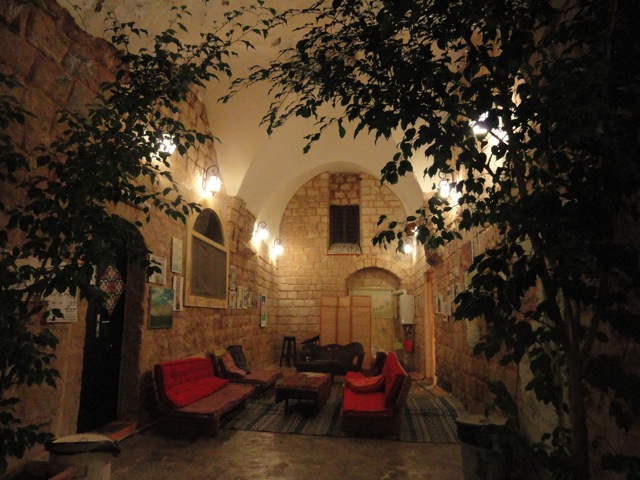
The Inn at night
As my good friend and partner Aziz Abu Sarah says: “If you must divide us, don’t divide us between Israelis and Palestinians. The only division is between those who believe in justice, peace, and equality—and those who don’t, yet.”
To advance this vision, Aziz and I have launched InterAct, a nonprofit organization with a bold mission: to achieve peace by 2030. InterAct builds trust, fosters dialogue, and creates shared spaces where Israelis and Palestinians can meet as equals. Over the past two years, we have come to realize that our message is like water for those in the desert—vital, life-giving, and desperately needed. We aspire to share this sustenance with all those seeking hope and change.
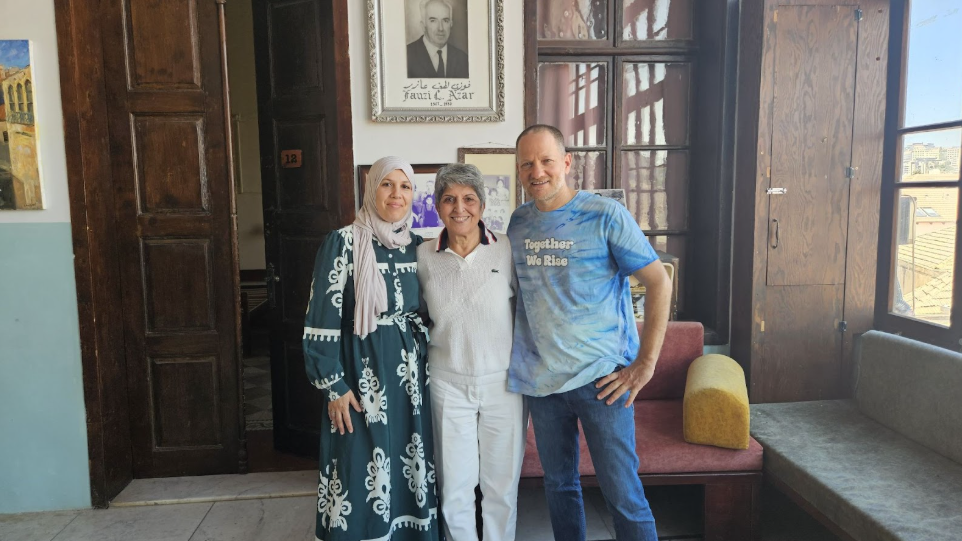
Odette Azar Shomar, Marwa Taha Abu Rany and I in the main hall of Beit Fauzi Azar.
Last year, Aziz and I opened the 2024 TED Convention with our healing conversation. Since then, we have shared our message with millions through the media and with thousands in person—including world leaders such as the late Pope Francis and Pope Leo XIV. These milestones remind us that the world is listening, and that change is within reach.
Maoz Inon and Aziz Abu Sarah speak at SESSION 1 at TED2024: The Brave and the Brilliant, on Monday, April 15, 2024. Vancouver, BC, Canada. Photo: Ryan Lash / TED
As part of this journey, I plan to send updates on our efforts every few weeks. You can also visit the InterAct website to see upcoming events. If I’m in your neighborhood, I’d love to meet you.
When I first shared my dream of opening a guesthouse, my parents stood beside me and gave me the courage to begin. Today, as I pursue the even greater dream of peace, I ask you to stand beside me in the same way. Help me amplify our message—share our story with your friends, your communities, and your networks. The more voices join, the stronger and more unstoppable our call for peace becomes.
Here’s how you can help:
Forward this article to those you know. Forward this email to those you know and ask them to join the mailing list Invite us to speak with the media, in webinars or at public events. Share our TED talk on social media
Born on a kibbutz in the Negev Desert, Maoz spent a year backpacking around the world when he was 22, and it was then that he discovered the power of the hostel to bring all kinds of people together and stimulate an area’s local economy. At 28, he embarked on the Israel Trail and was inspired to bring this world of the independent backpacker to his home country.
In 2005 Maoz opened his first hostel and the first guest house in Nazareth, Fauzi Azar Inn. He received international praise for bringing a new model for travel to Israel and sparking Nazareth’s resurgence as a destination for travelers. In 2000 the Lonely Planet called Nazareth a city to “avoid,” while in 2011 former British Prime Minister Tony Blair came to visit Nazareth and the Fauzi Azar while in Israel, a sign of the city’s much-improved status among foreigners.
Following Fauzi, Maoz and his American friend David Landis went on to develop the Jesus Trail, a walking trail through the northern region of Israel. The project was intended to stimulate and support the local economy in smaller, out-of-the-way Israeli towns and also bridge cultural gaps by trekking through currently and historically significant sites for Christians, Jews & Muslims. This project was also noted by international media as a positive development for Israeli tourism.
In 2006 Maoz met Yaron Burgin, who was staying as a guest at Fauzi Azar. After talking and brainstorming, the two proceeded to create ILH – Israel Hostels, a network of Israeli hostels with high standards of cleanliness, true backpackers’ vibes, affordable prices and “more than a bed to sleep in.”
It became clear that Jerusalem needed an ILH-style hostel, and Maoz teamed up with Gal, Dror, Nitzan, and Yaron, to create it. The five opened their dream hostel in the city center of Jerusalem, and Maoz saw his dream for Israel and the Middle East realized one step further.
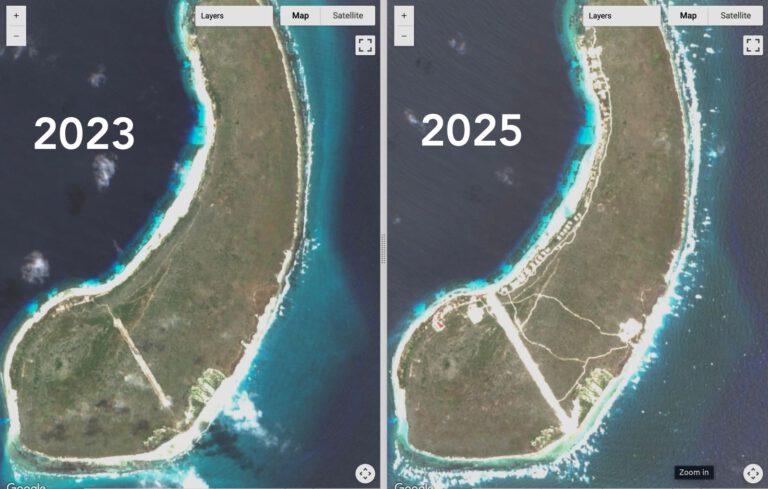
Before and after Qatari development on Assomption Island. Image was sent to us and is believed to show development up until at least June, 2025.
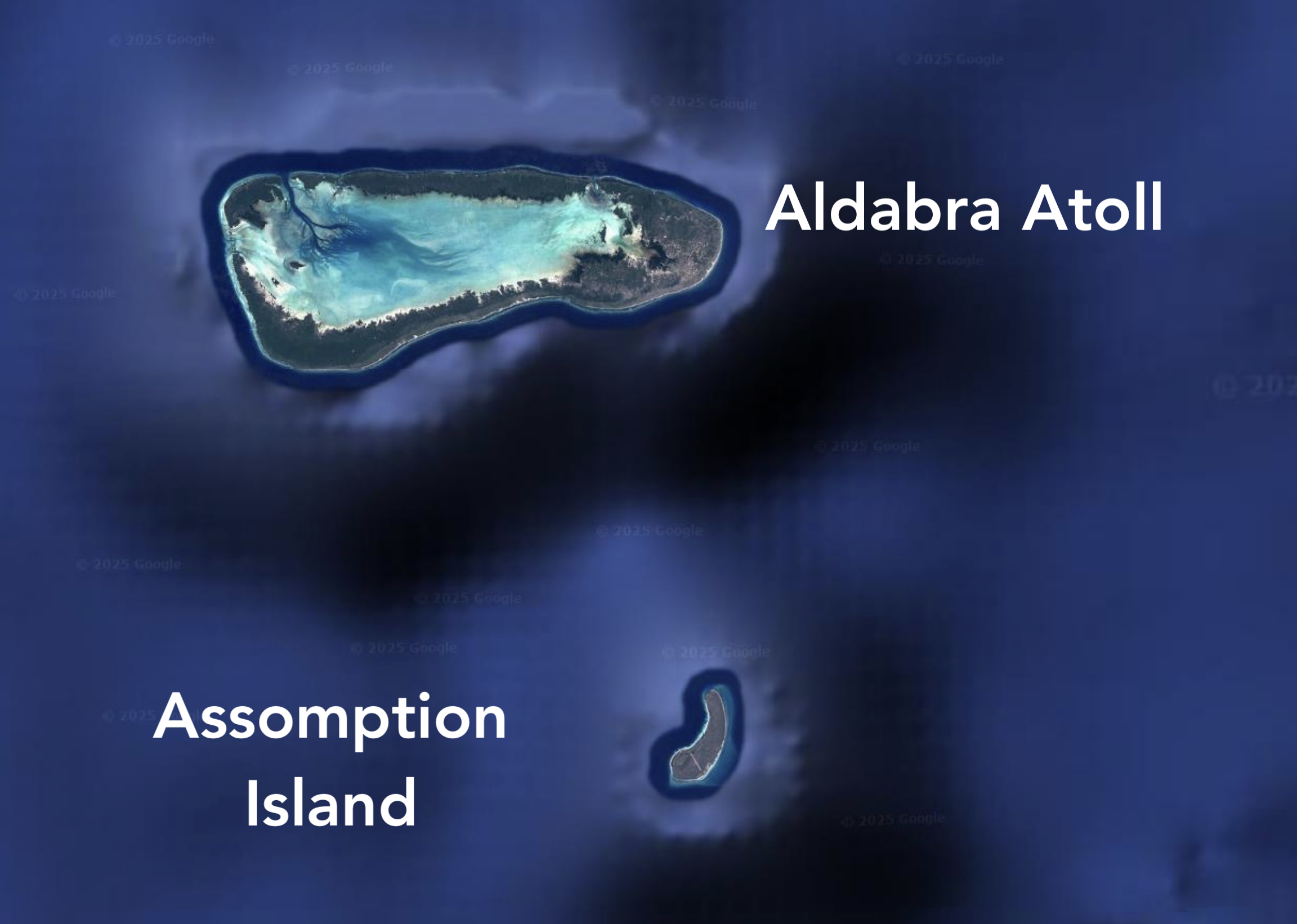
The damage appeared on Google Earth, and then was somehow scrubbed: but we have obtained a before and after photo of Qatari development on Assomption Island in the Seychelles. The same images appear on the landsat open source data supplied by EU’s Copernicus. Why this matters? Assomption Island, one of Seychelles’ Outer Islands lying just 25 miles from Aldabra Atoll, is being rapidly transformed by large-scale construction despite global concern over its ecological importance.
Image from dataspace.copernicus.eu from June, 2025 shows what Google Earth does not see: an extended runway from shore to shore and sites developed for luxury villas all along turtle nesting sites.
Once lightly inhabited and largely recovering after decades of limited human activity, Assomption is now the site of major earthworks, dredging, and runway expansion for an ultra-luxury development on the beach –– that conservationists say could permanently alter the island’s environment and threaten nearby Aldabra, a UNESCO World Heritage Site known as the “outpost of evolution.”
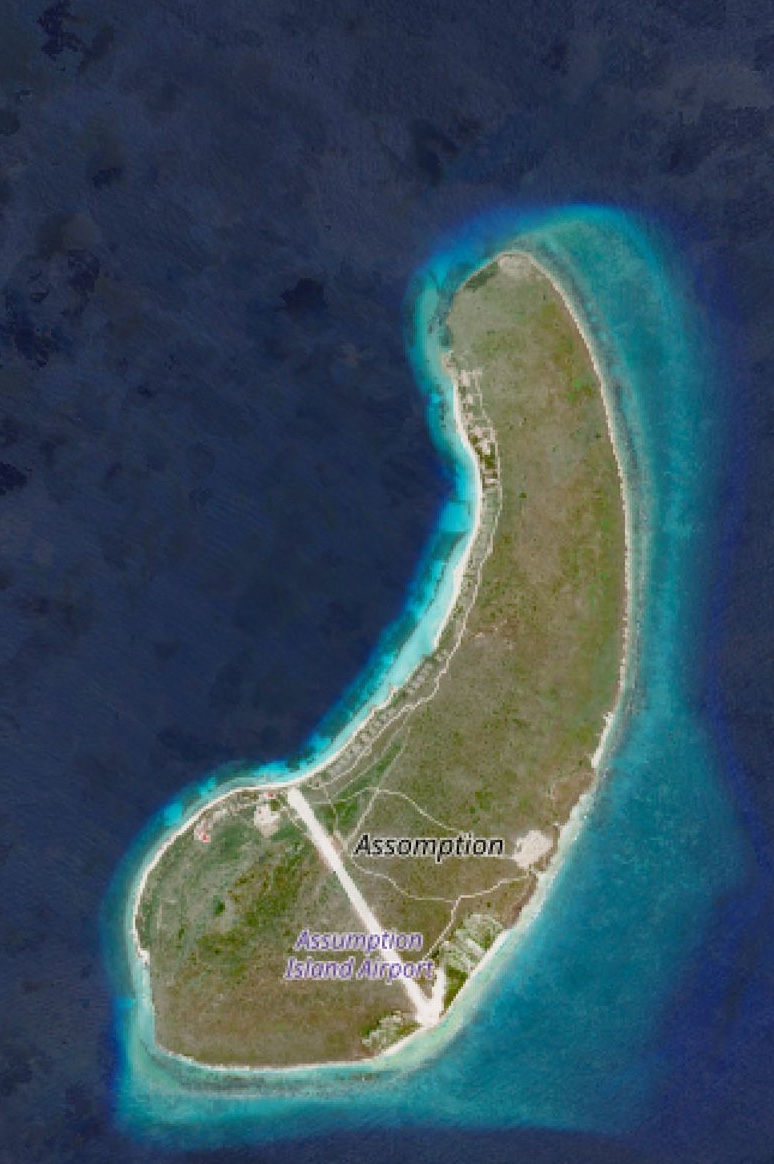
Aldabra and Assomption (sometimes spelled Assumption) Islands
Photographs and satellite images taken between approximately 2023 and June 2025 show widespread clearing of dunes and vegetation, the extension of the airstrip across the center of the island, and the preparation of foundations for as many as 40 villas. The development, backed by Qatari investors through a company Assets Group, aims to create a luxury resort enclave marketed to the ultra-wealthy. Only the ultra wealthy can hope to dive around the atoll. Getting there means a small plane into Assomption and then a charter boat to the island. Guests need to sleep on the boat. Read this personal account of being a dive master at Aldabra Atoll.
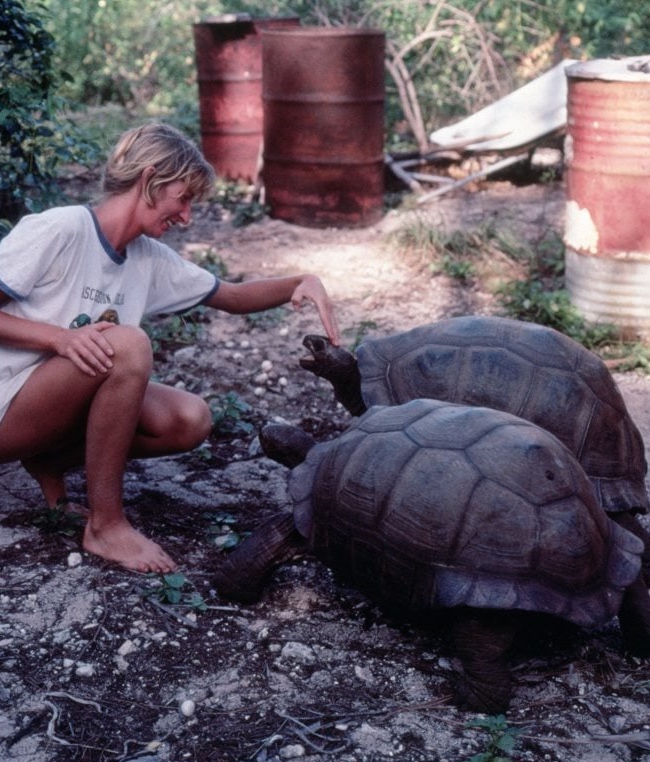
Jeanne Mortimer in her early days with the tortoises and turtles in the Seychelles
Conservation groups, including Friends of Aldabra and Seychelles at Heart, say the project has proceeded without proper environmental oversight and in violation of Seychelles’ own constitutional protections guaranteeing citizens the right to a healthy environment.
Damaged turtle on Assomption Island via Friends of Aldabra
Researchers who have studied the island for decades describe it as a key ecological buffer for Aldabra, helping to protect the atoll from pollution, invasive species, and light disturbance. If Assomption’s natural systems collapse, they warn, Aldabra could be next.
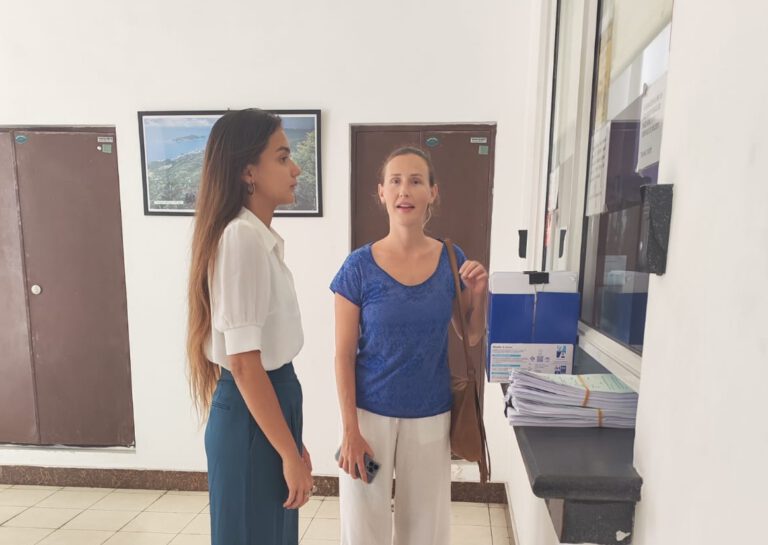
In September, two Seychellois citizens, Victoria Duthil and Lucie Harter, filed a constitutional petition in the Supreme Court of Seychelles to halt the project, arguing that it undermines the country’s environmental laws and its international obligations under UNESCO conventions. The petition targets the government, which granted the development lease and continues to issue work permits despite the legal challenge. The lawsuit has become a rallying point for citizens alarmed by the scale of change occurring on the remote island and by the lack of transparency surrounding the project. This issue will probably determine the next election in the Seychelles.
Victoria Duthil and Lucie Harter at Supreme Court to file constitutional petition
An Environmental and Social Impact Assessment for the resort identified major long-term risks to turtle nesting, dune stability, and coastal habitats, yet many of its recommendations appear to have been ignored. Conservationists say the new lighting and air traffic alone will devastate nocturnal wildlife. Beach dredging, they add, has already altered currents and sediment flows, increasing the risk of erosion and devastating turtle nesting sites. Pollution and runoff from the site in water and by air are expected to travel toward Aldabra, which hosts 100,000 giant tortoises and some of the most diverse coral ecosystems in the world. Every visitor to that island must have their clothing and shoes checked for the tiniest of seeds.
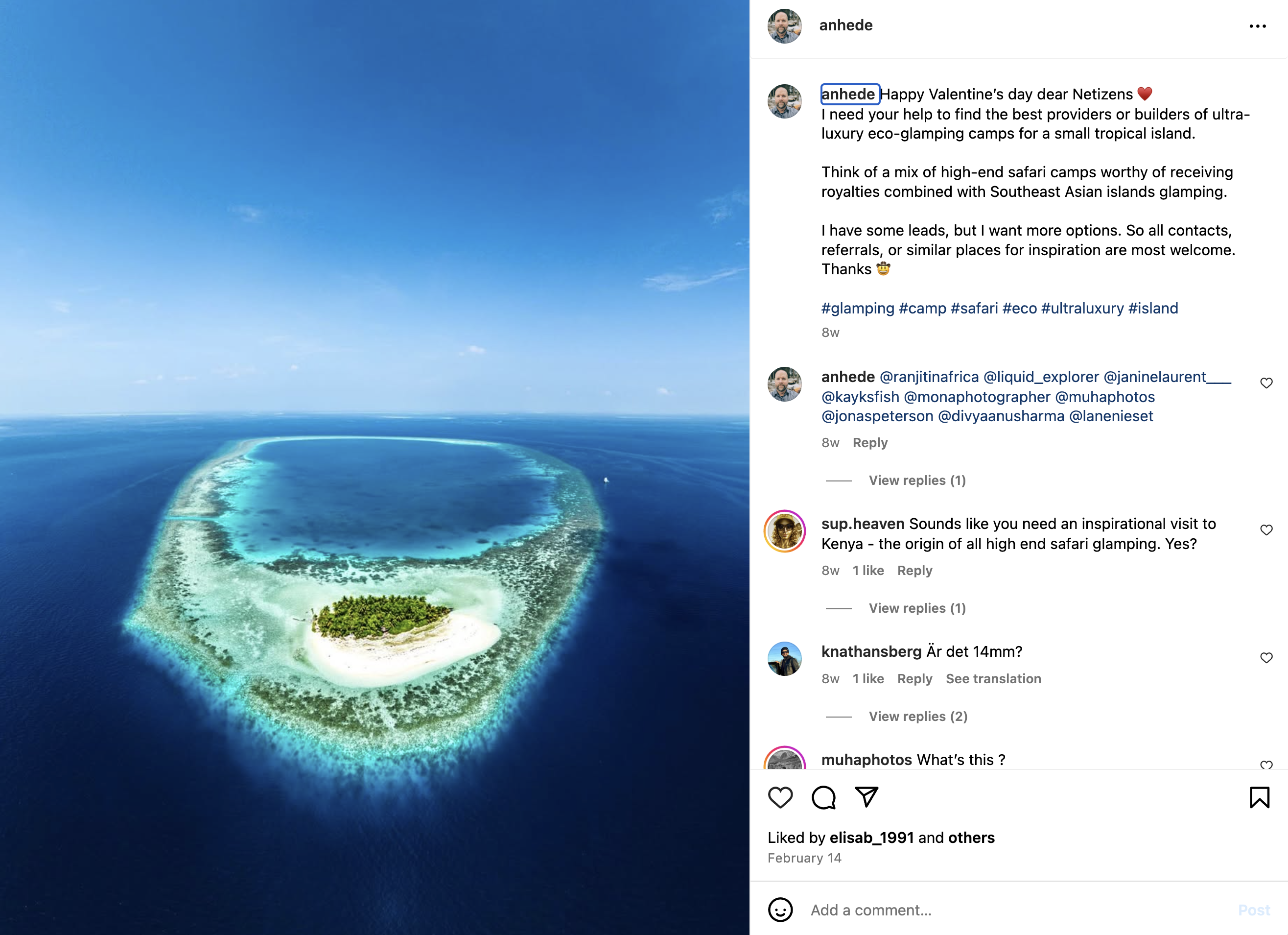
Developers have advertised the Assomption project as a sustainable tourism venture that will bring jobs and foreign revenue to Seychelles. They have hired a British PR firm called the PC Agency headed by Paul Charles and a Swedish “environmentalist” photographer Jesper Anhede to scout locations and to court buyers and “eco” builders. We reached out to Charles and Jesper to which there has been receipt of our inquiries, but no comments made. Jesper blocked us on Instagram.
Jesper Anhede, hired by Qatar to be their environmental photographer and liaison to the west.
Environmental groups like Friends of Aldabra are worried because they counter that the resort’s marketing materials promise exclusive access to Aldabra, a strict conservation zone closed to mass tourism. They warn that the development of Assomption creates an open channel—physical and economic—between Aldabra and the luxury market, undermining decades of conservation policy designed to keep the atoll isolated from human disturbance.
Marco Francis has made protecting this island as part of his election campaign
Until recently, Assomption had been protected under national environmental frameworks, serving as a controlled buffer to Aldabra’s strictly protected ecosystem. Conservationists say that status has now been effectively removed. What began as a quiet island has become a construction hub for a luxury enclave which will give access to Aldabra and other isolated islands that most Seychellois, a nation of 120,000, will never see.
Environmental observers argue that the issue is larger than Assomption alone. It symbolizes the growing global tension between development and conservation in fragile island states. If this project continues unchecked, the “outpost of evolution” may be destroyed.
Victoria Duthil and Lucie Harter at Supreme Court to file constitutional petition
We’ve covered the story of rats and royalty at the Seychelles Islands extensively and the next step in stopping the construction of Qatari villas on turtle nesting sites is led by two Seychellois citizens — Victoria Duthil (from Friends of Aldabra) and Lucie Harter (from Seychelles at Heart). Can the right thing trump money?
The duo have filed a petition in the Constitutional Court of Seychelles seeking an injunction to stop construction of a luxury Qatari hotel development on Assomption Island, 20 miles from the Aldabra Atoll UNESCO World Heritage Site. It is known as the “outpost of evolution” but biologists are worried it will be a playground for rich Middle Easterners.
The Aldabra Atoll is known as the outpost for evolution.
As we speak, critical turtle nesting sites are being bulldozed, the island being sold by the government in a 70-year lease and with a blind eye.
The petition filed last month invokes Article 38 of the Seychelles Constitution (the right to a clean, healthy and ecologically balanced environment).
In the image you can see that the beachfront has been dredged. This is a critical turtle nesting site. Via Friends of Aldabra
Assomption Island is next to the Aldabra Atoll, a UNESCO World Heritage Site globally recognised as one of the most important biodiversity hotspots on Earth. After decades of human degradation, Assomption was showing signs of ecological recovery, serving as a key habitat for sea turtles, butterflies, and other insects.
The Qatari-led construction project poses a serious risk of irreversible harm to these fragile ecosystems, threatening to undo decades of conservation work in the Outer Islands.
The claimants say that “legal action was taken to safeguard the constitutional right of every Seychellois to live in and enjoy a clean, healthy, and ecologically balanced environment, as stated in Article 38 of the Constitution of Seychelles.”
Stop Notice
From the outset, “we have reported that this development has proceeded without transparency or legal safeguards. The Environmental and Social Impact Assessment (ESIA) was conducted by an NGO with financial and governance ties to the project contractor, raising serious concerns about conflict of interest.
“Construction began before any environmental accountability had been assigned: no environmental officer was present, no monitoring was in place, and the biosecurity protocol ignored—despite this being critical to prevent invasive species from devastating island ecosystems.”
Green Prophet interviewed turtle expert Jeanne Mortimer earning her the title of Madame Torti in the Seychelles. She was not consulted about how to safeguard the turtles but knows how it can be done.
Jeanne Mortimer in her early days with the tortoises and turtles in the Seychelles
“There is a lot going on behind the scenes related to Assomption. Actually I am somewhat optimistic. We will see…” Jeanne Mortimer told Green Prophet today. Our video with her has gone viral.
According to Mongabay and various NGO and media reports, the PR agency named The PC Agency is being used by Assets Group to promote the development and its narrative (for example, offering tourism packages). Also, Mongabay says that the London-based PR company: “Through a website run by its PR firm, the PC Agency, Assets Group has made it clear it is offering tourists an Aldabra islands package not limited to Assomption Island.”
“In May 2025, the Planning Authority issued a Stop Notice for these violations, but it appears to have been immediately waived or disregarded. Since then, evidence has surfaced of unauthorised dredging, light pollution visible from Aldabra that disrupts the behaviour of both terrestrial and marine species, and a photo of a gravely injured giant tortoise.”
It is common for Middle East developers to hire Londoners and Europeans to greenwash development projects in the Middle East. It is happening currently in Saudi Arabia with its Neom mega project.
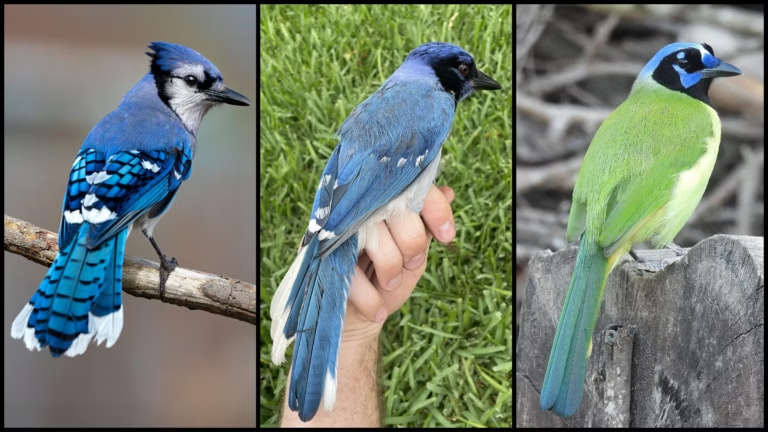
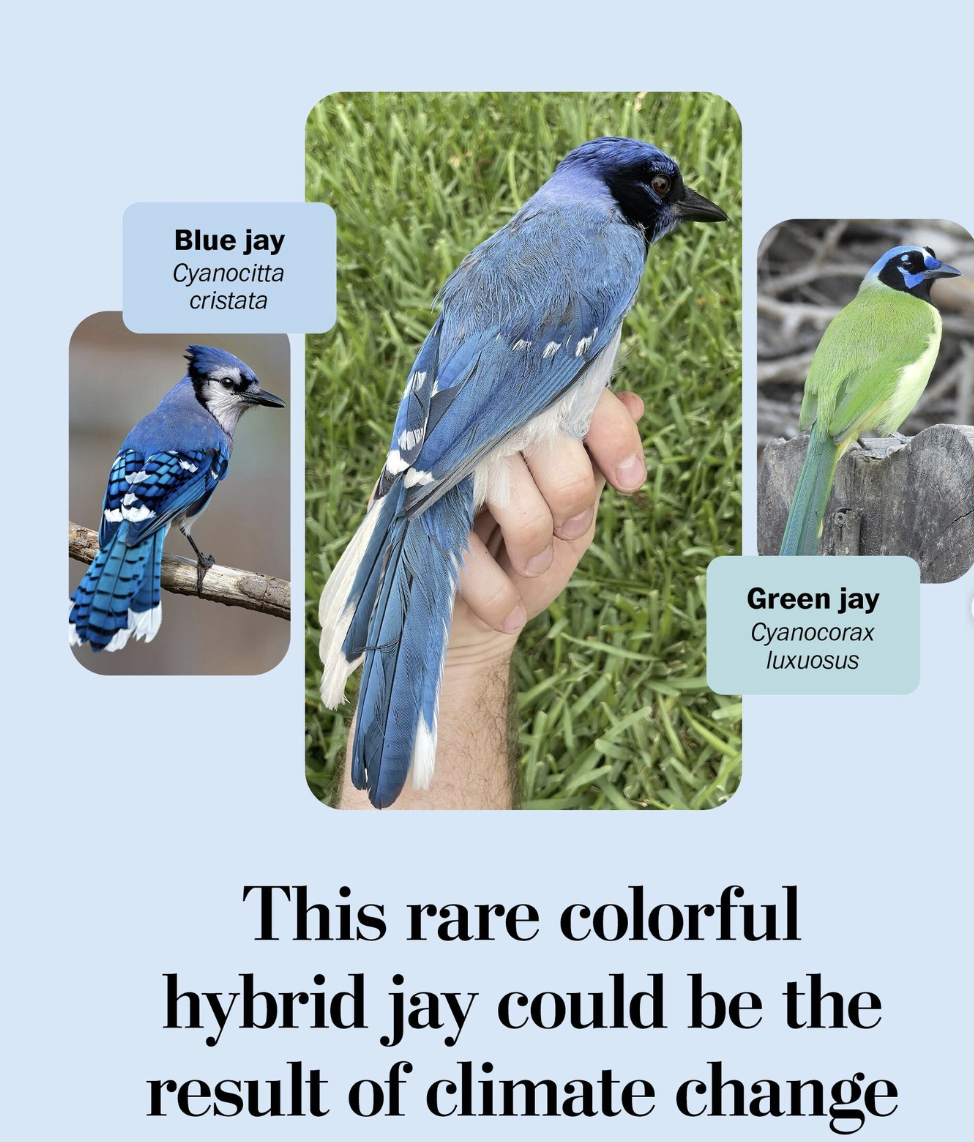
A rare hybrid bird identified in a suburb of San Antonio, Texas (center panel, credit: Brian Stokes) is the result of mating between a male blue jay (left, credit: Travis Maher/Cornell Lab of Ornithology/Macaulay Library) and a female green jay (right, credit: Dan O’Brien/Cornell Lab of Ornithology/Macaulay Library).
Years ago, when I was studying biology at the University of Toronto, the textbook example of climate-driven evolution was the case of the peppered moth. Two color forms — one white, one black — told a simple story of natural selection: in the soot-choked air of industrial England, the darker moths survived better because they were harder for predators to see.
Now, in a new twist on species diversity, ornithologists are witnessing not just color changes, but the blending of entire species. In Texas, a green jay and a blue jay — birds separated by seven million years of evolution — have produced a hybrid offspring. Their unexpected creation, likely spurred by climate change as both species’ ranges expand and overlap, has earned a nickname as curious as its colors: the “grue jay.”
Biologists at The University of Texas at Austin have reported discovering a wild bird that appears to be the natural hybrid of a green jay and a blue jay—a cross that may be one of the first known to result from climate-driven range shifts.
Brian Stokes
“We think it’s the first observed vertebrate that’s hybridized as a result of two species both expanding their ranges due, at least in part, to climate change,” said Brian Stokes, a graduate student in ecology, evolution and behavior at UT Austin and first author of the study published in Ecology and Evolution.
The green jay (Cyanocorax yncas), a tropical bird found across Central America and southern Texas, and the blue jay (Cyanocitta cristata), a temperate species native to eastern North America, are separated by roughly seven million years of evolution. Until recently, their ranges rarely overlapped. In the 1950s, green jays reached only the southern tip of Texas, while blue jays ranged as far west as Houston. But as climate change has warmed and dried parts of Texas, green jays have pushed north and blue jays west, their territories now overlapping around San Antonio.
Stokes discovered the unusual bird while monitoring social media posts by birders to locate potential study sites. A homeowner northeast of San Antonio posted a photo of a mysterious blue bird with a black mask and white chest. “The first day, we tried to catch it, but it was really uncooperative,” said Stokes.
This is how you make a grue jay
“But the second day, we got lucky.”
The bird was caught using a mist net, briefly examined, and released after a small blood sample was taken for genetic testing. Analysis by Stokes and his advisor, Tim Keitt, a professor of integrative biology at UT Austin, confirmed the bird was the male hybrid offspring of a green jay mother and a blue jay father.
Interestingly, a similar hybrid was created in captivity in the 1970s and preserved at the Fort Worth Museum of Science and History—and it looks nearly identical to the wild specimen observed by Stokes.
“Hybridization is probably way more common in the natural world than researchers know about because there’s just so much inability to report these things happening,” Stokes said. “And it’s probably possible in a lot of species that we just don’t see because they’re physically separated from one another and so they don’t get the chance to try to mate.”
The research was supported by a ConTex Collaborative Research Grant through the UT System, the Texas EcoLab Program, and Planet Texas 2050, a university-wide climate resilience initiative.
While the researchers didn’t name the bird, some observers have informally dubbed it the “grue jay”—a playful nod to other naturally occurring hybrids such as the grolar bear (polar bear–grizzly mix), coywolf (coyote–wolf), and narluga (narwhal–beluga).
Looking for an eco deck or dock for your ecological floating home or houseboat? The elevated structure was designed by Dutch architect Koen Olthuis and the Waterstudio team. Image via Ocean Builders
Decks & Docks in Nashville, Tennessee, is a trusted source for premium marine construction materials, offering a wide range of products for homeowners, contractors, and DIY enthusiasts. Located at 344 Wilhagan Road, their showroom features decking, railing, lighting, hardware, and accessories—everything you need for your next project in one place.
Whether you’re planning a small DIY deck or a large-scale construction, Decks & Docks provides expert guidance to help you select the right materials for your project. Their knowledgeable team is committed to delivering exceptional service and ensuring every customer finds exactly what they need.
I was shopping online for a candle the other day and quickly realized this: candles have gotten very expensive! Soy candles, aromatherapy candles, eco-friendly candles in fancy jars. If only there was a way to create some nice romantic lighting without breaking the bank.
But wait – there is! Introducing the orange peel candle: the solution to expensive candle-buying syndrome. And it’s a guaranteed prize for getting your daily dose of vitamin C from its citrusy contents.
Naturally providing the candle holder from the peel and the wick from the pith, all you need is a little oil and voila – you’ll have yourself a candle in no time!
Related: 5 ways to use orange peels in the kitchen – candied and
Try the fun and easy process for yourself by following along:
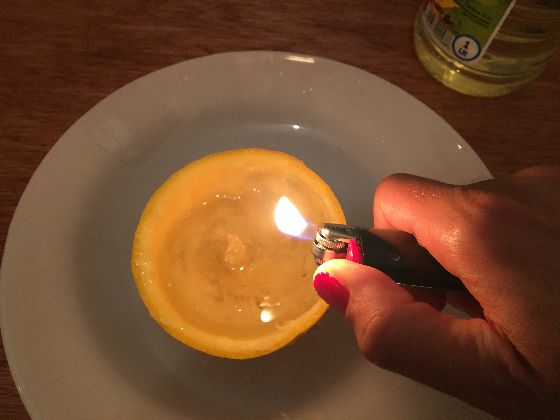
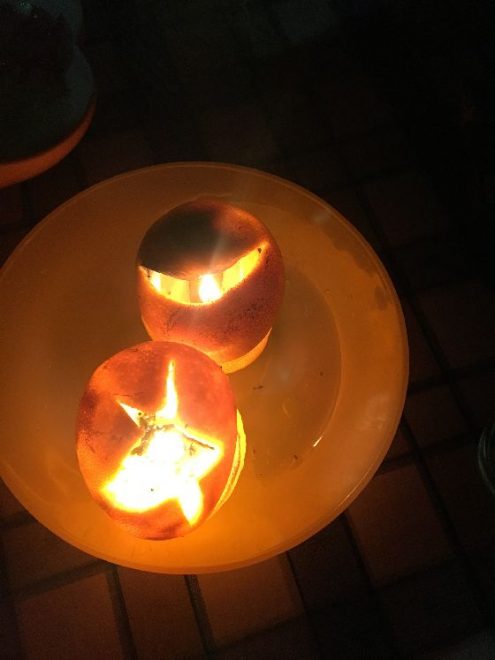
1. First, slice your orange in half. That’s the half with the knobby part on the outside – the one I’m holding in my right hand, in the picture. The pith coming from that knob is stronger and will make for a better wick.
2. Remove the fruit, being careful to leave the thick string of pith that extends up from the center intact. I used a spoon to make a nice clean shave inside the orange peel towards the end of this step.
3. Fill the orange peel with oil of your choice. Here in my kitchen in Greece, where I’m currently living for work, I had only sunflower oil and extra-virgin olive oil. Deciding to save the latter for eating, I went with the sunflower oil. Do not drown the string of pith that extends upward – remember, this is your wick!
4. Light it up! (Optional soundtrack: “Light It Up” by Major Lazer, followed by “(Burn Baby Burn) Disco Inferno” by The Trammps) It took a while for the pith to catch fire; I felt as if I was toasting a marshmallow, watching in eager anticipation. Just be patient, and it will light. Good things come to those who wait!
5. Optional: Create candle covers by cutting shapes into the as-of-yet unused orange peel halves. I chose a crescent moon and a star.
6. Especially optional: Place your candle in a bowl that’s filled with water. Marvel as it floats around, and place a freshly picked flower in the water. You can customize your add-ins; choose your favorite leaf or flower to add an herbal or floral note to the orange scent from the peel. And then – because why not – take a selfie.
A word of caution: I left my orange peel candle out for a couple nights, and when I checked back, I saw that hundreds of fruit flies had come to feast. Most had died in their gluttony, floating in the oil inside the orange peel, but many were lingering above it. So I’d suggest refrigerating your orange peel candles after their first use, if you plan to reuse them later.
What do you do when life hands you oranges? Why, make orange peel candles, of course! If you have grapefruits or lemons, you can also make candles from their peels using this how-to guide.
Eni’s Tokomak for making fusion happen – a flair for Italian design
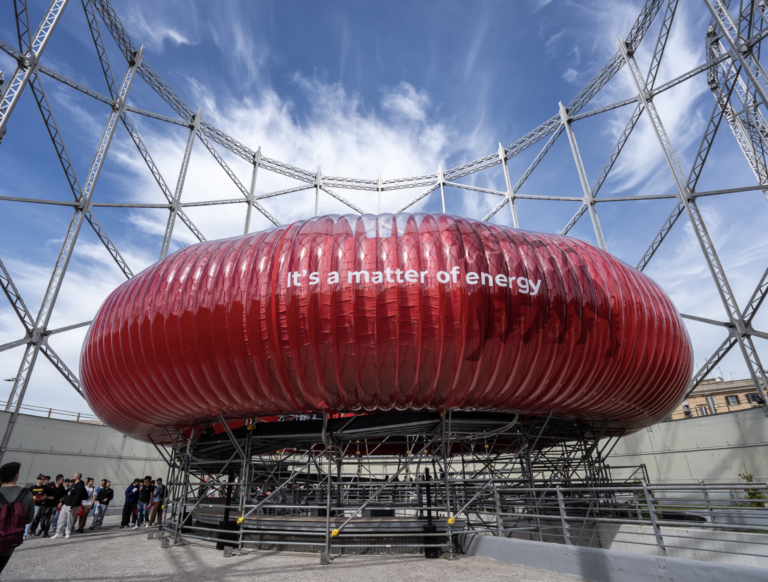
Fusion energy is hard to create and it’s hard to explain. Brian gives a great background here. International design and innovation office CRA-Carlo Ratti Associati and architect Italo Rota, together with Italy’s energy company Eni, present a project dedicated to magnetic confinement fusion, one of the most innovative technologies for the decarbonization of energy systems. The project showcases the mock-up of a Tokamak reactor, built within a former gasholder in Rome, Italy, in order to inform visitors about this breakthrough technology with Italian flair.
It was released in 2022.
The project by CRA and Italo Rota is part of Maker Faire Rome, Europe’s leading event for the community of Makers. It is situated in the site of Gazometro Ostiense, one of the foremost symbols of the Italian capital’s modern industrial heritage, located just three kilometers southwest of the Colosseum. Inside a 50-meter-high, 40-meter-wide gasholder, visitors can explore the conceptual model of a Tokamak, a fundamental component in magnetic confinement technology processes. After an ascending path, people can access inside the Tokamak. Here, within a red-lit circular corridor, a series of multimedia content narrates the technology and its ongoing scientific investigations.
“Magnetic confinement fusion is a clean technology that has the potential to be one of tomorrow’s key decarbonization solutions,” comments Carlo Ratti, founder of CRA and Director of the MIT Senseable City Lab. “With the project, we wanted to start an open-design process to imagine how fusion power plants will be integrated in sub-urban areas – prompting makers and architects alike to join a discussion on our future energy landscape.”
“We have the chance to explore new forms of storytelling about energy,” adds Italo Rota, co-designer of the installation. “We believe that design is a powerful tool to turn a narration into an experience, allowing visitors to sense the energy while being surrounded by a unique atmosphere.”
The project follows Eni’s work on magnetic confinement, which has been unfolding in the last few years through a series of academic collaborations – most notably, with the MIT Plasma Science and Fusion Center (PSFC) – and the energy company Commonwealth Fusion Systems (CFS). During the process of magnetic confinement, the fusion of two hydrogen nuclei releases an enormous amount of energy, similarly to how it happens inside the sun and other stars. The most substantial advantage of this technology is that it does not emit greenhouse gases or highly polluting or highly radioactive substances. Furthermore, it is safe and virtually inexhaustible.
In the past years, CRA has been developing several energy-related projects on different scales: from the Helsinki Hot Heart, a series of islands with the dual function of thermal energy storage – currently the largest urban decarbonization project in the world – and recreational public spaces, to the masterplan for MIND (Milan Innovation District) to CapitaSpring, a 280-meter-tall high-rise oasis in Singapore designed together with BIG – Bjarke Ingels Group.
Over the past years, CRA and Eni have been collaborating to promote new forms of circularity and sustainable energy production. Their projects have been showcased at international events such as the Maker Faire in Rome, Milan Design Week, and Expo Dubai 2020.
In May 2025, a shocking rescue in Yerevan, Armenia, brought global attention to a longstanding problem in the Caucasus: wild bears kept in cages as tourist curiosities, “pets,” or backyard mascots. Three Syrian brown bears – Aram, Nairi, and their daughter, Lola – were liberated after years of abuse in filthy cages. Their rescue, led by the Foundation for the Preservation of Wildlife and Cultural Assets (FPWC) with support from International Animal Rescue (IAR), revealed not just one family’s suffering, but a broader pattern that persists across the country.
For decades, bears in Armenia and neighboring regions have been captured and displayed in shocking conditions where It has been common for businesses to keep a bear chained in a small cage to attract diners or tourists. Wealthy or rural families sometimes treat bears as status symbols, confining them in sheds or cages without proper care. Adult bears are often bred, and their cubs sold into a cycle of captivity—sometimes to other private owners, sometimes abroad.
Alan Knight, President of International Animal Rescue, who was at the rescue, said: “These were some of the worst conditions I have ever seen. The stench, the filth, the sheer cruelty of locking these animals up in tiny cages and feeding them cola, it was absolutely horrific.”
This happens in Armenia not because of religious practice, but mostly from cultural tradition, economic motives, and weak enforcement of animal welfare laws. Bears in Armenia are iconic symbols of strength and survival, and some people wrongly believe they can be “tamed.” In reality, such captivity leads only to neglect, suffering, and the gradual decline of wild bear populations.
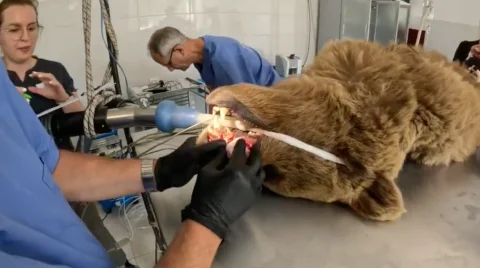
Rescued Armenian bear needs a dentist after being fed soda and junk food
Tourists may unwittingly fuel the problem. When visitors stop at a roadside café to take selfies with a caged bear or when they “like” such photos on social media, it signals to owners that keeping bears is profitable. That’s why tourists can play a crucial role in stopping this cruelty. Don’t take selfies with bears!
What tourists can do when you see a bear or any wild animal like a drunk monkey or snake being exploited: Don’t dine, stay, or spend money in places where animals are caged for entertainment, even if the kids beg. If you see a captive bear in Armenia (or elsewhere in the region), take discreet photos or videos and share them with local animal welfare groups such as FPWC, IAR, or international NGOs. These tip-offs are often what trigger investigations and rescues. The links are below.
Visit or donate to ethical wildlife sanctuaries, where rescued bears live in naturalistic environments and receive proper care. And yes, thanks to local activists and global attention, progress is being made. Armenia has strengthened its wildlife protection laws in recent years, and NGOs have successfully rescued dozens of bears. Sanctuaries in Urtsadzor and beyond are giving once-abused animals safe new homes. But rescues remain expensive, slow, and dependent on public pressure and donations.
Brown Bears Can and Do Attack
While it is tragic to see brown bears caged and abused, it is equally important to remember that these are not domesticated animals. Brown bears are among the most powerful carnivores on Earth, capable of inflicting fatal injuries on humans when provoked or surprised. Their sheer size, strength, and unpredictability make them both awe-inspiring and dangerous.
An unforgettable account of this truth is told by the French writer and anthropologist Nastassja Martin in her memoir In the Eye of the Wild (Croire aux fauves). In 2015, while conducting fieldwork on the Kamchatka Peninsula in Siberia, Martin was attacked by a brown bear. The bear crushed part of her skull and jaw in a brief but violent encounter.
Martin survived — but her story is not just about survival. The book, translated into English by Sophie R. Lewis, weaves memoir, anthropology, and philosophy into a haunting reflection on what it means to live through trauma. She explores not only the physical scars but also the metaphysical dimension of her experience, suggesting that encounters with wildness force us to rethink the boundaries between humans and animals, nature and culture, fear and reverence like the forthcoming book Bearland, by Karin Kloosterman.
A Global Problem of Tourist Sideshows
Sadly, Armenia is not alone. Around the world, wild animals are drugged, chained, or mutilated to entertain tourists.
In Thailand we have seen monkeys are often drugged and forced to perform tricks, take photos with tourists, or ride bicycles in “shows.” Behind the scenes, they live in chains and suffer permanent trauma.
In Morocco (Marrakesh) we have seen snake charmers display cobras and vipers in public squares, often with their fangs removed or mouths sewn shut. The snakes slowly starve or die from infection, replaced by more animals taken from the wild.
In Europe and the Middle East birds of prey are tethered for selfies, and lion cubs are illegally traded as exotic pets.
At this year’s World Green Economy Summit 2025, Tech Mahindra’s Chief Sustainability Officer, Sandeep Chandna, is not mincing words. In an exclusive conversation with Green Prophet, he insists that sustainability has outgrown its role as a corporate side-project. Forget box-ticking ESG reports — Chandna says the future belongs to companies bold enough to treat sustainability as their core strategy for innovation, resilience, and survival.
Why does this matter? Because Tech Mahindra isn’t just talking the talk. It’s the first Indian company to win the Terra Carta Seal from King Charles III, ranked #2 globally for IT services on the S&P Dow Jones Sustainability Indices, and is already cutting emissions with AI-powered tools and a growing renewable energy footprint. Chandna reveals how putting a price on carbon inside the company — $12 a ton — is changing investment decisions, and how platforms like i.GreenFinance are pushing banks and institutions toward measurable green impact.
For those still treating ESG as a PR exercise, this is a warning shot. Chandna’s message is clear: sustainability is no longer optional. It’s the new operating system for business — one that could define winners and losers in the decade ahead.
Green Prophet: At the World Green Economy Summit 2025, what key message will you be delivering to global sustainability leaders?
At the World Green Economy Summit 2025, our core message will be clear: sustainability must shift from being a compliance checkbox to a strategic, purpose-driven imperative that powers innovation, resilience, and inclusive growth. We stand at a critical inflection point where ESG is no longer a reporting exercise, it is the blueprint for future-ready enterprises. We want to spotlight how digital transformation, when purposefully aligned with climate and social goals, can catalyze systemic change. Tech Mahindra’s journey, from pioneering green IT to launching AI-powered sustainability platforms, demonstrates that technology is an enabler and a force multiplier. We will also advocate for cross-sector collaboration, urging leaders to move beyond silos and co-create solutions that honor both planetary boundaries and human aspirations.
How does Tech Mahindra’s role as the only Indian company with the Terra Carta Seal influence your global positioning in sustainability?
Being awarded the Terra Carta Seal by His Majesty King Charles III is both an honor and a mandate. It places Tech Mahindra among a select cohort of global companies recognized for credible, science-aligned transition strategies. As the First Indian recipient, it amplifies our voice in international sustainability dialogues and affirms our leadership in climate-conscious innovation. The Seal validates our commitment to nature-positive solutions, from smart infrastructure to green software. It also strengthens our engagement with standards and frameworks like the Global Reporting Initiative (GRI) 2021, Sustainability Accounting Standards Board (SASB), International Sustainability Standards Board’s (ISSB) IFRS S1 and S2 standards, Business Responsibility and Sustainability Reporting (BRSR), International Integrated Reporting Council (IIRC), Taskforce on Climate-related Financial Disclosures (TCFD), Taskforce on Nature-Related Financial Disclosures (TNFD), and Greenhouse Gas (GHG) Protocol standards. More than recognition, it is a call to action: to lead with integrity, scale impact, and inspire others across industries and borders.
You’ve been ranked #1 in India and #2 globally in the S&P Dow Jones Sustainability Indices for IT services. How do you translate such rankings into tangible real-world impact?
These rankings are a testament to our rigor and transparency across ESG dimensions, but their true value lies in how we operationalize them. At Tech Mahindra, we have embedded sustainability into the DNA of our business. From reducing Scope 1 and 2 emissions by over 31% since 2016 to sourcing 31% renewable energy across owned campuses, our actions speak louder than metrics. We have achieved Zero Waste to Landfill certification at key locations and implemented ESG-aligned procurement protocols. These outcomes benefit the environment, enhance stakeholder trust, drive cost efficiencies, and position us as a preferred partner for purpose-driven customers.
Can you share a project or initiative where your sustainability strategy delivered measurable results for both the business and the environment?
One of our most impactful initiatives has been the transition to renewable energy across our campuses. Through strategic investments in solar infrastructure and green power purchase agreements, we have achieved a 31% renewable energy mix at owned locations and nearly 23% globally. This has led to a 31% reduction in Scope 1 and 2 emissions compared to our 2016 baseline. Beyond environmental gains, the initiative has delivered tangible business benefits, lower operational costs, enhanced energy resilience, and stronger ESG credentials. Complementing this is our green mobility program, which promotes electric vehicle adoption and sustainable commuting, further reinforcing our commitment to climate-positive action.
With a goal of carbon neutrality by 2030 and net zero by 2035, what innovations or policies will be most critical in reaching these targets?
Achieving these ambitious milestones demands a holistic and forward-looking strategy. Our internal carbon pricing, currently set at $12 per metric ton, serves as a financial compass, guiding investments toward low-carbon alternatives. We are aggressively scaling renewable energy adoption, targeting 90% sourcing by 2030. Innovations such as AI-driven energy optimization, smart buildings, and digital twins are being deployed to enhance operational efficiency. Policy-wise, we are aligning with SBTi-approved Net Zero targets and embedding ESG criteria into procurement and vendor governance. These levers, technology, policy, and behavioral transformation are essential to decarbonizing our value chain while sustaining growth and competitiveness.
How is internal carbon pricing changing decision-making within Tech Mahindra?
Our internal carbon pricing mechanism has fundamentally reshaped how we evaluate investments and operational decisions. By assigning a tangible cost to carbon, $12 per metric ton, we have embedded climate risk into our financial modeling and strategic planning. This approach incentivizes low-carbon innovation, accelerates renewable energy adoption, and ensures that sustainability is a core consideration in everything from facility upgrades to supply chain choices. It is a cultural shift that reinforces our commitment to responsible growth and climate stewardship. It empowers teams to make decisions that are not only economically sound but environmentally aligned.
Could you elaborate on how platforms like i.Greenfinance are helping clients accelerate their own sustainability journeys?
AI platform for green finance
i.GreenFinance is a transformative platform that enables financial institutions to embed sustainability into their lending and investment decisions through automated ESG scoring with sector-specific KPI weighting. For instance, carbon emissions are prioritized in energy lending, while biodiversity and land-use practices take precedence in agriculture. These weights are fully adjustable to reflect regional requirements, regulatory frameworks, and institutional sustainability policies.
Built on an API-first architecture, the platform integrates seamlessly into existing Loan Origination Systems, enabling smart green loan underwriting where sustainability insights and ESG scores are embedded directly into credit decisioning workflows without disrupting core banking systems. Beyond origination, i.GreenFinance provides post-approval tracking of loan proceeds to ensure disbursed funds support their intended sustainable projects, from renewable energy deployment to green infrastructure upgrades. This delivers transparency and accountability for both lenders and borrowers.
The platform combines taxonomy mapping, feasibility reporting, and real-time analytics to provide comprehensive views of project viability and climate risk. These outputs are designed to support internal decision-making, helping lenders evaluate applications, monitor fund usage, and align portfolios with global sustainability standards.
With high configurability, i.GreenFinance adapts to each institution’s policies, product mix, and regional context. By making ESG performance sector-specific, customizable, auditable, and trackable across the loan lifecycle, the platform empowers institutions to move from intent to measurable impact, accelerating their journey toward responsible finance and net zero alignment.
What role will AI, IoT, and other emerging technologies play in driving sustainability transformations for global clients?
With the emergence of Generative AI, we’re solving sustainability’s most pressing challenges at unprecedented scale. i.GreenFinance exemplifies this innovation, delivering smart green loan underwriting, feasibility analysis, and real-time proceeds tracking that transforms how financial institutions approach sustainable lending.
Beyond finance, we’re tackling complex sustainability challenges using agentic AI across ESG reporting automation, dynamic materiality assessment, climate risk evaluation, supply chain assessments, and document intelligence. These solutions address a critical pain point for large enterprises, interoperability across multiple reporting regimes including CSRD, ISSB, SFDR, and regional taxonomies. Our platforms automatically harmonize data across frameworks, ensuring sustainability information is configurable, actionable, and audit ready.
IoT technology complements our AI capabilities by feeding real-time sensor data from assets, buildings, and infrastructure directly into our platforms. This integration enables continuous monitoring, predictive analytics, and early-warning systems for emissions tracking, energy efficiency optimization, and resource usage management—transforming raw operational data into actionable sustainability insights that drive immediate decision-making.
The convergence of AI and IoT creates intelligent sustainability ecosystems that provide 360-degree visibility into environmental performance. Organizations can now identify inefficiencies before they occur, optimize resource allocation in real-time, and demonstrate measurable progress toward sustainability goals with unprecedented precision.
Together, AI and IoT are redefining sustainability, making it smarter, faster, and measurable while empowering organizations to evolve from reactive compliance to proactive strategic foresight and value creation. This technological revolution enables businesses to anticipate risks, capitalize on opportunities, and accelerate their transformation toward sustainable operations.
Your first TNFD report integrates nature-related risks into corporate strategy. How will this shape future investments and operations?
Our TNFD-aligned disclosures mark a strategic evolution, from climate-centric reporting to nature-inclusive governance. By assessing dependencies on biodiversity, water, waste management and ecosystem services, we are embedding nature risk into investment decisions, site planning, and supply chain management. Future expansions will be evaluated for financial viability and ecological integrity. We are developing nature-positive KPIs and integrating them into our ESG dashboards, ensuring that regeneration is part of our strategy.Our proactive efforts to manage nature-related risks and seize opportunities reflect our dedication to creating long-term value for our stakeholders while safeguarding the environment. We understand that the journey towards sustainability is ongoing, and we are committed to continuously improving our practices and strategies to meet the evolving challenges of our global ecosystem. TNFD is helping us future-proof our business, align with planetary boundaries, and contribute meaningfully to global biodiversity goals.
Beyond corporate targets, what legacy do you hope Tech Mahindra’s sustainability strategy will leave for the industry and the planet?
We aspire to leave behind a legacy of transformation, where sustainability is a catalyst for systemic change. We want to demonstrate that purpose-driven technology can solve complex global challenges, from climate resilience to social equity. By embedding ESG into our core strategy, launching nature-positive platforms, and championing inclusive innovation, we aim to inspire a paradigm shift across industries. If we can help reframe sustainability as a source of value, trust, and regeneration, then our legacy will be one of leadership in building a better future for generations to come.
If you’ve ever jumped on the latest diet trend only to abandon it a few weeks later, Cleveland-based fitness coach Harsha Pakhal is here to reassure you that you’re not alone. From juice cleanses to no-carb challenges, most quick fixes fizzle out because they’re too extreme to maintain.
You need simple, sustainable habits that will actually stick. A big overhaul of your routine and habits won’t get you there because you need to slowly combine new habits with existing ones. That’s how you change your mindset and attitude towards food.
Eating healthy is so much easier when you make it fun instead of seeing it as a chore. One of the ways to do this is to stop labelling foods as “good” and “bad.” Telling yourself a food is off-limits tends to make it more appealing.
Research shows restriction often leads to stronger cravings and overeating once the “bad” food is allowed. So instead of it making you feel better, you end up sending yourself on a guilt trip. Your body knows what it needs to eat, and labelling or demonizing food takes away your ability to do that freely.
Prioritize Protein and Plants at Every Meal
Protein helps stabilize energy, supports muscle repair, and keeps hunger in check. Making it the anchor of each meal makes it easier to manage your cravings and stay on track with balanced meals throughout the day. So invest in those eggs, chicken, tofu, or bean staples because they’re the foods that are going to keep your hunger at bay.
Vegetables and fruits provide essential vitamins, minerals, and fiber. Pakhal encourages clients to focus on adding more colorful produce to their plates, which naturally creates a more nutrient-dense meal without feeling restrictive.
Stay Consistent with Hydration
Dehydration often shows up as fatigue or even false hunger cues. A simple routine like drinking a glass of water first thing in the morning and keeping a bottle nearby can make a noticeable difference in energy and focus.
Plan, Don’t Wing It
Last-minute food decisions usually lead to less healthy choices. So it’s time to make meal prepping your best friend. It doesn’t have to mean spending an entire Sunday afternoon in the kitchen. Even some light meal prep, like lunch salads and cooked protein, can make a huge difference when that hunger hits.
Practice the 80/20 Rule
Perfection isn’t the goal. By eating nutrient-rich foods about 80% of the time and allowing room for favorite treats the other 20%, clients can stay on track without feeling deprived. “That flexibility is what makes a healthy lifestyle sustainable,” says Pakhal.
Reframing Nutrition Success
For Pakhal, the real progress comes from building a rhythm that lasts. His clients often report better energy, improved mood, and greater consistency long before they notice changes on the scale. By focusing on habits rather than extremes, they create results they can maintain.
The Takeaway
If fad diets have left you frustrated, it may be time to rethink your approach. Starting with one of Pakhal’s five habits and practicing it consistently can lead to meaningful, long-term change.
About Harsha Pakhal
Harsha Pakhal is a Cleveland-based fitness coach and personal trainer. He specializes in helping clients build sustainable habits around movement, nutrition, and lifestyle. His approach emphasizes consistency, strength, and long-term health rather than quick fixes or short-term results.
Tattoo artists might be wondering if they will be out of jobs, or just able to license their NFT designs to a computer? A new Austin-based startup called Blackdot says it has built an AI-powered tattoo machine that is safer and less painful than getting a human-applied tattoo.
Called Aero for Artist Enabled Robotic Operator, Blackdot’s machine uses computer vision, fine control, and very shallow needle penetration to reduce discomfort. It is now installed at Bang Bang in New York, and already operating in Austin.
In some areas of medicine, robotics and machine learning have changed the name of the game and survival outcome for removing cancers like prostate. Robotics can help a human operator be more precise, but are we ready to hand over the controls?
According to the people at Aero, the device tattoos in dot-based grayscale patterns, applying many minute points rather than deep continuous lines — a technique they say limits pain and improves precision.
Precision in the design
One upside: fewer tattoos gone wrong?
Tattoos, not just in hipster times, have long carried a dual identity: as personal art but also no small part of getting a tattoo is about the pain and the act of bodily risk. Also, I wonder: does a machine-made tattoos open up the practice of skin art at a time when researchers are calling us to pay attention to the risks of the materials in tattoos and a possible link to auto-immune diseases and cancer. As there is little regulation, there is little known about the long-term health effects of tattooing.
What do the world’s religions say about tattoos?
From a Islamic perspective, tattooing is generally considered prohibited (haram) in many schools of thought. The Prophet Muhammad is narrated in hadith literature to have cursed both the tattooer and the tattooed (for altering the creation of God). Some scholars argue that tattoos break the ritual purity (ablution, or wudu) because they alter the skin surface.
We find some literature to back up the Islamic prohibition: ‘Abd-Allaah ibn Mas’ood said: “May Allah curse the women who do tattoos and those for whom tattoos are done, those who pluck their eyebrows and those who file their teeth for the purpose of beautification and alter the creation of Allah.” (Al-Bukhari, al-Libas, 5587; Muslim, al-Libas, 5538).
In parts of Lebanon, Iraq, and Iran, some Shiite communities have historically tolerated or quietly practiced tattooing, especially small religious motifs (like the names of Imams or sacred symbols). And among younger Shiites, especially in diaspora communities, tattoos are increasingly popular as personal or religious expression — though clerical authorities still discourage them.
A Shiite tattoo of Hezbollah’s late leader Hassan Nasrallah in Lebanon, via AP
Orly Weintraub Gilad has her grandfather’s Auschwitz number, A-12599, tattooed on her arm. John Jeffay for the ConversationRazzouk Tattoo since 1300!
In Christian traditions, the picture is more varied. Some conservative or literalist communities may discourage tattoos, particularly when associated with body modification or vanity, but there is no universally binding doctrine rejecting them. Many churches do not formally forbid tattoos, leaving it to individual conscience, church culture, or pastoral guidance. This blog offers some history of Christian tattoos in Jerusalem. The author points out that some conservative or literalist groups still reject tattoos outright, holding to Leviticus as binding.
Many other Christians see tattoos as a matter of conscience, arguing that Old Testament prohibitions were tied to ritual purity, pagan associations, or covenant identity, and are not binding in the same way after Christ. In some traditions (like the Razzouk family in Jerusalem), tattooing is even a Christian devotional act, marking pilgrimage and identity.
Unlike in Abrahamic religions, tattoos (godna in Hindi) have been widely practiced in Hindu culture for centuries. Tribal and rural communities across India have used tattoos for spiritual protection, identity, and beauty. Some designs are linked to deities, mantras, or cosmic symbols.
What about the art of it?
Almost painless tattoos may worry tattoo artists who will be out of jobs unless they figure out how to sell designs as NFTs, and also people who may more liberally get tattoos without possible health or spiritual implications.
In Sci-Fi dystopia, we’ve reported on how tattoos can be used for nefarious purposes, such as IDing and tracking people. Such as the tattoo below, from MIT Media Lab.
Designers from MIT Media Lab have teamed with Microsoft Research on a project to develop “smart tats” able to interface with remote technology. They can also report on their users health and environment, essentially turning human skin into a gadget.
Tattoos could be used as a trackpad to remotely control your mobile phone or adjust the volume of the music you tune into. They can track user data and report back to you, like a body-integral Fitbit, with embedded thermochromic displays that change color in reaction to heat, reporting on body temperature, blood pressure, breathing patterns. It might also report on your immediate environment, checking air quality, weather conditions, and alert you to the presence of harmful substances.
After hearing all sides — from health warnings and religious prohibitions to the futuristic promises of AI-driven tattoo machines — I’ve made my choice. I’ll keep my skin tattoo-free, au naturel. For me, my body already carries its own stories.
The medical cannabis boom felt in Israel may show signs of a giant cooldown. Syqe was one of the darlings of the medical cannabis pharma space, as a doseable drug. This is an industry I helped spark into life when I started the Canna Tech Conference in Jaffa about 10 years ago. Much has changed and a lot of the hype has died down, mainly due to loosened restrictions on access to cannabis, making it easy for people to self medicate in the United States and Canada.
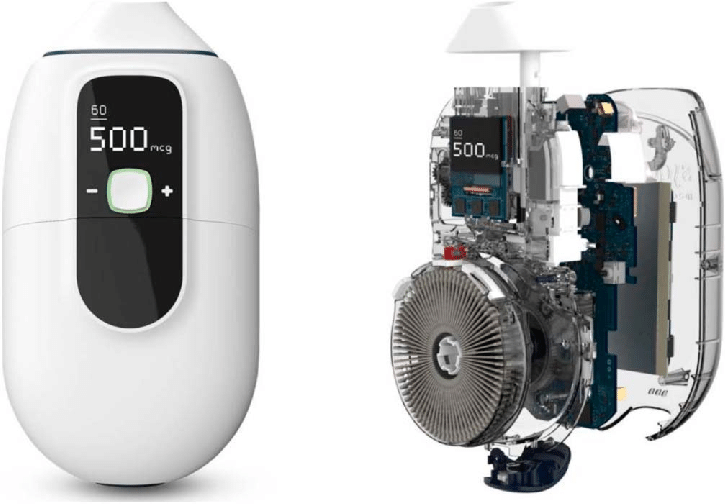
One of the challenges in cannabis as medicine is dosing (read this article on half of all medical cannabis drugs being mislabled). What’s written as THC or CBD concentration may be far from what’s inside the plant or how it affects your body, and how it’s delivered. Syqe, an inhaler dosing system in Israel promises to make dosing a pharmaceutical science, but in waiting for the coveted US FDA approval, Syqe says it needs to lay off 50 of its staff of about 150 based in Tel Aviv. If their product works they may be actually a solution to the mislabeling.
This backing gave Syqe financial muscle and strategic reach—but also raises reputation and strategic risks, given tobacco’s fraught public perception in the health space. Imagine if McDonald’s bought into a regenerative kale farm. The cash infusion could scale production, but people would always wonder if the lettuce was being served with a side of fries.
According to recent news Syqe Medical recently cut 50 employees, about 32% of its workforce, with the majority coming from its development (R&D) department. If the company succeeds or not, is only an insider’s guess. The inhaler uses a unique cartridge containing dozens of “VaporChips,” each holding a measured dose of cannabis flower, allowing accurate administration according to a doctor’s prescription. The question is does it work in dosing, can it work? Sometimes funds run out before the right tests can be checked and confirmed by the FDA.