Red Tide Blooms Threaten Gulf of Oman, Shut Down Kalba Desalinization Plants

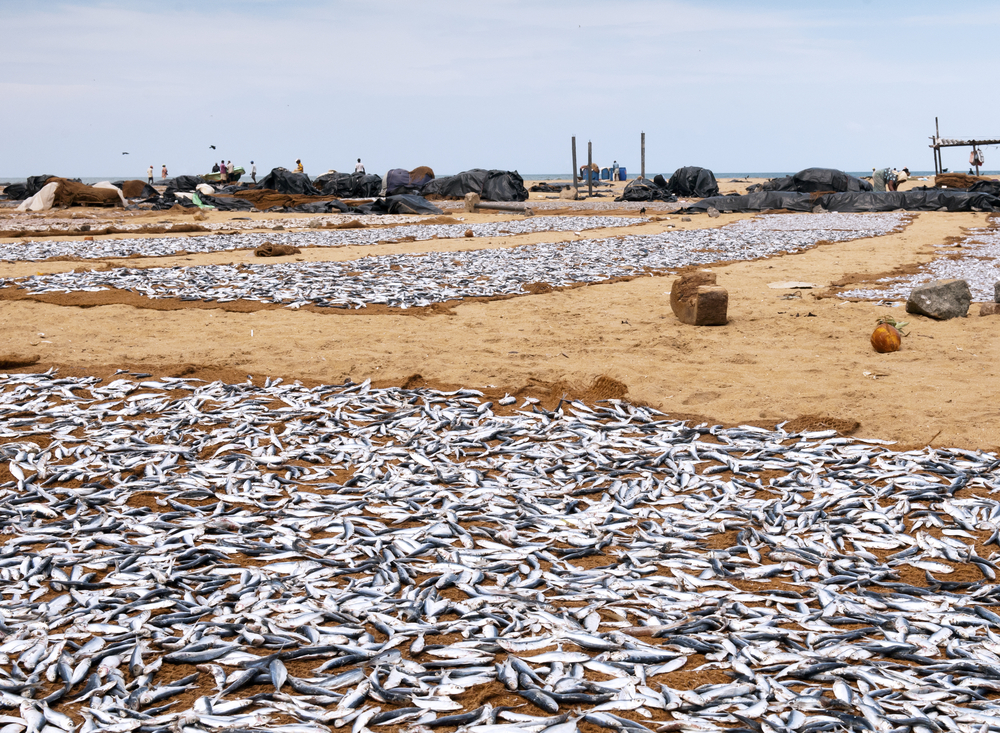
dead fish on beach red tideIs red tide a man-made pollutant or a natural phenomenon? Is it a plant, animal or chemical? The answer is all of the above.

The United Arab Emirates Ministry of Environment and Water indicates that red tide may be present in the waters of the Gulf  of Oman. As a precautionary measure, Sharjah Electricity and Water Authority (SEWA) shut down some desalinization plants in Kalba.

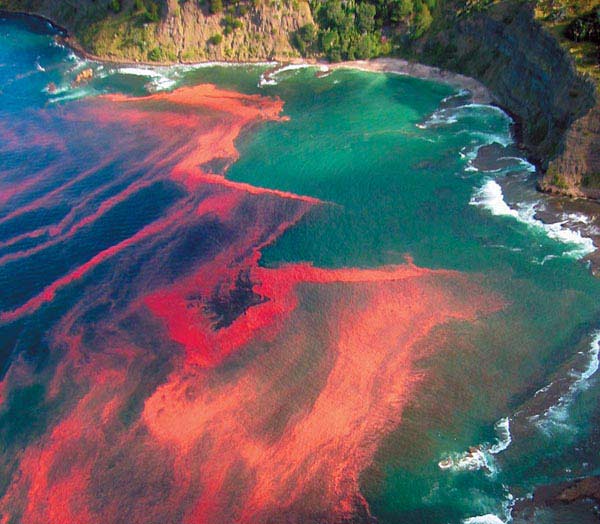
Red tide is caused by a population explosion in certain species of plankton. The poison these microorganisms produce is usually reddish or brown in color and is toxic to the nervous system of fish and many other vertebrates. Red tide outbreaks can cause large fish die-offs and impact other animals. A red tide in the Eastern Gulf of Mexico recently killed at least 174 endangered Florida Manatees by weakening their muscles so they could no longer lift their heads to breath. Red tide does not necessarily kill shrimp and other shellfish, but its toxin is concentrated in these animals and can be passed on to humans who consume them.
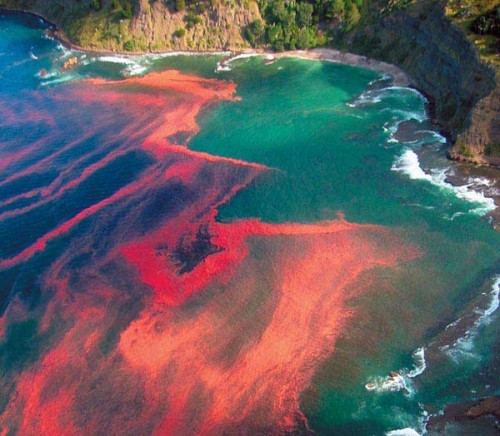
red tide iranYou might first notice red tide by the rancid smell of dead fish strewn across the beach and water. The sea turns a reddish-brown and then you begin to cough and then notice that others around you are also coughing and wheezing. You might have a wonderful shellfish meal and later succumb to a poison that may require hospitalization. Red tide kills fish, damages human health and economies.

I experienced the effects of a lingering red tide outbreak in the eastern Gulf of Mexico during the early 1990s. It infected my eyes and skin. Breaking waves would spray the toxin into the air, causing respiratory problems for people who lived near the sea. Friends wondered if red tide was a man-made pollutant or a natural phenomenon? Is it a plant, animal or chemical? The answer is all of the above.

Red tide is caused by living microorganisms known as dinoflagellates. These creatures sound like the invincible super monster of the sea. Like a plant they are capable of photosynthesis, but they can also move through the water, poison animals, capture prey, glow in the dark and go dormant for years before blooming back to life.

They can also reproduce and multiply into enormous numbers. The Red Sea may have taken its name from the red tide produced by a microorganism named Trichodesmium  erythraeum and some scholars believe red tide fits the description of the first biblical plague in Exodus where the Nile river turned to blood.

Red tide has been a part of the ocean ecosystem for millennia, but by providing dinoflagellates with the nitrogen and phosphorus fertilizer, people have tipped the balance in favor of red tide blooms. Blooms in the Middle East seem to be associated with winter storms which blow dust from the land into the sea. Nutrients from this dust spark the population explosion which leads to the red tide.

Photo of dead fish on beach via shutterstock

Red tide image credit: Carleton College


Brian Nitz
Brian Nitzhttp://www.greenprophet.com
Brian remembers when a single tear dredged up a nation's guilt. The tear belonged to an Italian-American actor known as Iron-Eyes Cody, the guilt was displaced from centuries of Native American mistreatment and redirected into a new environmental awareness. A 10-year-old Brian wondered, 'What are they... No, what are we doing to this country?' From a family of engineers, farmers and tinkerers Brian's father was a physics teacher. He remembers the day his father drove up to watch a coal power plant's new scrubbers turn smoke from dirty grey-back to steamy white. Surely technology would solve every problem. But then he noticed that breathing was difficult when the wind blew a certain way. While sailing, he often saw a yellow-brown line on the horizon. The stars were beginning to disappear. Gas mileage peaked when Reagan was still president. Solar panels installed in the 1970s were torn from roofs as they were no longer cost-effective to maintain. Racism, public policy and low oil prices transformed suburban life and cities began to sprawl out and absorb farmland. Brian only began to understand the root causes of "doughnut cities" when he moved to Ireland in 2001 and watched history repeat itself. Brian doesn't think environmentalism is 'rocket science', but understanding how to apply it within a society requires wisdom and education. In his travels through Europe, North America, Asia and the Middle East, Brian has learned that great ideas come from everywhere and that sharing mistakes is just as important as sharing ideas.
2 COMMENTS

Comments are closed.

Hot this week

Why Health Systems Are Reaching a Turning Point

Health emerges from a continuous energy and material flow from water through food to human physiology. Technical energy systems support this cycle through water treatment, agriculture, and infrastructure.

Sustainability That Sells: How Profit and Purpose Come Together in the Hive

Whether you are a commercial grower, hobbyist beekeeper or retail equipment supplier, this system opens a new income stream with minimal environmental impact.

The Fitness App Revolution: Building the Future of Wellness Through Strategic Development

In an era where smartphones are ubiquitous and health consciousness is at an all-time high, the fitness industry has undergone a radical digital transformation. Fitness applications have moved far beyond simple pedometers, evolving into comprehensive wellness platforms that serve as personal trainers, nutritionists, and community hubs right in our pockets.

A Brief History of Basil From India to Italy

Beloved, fortunate, sweet, and royal; an herb with a long and storied history in Asia and across the world. Called by many names, basil has featured in previous Green Prophet articles, so enjoy another serving, a brief history of basil.

How Renewable Energy is Revolutionizing the Way We Power Our World

Solar has become the star of the transition thanks to modular hardware and straightforward installation. It fits dense cities and remote towns alike. Many companies are turning to rooftop arrays and carport systems - and exploring commercial solar installation as a practical way to lock in future savings.

Topics

Why Health Systems Are Reaching a Turning Point

Health emerges from a continuous energy and material flow from water through food to human physiology. Technical energy systems support this cycle through water treatment, agriculture, and infrastructure.

Sustainability That Sells: How Profit and Purpose Come Together in the Hive

Whether you are a commercial grower, hobbyist beekeeper or retail equipment supplier, this system opens a new income stream with minimal environmental impact.

The Fitness App Revolution: Building the Future of Wellness Through Strategic Development

In an era where smartphones are ubiquitous and health consciousness is at an all-time high, the fitness industry has undergone a radical digital transformation. Fitness applications have moved far beyond simple pedometers, evolving into comprehensive wellness platforms that serve as personal trainers, nutritionists, and community hubs right in our pockets.

A Brief History of Basil From India to Italy

Beloved, fortunate, sweet, and royal; an herb with a long and storied history in Asia and across the world. Called by many names, basil has featured in previous Green Prophet articles, so enjoy another serving, a brief history of basil.

How Renewable Energy is Revolutionizing the Way We Power Our World

Solar has become the star of the transition thanks to modular hardware and straightforward installation. It fits dense cities and remote towns alike. Many companies are turning to rooftop arrays and carport systems - and exploring commercial solar installation as a practical way to lock in future savings.

How does one start prepping?

Faced with an extreme winter storm this year, Americans wonder how to be prepared for catastrophe. Miriam has lived through wars in the Middle East - so she's prepared on giving you a guide to prepping.

Fishermen sue tire manufacturers on behalf of the salmon

A federal trial in San Francisco has brought US tire manufacturers, fishing groups, and environmental scientists into court over a chemical most drivers have never heard of — but which scientists say may be silently reshaping aquatic ecosystems.

Listening to Water: Tarek Atoui’s Next Work for Tate Modern

Born in Beirut, Lebanon in 1980 and now living in Paris, Atoui has spent years building instruments that don’t sit comfortably in concert halls. Many of them involve water, glass, and ceramics — materials that react to sound instead of simply producing it.

Related Articles

Popular Categories