 Image via Tunisia Live
Having met strict regulations in the United States and other developed countries that have slowed down their ambitions, Shell has sought to use less developed nations as guinea pigs for an as-yet unproven shale gas extraction technology. But they have met surprise opposition in Tunisia, which boasts a relatively strong civil society despite the rising influence of Islamic extremists.
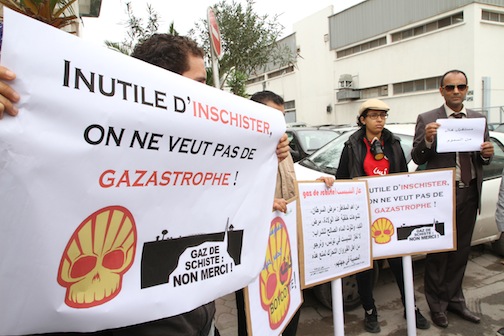
Dozens of activists from various environmental advocacy groups and other civil organizations gathered yesterday in front of the Tunisian Ministry of Industry and Energy to protest a budding relationship between the ministry and the energy giant.
Shale gas risks
Whilst shale gas extraction is not a new phenomenon, environmentalists and scientists caution that the process comes with high risk.
“Recent advances in horizontal drilling and hydraulic fracturing have made extraction of natural gas from shale formations more technologically and economically feasible,” according to the US Environmental Protection Agency.
“Hydraulic fracturing is a method of extracting natural gas from highly impermeable rock formations by injecting large amounts of fracturing fluids at high pressures to create a network of fissures in the rock formations and provide the natural gas a pathway to travel to the well for extraction,” they add.
But geologic pressure within the shale formation forces these fluids, called shale gas wastewater that contains high concentration of inorganic and organic chemicals, metals and “naturally occurring radioactive materials.
Improperly discharged or treated, this wastewater can pollute water supplies, a concern shared among Tunisian activists.
Putting lives at risk for profit
Hamma Hammami, secretary general of the Tunisian Worker’s Party, told Tunisia Live that the government’s consideration of Shell’s shale gas plans in the country are both careless and irresponsible.
“The government would put lives at risk in order to profit from the shale gas extraction,” he added.
Although the Tunisian Ministry of Industry and Energy, Lamine Chakhari recently told local news that they were planning to sign an agreement with the energy company, a spokesperson for the ministry, Youssef Hachemi, said that no such agreement has yet been signed.
Though Hachemi acknowledged the potential economical benefits, he said that the ministry is working the National Committee for Hydrocarbons to study the company’s proposal and have requested an environmental impact assessment.
Whilst a 2010 US EPA report shows that shale gas releases less greenhouse gas emissions than coal,”recent evidence suggests that methane has a global warming potential (GWP) that is 105-fold greater than carbon dioxide when viewed over a 20-year period and 33-fold greater when viewed over a 100-year period.”
“However, the U.N. Intergovernmental Panel on Climate Change (IPCC), a preeminent authority on this issue, ascribes a GWP of only 25 to methane over a 100-year period, and only 72 over a 20-year period.“
Meanwhile, “a 2011 study published in Climatic Change Letters controversially claimed that the production of electricity using shale gas may lead to as much or more life-cycle GWP than electricity generated with oil or coal.”
The continuing debate reveals a great deal of uncertainty, although residents of Pennsylvania, where shale gas extraction is well underway, have reported a slew of new health problems since companies started working near their homes.
Tunisia’s civil society
Meanwhile, countries in North Africa and the Middle East, including Egypt and Jordan, which are desperate to meet energy shortfalls, are easy targets for Shell. Unlike the United States, where a host of organizations are well-poised to fight the corporate giant, both these countries have weak environmental movements.
But Tunisia is proving to be harder to manipulate.
“AgriEcoForest, an environmental advocacy group, demanded that the Constituent Assembly order the immediate freezing of any activity related to the exploration and extraction of shale gas and the suspension of the license granted to Shell in the region of Kairouan,” said Achref Gharbi, secretary general of the association, according to Tunisia Live.
He also promised to boycott Shell products if the plans proceed.