

 Dirty, polluted, and badly managed: Understanding Cairo, The Logic of a City Out of Control goes beyond the usual rhetoric
“The Egyptian middle classes and intelligentsia, as well as a sizable slice of the foreign community, love to deplore what Cairo has become. Crowds and congestion, pollution, garbage, chaos, gridlocked traffic, horrendous architecture, and no green space, all are endlessly invoked to describe the mess that Cairo has become.”
This is how David Sims, a Cairo based urban planner and economist, puts it. And whether one reads Egyptian newspapers or publications on urban planning, this is how Egypt’s capital city is usually depicted. Sometimes part of an appeal to change just about everything, rarely is checked whether these descriptions are fact or fiction.
Sim’s book distinguishes itself from others by going beyond the usual complaining.
Instead, it tries to understand how these phenomena were created and continue. Quickly, the erroneously narratives about the necropolis or the rooftops, which would both house close to half a million people, are dealt with. And when what is told about Cairo appears to be more than just a lie, the informal settlements for example, he starts investigating them.
As such, Sims shows us that Cairo’s radical population-increase didn’t make the number of inhabitants of the formal city increase.
No, it were the “ashwa’iyyat” (informal areas) that absorbed Cairo’s growing population. The never-ending informal settlements nowadays accommodate more than ten million people and they only germinated half a century ago.
But this “order without design” is not what the governments or the elites preferred. Policy-makers always tried to stop the informality by putting laws in place and offering an alternative to cope with population growth.
They thought: “Why would you build on valuable agricultural soil when there’s so much desert to be wasted?” and launched initiatives to build new desert cities.
It didn’t work.
Forty years of heavy investments later the desert cities barely house six hundred thousand inhabitants and informal building is still thriving.
“Understanding Cairo” doesn’t limit itself to what went wrong. In the 70’s it was generally assumed that a Cairo with more than 9 million people would not function. No car would be able to move, air pollution would be intolerable and the city would be unliveable.
But with almost 20 million people it still functions. Cairo even appears to outperform similar Third World cities. Traffic goes remarkably smooth, and its housing improved overtime. But how?
Read the book and find out.
While “Understanding Cairo” isn’t about sustainability, David Sims surely grasps the concept. He in fact teaches us a valuable lesson. Without understanding a city’s dynamics one cannot create a good vision.
::Buy Understanding Cairo here
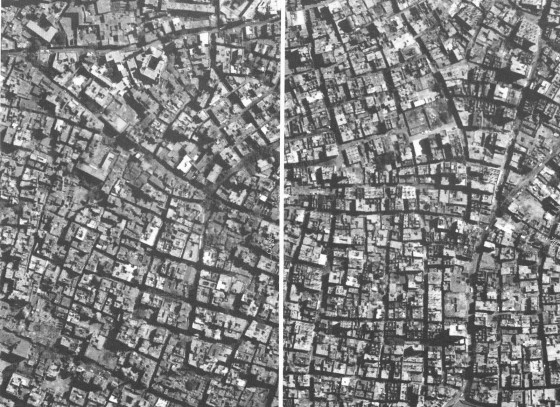
Above image:”Contrasting urban fabrics over nine hundred years. Top: the Bab al-Wazir area of historic Cairo (developed in the eleventh century); bottom Fustat Plateau area (developed in the 1980s). David Sims, Understanding Cairo, The Logic of a city out of control, p. 117″



Euhm,
You forget to mention why Egypt doesn’t fall in the developing nations category. Is it too rich, or too poor? And with which mayor third world cities do you compare it? I don’t have the book with me anymore, but the author wasn’t comparing it with the poorest cities in the world (so not with Port-aux-Prince or Moghadishu for example) but with important megalopolises like Bombai, Sao Paulo, etc (am just guessing them, so don’t shoot me if I get it wrong). Why would the intelligentsia want to claim Egypt to be a developing country while it isn’t?
And the third comment, that’s of course what we all know as the environmental Kuznets curve. Cairo actually has a relative low degree of car ownership (compared to the cities mentioned above), especially in the informal areas (not in Doqqi or Mohandiseen).
I love that article,
however the comparison to other “third world” countries is a bit inacceptable for me.
First, the term itself is a bit dodgy, but I’m not a friend of general Neusprech anyway.
Second, Egypt with especially Cairo does not fall into this category of “developping nations” or however we name it, even if its intelligentsia wants to claim it that way sometimes.
Third, the more a popluation develops economically the less the infrastructure should work in the medium or short term… meaning all the other “third world” cities i’ve been to, had remarkably effecient infrastructure (much btter than Cairo), since few people own cars to block the road.
Thanks