
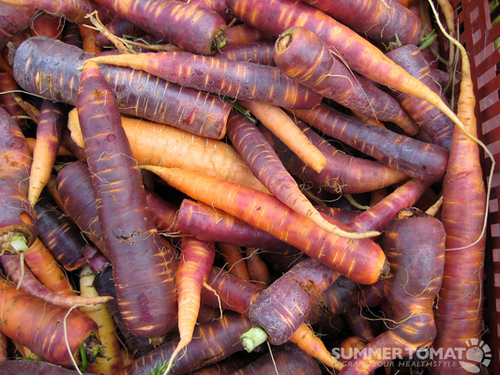

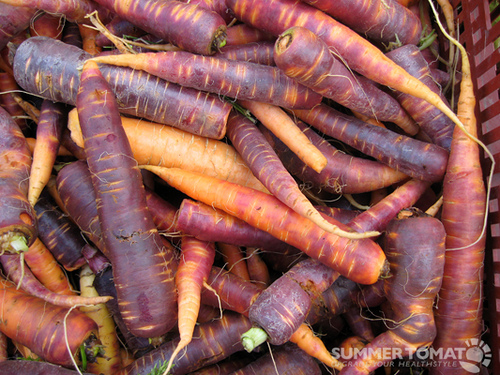
 Originating in ancient Egypt, carrots didn’t start out so orange. Can you imagine how Bugs Bunny would look chomping down on one of these?
When you think of carrots what is the first thing that comes to mind? One thing is for sure, you don’t think “Gee, you mean that long purple vegetable.” Well here’s news for you, the original color of the carrot was not orange! Carrots originated in Middle Asia with some historians believing that they were known as far back as Ancient Egypt over 5,000 years ago. It is not clear if they were actually cultivated at this time, however by the 10th century in Afghanistan, they were being grown in the colors purple or yellow.
These weren’t the only colors around, however. In addition to purple and white, carrots were grown in red, yellow and even black. In fact to begin with carrots were not favored as a favorite vegetable, but rather in the times of the Ancient Romans, as a medicinal herb and even as an aphrodisiac. A “green” aphrodisiac at that.
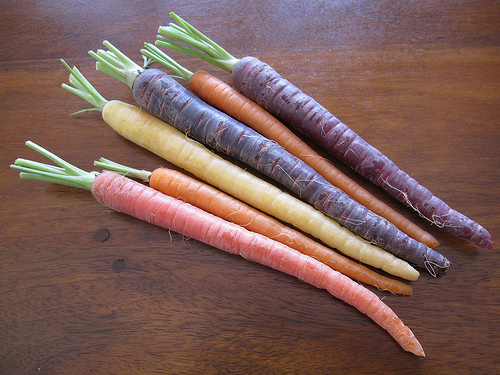
Here’s a simple way to add colour onto your table
Today we know that carrots have great nutritional value being low in calories. Not only that but carrots are an excellent source of carotene, which the body converts into Vitamin A. It is this particular vitamin that really helps with vision, which is why carrots are a great vegetable to add to your diet. If you ask us, your natural advisor? Search no more! Carrots are the thing!
Blame it on the “orange” Dutchmen
When you are preparing your carrots for eating, whether you plan on cooking them or eating them raw, there is something important to keep in mind: don’t peel the skin! In carrots, like many vegetables, most of the nutritional value is just below the skin, so instead of peeling, just scrub the skin clean. And choose organic varieties when you can.
So our popular orange carrot of today, isn’t even one of the original, natural color. Actually it is the product of cross breeding the red and yellow carrots. In the 16th century some Dutch farmers succeeded in growing the first orange carrots in honour of the House of Orange. It is this color carrot, which is most widespread today.
So when you are next making a delicious carrot salad, think just how much more colorful purple would look on your table. Try a local farmer’s market, or health food store near you and taste the difference. Or look for a way near you to order seeds of heirloom varieties of ancient carrots.
Read more on vegetables and health:
How green is your garlic
RECIPE – Flavors of Peasant Cooking: Majadra Means Lentils and Rice
Conserve What You Eat




Most carrots were purple before Dutch growers make them orange.
The juice is dark purple as in this video https://youtu.be/AZwSTWkY2q0
Yes there are a lot of versions of the origin of orange carrots and the apocryphal Dutch tale. We can only go on verified documentary evidence and that is what the Carrot Museum explains and examines. There is no record of the “invention” of orange carrots to honour the Royal Orange Family.
The fact remains that there were orange carrots as early as 512ad and nowhere near Holland or the 16thC!
Well I guess there are alot of versions to that story out there, so thanks for the correction. Either way, it is definitely interesting to note that orange was not the original colour!
There’s a World Carrot Museum?? :O
Orange carrots are NOT a result of cross breeding between red and yellow, it does not work like that in nature.
Orange was probably developed from a found mutant in the wild.
The Dutch developed orange carrots to make a stable and consistent vegetable, not to honour the House of Orange, that is simply a romantic tale with no historical evidence to back it up.
The World Carrot Museum has the full history of carrots.
Well done, John. As a representative of the Carrot Museum, I guess you have the upper hand.
Can we interview you about the “true” history of the carrot?