
 The world is on fire: once confident Europeans are now reeling from an energy crisis. Mortgage rates are skyrocketing, the cost of food is becoming crazy (Yemenites are starving), gas prices are crippling Canada and the US, yet somehow architects who claim to be sustainable leaders are laughing all the way to the bank.
It’s reasonable that the prince of Saudi Arabia, Mohammed bin Salman, Crown Prince and Chairman of Neom wants what he wants: endless opulence fuelled by oil money to dazzle the west with fake grandeur. The joke is that western architect firms participate in these scandals. The latest is a winter wonderland village that Saudi Arabia will build in the middle of the desert as part of Saudi Arabia’s climate nightmare city Neom.
Trojena part of Vision 2030
“Trojena will redefine mountain tourism for the world by creating a place based on the principles of ecotourism, highlighting our efforts to preserve nature and enhance the community’s quality of life, which is aligned with the goals of the Kingdom’s Vision 2030,” he said in a statement.
“It also confirms our commitment to be part of the global effort to protect the environment. Trojena will be an important addition to tourism in the region, a unique example of how Saudi Arabia is creating destinations based on its geographical and environmental diversity.”
Nice statements but what’s the carbon footprint of building a giant resort in the middle of a pristine desert. What kind of magical renewable energy does the prince of Saudi Arabia think will run this project? 
Saudi Arabia won the bid to host the 2029 Asian Winter Games at what will be called its Trojena resort, designed by Zaha Hadid Architects (Zaha Hadid passed away a number of years ago at a young 65), The Holland-based UNStudio, UK’s Aedas, German’s LAVA and Bureau Proberts from Australia.
Have any of these firms no sense to say that the Emperor of Saudi Arabia is wearing no clothes?
Distorted applications of renewable energy
These firms that talk about sustainability (and remove themselves from airport projects) like they actually care about the state of our climate, are designing the 2029 Asian Winter Games for a 50-mile skiing and outdoor activity resort that is set to be completed in 2026 as part of Neom. It will operate all year long as a ski resort in the colder months, and a wellness retreat in the warmer.
“Trojena will have a suitable infrastructure to create the winter atmosphere in the heart of the desert, to make this Winter Games an unprecedented global event,” explained Neom chief executive Nadhmi al-Nasr.
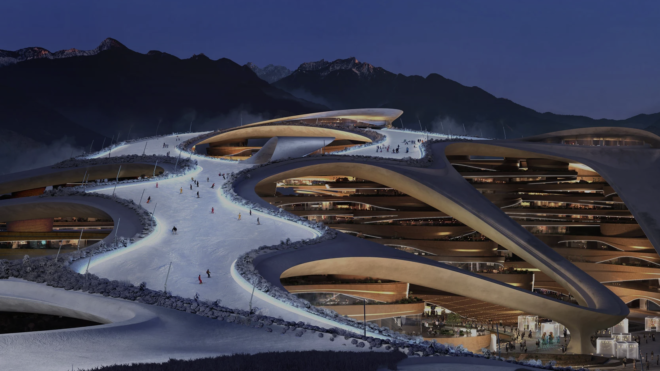
The Olympic Council of Asia picked the Saudi candidacy: “The deserts and mountains of Saudi Arabia will soon be a playground for Winter sports!” the OCA said in a statement announcing its decision early this month.
The International Olympic Committee said on Wednesday it was not consulted in the decision by the Olympic Council of Asia to pick Saudi Arabia as the hosts of the 2029 Asian winter Games, reports Reuters.
Foreign starchitects plan Saudi’s future
The firm Lava master-planned the resort, which will offer winter skiing, making it the first outdoor ski location in the country.
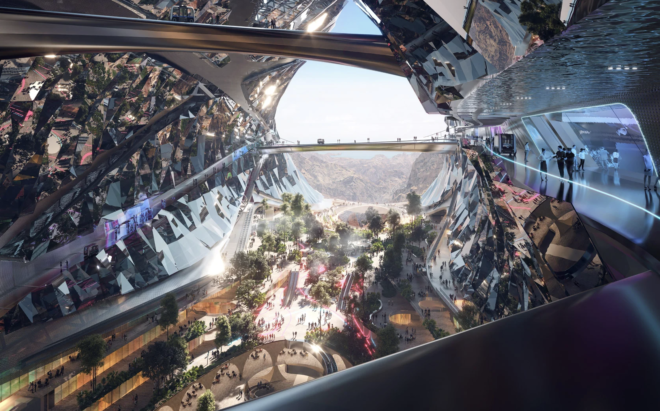
The same firm, Lava, also designed a futuristic folded-vertical village for Trojena, see above.
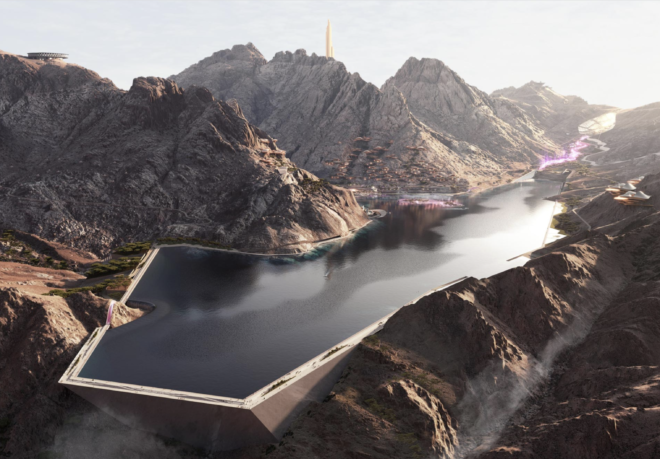
Location of Trojena, part of Neom
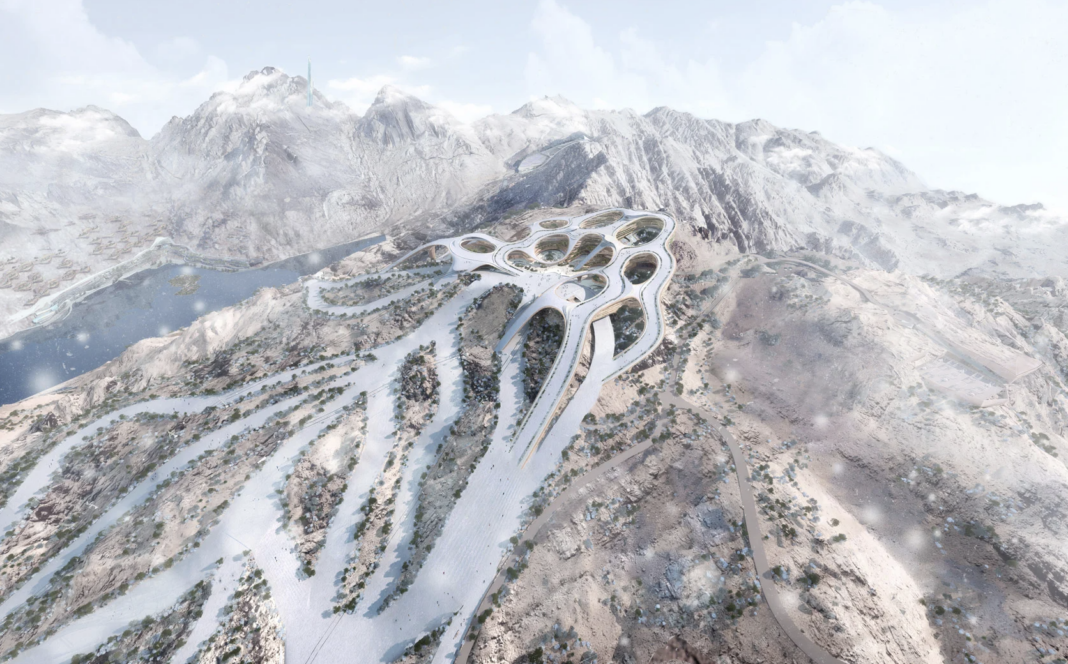
Geographically speaking, Trojena is located about 30 miles (or 50km) from the Red Sea coast and is close to the border of Jordan. While the majority of Saudi Arabia is a desert climate, the southwestern part where Trojena will be built is semi-arid. It will be part of a massive development project called Neom.
The exact site is to be constructed on a mountain across the sea from Mount Sinai, called Jabal al-Lawz, also known as Gebel el-Lawz, which is a mountain located in northwest Saudi Arabia, near the Jordanian border, above the Gulf of Aqaba at 8,465 feet above sea level. The name means ‘mountain of almonds’.
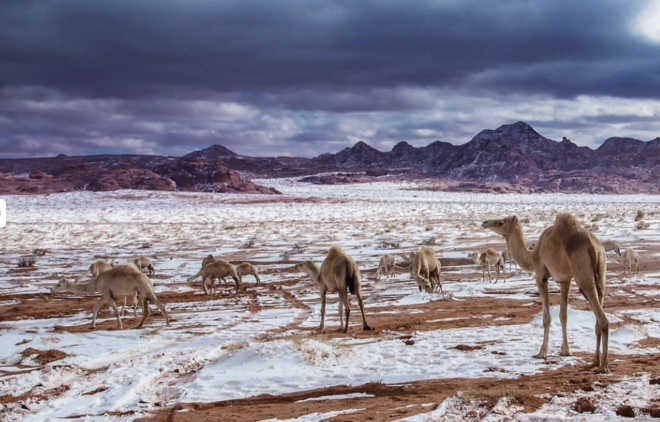
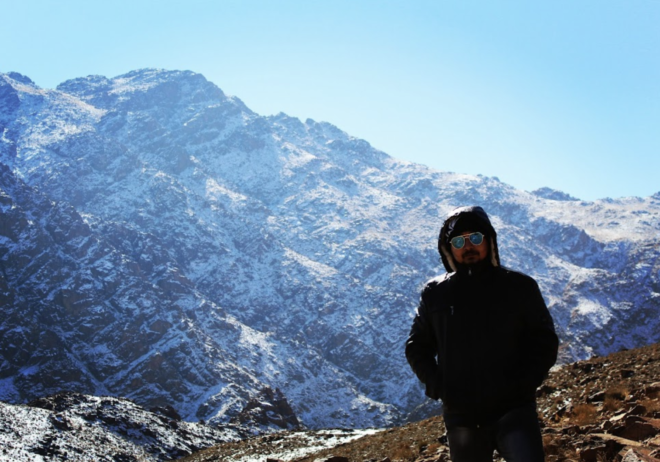
The peak of Mount Lawz, consists of a light-colored, calc-alkaline granite.
 A man-made freshwater lake designed by Bureau Proberts, of Australia will need to be full of water year-round to fuel the snow machines, while Zaha Hadid Architects “came up with other elements of the design”, reported the Neom team in a press release.
Weather patterns in Trojena, Neom
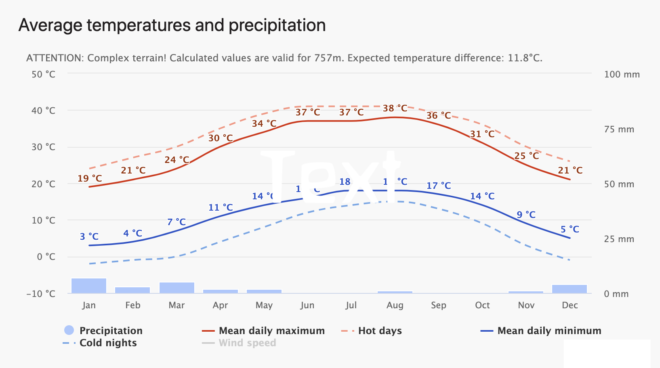
The best temperatures for making snow are between -5°C (23°F) and -25°c (-13°F). Too warm, ski resort owners report and their machines are too expensive to run. The ideal conditions are dry and cold. Only for a short window, in January, do temperatures at the proposed Trojena site, dip below 0°C.
Trojena advertises its skiing will be open December to March. Wellness season, adventure season and lake season, the rest of the year.
Snow machines’ carbon footprint
Based at the University of Colorado-Boulder, the National Snow and Ice Data Center (NSIDC) conducts studies on changing weather patterns and climate change and the effects of climate on snow and snow production in the United States.
NSIDC, software developer Julia Collins has some thoughts on snowmaking. She’s not a fan. “If the weather is too warm, it doesn’t do any good, and it has a carbon footprint,” she says.
Architecture magazines such as Dezeen continue to advertise bombastic planet-sabotaging projects as though they are revolutionary.
Commenters on Dezeen magazine, on the other hand, offer their sobering view:
“Starchitects (and especially those who aren’t themselves, but work by borrowing the fame of somebody else) are truly miserable as they will do anything for money,” said one.
“Just save everyone some time and pump oil right onto the mountains and then light it on fire,” said another.
“It just goes to show that money can buy anything, except taste, morals, common sense, principles, ethics etc.”
… are some of my favorites.