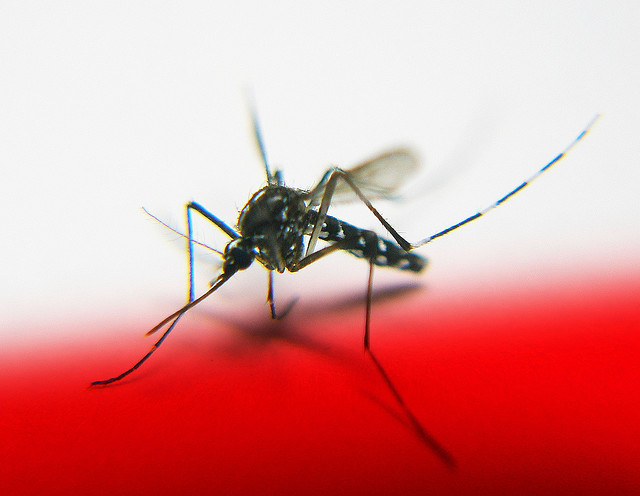
Mosquitoes. Those pesky creatures that suck your blood and if you are lucky, just make you scratch. They do have one major negative role, however, – as airborne carriers of serious diseases from malaria to Zika. They congregate around water, from little puddles to large lakes.
Since covering our water sources in pesticides is not possible anymore (we know about the health effects) eradication is difficult. Scientists from Israel’s Ben-Gurion University who call themselves FlyGEM, has come up with a genetically engineered solution – have the males transfer a bacteria to the females which produces a poison that kills mosquito larvae shortly after birth. The team and their advisors have filed a patent on the idea after competing for a solution to presentat the the iGEM Competition – an international team competition to promote synthetic biology held annually in Boston.
The meeting is a good motivator for getting a group of undergraduate students to brainstorm and then experiment with unique out-of-the-box ideas on a tight one-year deadline. Past teams have focused on the plastic problem, on ALS and other diverse topics.
FlyGEM decided to tackle the problem of mosquitoes. During their literature review, the young scientists found that there is a bacteria in the mosquito’s gut called BTI, which, when activated, produces a poison that only kills mosquito larvae. The problem was how to get it to the larvae. Infecting female mosquitoes was out of the question – it’s illegal to release female mosquitos into the wild in Israel, as it is in most countries, because they’re airborne disease vectors.
So, the team was faced with how to get the poison to the larvae through the males. They tweaked the male mosquito’s gut microbiome to express BTI and then sent it on its way to find and mate with the females. The females then put the bacteria on the eggs, and when the larvae are born, most of them die. What’s more, the other larvae eat the dead ones, the team discovered, and then die themselves.
Since the poison comes from the mosquito’s own gut and is only lethal to other mosquitos, the students feel they have discovered a delivery mechanism that far surpasses current human-orchestrated ones based on pesticides.
The team is advised by Prof. Lital Alfonta and Dr. Ramon Birnbaum of the Department of Life Sciences. The students also consulted Prof. Uri Abdu and Prof. (Emer.) Arieh Zaritsky of the Department of Life Sciences and Dr. Ido Tzurim and Prof. Eitan Ben-Dov of Achva College.
Team leader Mey Tal Banar, “After an incredible year, I am a great believer in the project and the product that we will present: a targeted, innovative method that could replace the current methods of global mosquito control. I want to thank the project’s executive team, our advisors and the teaching assistants. Without their guidance and support, we would not have gotten this far. And our thanks to the department and to the University for the opportunity to participate in this challenging international competition.”
Prof. Lital Alfonta, one of the project’s advisors, “The students’ progress over a single year has been impressive and unusual. After a further pilot project in urban areas to test out our method, there is a good chance that this will become humanity’s next biological pest control method. For now, we have focused on a single type of mosquito, Aedes aegypti, [that can spread dengue fever, chikungunya, Zika fever, Mayaro and yellow fever], but we have the ability to target other disease-carrying mosquitoes.”
The FlyGEM website