
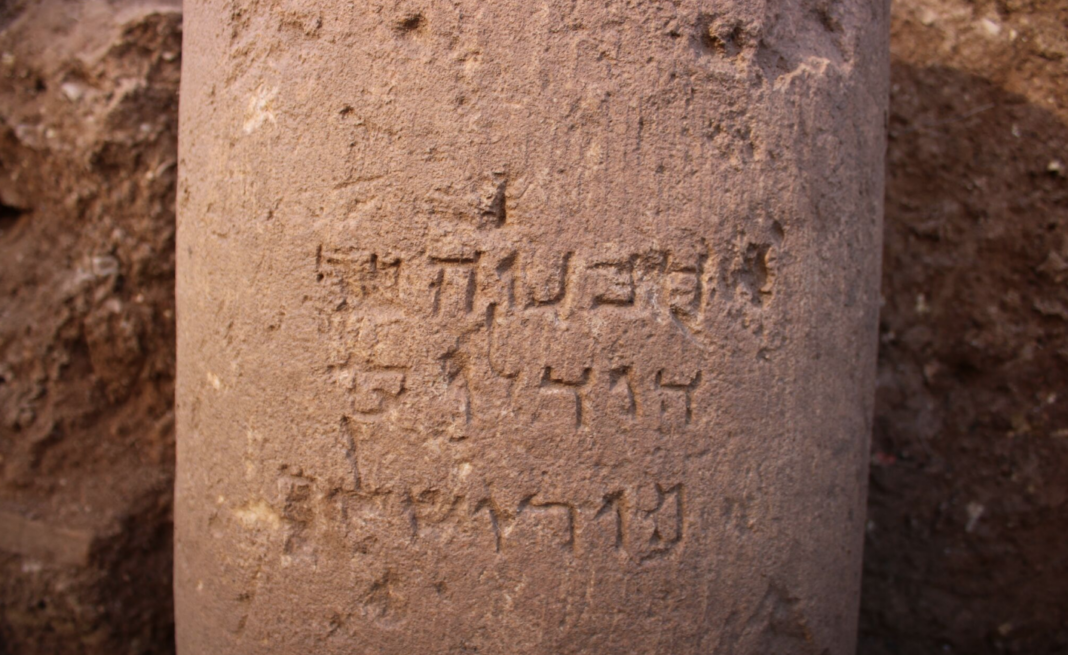


An exciting find from Jerusalem was presented for the first time today (Tuesday) during a joint press conference of the Israel Antiquities Authority and the Israel Museum: a unique stone inscription dating to the Second Temple Period (First Century CE), mentioning Jerusalem, written in Hebrew letters, and using the spelling as we know it today.
The inscription was found this last winter near Binyanei Ha’Uma, during an excavation directed by the IAA’s Danit Levy, prior to the construction of a new road, undertaken and funded by Moriah – the Jerusalem Development Company and the Jerusalem Development Authority. During the excavations, the foundations of a Roman structure were exposed, which were supported by columns. The most important discovery was a stone column drum, reused in the Roman structure, upon which the Aramaic inscription appears, written in Hebrew letters typical of the Second Temple Period, around the time of Herod the Great’s reign.
The inscription reads:
Hananiah son of
Dodalos
of Jerusalem
Prof. Ido Bruno, Director of the Israel Museum, stated: “As a resident of Jerusalem, I am extremely excited to read this inscription, written 2,000 years ago, especially when I think that this inscription will be accessible to every child that can read and uses the same script used two millennia ago. The important and interesting cooperation between the IAA and the Israel Museum, brought to light in the handling and display of new finds, provides an opportunity for the public to be exposed to important discoveries from all over the country, learning about the ancient cultures that developed in Israel over generations.”
Dr. Yuval Baruch, Jerusalem Regional Archaeologist of the Israel Antiquities Authority, and Prof. Ronny Reich of Haifa University, who read and studied the inscription, note that “First and Second Temple period inscriptions mentioning Jerusalem are quite rare. But even more unique is the complete spelling of the name as we know it today, which usually appears in the shorthand version. This is the only stone inscription of the Second Temple period known where the full spelling appears. This spelling is only known in one other instance, on a coin of the Great Revolt against the Romans (66-70 CE). The unusual spelling is also attested to in the Bible, where Jerusalem appears 660 times, with only 5 mentions – of a relatively late date – having the full spelling (Jeremiah 26:18, Esther 2:6, 2 Chronicles 25:1, 2 Chronicles 32: 9, and 2 Chronicles 25: 1).”
According to Dudy Mevorach, Chief Curator of Archaeology at the Israel Museum, “the archaeological context of the inscription does not allow us to determine where it was originally displayed, or who Hananiah son of Dodalos was. But it is likely that he was an artist-potter, the son of an artist-potter, who adopted a name from the Greek mythological realm, following Daedalus, the infamous artist. It is interesting that he decided to add his origin from nearby Jerusalem to his family name.”
In the area of Binyanei Ha’Uma, where the unique find was discovered, excavations have been conducted for many years – most recently by Danit Levy and Dr. Ron Be’eri, of the Israel Antiquities Authority, who slowly exposed extensive portions of a potter’s quarter, which produced vessels for Jerusalem for a period of over 300 years, spanning the Hasmonean Period through to the Late Roman era. According to Danit Levy, “This is the largest ancient pottery production site in the region of Jerusalem.” In the latter part of the Second Temple period, particularly during Herod’s reign, the production was focused on manufacturing cooking vessels. The production installations were found spread across the site, organized into manufacturing units that included kilns, pools for preparing clay, plastered water cisterns, ritual baths, and work spaces for drying and storing the vessels. Alongside the area where the pottery was produced, a small village developed, whose economy was based on pottery production.
The pots were sold in large quantities to the population in Jerusalem and its environs, and those arriving at its gates – in particular the pilgrims arriving in the city. Subsequent to the destruction of Jerusalem in 70 CE, the potter’s workshop resumed its activities on a small scale, until the early 2nd Century CE, when the Roman 10th Legion established its workshop on the site, for the mass production of ceramic building materials – rooftiles, bricks, and pipes, alongside tableware, cooking ware and storage vessels, typical of the Roman army. The legionary kilns and its products are on display in the convention center at Binyanei Ha’Uma and at the Israel Museum.
Beside the unique inscription, two additional finds will be on display at the Israel Museum, beginning tomorrow. The first is a Greek mosaic inscription of the 6th Century CE, exposed near Damascus Gate, commemorating the construction of a public building in Jerusalem in the Byzantine period – likely a hostel – by the emperor Justinian and an abbot by the name of Constantine.
Both are mentioned together in another inscription commemorating the construction of the grand Nea Church, exposed in the Jewish Quarter excavations in the 1970’s, already displayed in the Israel Museum. Both attest to the development of the city some 1,500 years ago by the empire, as part of the mass pilgrimage of Christians to the Holy Land in this period.


