

I am with Elon Musk and his dream to move to Mars. I have always had a feeling that we’re not alone.
For decades, scientists searching for extraterrestrial intelligence have focused on one specific type of radio signal, extremely narrow spikes in frequency. These “narrowband” signals are considered strong candidates for technological transmissions because natural astrophysical processes rarely produce them. However, new research from the alien-hunting organization, the SETI Institute, suggests alien signals might be harder to detect than previously thought, not because they do not exist, but because they may become distorted before leaving their home star systems.

The study, published in The Astrophysical Journal, explores how stellar “space weather” could blur radio transmissions from distant civilizations. Turbulent plasma near stars, including charged particles carried by stellar winds and eruptions such as coronal mass ejections, can interfere with radio waves as they travel outward from a transmitting planet. Even if a civilization sends a perfectly narrow signal, the plasma surrounding its star could spread the signal’s energy across a wider range of frequencies.
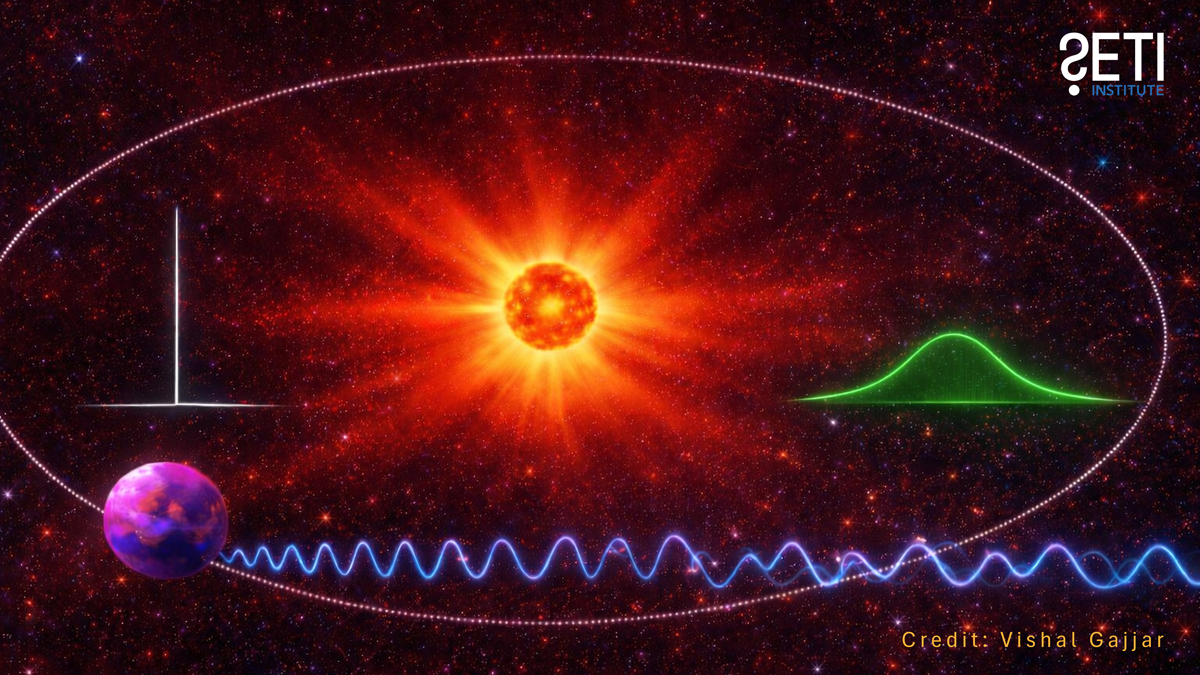
surroundings plasma winds into a wider, fainter signal (right, green). The study suggests we may
be missing signals by mostly looking for the sharp white shape instead of the broader green one
(credit: Vishal Gajjar).
This process weakens the signal’s peak strength and makes it more difficult for traditional SETI detection systems to identify. Many current search pipelines are optimized to detect ultra-sharp signals, meaning broadened transmissions could slip below detection thresholds.

“SETI searches are often optimized for extremely narrow signals,” said Dr. Vishal Gajjar, astronomer at the SETI Institute and lead author of the study. “If a signal gets broadened by its own star’s environment, it can slip below our detection thresholds, even if it’s there, potentially helping explain some of the radio silence we’ve seen in technosignature searches.”

To understand how strong this effect might be, researchers studied radio transmissions from spacecraft within our own solar system. By measuring how solar plasma affects these signals, the team developed models that estimate how stellar turbulence might distort transmissions in other planetary systems.
Their findings suggest the effect could be particularly strong around M-dwarf stars, small and active stars that make up roughly 75% of the Milky Way’s stellar population. Because these stars often produce intense stellar activity, signals from planets orbiting them could become significantly broadened before escaping the system.
The research suggests future SETI searches may need to expand their approach, developing detection systems capable of identifying signals that have been smeared or broadened by stellar environments, not just perfectly narrow ones. By accounting for how stellar activity reshapes radio transmissions, scientists hope to design searches that are better matched to what actually arrives at Earth, potentially revealing signals that have so far remained hidden.