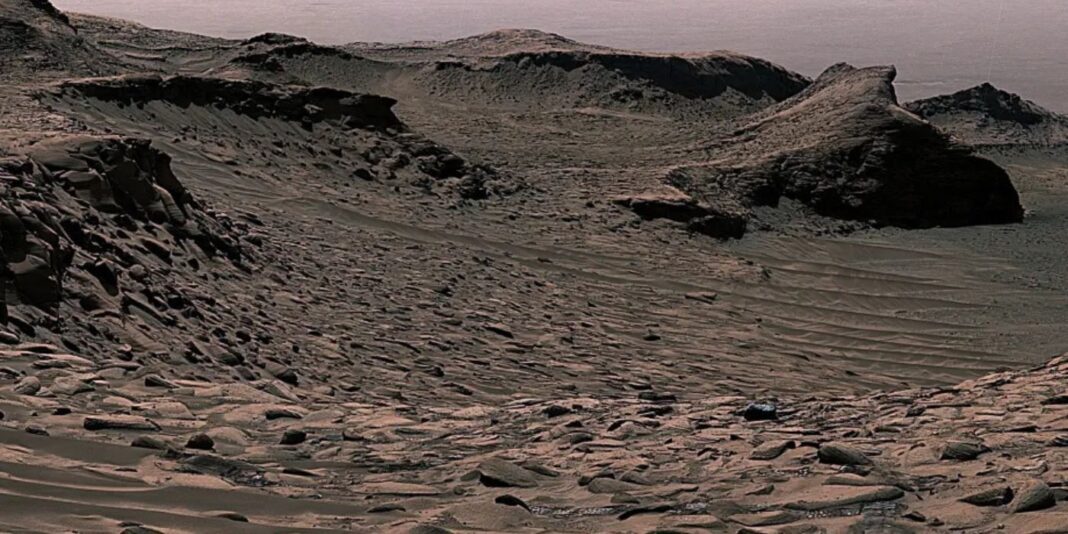


We have heard that peak climate change might be in sight. Does Mars have more clues about our future? Travelling from Mars’s equator toward its northern latitudes, planetary scientists reach a region called Coloe Fossae — a landscape carved by deep valleys, collapsed blocks of terrain, scattered craters, and remarkably, the fingerprints of a long-vanished ice age. New high-resolution images from ESA’s Mars Express mission offer the clearest evidence yet that the Red Planet once cycled through dramatic shifts in climate, much like Earth.
Earth has experienced several major ice ages over the past 2.5 billion years, the most recent peaking around 20,000 years ago when global temperatures fell to 7–10 °C. These events are driven by natural changes in Earth’s orbit and axial tilt — processes known as Milankovitch cycles. They bear no relation to modern, human-driven global warming, which scientists continue to warn about the climate crisis.
Mars, too, has undergone its own glacial rhythms. The new Mars Express imagery shows long, parallel lines cutting diagonally across Coloe Fossae — fractures created as alternating segments of ground collapsed over geological time. Scattered across the area are craters of every age and state: fresh and sharp-edged, or softened by erosion.
On the crater floors and valley bottoms lie the most intriguing features: swirling, textured patterns known as lineated valley fill and concentric crater fill. These formations arise when icy debris slowly flows, glacier-like, across the surface before becoming coated with rock and dust. On Earth, similar structures are found in glaciated mountain ranges and polar regions.
What makes Coloe Fossae especially fascinating is its latitude: 39°N — far from Mars’s polar caps. How did ice accumulate so far south?
The answer lies in Mars’s shifting axial tilt. Unlike Earth, whose tilt is stabilized by its large Moon, Mars wobbles chaotically over millions of years. During periods of extreme tilt, ice can migrate from the poles into mid-latitudes. Throughout multiple cold phases, glaciers spread outward and then retreated, leaving behind the flows and fills visible today. Scientists believe this region may have been covered in ice as recently as 500,000 years ago, when Mars’s most recent ice age ended.
The broader region, known as Protonilus Mensae, marks the dramatic boundary between Mars’s smooth northern lowlands and heavily cratered southern highlands. In some places, this global divide rises as a cliff two kilometers high; in others, like Coloe Fossae, it is a rugged transitional zone shaped by glaciers, impacts, and tectonic collapse. Similar features were observed in Acheron Fossae, highlighted in a previous Mars Express release.
These discoveries deepen our understanding of Mars as a dynamic planet with a shifting climate — and may even inform future studies of how planetary climates evolve, including our own,