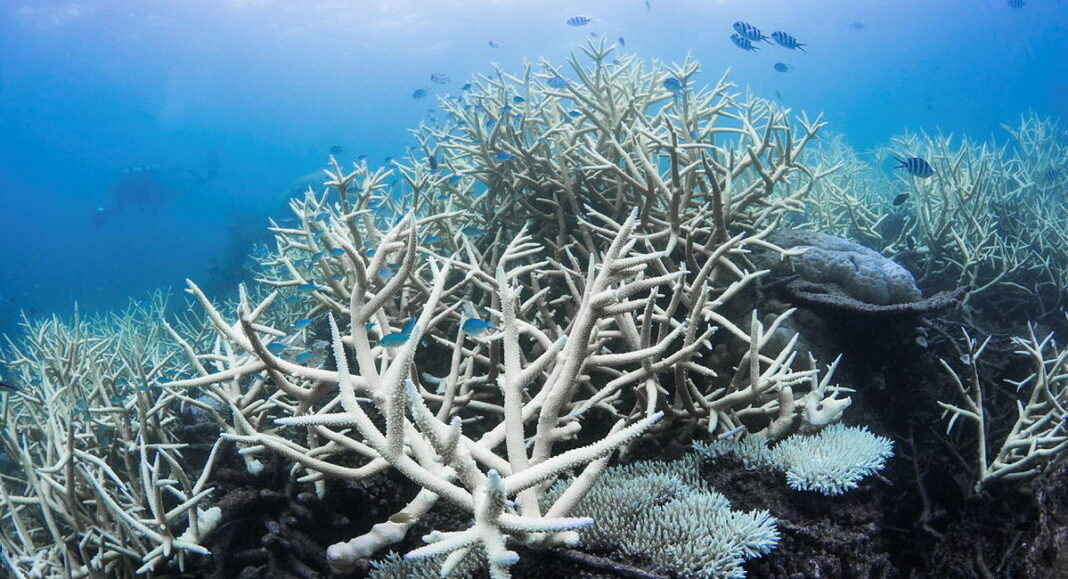


Widespread mortality of warm-water coral reefs under way, as world reaches first tipping point
The world faces a “new reality” as we have reached the first of many Earth system tipping points that will cause catastrophic harm unless humanity takes urgent action, according to a landmark report released by the University of Exeter and international partners.
With ministers gathering ahead of the COP30 summit, the second Global Tipping Points Report finds that warm-water coral reefs – on which nearly a billion people and a quarter of all marine life depend – are passing their tipping point. Widespread dieback is taking place and – unless global warming is reversed – extensive reefs as we know them will be lost, although small refuges may survive and must be protected.
We are on the brink of more tipping points, with devastating risks for people and nature: the irreversible melting of polar ice sheets, the collapse of key ocean currents and the dieback of the Amazon rainforest – where COP30 will be held.
With global warming set to breach 1.5°C, the report – by 160 scientists at 87 institutions in 23 countries – argues that countries must minimise temperature overshoot to avoid crossing more tipping points. Every fraction of a degree and every year spent above 1.5°C matters.
Green Prophet published an IRENA report today that shows while we’ve made progress in renewables, we aren’t going to make targets unless we double up.

Action to trigger “positive tipping points” of self-propelling change – such as the rollout of green technologies – now offers the only credible route to a safe, just and sustainable future, the report says.
The researchers are working with Brazil’s COP30 Presidency to ensure that tipping points are on the agenda at the summit.
Professor Tim Lenton, from the Global Systems Institute at the University of Exeter, said: “We are rapidly approaching multiple Earth system tipping points that could transform our world, with devastating consequences for people and nature. This demands immediate, unprecedented action from leaders at COP30 and policymakers worldwide.
“In the two years since the first Global Tipping Points Report, there has been a radical global acceleration in some areas, including the uptake of solar power and electric vehicles. But we need to do more – and move faster – to seize positive tipping point opportunities. By doing so, we can drastically cut greenhouse gas emissions and tip the world away from catastrophic tipping points and towards a thriving, sustainable future.”
Dr Mike Barrett, chief scientific advisor at WWF-UK and co-author of the report, said: “The findings of this report are incredibly alarming. That warm-water coral reefs are passing their thermal tipping point is a tragedy for nature and the people that rely on them for food and income. This grim situation must be a wake-up call that unless we act decisively now, we will also lose the Amazon rainforest, the ice sheets and vital ocean currents. In that scenario we would be looking at a truly catastrophic outcome for all humanity.

“As we head into the COP30 climate negotiations it’s vital that all parties grasp the gravity of the situation and the extent of what we all stand to lose if the climate and nature crises are not addressed. The solutions are within our reach. Countries must show the political bravery and leadership to work together and achieve them.”
The report says that the nature of abrupt and irreversible Earth system tipping points mean that they pose a different type of threat to other environmental challenges, and that current policies and decision-making processes are not adequate to respond. Global action must include accelerating emissions reductions and scaling up carbon removal to minimise temperature overshoot. The expected impacts of tipping processes need to be considered in risk assessments, adaptation policies, loss and damage mechanisms and human rights litigation.
Dr Manjana Milkoreit, from the University of Oslo, said: “Current policy thinking doesn’t usually take tipping points into account. Tipping points present distinct governance challenges compared to other aspects of climate change or environmental decline, requiring both governance innovations and reforms of existing institutions.
“Preventing tipping points requires ‘frontloaded’ mitigation pathways that minimise peak global temperature, the duration of the overshoot period above 1.5°C, and the return time below 1.5°C. Sustainable carbon dioxide removal approaches need to be rapidly scaled up to achieve this.”