
Getting cadmium out of my chocolate through the roots

Simran Sethi cacao book
Simran Sethi is a writer and activist who protects food we love, like chocolate and wine. Scientists too are working to protect the food we love safer through more sustainable agricultural practices.

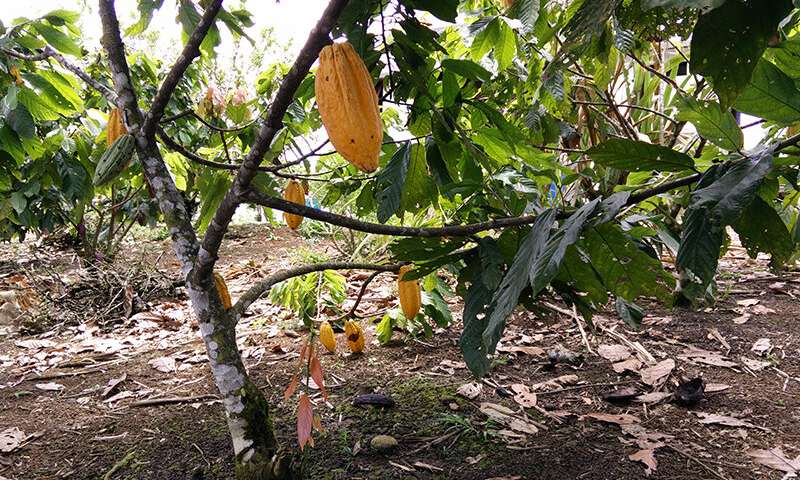
I am an addict. They say it’s good for me if I eat the 90% cacao, fair trade and organic. Chocolate is universally adored. But few know that farming for cacao is complicated business, mostly done by small-scale low-income farmers in Latin America, specifically Ecuador. New evidence suggests that eating too much chocolate might be dangerous because it grows in soils with high amounts of cadmium, which can build up in the body and cause cancer (see ceramic coated cooking pans).

The good news is that there are scientists working to help the farmers lower cadmium from their cacao trees. David Argüello from Belgium along with a team from Ecuador have found ways to reduce cadmium in chocolate trees, using lime. They report about it in the science Journal of Environmental Quality

cadmium cacao
Scientists find that applying lime to the soil and that below the surface into the roots can help reduce cadmium buildup in cacao, or its end-product chocolate

Argüello says: “The cadmium issue threatens the livelihood of farmers because their products may not be suitable for trade and some buyers would prefer not to buy polluted cacao beans. We have to understand how cacao plants takes up the element.”

David Argüello
David Argüello

Traditionally in science, researchers would look at studies of other crops to see what works to prevent cadmium uptake. Something commonly added to the soil to help with this issue is lime, or calcium carbonate, a compound derived from limestone which is cheap and widespread and easy to obtain. This changes the cadmium chemically so that it’s not as likely to be absorbed by the crops, Argüello explains. 

However, most crops like corn or sunflowers are replanted each year. This allows the lime to be mixed deep into the soil between crop seasons which is good. Cacao plants for chocolate, on the other hand, are trees that live for many years. It’s not possible to put lime into much of the soil without disturbing the roots of cacao. Farmers can only apply lime to the surface. 

“This crop is very different than other conventional plants. The information available for its management is scarce and outdated. Many farmers get the advice that adding lime will solve the issue. But we wanted to investigate this,” Argüello explains. 

The research team used an experiment where they planted cacao seedlings in pots in a greenhouse. This allowed them to add lime to the topsoil and subsoil and then test the cacao leaves for cadmium levels. 

The solution needs to be deep rooted

Their findings show that adding lime to both layers decreased cadmium in the cacao leaves, which was not surprising. They also found that liming only the top layer also decreased cadmium. However, they discovered that when only the top layer is limed, more cadmium is taken up from roots in the bottom layer. This means that researchers and farmers cannot ignore high cadmium levels deep in soils.
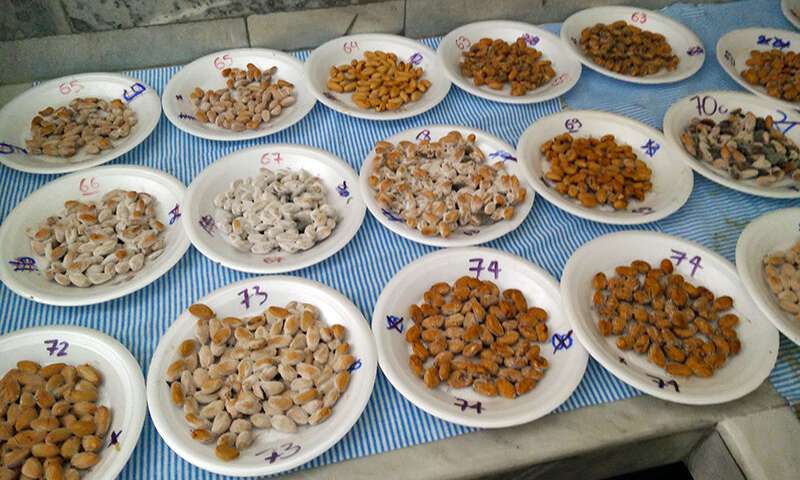
cacao beans, cadmium
The cacao beans were tested for amounts of cadmium in them. Results on how to apply lime can save the livelihood of smallholder farmers.

“Other nutrients, such as zinc, are chemically similar to cadmium,” Argüello says. “We hypothesize that the reduction of the availability of those nutrients in the top layer due to liming causes the roots in the bottom layer to compensate. During that process, zinc uptake increases but some undesired cadmium is also taken up as a mistake.”

The researchers say their findings have helped scientists understand how cacao plants behave and can possibly chart a path to finding an effective reduction strategy. Argüello hopes their work can help small cacao farmers sell their products. I hope they can find a way to create systems that lead to regenerative agricultural approaches (see the film Kiss the Ground with Woody Harrelson). Maybe there is a biosystem that can be created that can reduce the cadmium more naturally than just dumping lime on the problem.  

“I am from Ecuador and cacao is the most traditional export commodity for my country,” says Argüello. “Every time I travel and find a bar of chocolate produced in Ecuador, I feel happy and proud. I like to think that my work will help small cacao farmers sell their products and help my country to continue to be recognized worldwide.”

Looking for a guide to sustainable chocolate? We have to start somewhere, so you can start here.

Karin Kloosterman
Karin Kloostermanhttp://www.greenprophet.com
Karin Kloosterman is an award-winning journalist, innovation strategist, and founder of Green Prophet, one of the Middle East’s pioneering sustainability platforms. She has ranked in the Top 10 of Verizon innovation competitions, participated in NASA-linked challenges, and spoken worldwide on climate, food security, and future resilience. With an IoT technology patent, features in Canada’s National Post, and leadership inside teams building next-generation agricultural and planetary systems — including Mars-farming concepts — Karin operates at the intersection of storytelling, science, and systems change. She doesn’t report on the future – she helps design it. Reach out directly to [email protected]

LEAVE A REPLY

Please enter your comment!
Please enter your name here

TRENDING

Dark chocolate benefits means slowing aging: make Italian hot chocolate with this recipe

Eating dark chocolate can keep you looking young. Make your own healthy hot chocolate mix

Inflatable concrete homes: a California and Ontario case study

Across Ontario and California, builders are rethinking concrete housing through inflatable-shell design—an approach that replaces wooden formwork with air and innovation. A 1,000-square-foot low-carbon concrete shell, insulated with hempcrete, can be erected in a day and cost far less than conventional construction. Over time, the savings in energy, materials, and mortgage costs make this model a realistic response to rising living expenses and climate stress. With low-carbon cement, hempcrete walls, and renewable energy, inflatable concrete homes show how even the world’s most carbon-heavy material can become part of a sustainable future—if built smartly, and within local building codes.

Lizard tail stew, dhub mansaf, is a favored folk dish in Saudi Arabia

By exploring forgotten folk dishes like lizard stew, Green Prophet continues to connect the dots between culture, ecology, and the future of sustainable living in the Middle East.

Biodiversity Blueprint Set for 2026

If we seize this moment, the 2026 review can catalyse a new wave of finance (see Green Finance mechanisms in the UAE), innovation and policy coherence — and move us closer to the vision of a nature-positive world by 2050. If not, the checkpoint risks becoming another missed opportunity while ecosystems, livelihoods and economies continue to degrade.

Regenerative circling faming with man, AI, robots and solar power

In the next wave of regenerative agriculture, the farm is no longer a grid of efficiency but a living circle—with the human spirit at its core. Instead of replacing the farmer, AI and robotics now orbit like silent companions, extending our hands rather than erasing them. A rotating robotic arm moves through the plot not as a master, but as an assistant, guided by ecological intelligence and human intuition. This is not automation for profit—it’s a return to sacred design, where technology becomes humble, circular, and in service to the soil, the grower, and the wider web of life.

Qatar’s climate hypocrisy rides the London Underground

Qatar remains a master of doublethink—burning gas by the megaton while selling “sustainability” to a world desperate for clean air. Wake up from your slumber people.

How Quality of Hire Shapes Modern Recruitment

A 2024 survey by Deloitte found that 76% of talent leaders now consider long-term retention and workforce contribution among their most important hiring success metrics—far surpassing time-to-fill or cost-per-hire. As the expectations for new hires deepen, companies must also confront the inherent challenges in redefining and accurately measuring hiring quality.

8 Team-Building Exercises to Start the Week Off 

Team building to change the world! The best renewable energy companies are ones that function.

Thank you, LinkedIn — and what your Jobs on the Rise report means for sustainable careers

While “green jobs” aren’t always labeled as such, many of the fastest-growing roles are directly enabling the energy transition, climate resilience, and lower-carbon systems: Number one on their list is Artificial Intelligence engineers. But what does that mean? Vibe coding Claude? 

Somali pirates steal oil tankers

The pirates often stage their heists out of Somalia, a lawless country, with a weak central government that is grappling with a violent Islamist insurgency. Using speedboats that swarm the targets, the machine-gun-toting pirates take control of merchant ships and then hold the vessels, crew and cargo for ransom.

Leopoldo Alejandro Betancourt López Turned Ocean Plastic Into Profitable Sunglasses

Few fashion accessories carry the environmental burden of sunglasses. Most frames are constructed from petroleum-based plastics and acrylic polymers that linger in landfills for centuries, shedding microplastics into soil and waterways long after they've been discarded. Leopoldo Alejandro Betancourt López, president of the Spanish eyewear brand Hawkers, saw this problem differently than most industry executives.

Why Dr. Tony Jacob Sees Texas Business Egos as Warning Signs

Everything's bigger in Texas. Except business egos.  Dr. Tony Jacob figured...

Israel and America Sign Renewable Energy Cooperation Deal

Other announcements made at the conference include the Timna Renewable Energy Park, which will be a center for R&D, and the AORA Solar Thermal Module at Kibbutz Samar, the world's first commercial hybrid solar gas-turbine power plant that is already nearing completion. Solel Solar Systems announced it was beginning construction of a 50 MW solar field in Lebrija, Spain, and Brightsource Energy made a pre-conference announcement that it had inked the world's largest solar deal to date with Southern California Edison (SCE).

Related Articles

Popular Categories