

Bread Baked With 5000-Year-Old Egyptian Yeast

bread-from-ancient-yeast

Physicist and video-game inventor Seamus Blackley enjoys studying Egyptology and baking sourdough bread.  That’s not all he does. Recently, he succeeded in physically traveling through time. That is, he baked bread from an original, 5000-year-old Egyptian yeast culture, and with flour milled from the grains the ancients would have used. Eating history. That’s as close to time-travel as you can get. 

Together with microbiologist Richard Bowman of the University of Iowa and archeologist Serena Love of the University of Queensland, Blackley obtained permission from  Boston’s Museum of Fine Arts and Harvard’s Peabody Museum in Massachusetts to collect yeast from their collections of ancient Egyptian pottery.

The yeasts have lain dormant inside the clay pots since the last time bakers used them to make dough rise: about five thousand years ago. In an interview with the London Times, Blackely explained how he collected it.

“You pump a fluid in carefully with a syringe and some sterile cotton in contact with the ceramics. It soaks in and you vacuum it back out.” 

Most of the samples taken from the ancient vessels went off to Love and Bowman’s labs for analysis and preservation. Blackley kept some for his own experiment at home. 

Blackely undertook the delicate, finicky task of creating a live sourdough starter from the 5000-year-old yeasts. To minimize contact with modern yeasts and bacteria, he sterilized all the equipment, even to the point of sterilizing the flours used to make the starter and the dough. However, he stored the semi-liquid result in an endearingly modern (sterilized) jam jar. 
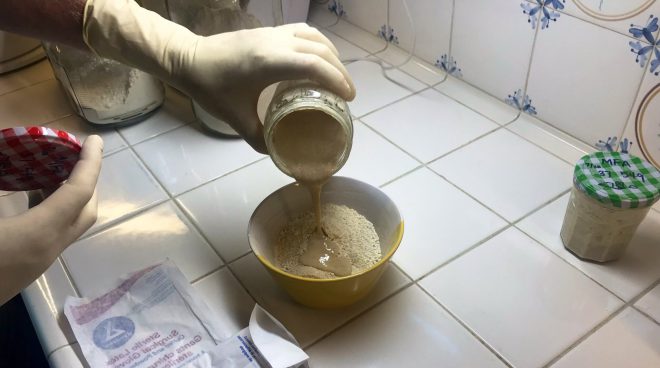
5000-year-old-yeast

Voilá, a bubbly sourdough starter  from yeasts woken after a millenial sleep.
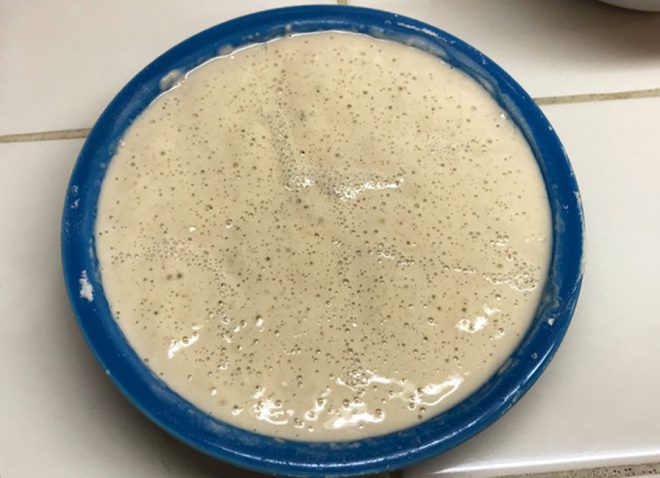
500-year-old-yeast

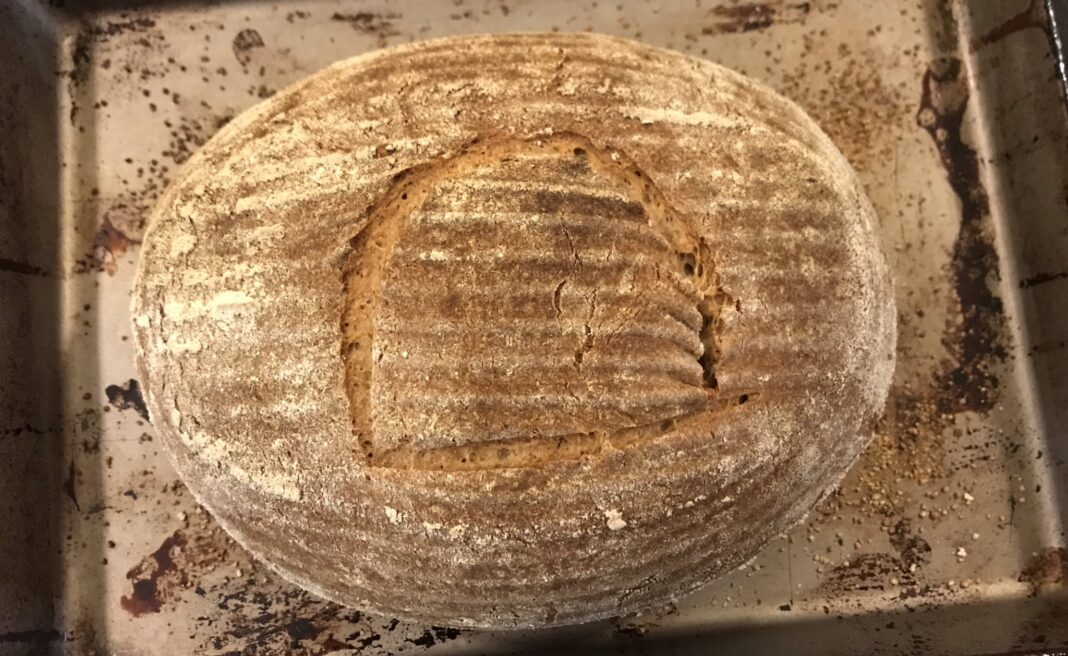
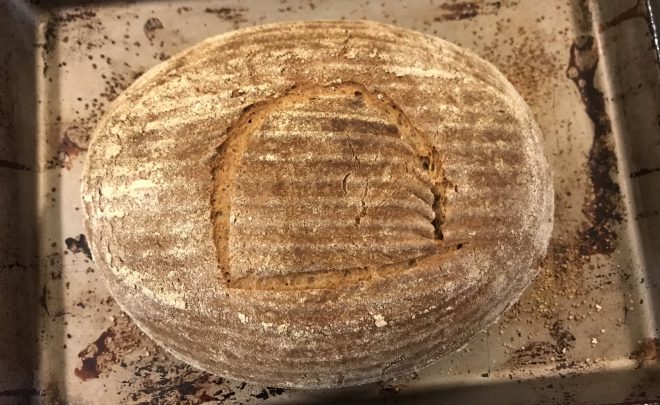
The results: a delicious-looking, perfectly raised loaf of bread, marked with the hieroglyphic for bread.

bread-from-ancient-yeast

Afraid that the ancient yeast culture will open the way to weird ancient diseases? Hardly. Once yeasts have done their job of making the dough rise, baking kills them. If I had the chance, I would happily sample some of that bread myself. 

Blackely unfolds the whole story on Twitter. He says, “The crumb is light and airy, especially for a 100% ancient grain loaf. The aroma and flavor are incredible. I’m emotional. It’s really different, and you can easily tell even if you’re not a bread nerd. This is incredibly exciting, and I’m so amazed that it worked.” 

You can follow the entire story, complete with hilarious “mummy” comments, at @SeamusBlackely. The physicist-turned-microbiologist writes entertainingly, and provides a generous number of photos of the process for bread nerds like me.

Trapping the true yeasts is an ongoing experiment. The team is determined to isolate the original culture via genetic testing. It may be possible to reproduce it without any contamination from modern airborne yeasts and bacteria. But they’re reasonably sure that the cultures already obtained have enough of the original Old Kingdom yeasts to reproduce the daily bread that people ate back then, in ancient Egypt. 

The next step, Blackley says, is to bake the bread  by the ancient baking methods. Presumably this means baking the dough in a charcoal-fueled oven, in the clay cones that look like our modern flower pots. This method was already successfully replicated in 1993, by American biologist and master baker Ed Wood, who flew to Cairo with a team of like-minded scientists and the archeologist Mark Lehrner for that purpose. They  constructed a bakery based on a surviving ancient model and after much trial and error,  baked ancient-style bread. 

I’m waiting excitedly for the next phases in this experiment. Who knows, maybe some day we’ll be able to taste the bread of the ancients and do a little time-travel ourselves.

Miriam Kresh
Miriam Kreshhttps://www.greenprophet.com/
Miriam Kresh is an American ex-pat living in Israel. Her love of Middle Eastern food evolved from close friendships with enthusiastic Moroccan, Tunisian and Turkish home cooks. She owns too many cookbooks and is always planning the next meal. Miriam can be reached at miriam (at) greenprophet (dot) com.
1 COMMENT

Comments are closed.

TRENDING

The first bread was baked in Jordan’s Black Desert

The Natufian hearths from Jordan’s Black Desert invite a reframing of food history. Bread and beer were not simply by-products of agriculture; the desire for these transformed foods may have helped drive cultivation itself. They also remind us that ingenious, place-based foodways—wild grains, tubers, local milling, communal baking—were born in arid lands and basalt fields. As climate stresses grow, that lesson in resilience and resourcefulness from the deep past feels timely.

Why do mummies smell so sweet?

Researchers are investigating whether the smell of an Egyptian mummy could enable them to discover what materials were used to preserve the body without disturbing it. They extracted air from the sarcophagi of nine mummies and asked expert smellers to rate the scents for contemporary odour qualities such as woodiness and sweetness.

Sustainable development goals for Yemen?

Yemen is all over the news the last couple of months as the Houthi terrorists play a role in Israel's war against Hamas. As a sustainable news reporter, I've been interested in Yemen because as much of the Middle East progresses, Yemen with its internal conflicts remains one of the world's driest and hungriest cultures.

Making organic sourdough from ancient wheat he grows

We feel what happens to food prices and our...

Recipe: Olive and Za’atar-Topped Focaccia

What do you get when you top a typical focaccia with olives and za'atar? A flavorful flatbread.

Turning Your Energy Consultancy into an LLC: 4 Legal Steps for Founders in Texas

If you are starting a renewable energy business in Texas, learn how to start an LLC by the books.

Tracking the Impacts of a Hydroelectric Dam Along the Tigris River

For the next two months, I'll be taking a break from my usual Green Prophet posts to report on a transnational environmental issue: the Ilısu Dam currently under construction in Turkey, and the ways it will transform life along the Tigris River.

6 Payment Processors With the Fastest Onboarding for SMBs

Get your SMB up and running fast with these 6 payment processors. Compare the quickest onboarding options to start accepting customer payments without delay.

Qatar’s climate hypocrisy rides the London Underground

Qatar remains a master of doublethink—burning gas by the megaton while selling “sustainability” to a world desperate for clean air. Wake up from your slumber people.

How Quality of Hire Shapes Modern Recruitment

A 2024 survey by Deloitte found that 76% of talent leaders now consider long-term retention and workforce contribution among their most important hiring success metrics—far surpassing time-to-fill or cost-per-hire. As the expectations for new hires deepen, companies must also confront the inherent challenges in redefining and accurately measuring hiring quality.

8 Team-Building Exercises to Start the Week Off 

Team building to change the world! The best renewable energy companies are ones that function.

Thank you, LinkedIn — and what your Jobs on the Rise report means for sustainable careers

While “green jobs” aren’t always labeled as such, many of the fastest-growing roles are directly enabling the energy transition, climate resilience, and lower-carbon systems: Number one on their list is Artificial Intelligence engineers. But what does that mean? Vibe coding Claude? 

Somali pirates steal oil tankers

The pirates often stage their heists out of Somalia, a lawless country, with a weak central government that is grappling with a violent Islamist insurgency. Using speedboats that swarm the targets, the machine-gun-toting pirates take control of merchant ships and then hold the vessels, crew and cargo for ransom.

Related Articles

Popular Categories