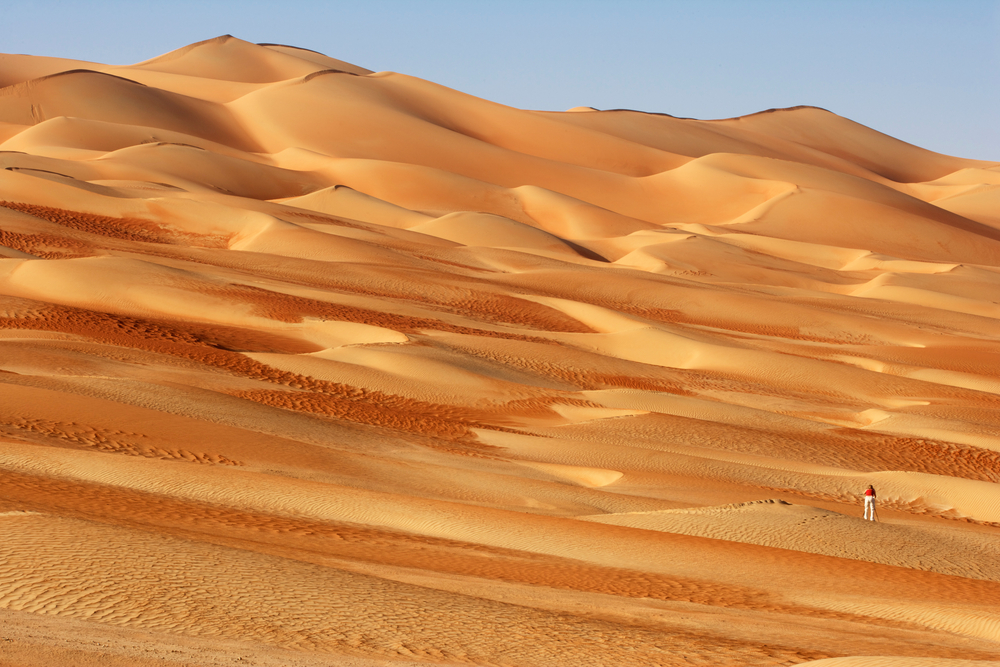
Can you believe earth is running out of sand?

dunes_of_rub_al_khaliBritish economist Milton Friedman once warned that if you put the government in charge of the Sahara Desert, in five years you’d have a shortage of sand. Whether governments or free markets are to blame, it is possible to deplete abundant resources such as Irish rain.

Now thanks to global obsessions with concrete icons, fracking and poor resource management, even places such as Saudi Arabia are running out of sand.

Sand, it seems, is the epitome of abundance. There are an estimated seven quintillion grains of sand on earth.

That’s 7000000000000000000, count them! But as with oil and water and Helium, the second most abundant element in the universe, we are consuming sand with the false assumption that a very large number is the same as infinity.

Sand may be inexpensive compared to other natural resources but it is extremely useful, even crucial to certain parts of our modern life. Sand is used to make the glass and concrete used in dams and massive skyscraper construction projects in places such as Dubai and Saudi Arabia. It is also being used in 3D printed structures and other futuristic building designs.

The recent obsession with fracking has also caused a rapid rise in the consumption of this limited resource.

In 2009 Green Prophet reported that the massive construction boom caused a shortage of the high quality desert sand used in construction.

So Bahrain and other Persian gulf countries began to restrict the export of sand. Not long after this, sand was being imported to replenish eroded beaches in places such as Cesarea where man-made structures interfere with the normal inflow of sand from the sea.

Peak sand

And while some desert sands are excellent construction materials, these fine-grained sands tend to blow or erode too much to make for good beach sand. So Saudi Arabia has imported beach sand from as far away as Australia.

According to an article published in Der Spielgel, the United Nations Environment Program (UNEP) estimates that 40 billion tons of sand are consumed each year, 3/4ths of it in the production of concrete– enough to encircle the earth with a wall 25 meters high.

Fracking requires yet another type of sand. Companies which were previously focused on the relatively small market of sand for golf course have made hundreds of millions of dollars by strip mining places such as the North American pine barrens where enormous flocks of passenger pigeons once lived.

This sand is then used in hydraulic fracturing (fracking), a process where materials are pumped into the ground at high pressure in order to fracture rock and force the stubborn last few drops of oil out of geologic deposits.

Sand is also being used to increase and decrease the amount of territory belonging to certain countries. Singapore has reportedly imported enough sand from Indonesia and Vietnam to increase its area by more than 20% over the past 50 years.

Hong Kong may be doing the same and China is pouring sand into South China Sea in order to create new territory in the disputed Spratly Islands. Poorer countries such as Cape Verde are smuggling their sandy shorelines away to richer countries in a practice that could complicate already difficult political situations in the Middle East.

So the next time you visit a sandy beach or desert, be sure to dump the sand out of your shoes before you go home.


Brian Nitz
Brian Nitzhttp://www.greenprophet.com
Brian remembers when a single tear dredged up a nation's guilt. The tear belonged to an Italian-American actor known as Iron-Eyes Cody, the guilt was displaced from centuries of Native American mistreatment and redirected into a new environmental awareness. A 10-year-old Brian wondered, 'What are they... No, what are we doing to this country?' From a family of engineers, farmers and tinkerers Brian's father was a physics teacher. He remembers the day his father drove up to watch a coal power plant's new scrubbers turn smoke from dirty grey-back to steamy white. Surely technology would solve every problem. But then he noticed that breathing was difficult when the wind blew a certain way. While sailing, he often saw a yellow-brown line on the horizon. The stars were beginning to disappear. Gas mileage peaked when Reagan was still president. Solar panels installed in the 1970s were torn from roofs as they were no longer cost-effective to maintain. Racism, public policy and low oil prices transformed suburban life and cities began to sprawl out and absorb farmland. Brian only began to understand the root causes of "doughnut cities" when he moved to Ireland in 2001 and watched history repeat itself. Brian doesn't think environmentalism is 'rocket science', but understanding how to apply it within a society requires wisdom and education. In his travels through Europe, North America, Asia and the Middle East, Brian has learned that great ideas come from everywhere and that sharing mistakes is just as important as sharing ideas.
1 COMMENT

LEAVE A REPLY

Please enter your comment!
Please enter your name here

TRENDING

Huge Fish Nursery Discovered Under Freezing Arctic Seas

In 2019, an underwater robot camera exploring the seabed...

Lizard tail stew, dhub mansaf, is a favored folk dish in Saudi Arabia

By exploring forgotten folk dishes like lizard stew, Green Prophet continues to connect the dots between culture, ecology, and the future of sustainable living in the Middle East.

Afghan Taxis Get Ancient Persian A/C Hack—And It Works Better Than Yours

The Afghan windcatcher car cooler isn’t just clever. It’s low-cost climate adaptation. With rising global temperatures and millions of cars still without functioning air con, it’s a design-for-the-rest-of-us moment. A punk rock move in a world of overdesigned heat tech. Plus, it’s deeply sustainable: no refrigerants, no increased fuel use, no carbon guilt. Just water, airflow, and a little DIY spirit.

Iran is sinking in sinkholes from overwatering

What's that sinking feeling? In Iran, the very ground under...

Arab agricultural land is on the brink

Across the Arab world, croplands face a perfect storm of stressors. Excessive fertilizers and pesticides erode soil ecology. Poor drainage and over-irrigation drive salinization, leaving fields crusted with salt. Rising temperatures, dwindling groundwater, and more frequent sand-and-dust storms—all amplified by climate change—compound the crisis.

Qatar’s climate hypocrisy rides the London Underground

Qatar remains a master of doublethink—burning gas by the megaton while selling “sustainability” to a world desperate for clean air. Wake up from your slumber people.

How Quality of Hire Shapes Modern Recruitment

A 2024 survey by Deloitte found that 76% of talent leaders now consider long-term retention and workforce contribution among their most important hiring success metrics—far surpassing time-to-fill or cost-per-hire. As the expectations for new hires deepen, companies must also confront the inherent challenges in redefining and accurately measuring hiring quality.

8 Team-Building Exercises to Start the Week Off 

Team building to change the world! The best renewable energy companies are ones that function.

Thank you, LinkedIn — and what your Jobs on the Rise report means for sustainable careers

While “green jobs” aren’t always labeled as such, many of the fastest-growing roles are directly enabling the energy transition, climate resilience, and lower-carbon systems: Number one on their list is Artificial Intelligence engineers. But what does that mean? Vibe coding Claude? 

Somali pirates steal oil tankers

The pirates often stage their heists out of Somalia, a lawless country, with a weak central government that is grappling with a violent Islamist insurgency. Using speedboats that swarm the targets, the machine-gun-toting pirates take control of merchant ships and then hold the vessels, crew and cargo for ransom.

Leopoldo Alejandro Betancourt López Turned Ocean Plastic Into Profitable Sunglasses

Few fashion accessories carry the environmental burden of sunglasses. Most frames are constructed from petroleum-based plastics and acrylic polymers that linger in landfills for centuries, shedding microplastics into soil and waterways long after they've been discarded. Leopoldo Alejandro Betancourt López, president of the Spanish eyewear brand Hawkers, saw this problem differently than most industry executives.

Why Dr. Tony Jacob Sees Texas Business Egos as Warning Signs

Everything's bigger in Texas. Except business egos.  Dr. Tony Jacob figured...

Israel and America Sign Renewable Energy Cooperation Deal

Other announcements made at the conference include the Timna Renewable Energy Park, which will be a center for R&D, and the AORA Solar Thermal Module at Kibbutz Samar, the world's first commercial hybrid solar gas-turbine power plant that is already nearing completion. Solel Solar Systems announced it was beginning construction of a 50 MW solar field in Lebrija, Spain, and Brightsource Energy made a pre-conference announcement that it had inked the world's largest solar deal to date with Southern California Edison (SCE).

Related Articles

Popular Categories