

Measuring acid in our oceans using the bodies of small marine animals

acid-seas-israel
The world is warming. Glaciers are melting. Added carbon dioxide gas is causing our seas to become acidic. This in turn melts corals, and causes a host of environmental problems scientists are just beginning to quantify. But measuring the effect of acidification on oceans and seas is tricky because water moves and it can be deep. Different species are affected by acidification in different ways. Scientists from Israel have found a new way to make sense of the unknowns.

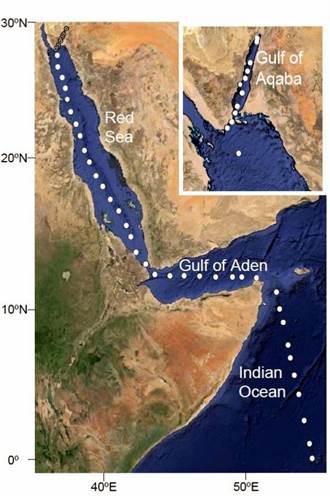
To get a clearer picture of how ocean acidification is affecting large marine areas, the group of Israeli researchers from Hebrew University studied a 5,000 km long strip of ocean from Eilat to the Seychelles crossing the Red Sea, the Gulf of Aden and the Western Indian Ocean.
acid-ocean
A Google Earth image of the research cruise showing the sampling stations along the ~5,000 Km oceanographic transect described in the PNAS paper.

The researchers developed a new method to simultaneously assess the overall calcification rates of coral reefs and pelagic (open sea) plankton over a whole oceanic basin, based on variations in surface water chemistry.

Getting a baseline down for science

These variations result from the tendency of organisms that precipitate calcium carbonate skeletons to replace some of the calcium in their skeletons with other elements (e.g. the element strontium).

These replacements depend on growth conditions and are typical for each group of organisms. Owing to this characteristic, corals produce calcium carbonate with a different chemistry than calcareous (composed largely of calcium carbonate) plankton, and their overall effect alters the chemistry of the ocean water.

This is the first study that demonstrates the feasibility of quantifying this type of information on an oceanic basin scale.

The group estimated that pelagic plankton precipitate 80% of the Red Sea calcium carbonate, and coral reefs precipitate about 20%.

This data they say is a crucial milestone if we wish to track the effect of human-caused activity since it is not possible to quantify change without having objective baseline conditions.

Monitoring the variations in coral and plankton growth rates every few years can provide essential information regarding rates of environmental change in tropical and subtropical seas like the Red Sea, Caribbean and South China Sea.
sea plankton
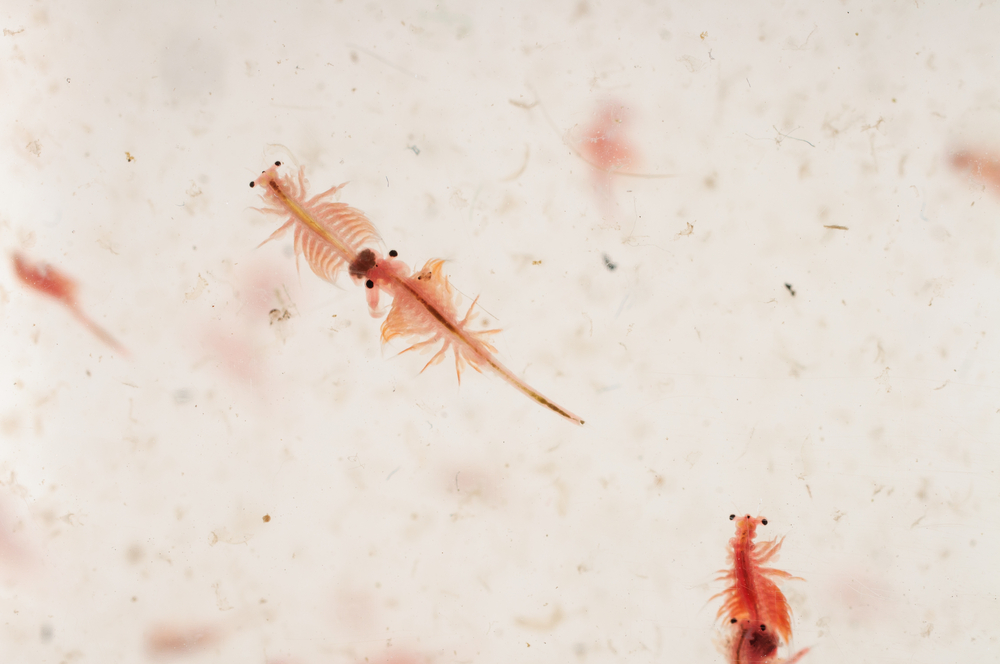
Cute and cuddly sea plankton are affected by ocean acidification caused by global warming.

The research was published in PNAS (Proceedings of the National Academy of Sciences of the United States of America) and was supported by the Israel Science Foundation, the Bill and Melinda Gates Foundation and the Israeli Ministry of Science and Technology.

Top photo: An aerial photo of a coral reef. Researchers developed a new tool to quantify the effect of ocean acidification on calcifying organisms. (Photo: Boaz Lazar, Hebrew University); Plankton photo from Shutterstock


Karin Kloosterman
Karin Kloostermanhttp://www.greenprophet.com
Karin Kloosterman is an award-winning journalist, innovation strategist, and founder of Green Prophet, one of the Middle East’s pioneering sustainability platforms. She has ranked in the Top 10 of Verizon innovation competitions, participated in NASA-linked challenges, and spoken worldwide on climate, food security, and future resilience. With an IoT technology patent, features in Canada’s National Post, and leadership inside teams building next-generation agricultural and planetary systems — including Mars-farming concepts — Karin operates at the intersection of storytelling, science, and systems change. She doesn’t report on the future – she helps design it. Reach out directly to [email protected]
2 COMMENTS

Comments are closed.

TRENDING

Eco organization offices destroyed by Iran missile

Tel Aviv's eco organization, the Heschel Center, was impacted by an Iranian missile.

What are AWG air-water generators, and why they aren’t a golden-bullet solution (yet)

Atmospheric water generators (AWGs) sound like magic: machines that can pull drinking water out of air. The idea is mentioned in the Bible, where the elders would pray for water collected as dew on plants and the catch on turning this into a machine is in the physics. To turn invisible vapor into liquid, you must remove heat, especially the latent heat of condensation.

Jordan’s $6 Billion Aqaba–Amman Desalination Project from the Red Sea Moves Forward

In 2025, the Jordanian government signed agreements with a consortium led by Meridiam and SUEZ, alongside VINCI Construction and Orascom Construction. Under a 30-year concession agreement, the consortium will design, build, finance, operate, and maintain the system before transferring it back to the Jordanian government. The total investment is estimated at approximately $6 billion USD.

The Saudi Startup Turning Desalination’s Toxic Waste Into Its Own Disinfectant

For millennia, the Middle East's water crisis seemed an immutable fact of geography — a region defined as much by what it lacked as by what lay beneath its sands. Today, a convergence of plummeting solar costs, advancing membrane technology, and hard-won engineering expertise is rewriting that story.

Earth building with Dead Sea salt bricks

Researchers develop a brick made largely from recycled Dead Sea salt—offering a potential alternative to carbon-intensive cement.

Should You Invest in the Private Market?

startustartup Unlike public stock exchanges, which offer daily trading, strict...

How to build a 100-year-company

Kongō Gumi is a Japanese construction company, purportedly founded in 578 A.D., making it the world's oldest documented company. What can we learn about building sustainable businesses from them?

From Pilot Plant to Global Stage: How Aduro Clean Technologies’ 2026 Expansion Signals a Turning Point for Chemical Recycling Investors Like Yazan Al Homsi

The company's Next Generation Process (NGP) Pilot Plant in London, Ontario, has officially moved into initial operating campaigns, generating the kind of structured, repeatable data that separates laboratory promise from commercial viability.

How AI Helps SaaS Companies Reduce Repetitive Customer Support Work

SaaS products are designed for large numbers of users with different levels of experience, and also in renewable energy.

Pulling Water from the Air

Faced with water shortage in Amman, Laurie digs up...

Turning Your Energy Consultancy into an LLC: 4 Legal Steps for Founders in Texas

If you are starting a renewable energy business in Texas, learn how to start an LLC by the books.

Tracking the Impacts of a Hydroelectric Dam Along the Tigris River

For the next two months, I'll be taking a break from my usual Green Prophet posts to report on a transnational environmental issue: the Ilısu Dam currently under construction in Turkey, and the ways it will transform life along the Tigris River.

6 Payment Processors With the Fastest Onboarding for SMBs

Get your SMB up and running fast with these 6 payment processors. Compare the quickest onboarding options to start accepting customer payments without delay.

Related Articles

Popular Categories