
Wild Grains And Our Daily Bread Threatened by Global Warming

wild grains global warmingSturdy wild wheat and barley are essential for humanity’s survival. New study shows we are losing  genetic diversity

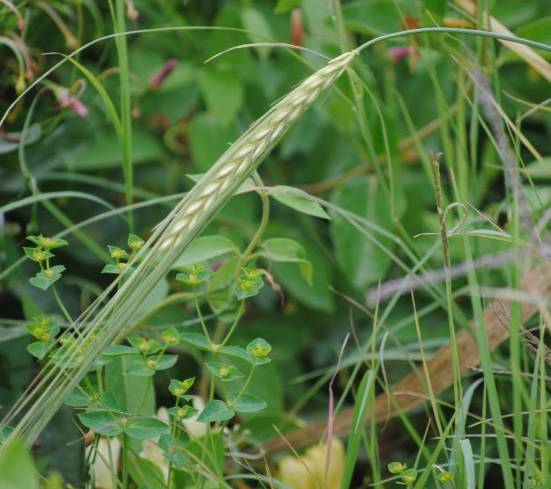
Israel’s wild wheat and barley are known to be the ancestors of our modern grains.  When Man  cultivated them, their genetic resistance to drought and disease carried over to cultivated varieties. This aided mankind’s struggle to grow predictable harvests and put fresh bread on the shelf every day.  Great, but all that’s history, right? One would think that with the modern world’s stores of cultivated grain, and seed banks to back up those supplies, our future food sources are safe. At least in regard to that essential staple, bread.

It’s not so simple. Threats to our food supply, and that of future generations, are now coming from man-made time bombs like Monsanto’s sterile GMO seeds. Monsanto is currently working on producing GMO wheat. In addition, according to researchers at the University of Haifa’s Institute of Evolution, global warming has already caused disturbing genetic changes in wild wheat and barley.  In a chain of dependency, science borrows wild grains’ genetic material to improve modern wheat and barley’s ability to survive a hotter, drier world. And to feed our hunger. The question is, how much longer will we be able to depend on them?

Prolonged drought has already caused half a million people to abandon their homes in Syria alone. More droughts are predicted around the world. Together with a rising world population and consequent rising food demands, science’s ability to transfer drought-resistant genetic characteristics from wild grains is crucial.

In a recent study led by Prof. Eviatar Nevo from the Institute of Evolution, wheat and barley grains taken from locations across Israel over 1980, 2008 and 2009 were green-house grown upon gathering. The grains flowered an average of 10 days early.

This sounds like adaptability and increased drought resistance on one hand – grains with welcome new genetic material which we can use to improve cultivated varieties.

On the dark side, the same study shows that grains grown in 2008 have less genetic diversity compared to those grown in 1980. It’s not clear if this  foretells the opposite – erosion of  desirable characteristics for grain survival.

Israel’s territory contains a multitude of ecosystems, but many have shrunk away because of too-few nature reserves, and those too small to preserve ecosystems in their entirety. In spite of ongoing conservation efforts by the Israel Nature Reserves Authority, there’s less open land in which wild grains can thrive.

“We have a large gene bank and are constantly trying to find ways to upgrade cultivars,” Prof Nevo told Haaretz newspaper. “The findings of the current research prove a need for much more massive action to allow wild strains to flourish in nature as well.”

This calls for special protection measures and  legal management of wild spaces. Will the government wake up and put the needed conservation legislation in place?

:: Haaretz

More on wheat and food from Green Prophet:

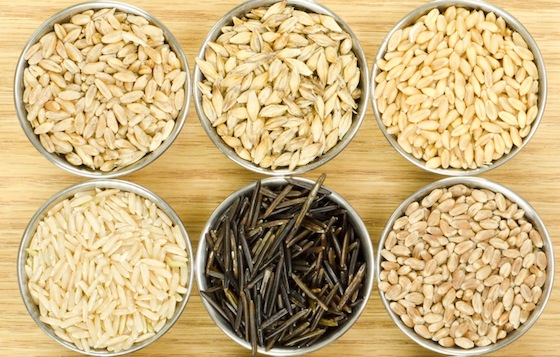
Image of grains from Shutterstock

Miriam Kresh
Miriam Kreshhttps://www.greenprophet.com/
Miriam Kresh is an American ex-pat living in Israel. Her love of Middle Eastern food evolved from close friendships with enthusiastic Moroccan, Tunisian and Turkish home cooks. She owns too many cookbooks and is always planning the next meal. Miriam can be reached at miriam (at) greenprophet (dot) com.
1 COMMENT

Comments are closed.

Hot this week

Why Health Systems Are Reaching a Turning Point

Health emerges from a continuous energy and material flow from water through food to human physiology. Technical energy systems support this cycle through water treatment, agriculture, and infrastructure.

Sustainability That Sells: How Profit and Purpose Come Together in the Hive

Whether you are a commercial grower, hobbyist beekeeper or retail equipment supplier, this system opens a new income stream with minimal environmental impact.

The Fitness App Revolution: Building the Future of Wellness Through Strategic Development

In an era where smartphones are ubiquitous and health consciousness is at an all-time high, the fitness industry has undergone a radical digital transformation. Fitness applications have moved far beyond simple pedometers, evolving into comprehensive wellness platforms that serve as personal trainers, nutritionists, and community hubs right in our pockets.

A Brief History of Basil From India to Italy

Beloved, fortunate, sweet, and royal; an herb with a long and storied history in Asia and across the world. Called by many names, basil has featured in previous Green Prophet articles, so enjoy another serving, a brief history of basil.

How Renewable Energy is Revolutionizing the Way We Power Our World

Solar has become the star of the transition thanks to modular hardware and straightforward installation. It fits dense cities and remote towns alike. Many companies are turning to rooftop arrays and carport systems - and exploring commercial solar installation as a practical way to lock in future savings.

Topics

Why Health Systems Are Reaching a Turning Point

Health emerges from a continuous energy and material flow from water through food to human physiology. Technical energy systems support this cycle through water treatment, agriculture, and infrastructure.

Sustainability That Sells: How Profit and Purpose Come Together in the Hive

Whether you are a commercial grower, hobbyist beekeeper or retail equipment supplier, this system opens a new income stream with minimal environmental impact.

The Fitness App Revolution: Building the Future of Wellness Through Strategic Development

In an era where smartphones are ubiquitous and health consciousness is at an all-time high, the fitness industry has undergone a radical digital transformation. Fitness applications have moved far beyond simple pedometers, evolving into comprehensive wellness platforms that serve as personal trainers, nutritionists, and community hubs right in our pockets.

A Brief History of Basil From India to Italy

Beloved, fortunate, sweet, and royal; an herb with a long and storied history in Asia and across the world. Called by many names, basil has featured in previous Green Prophet articles, so enjoy another serving, a brief history of basil.

How Renewable Energy is Revolutionizing the Way We Power Our World

Solar has become the star of the transition thanks to modular hardware and straightforward installation. It fits dense cities and remote towns alike. Many companies are turning to rooftop arrays and carport systems - and exploring commercial solar installation as a practical way to lock in future savings.

How does one start prepping?

Faced with an extreme winter storm this year, Americans wonder how to be prepared for catastrophe. Miriam has lived through wars in the Middle East - so she's prepared on giving you a guide to prepping.

Fishermen sue tire manufacturers on behalf of the salmon

A federal trial in San Francisco has brought US tire manufacturers, fishing groups, and environmental scientists into court over a chemical most drivers have never heard of — but which scientists say may be silently reshaping aquatic ecosystems.

Listening to Water: Tarek Atoui’s Next Work for Tate Modern

Born in Beirut, Lebanon in 1980 and now living in Paris, Atoui has spent years building instruments that don’t sit comfortably in concert halls. Many of them involve water, glass, and ceramics — materials that react to sound instead of simply producing it.

Related Articles

Popular Categories