

Dead Sea Almost Died Eons Ago

Zvi Ben-Avraham drilling dead sea, drying dead sea
New drilling results from the Dead Sea provides clues that the Dead Sea almost dried up because of climate change — 125,000 years ago!

The rapidly dropping water level of the Dead Sea, a cause of much concern today, occurred as well in the distant past, resulting in the severe drying up of the lake, an international drilling project there has shown. The project opens a window into the climatic and seismic history of the Dead Sea over the past hundreds of thousands of years.

The project discovered that about 125,000 years ago, the lake had dried up almost completely as a result of climate change. This finding arouses worry about the present status of the Dead Sea – the lowest place on earth — in which human intervention is causing acceleration of the drying-up process.

A special rig was brought to Israel for the purposes of the drilling project, including equipment to bring up sediment samples from beneath the lake floor. The drilling was done from November 2010 until March 2011 in two areas: in the center of the lake at a depth of 300 meters and near the Ein Gedi shore.

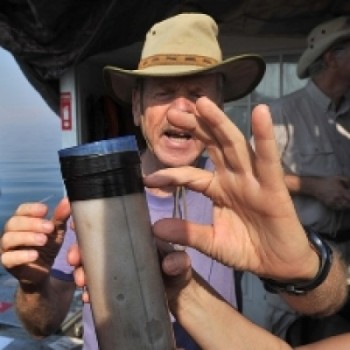
The drilling was done under the auspices of the International Continental Drilling Program (ICDP) under the direction of Prof. Mordechai Stein of the Geological Survey of Israel and the Hebrew University and Prof. Zvi Ben-Avraham of Tel Aviv University (pictured above), with support from the Israel Academy of Sciences and Humanities.

The Dead Sea is a salt lake located in a deep tectonic depression – the Dead Sea basin — in which the loss of water is only through evaporation. The lake behaves like a large water gauge of its watershed. The Jordan River and the Arava stream transport sediments and waters from north and south that reflect the environmental conditions in the Mediterranean and desert climate zones.

Over the past hundreds of thousand of years, the lake accumulated information on the hydrological–climate conditions in these regions. Moreover, the reconstruction of climates of the past are relevant to human history since the Dead Sea basin is located along a major route for pre-historic man on his way out of Africa.

The sediments that were drilled and recovered from the floor of the Dead Sea contain the information that enables us to reconstruct the climatic conditions that existed here and even in more distant areas such as the Arabian and Sahara deserts, said Stein.

A preliminary analysis of the drilled cores discovered, at a depth of 250 meters below the lake floor (and 550 meters below the lake surface), thick sequences of salt covered by rock pebbles that indicate a period when the lake retreated and nearly dried up. These sequences are overlain by marly (muddy) sediments that indicate, conversely, an enhanced input of freshwater to the lake and wetter climate conditions in the watershed.

Today, the Dead Sea is at a level of 426 meters below sea level and sinking rapidly. The evaporation of the lake in the past should be a warning sign for us now in terms of a possible drying up in the future, say the scientists. Whereas in the past, forces of natural climate change brought about a refilling on the sea through drainage of waters coming into the basin, this cannot happen as long as the waters of the Jordan River are diverted by its neighboring states.


2 COMMENTS
  1. Hear! Hear! The sooner the cities are at least for a generation on desalinated water to allow the R.Jordan to replenish the sea the better. Meanwhile a lot of orchards and market gardening agriculture can make do with recycled sewerage.
    The historic changes are probably to do with the ice ages which dried the atmosphere and lowered sea levels which is why there are traces of habitation and large land animals on the beds of the North Sea, the Black Sea, and the seas between Indo China and Indonesia.

  2. What we may learn fro0m this is that the climate change currently occurring may be more a natural phenomena than human caused. Of course,
    CO2 emissions and other factors caused by humankind don’t help the situation.

Comments are closed.

TRENDING

Earth building with Dead Sea salt bricks

Researchers develop a brick made largely from recycled Dead Sea salt—offering a potential alternative to carbon-intensive cement.

Farm To Table Israel Connects People To The Land

Farm To Table Israel is transforming the traditional dining experience into a hands-on journey.

Remilk makes cloned milk so cows don’t need to suffer and it’s hormone-free

This week, Israel’s precision-fermentation milk from Remilk is finally appearing on supermarket shelves. Staff members have been posting photos in Hebrew, smiling, tasting, and clearly enjoying the moment — not because it’s science fiction, but because it tastes like the real thing.

An Army of Healers Wins the 2025 IIE Goldberg Prize for Peace in the Middle East

In a region more accustomed to headlines of loss than of listening, the Institute of International Education (IIE) has chosen to honor something quietly radical: healing. The 2025 Victor J. Goldberg Prize for Peace in the Middle East has been awarded to Nitsan Joy Gordon and Jawdat Lajon Kasab, the co-founders of the Army of Healers, for building spaces where Israelis and Palestinians — Jews, Muslims, Christians, Druze, and Bedouins — can grieve, speak, and rebuild trust together.

Peace hospital opens between Jordan and Israel

The proposed medical centre, described by Emek HaMaayanot Regional Council head Itamar Matiash as “a centre for cancer treatment, so that people from Jordan or further away could come and receive treatment,” would become the flagship of a wider cluster of medical, academic and innovation-based services planned for the Israeli half of the zone.

Turning Your Energy Consultancy into an LLC: 4 Legal Steps for Founders in Texas

If you are starting a renewable energy business in Texas, learn how to start an LLC by the books.

Tracking the Impacts of a Hydroelectric Dam Along the Tigris River

For the next two months, I'll be taking a break from my usual Green Prophet posts to report on a transnational environmental issue: the Ilısu Dam currently under construction in Turkey, and the ways it will transform life along the Tigris River.

6 Payment Processors With the Fastest Onboarding for SMBs

Get your SMB up and running fast with these 6 payment processors. Compare the quickest onboarding options to start accepting customer payments without delay.

Qatar’s climate hypocrisy rides the London Underground

Qatar remains a master of doublethink—burning gas by the megaton while selling “sustainability” to a world desperate for clean air. Wake up from your slumber people.

How Quality of Hire Shapes Modern Recruitment

A 2024 survey by Deloitte found that 76% of talent leaders now consider long-term retention and workforce contribution among their most important hiring success metrics—far surpassing time-to-fill or cost-per-hire. As the expectations for new hires deepen, companies must also confront the inherent challenges in redefining and accurately measuring hiring quality.

8 Team-Building Exercises to Start the Week Off 

Team building to change the world! The best renewable energy companies are ones that function.

Thank you, LinkedIn — and what your Jobs on the Rise report means for sustainable careers

While “green jobs” aren’t always labeled as such, many of the fastest-growing roles are directly enabling the energy transition, climate resilience, and lower-carbon systems: Number one on their list is Artificial Intelligence engineers. But what does that mean? Vibe coding Claude? 

Somali pirates steal oil tankers

The pirates often stage their heists out of Somalia, a lawless country, with a weak central government that is grappling with a violent Islamist insurgency. Using speedboats that swarm the targets, the machine-gun-toting pirates take control of merchant ships and then hold the vessels, crew and cargo for ransom.

Related Articles

Popular Categories