
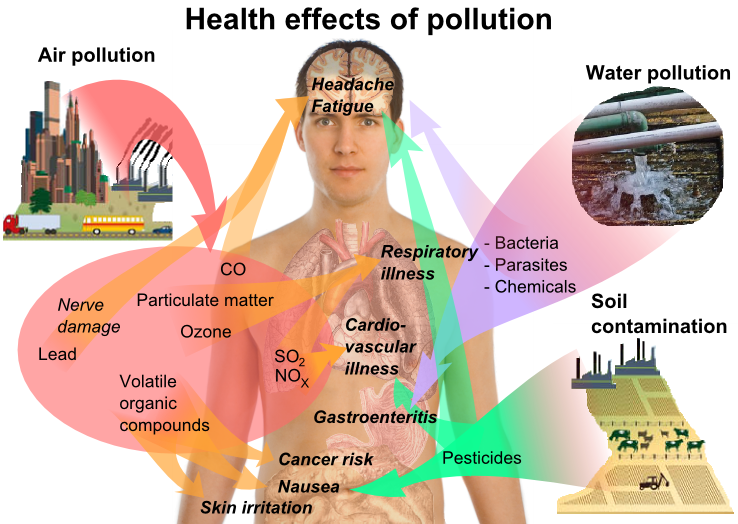

 There are many different kinds of pollution and many ways in which they are hijacking our children’s future.
Children exposed to pollution are more likely to develop autism, attention deficit disorder, and dyslexia, according to Haaretz. These findings were unveiled by both scientists at a recent conference in Israel, and those are only the dangers we know about. Modern society manufactures and uses 800,000 new chemicals, hundreds of which show up in children’s blood tests.
It will take decades or more to understand how each chemical affects children’s health (and the economy), but at least one thing is certain: 25% of autism cases can be attributed to environmental factors, according to Philip Landrigan from Mount Sinai Hospital in New York. This is especially disturbing for those of us in the Middle East, where we have higher rates of all kinds of pollution than most.
Landrigan explained that the international rise of autism and attention deficit disorder cases can’t be explained by genetics alone, or by higher rates of diagnosis. And while pollution is also harmful to adults and the environment, he says children are especially vulnerable.
Exposure to substances such as lead, mercury and pesticides is particularly dangerous for children, because they are more sensitive to these materials – in part because their brains are still developing, Landrigan said. A child’s body also breaks down poisonous materials less efficiently than the adult body does, and any given quantity of chemical has more of an impact on a child because it constitutes a larger proportion of his body mass.
The United States and Europe have decent regulatory controls for manufacturers producing harmful chemicals, and public health officials are sort of monitoring the situation, but pollution is low on the list of priorities for countries in the Middle East.
Although major offenders, in the midst of so many other economic, political, and social problems, countries such as Egypt, Iran, Iraq and Lebanon are unlikely to get a handle on their problems any time soon. Not only that, but these conditions probably won’t be diagnosed or treated.
Here are just a few examples of pollution in the Middle East and North Africa:
In addition to the extraordinary pollution that already defines life in Cairo – as a result of thousands of cars on the road and poor waste management systems, every year around rice harvest time, what locals call the “black cloud” hovers over the city.
Mahmud Abdel Meguid, chairman of the state-run Abbasiya Chest Hospital, told IRIN. “This pollution causes a long list of diseases, including chronic obstructive pulmonary disease, and chest sensitivity at best, and respiratory failure at worst.”
Long after the rest of the world took control of mercury disposal, the Egyptian Environmental Affairs Agency (EEAA) finally teamed up with the Korean International Cooperation Agency (KOICA) in 2007 to do the same in Egypt. Only recently has a proper mercury disposal facility been opened in Alexandria, where mercury-filled fluorescent tubes and other hazardous waste is now handled. Even so, 10 million – 1/4 of the tubes manufactured in the country – end up in landfills and leach into the environment.
The World Health Organization estimates that 27 people a day die as a result of Iran’s chronic air pollution. In part this is caused by old cars that don’t meet modern emissions requirements, which in turn can be partially attributed to economic sanctions that have limited the country’s imports.
Mining Silt, Sewage, and Transformer Waste Streaming into Iraq’s Rivers:
After decades of on and off war, Iraq’s environmental problems are arguably greater than virtually any other country in the region. Among other problems, they are dealing with nuclear waste – contributing to high rates of deformed babies in Fallujah – and according to environmental conservationists Nature Iraq, entire sewage loads of Sulaimani are dumped into the Tangero river, which is used to irrigate agricultural fields and water livestock around Sulaimani, Arbat, Said Sadiq and New Halabja.
Lebanon – Sewage and Trash at Sea:
Like Egypt and Iraq, Lebanon has a serious trash problem. And sewage treatment facilities are badly in need of repair and management. This is a shame for a country that many find unique, and which boasts majestic but flailing cedar forests. There are hopeful stories of recycling and activism, but the government’s overall environmental neglect is bound to have long term effects on their children’s future.
:: Haaretz


One alternative is to refuse vaccination. Another is to space them out so that the toxin load is not so arduous for the developing body. Some vaccines for illnesses that are easily overcome by most children (chicken pox) can be avoided. Others, such as those for diseases that are usually contracted through adult activities (Hepatitis C) can be postponed. Finally, parents can demand non-toxic formulations of vaccines.
There are many arguments for and against vaccinations. A quick internet search yields countless cases demonstrating the harmful and sometimes lethal side effects of vaccines. The evidence supporting the use of vaccines is also largely anecdotal. The scientific standard of proof (double-blind, placebo controlled studies) is never used because it is deemed unethical to be used in the case where the assumption is that vaccines reduce morbidity.
Often, people who question the efficacy of vaccines are immediately ridiculed for their ignorance and coerced into accepting the ‘Kool-Aid” that everyone else has been drinking for so long. Still, parents have a responsibility to inform themselves of the risks and potential benefits and decide for themselves how to go forward rather than assume that governments, pharmaceutical firms, trade organizations and doctors have only their child’s best interests in mind.
That’s scary! And we do it blindly. But what are the alternatives?
Then there are the toxins that parents are encouraged / even forced to administer directly into a child’s bloodstream, starting withing a few hours of birth and continuing at various intervals throughout his young life: mercury, aluminum, formaldehyde, ammonium sulfate, MSG, various human and animal cells, and other things to gross to detail. What on earth are parents using that could introduce such noxious elements into the healthy bodies of their babies and young children you say?
Vaccines.