
Earth. Energy. Everything next.

Egyptian Park Authorities Killed Wrong Sharks After Red Sea Attacks

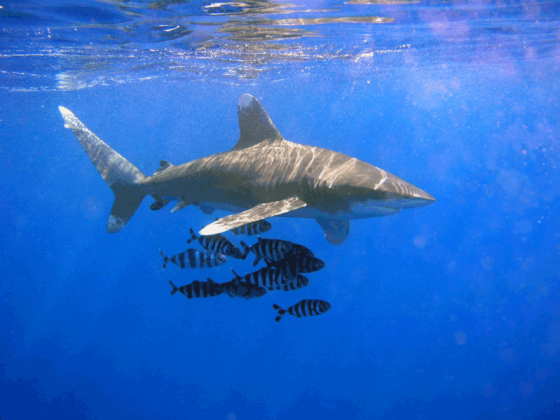
oceanic-white-tipAuthorities erroneously killed two sharks not responsible for the Red Sea attacks last week

Last week off the coast of Egypt’s tourist resort town Sharm al-Sheikh, three snorkellers were attacked by an Oceanic White Tip shark. Scientists claimed that such attacks are extremely rare for this species and sought to investigate the cause of its aberrant behavior.

Officials also promised that the shark would be captured and then released away from tourist areas in the Gulf of Suez. Instead, Egypt’s park authorities killed two sharks – one Mako and one Oceanic White Tip, neither of which is believed to be the shark responsible for the attacks.

Ostensibly to pacify tourists after three Russian tourists were badly injured last week – one person lost a hand and the others sustained leg and back injuries – authorities took drastic retributive measures.

A twelve member team tracked down and killed two sharks listed as vulnerable on the International Union for the Conservation of Nature (IUCN) Red list of threatened species.

Photographs taken before the attacks and compared to images of the two captured sharks reveal that the authorities killed the wrong shark. The White Tip responsible for the killings is still “at large.”

Neither the Chamber of Diving and Watersports (CDWS) or  The Hurghada Enviornmental Protection and Conservation Association (HEPCA) approve of how the matter was handled.

This is part of a statement released by HEPCA following the authorities’ action:

…both organisations would have preferred a more graded response to the unfortunate events. No attacks on divers have been reported from any of the dive sites in the Egyptian Red Sea, making the closure of all diving activities an unnecessary and extreme measure. While we fully appreciate the difficult and sensitive situation after such an unusual string of attacks for the tourism sector, the random catching and killing of large oceanic sharks in the area does not help to mitigate the problem; additionally it sends the wrong message that people entering the water are generally in danger of being attacked by sharks.

Why the shark attacked is still uncertain. Some speculate that Yemenese fishermen who poach the sharks for their fins – a delicacy in Japan – may have contributed to this strange behavior, while others suggest that ecosystem imbalance could may make sharks desperate for new food sources.

While we are concerned for the safety of tourists on the Sinai peninsula, we hope that the authorities will refrain from haphazard culling and opt instead to revert to the original plan to relocate the shark responsible for the attacks.

:: Reuters and HEPCA

More on the Red Sea:

Egypt Eco-Group HEPCA Reports Red Sea Spill is Capped

image via wikipedia

Tafline Laylin
Tafline Laylinhttp://www.greenprophet.com
As a tour leader who led “eco-friendly” camping trips throughout North America, Tafline soon realized that she was instead leaving behind a trail of gas fumes, plastic bottles and Pringles. In fact, wherever she traveled – whether it was Viet Nam or South Africa or England – it became clear how inefficiently the mandate to re-think our consumer culture is reaching the general public. Born in Iran, raised in South Africa and the United States, she currently splits her time between Africa and the Middle East. Tafline can be reached at tafline (at) greenprophet (dot) com.

Read More

TRENDING

Oil tankers are spilling and burning in the Middle East – where is the environmental outrage?

From the Red Sea to the Strait of Hormuz, ships have burned, tankers have leaked oil and cargo vessels have sunk since October 2023. A timeline of maritime disasters, environmental damage and cleanup efforts.

Can Scientists Predict Coral Bleaching Before It Happens?

Now researchers at the Woods Hole Oceanographic Institution (WHOI) in the US say they have developed a way to predict coral bleaching five to six months before it occurs, potentially giving reef managers enough time to intervene and save vulnerable corals.

Hydrophilis Rebreather: After the Penis Jokes and Shark Bait Memes, Oliver Isler Says His Underwater Dream Is Serious

The Hydrophilis rebreather is a new scuba system that could make diving safer and more fun.

Shebara hotel Saudi Arabia – is it eco-luxury dream or desert illusion?

A new breed of luxury has landed on the Red Sea, mirrored pods floating above coral reefs, reflecting sky and sea like something not entirely of this Earth. Energy powered by solar powers, drinking water pulled from the sea using desalination. 

Hydrophilis SCUBA gear could make us one with the sea

Hydrophilis, Oliver Isler’s experimental rebreather suit, reimagines diving by reducing drag, eliminating bubbles, and bringing humans closer to the natural movement of marine life.

Why Bronwyn Finnegan Chose the Nonprofit Sector Over Politics or Corporate Life

Bronwyn Finnegan could have pursued a career in politics or corporate leadership. Instead, she chose the nonprofit sector, where she focuses on financial sustainability, governance and helping mission-driven organizations build the capacity to survive and grow.

Scientists make lead-free perovskite solar cells that can weather the elements

Scientists have developed a “raincoat” for lead-free tin perovskite solar cells, helping them withstand air, moisture and heat while maintaining high efficiency.

The Essential Guide To Sustainability in Project Management

Sustainability is an approach where businesses and individuals balance the environmental, social, and economic aspects of a project such that current and future stakeholders are not overburdened with the impacts of the project in future.

Yerukim Forms a New Green Economy Where the Money is Really Green

The Yerukim members who pick up the recyclables get to keep the monetary reward, the public earns "green" bills that can be used in shops, and business owners get to be associated with environmentalism.

Choosing Riyadh over Dubai? What Investors Should Know

Saudi Arabia is deploying capital at unmatched scale to catalyze tourism and advanced industry while rewiring its power-and-water backbone. The investable frontier is widening—especially in renewables, grid storage, water efficiency/desal retrofits, and hospitality operating platforms. Prudent investors will insist on phased delivery, enforceable KPIs (energy, water, biodiversity), and RHQ/zone compliance—while pricing political-economy and reputational risks alongside growth upside.

Sell your cooking oil for biodiesel money

Want to make money on old french fry oil? Sell it.

Qatar Alternative Energy Summit Pairs Investors And Innovators

Alternative energy investors and innovators can meet n' greet in Doha, Qatar March 16 and 17.

Here’s How To Implement The Four Pillars Of Employee Engagement

If you throw a party for your work team and they are vegans, don't make it a barbecue. Know the sustainability values of your team to boost moral and retain good people.

Popular Categories