
Israel Carmel Fire – Taking Stock of How It Happened

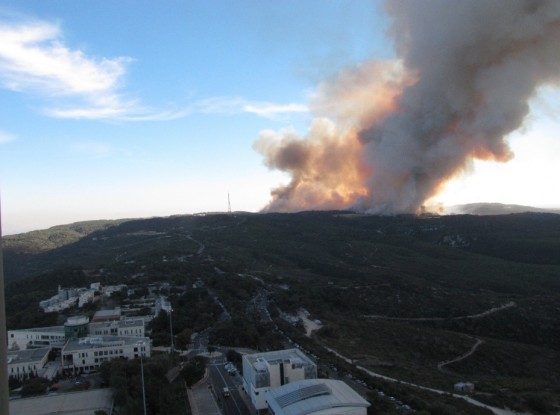
israel carmel fire view from University of HaifaView of the Israel Carmel Forest fire encroaching on the University of Haifa campus. Image credit University of Haifa

An act of God, arson, or negligence? A lot of questions are being asked by Israelis as to why they needed to suffer the worst fire in the nations’s histrry this weekend  – a fire that gobbled about 5,000 hectares of land. Scouts in the forests planted to watch for arsonists reported young men on horseback hurling molotov cocktails into fresh parts of forests to stoke the flames. But this is something you might not hear in the media for fear of political backlash.

Moving on to the conditions that allowed the fire to rage out of control, reporting from Haifa University, part of the UNESCO bioreserve in the Carmel Mountain is Dr. Lea Wittenberg and Dr. Dan Melkinson. They say that from all the fires on the Carmel over the past 30 years a total of about 3,000 hectares of forest were burnt. The present blaze has burnt down some 5,000 (12,350 acres) hectares.

“The extent and intensity of the fire depend on the conditions in the forest, on climate and topography. A young and damp forest will not burn. A mature forest that has accumulated many combustive materials and that is very dry due to a lack of rain, along with strong winds, will cause extensive fires. Nothing would have been able to stop this great fire from reaching the proportions that it did,” the researchers said.

“Since 1978 the Carmel Mountains have seen some 500 small and medium fires and 9 large-scale conflagrations, which are considered such when over 100 hectares are burnt. All these fires together burnt some 3,000 hectares of forest, while the present fire has burnt some 5,000 hectares,” says Wittenberg who has been researching the Carmel Forest for 20 years.

According to researchers, what determines the force of a fire is the forest conditions, and at times even the best human deployment cannot help: The extent and intensity of the fire depend on the conditions in the forest. A young and damp forest will not burn. A mature forest that has accumulated many combustive materials will burn easily.

“With no rainfall for the past eight months, the forest became extremely dry, and along with the strong winds, the present fire grew so wild. Nothing could have stopped it from reaching its great proportions. The smoke began at 11 a.m. and by noon we had a full view of massive flames,” the researchers report.

Even in this sort of enormous fire, there are locations that are burnt to a cinder and other places where the forest is only singed, they say. The problem with fires in the Carmel is that there are some areas that have been burnt twice or even three times over the past thirty years. It will be very difficult to revive these areas because of the extreme damage to their soil and vegetation.

Both have begun scouting the field in order to map out the region’s sensitivities. “The approach is not to ‘go out and bring back the green,’ but to observe the ground and consider where to plant anew and where not,” they noted.

If you don’t think this fire is a big deal, read what was lost – last year I wrote a feature on the United Nations protected Carmel Forest, pointing out species diversity in plants and animals, and how important it is for the local Druze communities.

Read more on the Israel Carmel Fire:
Israel Carmel Fire Kills 40 People
The Worst Fire in Israel’s History Rages Out of Control
Israel Carmel Fire Raging Out of Control Friday Morning


Karin Kloosterman
Karin Kloostermanhttp://www.greenprophet.com
Karin Kloosterman is an award-winning journalist, innovation strategist, and founder of Green Prophet, one of the Middle East’s pioneering sustainability platforms. She has ranked in the Top 10 of Verizon innovation competitions, participated in NASA-linked challenges, and spoken worldwide on climate, food security, and future resilience. With an IoT technology patent, features in Canada’s National Post, and leadership inside teams building next-generation agricultural and planetary systems — including Mars-farming concepts — Karin operates at the intersection of storytelling, science, and systems change. She doesn’t report on the future – she helps design it. Reach out directly to [email protected]
2 COMMENTS

Comments are closed.

TRENDING

Eco organization offices destroyed by Iran missile

Tel Aviv's eco organization, the Heschel Center, was impacted by an Iranian missile.

Nearly the half the world’s migratory species are declining, in new UN report for COP15

With larger, land-bound animals human encroachment and Middle East warns make it more troubling for the survival of migratory animals on land, air and at sea. A new United Nations report released this week warns that the situation is getting worse, not better.

What are AWG air-water generators, and why they aren’t a golden-bullet solution (yet)

Atmospheric water generators (AWGs) sound like magic: machines that can pull drinking water out of air. The idea is mentioned in the Bible, where the elders would pray for water collected as dew on plants and the catch on turning this into a machine is in the physics. To turn invisible vapor into liquid, you must remove heat, especially the latent heat of condensation.

Jordan’s $6 Billion Aqaba–Amman Desalination Project from the Red Sea Moves Forward

In 2025, the Jordanian government signed agreements with a consortium led by Meridiam and SUEZ, alongside VINCI Construction and Orascom Construction. Under a 30-year concession agreement, the consortium will design, build, finance, operate, and maintain the system before transferring it back to the Jordanian government. The total investment is estimated at approximately $6 billion USD.

The Saudi Startup Turning Desalination’s Toxic Waste Into Its Own Disinfectant

For millennia, the Middle East's water crisis seemed an immutable fact of geography — a region defined as much by what it lacked as by what lay beneath its sands. Today, a convergence of plummeting solar costs, advancing membrane technology, and hard-won engineering expertise is rewriting that story.

Should You Invest in the Private Market?

startustartup Unlike public stock exchanges, which offer daily trading, strict...

How to build a 100-year-company

Kongō Gumi is a Japanese construction company, purportedly founded in 578 A.D., making it the world's oldest documented company. What can we learn about building sustainable businesses from them?

From Pilot Plant to Global Stage: How Aduro Clean Technologies’ 2026 Expansion Signals a Turning Point for Chemical Recycling Investors Like Yazan Al Homsi

The company's Next Generation Process (NGP) Pilot Plant in London, Ontario, has officially moved into initial operating campaigns, generating the kind of structured, repeatable data that separates laboratory promise from commercial viability.

How AI Helps SaaS Companies Reduce Repetitive Customer Support Work

SaaS products are designed for large numbers of users with different levels of experience, and also in renewable energy.

Pulling Water from the Air

Faced with water shortage in Amman, Laurie digs up...

Turning Your Energy Consultancy into an LLC: 4 Legal Steps for Founders in Texas

If you are starting a renewable energy business in Texas, learn how to start an LLC by the books.

Tracking the Impacts of a Hydroelectric Dam Along the Tigris River

For the next two months, I'll be taking a break from my usual Green Prophet posts to report on a transnational environmental issue: the Ilısu Dam currently under construction in Turkey, and the ways it will transform life along the Tigris River.

6 Payment Processors With the Fastest Onboarding for SMBs

Get your SMB up and running fast with these 6 payment processors. Compare the quickest onboarding options to start accepting customer payments without delay.

Related Articles

Popular Categories