
Obama Tried to Get Saudis on Board at Copenhagen, Wikileaks Reveals

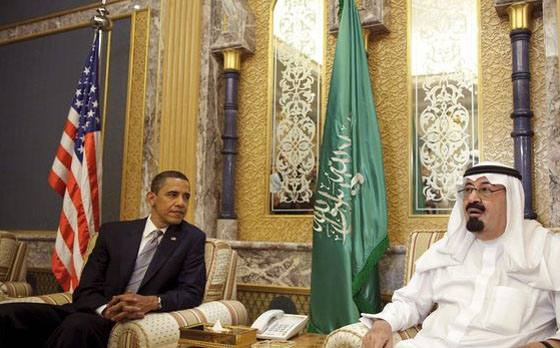
ClimateWire has revealed that leading up to the UN meeting at Copenhagen last December, the Obama administration leaned hard on the Saudis to get them to agree to the Copenhagen Accord.

According to Wikileaks of private communications within the state department, the administration went right to the source of opposition to climate negotiations. The Saudis.

The memos show that Saudi Arabia was privately pushed hard by the US to accept the Copenhagen Accord, and that climate change was a front burner issue for the Obama administration.

“Saudi officials are very concerned that a climate change treaty would significantly reduce their income just as they face significant costs to diversify their economy,” the US ambassador James Smith wrote, briefing Secretary of State Hillary Clinton. However, he alluded to a possible negotiating tactic in the memo. “The King is particularly sensitive to avoid Saudi Arabia being singled out as the bad actor, particularly on environmental issues,” he wrote.

Analysts said the Saudi memos, in particular, show the lengths the Obama administration went to in order to sway a fierce opponent of international climate action.

Saudi Arabia, the world’s largest oil producer, has a long blocked climate talks momentum at the international level, and among key allies like the US. US climate change policy has been effectively neutered by the political polarization created by Fox News and the US Chamber of Commerce, both of which are key advocates for the benefit of the oil industry.

Both use the US Republican party as a proxy, and demand a position against climate legislation as a condition of funding. Saudi Arabia invested in both organizations.

After the Copenhagen summit, there was a January 31 deadline for nations to be “associated with” the accord, by pledging the amounts that they could agree to cut.

“A/S Feltman noted the importance that the President places on climate change, and the Copenhagen Accord,” Smith wrote. “Given that Minister of Petroleum Al-Naimi was involved in crafting the final agreement, A/S Feltman noted the United States is counting on Saudi Arabia to associate itself with the accord by January 31.”

The vast majority,  138 nations, representing 87% of global emissions submitted pledges. Another 8 nations, mostly very minimal contributors: with well under 10% of emissions, refused to be associated with the Copenhagen Accord. Saudi Arabia is one of the few nations that joined neither group.

:: ClimateWire via Scientific American

More on Copenhagen and Saudi Arabia:
Finding the Arab Delegates at Copenhagen
The Middle Eastern View of Copenhagen
The World’s Poorest Protest Saudi Arabia’s Obstructionist Role in Copenhagen

1 COMMENT

Comments are closed.

Hot this week

Why Health Systems Are Reaching a Turning Point

Health emerges from a continuous energy and material flow from water through food to human physiology. Technical energy systems support this cycle through water treatment, agriculture, and infrastructure.

Sustainability That Sells: How Profit and Purpose Come Together in the Hive

Whether you are a commercial grower, hobbyist beekeeper or retail equipment supplier, this system opens a new income stream with minimal environmental impact.

The Fitness App Revolution: Building the Future of Wellness Through Strategic Development

In an era where smartphones are ubiquitous and health consciousness is at an all-time high, the fitness industry has undergone a radical digital transformation. Fitness applications have moved far beyond simple pedometers, evolving into comprehensive wellness platforms that serve as personal trainers, nutritionists, and community hubs right in our pockets.

A Brief History of Basil From India to Italy

Beloved, fortunate, sweet, and royal; an herb with a long and storied history in Asia and across the world. Called by many names, basil has featured in previous Green Prophet articles, so enjoy another serving, a brief history of basil.

How Renewable Energy is Revolutionizing the Way We Power Our World

Solar has become the star of the transition thanks to modular hardware and straightforward installation. It fits dense cities and remote towns alike. Many companies are turning to rooftop arrays and carport systems - and exploring commercial solar installation as a practical way to lock in future savings.

Topics

Why Health Systems Are Reaching a Turning Point

Health emerges from a continuous energy and material flow from water through food to human physiology. Technical energy systems support this cycle through water treatment, agriculture, and infrastructure.

Sustainability That Sells: How Profit and Purpose Come Together in the Hive

Whether you are a commercial grower, hobbyist beekeeper or retail equipment supplier, this system opens a new income stream with minimal environmental impact.

The Fitness App Revolution: Building the Future of Wellness Through Strategic Development

In an era where smartphones are ubiquitous and health consciousness is at an all-time high, the fitness industry has undergone a radical digital transformation. Fitness applications have moved far beyond simple pedometers, evolving into comprehensive wellness platforms that serve as personal trainers, nutritionists, and community hubs right in our pockets.

A Brief History of Basil From India to Italy

Beloved, fortunate, sweet, and royal; an herb with a long and storied history in Asia and across the world. Called by many names, basil has featured in previous Green Prophet articles, so enjoy another serving, a brief history of basil.

How Renewable Energy is Revolutionizing the Way We Power Our World

Solar has become the star of the transition thanks to modular hardware and straightforward installation. It fits dense cities and remote towns alike. Many companies are turning to rooftop arrays and carport systems - and exploring commercial solar installation as a practical way to lock in future savings.

How does one start prepping?

Faced with an extreme winter storm this year, Americans wonder how to be prepared for catastrophe. Miriam has lived through wars in the Middle East - so she's prepared on giving you a guide to prepping.

Fishermen sue tire manufacturers on behalf of the salmon

A federal trial in San Francisco has brought US tire manufacturers, fishing groups, and environmental scientists into court over a chemical most drivers have never heard of — but which scientists say may be silently reshaping aquatic ecosystems.

Listening to Water: Tarek Atoui’s Next Work for Tate Modern

Born in Beirut, Lebanon in 1980 and now living in Paris, Atoui has spent years building instruments that don’t sit comfortably in concert halls. Many of them involve water, glass, and ceramics — materials that react to sound instead of simply producing it.

Related Articles

Popular Categories