
Syria’s Dustbowl Attributed To Wasted Water

euphrates-water-wasteSyria’s livelihood is going down the drain. Unless the country learns to conserve, their future will be painfully dry.

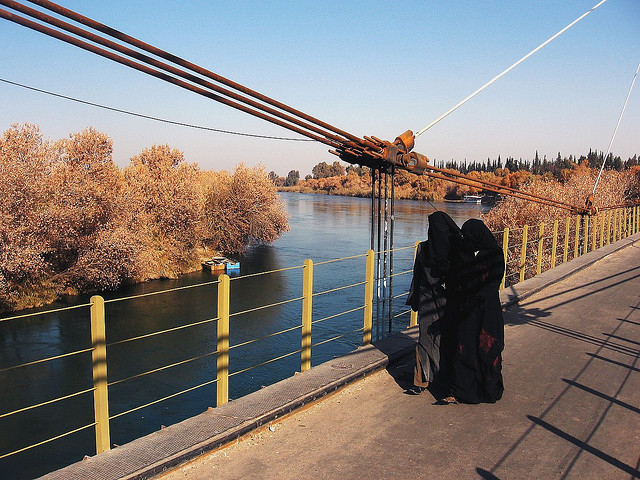
The Euphrates River, which meanders diagonally through the top quarter of Syrian territory, was once a source of agricultural bounty. Expatriates recall a time of lush plenty: orchards blooming with fruit, healthy cotton fields, and sparkling streams. Syria had it made with an agricultural surplus which could have easily sustained a healthy, vibrant population.

But then in the 1960s the Khabur River Project was developed to build a series of dams and canals, leading to excessive extraction. A culmination of that, a four year long drought exacerbated by rising temperatures, and old-fashioned bad management has dried up the Euphrates’ largest tributary, the Khabur River. Some are in denial, but scientists claim that unless the country learns how to stop wasting water, Syria faces a shriveled future.

What a waste!

Of the 80% of the country’s water resource allocated to agriculture, 70% is wasted. This waste is mostly attributed to antique irrigation methods. George Malaki Sawmi has replaced the former Irrigation Minister and is tasked with modernizing this system, according to The National.

But poor irrigation should not shoulder the entire blame. Swansea University water scientist Nidal Hilal suggests that all of society contributes to the waste responsible for the current water crisis.

“People are using water excessively,” he told the paper.

“The message of reduce, recycle and reuse needs to be heard in Syria, from the young people in schools right up to the highest authorities.”

At a Damascus conference addressing water use that concluded last week, scientists reported that between 2002 and 2008, water availability dropped from 1200 cubic meters to 750 cubic meters per person, according the The National.

Fleeing for greener pastures

“You can call it whatever you want, but as things stand, Syria doesn’t have enough water to meet its needs,” Ghassan Ejjeh – the conference chairman who is based in Brussels – told the paper.

“If they have 750 cubic metres a year, that’s a water crisis and it will quickly become something worse unless action is taken. Supplies dropped from 1,200 cubic metres to 750 very quickly and at that rate, there is going to be a real problem very soon.”

While the North Eastern province Hasika, where the Khabur River has run dry, has the fewest water resources, the historically fertile Jazeera region that provides much of the nation’s agriculture was hit by a  drought that prompted food assistance from aid agencies.

According to the United Nations, 600,000 people have already fled.

Authorities have investigated grand schemes for pumping water from the west coast to Damascus, but Mr. Hilal shuns this solution.

“For now we should look to the water that is available and just use it better. That will go a long way to dealing with this matter,” he told the paper.

:: The National

More on water shortages:

Saudi Arabia’s Desalination Market A $50 Billion Opportunity

Ecowash M.E.: How To Wash Your Car In A Water-Parched Desert

Water Problems in Cyprus Worse Than Those of Israel, Syria and Lebanon

image via Ai@ce

Tafline Laylin
Tafline Laylinhttp://www.greenprophet.com
As a tour leader who led “eco-friendly” camping trips throughout North America, Tafline soon realized that she was instead leaving behind a trail of gas fumes, plastic bottles and Pringles. In fact, wherever she traveled – whether it was Viet Nam or South Africa or England – it became clear how inefficiently the mandate to re-think our consumer culture is reaching the general public. Born in Iran, raised in South Africa and the United States, she currently splits her time between Africa and the Middle East. Tafline can be reached at tafline (at) greenprophet (dot) com.

Hot this week

The Fitness App Revolution: Building the Future of Wellness Through Strategic Development

In an era where smartphones are ubiquitous and health consciousness is at an all-time high, the fitness industry has undergone a radical digital transformation. Fitness applications have moved far beyond simple pedometers, evolving into comprehensive wellness platforms that serve as personal trainers, nutritionists, and community hubs right in our pockets.

A Brief History of Basil From India to Italy

Beloved, fortunate, sweet, and royal; an herb with a long and storied history in Asia and across the world. Called by many names, basil has featured in previous Green Prophet articles, so enjoy another serving, a brief history of basil.

How Renewable Energy is Revolutionizing the Way We Power Our World

Solar has become the star of the transition thanks to modular hardware and straightforward installation. It fits dense cities and remote towns alike. Many companies are turning to rooftop arrays and carport systems - and exploring commercial solar installation as a practical way to lock in future savings.

How does one start prepping?

Faced with an extreme winter storm this year, Americans wonder how to be prepared for catastrophe. Miriam has lived through wars in the Middle East - so she's prepared on giving you a guide to prepping.

Fishermen sue tire manufacturers on behalf of the salmon

A federal trial in San Francisco has brought US tire manufacturers, fishing groups, and environmental scientists into court over a chemical most drivers have never heard of — but which scientists say may be silently reshaping aquatic ecosystems.

Topics

The Fitness App Revolution: Building the Future of Wellness Through Strategic Development

In an era where smartphones are ubiquitous and health consciousness is at an all-time high, the fitness industry has undergone a radical digital transformation. Fitness applications have moved far beyond simple pedometers, evolving into comprehensive wellness platforms that serve as personal trainers, nutritionists, and community hubs right in our pockets.

A Brief History of Basil From India to Italy

Beloved, fortunate, sweet, and royal; an herb with a long and storied history in Asia and across the world. Called by many names, basil has featured in previous Green Prophet articles, so enjoy another serving, a brief history of basil.

How Renewable Energy is Revolutionizing the Way We Power Our World

Solar has become the star of the transition thanks to modular hardware and straightforward installation. It fits dense cities and remote towns alike. Many companies are turning to rooftop arrays and carport systems - and exploring commercial solar installation as a practical way to lock in future savings.

How does one start prepping?

Faced with an extreme winter storm this year, Americans wonder how to be prepared for catastrophe. Miriam has lived through wars in the Middle East - so she's prepared on giving you a guide to prepping.

Fishermen sue tire manufacturers on behalf of the salmon

A federal trial in San Francisco has brought US tire manufacturers, fishing groups, and environmental scientists into court over a chemical most drivers have never heard of — but which scientists say may be silently reshaping aquatic ecosystems.

Listening to Water: Tarek Atoui’s Next Work for Tate Modern

Born in Beirut, Lebanon in 1980 and now living in Paris, Atoui has spent years building instruments that don’t sit comfortably in concert halls. Many of them involve water, glass, and ceramics — materials that react to sound instead of simply producing it.

Leading Through a Dual-Energy Transition: Balancing Decarbonisation with Energy Security

Experience in one area of the energy industry isn't enough to guarantee readiness across all the others. That's where a structured program like an MBA in energy can come in. Today's advanced curricula explore energy economics, finance, policy, and strategic management alongside the technical subjects. And when pursuing an energy MBA online, professionals can skill up and retrain without having to step out of the labor market -- an important perk at a time when skilled professionals are already in short supply.

From Green Energy to Healthy Societies: Why old systems thinking is becoming relevant again

Across the Middle East and North Africa, large investments are being made in green hydrogen, renewable energy, water infrastructure and sustainability. Most of these efforts are discussed in the context of climate change, decarbonization and economic diversification. That framing is important, but it may not capture their full value.

Related Articles

Popular Categories