

The ancient Israelites used stones to collect dew from the air, and there is a prayer in the Jewish prayerbook that asks for dew for the crops. Now the modern Jews from the Land of Israel ones are taking the idea further.
The Israeli company Tal-Ya Water Technologies, promises to squeeze dew from the air for watering crops where water resources are precious or scarce. This new invention has a number of ecological benefits that go beyond simple water savings. They are similar to the Dutch passive irrigation product called Groasis which we featured here.
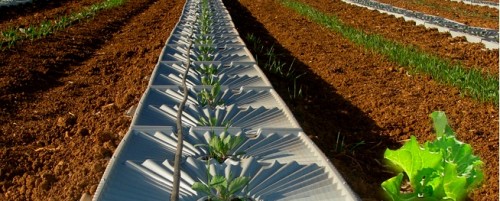
For about $1 a piece, which serves one plant or seedling, a square serrated tray made from a special plastic composite sits directly on the ground.

The reusable Tal Ya tray is fitted with a hole in the center for a plant to grow. Using non-PET recycled and recyclable plastic with UV filters, and a limestone additive, Tal-Ya’s trays do not degrade in the sun or after the application of pesticides or fertilizers.
An aluminium additive helps the trays — about 70 cm by 70 cm for a pepper plant — respond to shifts in temperature between night and day. When a change of 12 degrees centigrade occurs, dew forms on both surfaces of the Tal Ya tray, which funnels the dew and condensation straight to the plant and its roots.
The trays are also made in larger sizes for trees, Avraham Tamir, the company head and inventor tells Green Prophet.
Benefits of Tal Ya trays
Plastic trays clear weeds, naturally
“Using our system has a number of benefits,” Tamir says. Farmers don’t need to worry about weeds because the trays block the sun, so weeds can’t take root. “Farmers need to use much less water, and in turn much less fertilizer on the crop,” he explains. Less fertilizers and pesticides means less groundwater contamination.
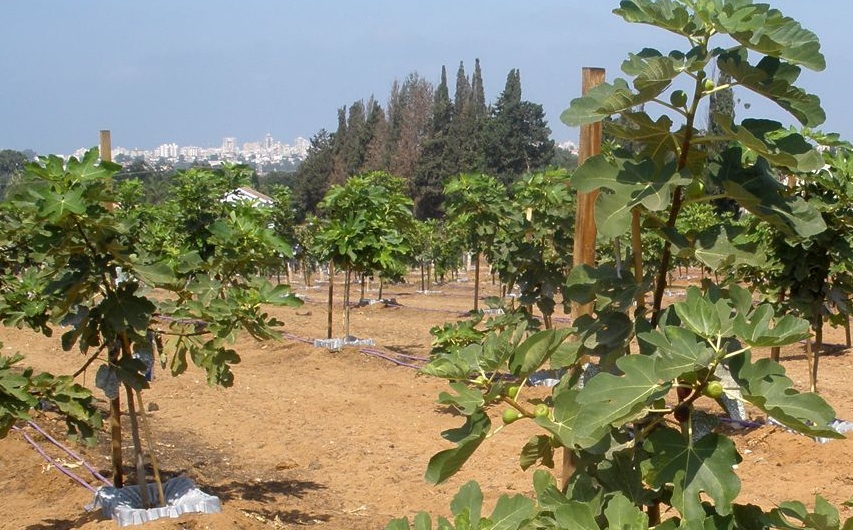
Locking together like pieces of Lego, see how they look in the field above, special sections of the tray make space for irrigation and watering equipment to fit into the solution.
Field tests in Israel with the Ministry of Agriculture suggests whopping water savings of up to 50 percent of irrigated water by using the Tal-Ya dew collecting system.
“Dew collection starts at night,” Tamir says. “The critical mass goes down below,” he explains while pointing to the serrated edges of the trays. If it rains, we can amplify 1 mm of rain so that it equals 27 mm.”
Protection from extreme temperature change
Water from dew and condensation is in effect distilled water. Adding this to the soil alleviates the salinity from irrigation, says the company. The trays also protect crops from extreme shifts in temperature, like in Canada or the United States where late and early season frosts put some crops at risk.
Of course, “the amount of water collected depends on location,” Tamir points out. Humidity factors, temperatures and precipitation are important to consider.
Founded four years ago and based in the village of Gan Yoshiya in Israel, research collaboration to help build Tal-Ya which means “God’s dew” in Hebrew, came from the Hebrew University, the Ministry of Agriculture, the Volcani Institute and Ben Gurion University.
Tal-Ya launched its new product at the Agritech exhibition in Tel Aviv. Tamir says he is now selling his product to Israeli farmers, and looking forward to international buyers from America.
Cons of Tal Ya trays
___
Update 2021: when I wrote this article years ago I was excited about small ideas that could improve agriculture. But there is a big but: Tal Ya trays are made from a non-renewable resource: plastic. Plastic leaches into the soil and eventually groundwater.
Plus there are aluminum additives in the tray. No till agriculture and regenerative organic agriculture using ground coverage from hay or compost is probably the way forward for farmers planting trees for this generation and next.

Read our interview with Nature’s Path about regenerative organic agriculture and learn from Woody Harrelson about why regenerative agriculture is best.
More innovative low-tech water technologies:
Watercones in Yemen to Evaporate Seawater to Drinking Water
EWA Collects Water From Thin Air
A Qatari Seawater Greenhouse



[…] Tal Ya Water Irrigation Trays Make the Most of Dew […]
Incredible irrigation technology! Israel is no doubt ahead of every country in agriculture!
I was raised stacking stones in a circle around plants in order to capture dew. To preserve it we placed mulch/compost within the circle.
The Tal-ya is an alternative. It appears the Tal-ya waters the plants only once a day which is much better than nothing. The Groasis seems to go one better by providing a continuous day long flow of water. The one negative is cost. Does anyone out there know if I can improvise a Groasis by using a angel food baking pan as a reservoir and a Tal-ya tray as a collector?
Dew in Isreal
Shalom,
in which areas of dew account when?
Withe regarts
[…] Green Prophet stories to see the pros and cons: A Farmer’s Story on Natural Sheep Grazing Tal Ya Water Irrigation Trays Make the Most of Dew EcoBaladi Sprouts Organic Vegetables From the West Bank Valley of the Thorns Permaculture and Green […]
[…] New Middle East desert research finds fishing line can help irrigate fields. Some companies like Tal Ya are making the most of dew in irrigating farmers’ fields. Others like EWA are squeezing water […]
RT @GreenProphet Tal Ya Water Irrigation Trays Make the Most of Dew http://bit.ly/wW7dJ