Health insurance is a regulated financial product. Insurers operate under binding contracts, overseen by state insurance commissioners, that legally obligate them to pay claims meeting policy terms. Policyholders who believe a covered claim was wrongfully denied have legal recourse through state regulatory channels.
The New Zealand Merino Company, now rebranded as Zentera, has quietly removed the phrase “world’s leading ethical wool brand” from its website, a notable change that comes after a disturbing investigation by PETA Asia-Pacific into the company’s ZQ-certified wool supply chain, PETA reports to Green Prophet.
Somehow vegetables with short seasons excite the imagination and appetite more sharply than produce that’s available all year around. Good Middle Eastern cooks have many recipes for delicate fava beans, and this turmeric-fragrant soup is one.
Health insurance is a regulated financial product. Insurers operate under binding contracts, overseen by state insurance commissioners, that legally obligate them to pay claims meeting policy terms. Policyholders who believe a covered claim was wrongfully denied have legal recourse through state regulatory channels.
The New Zealand Merino Company, now rebranded as Zentera, has quietly removed the phrase “world’s leading ethical wool brand” from its website, a notable change that comes after a disturbing investigation by PETA Asia-Pacific into the company’s ZQ-certified wool supply chain, PETA reports to Green Prophet.
Somehow vegetables with short seasons excite the imagination and appetite more sharply than produce that’s available all year around. Good Middle Eastern cooks have many recipes for delicate fava beans, and this turmeric-fragrant soup is one.
Health insurance is a regulated financial product. Insurers operate under binding contracts, overseen by state insurance commissioners, that legally obligate them to pay claims meeting policy terms. Policyholders who believe a covered claim was wrongfully denied have legal recourse through state regulatory channels.
The New Zealand Merino Company, now rebranded as Zentera, has quietly removed the phrase “world’s leading ethical wool brand” from its website, a notable change that comes after a disturbing investigation by PETA Asia-Pacific into the company’s ZQ-certified wool supply chain, PETA reports to Green Prophet.
Somehow vegetables with short seasons excite the imagination and appetite more sharply than produce that’s available all year around. Good Middle Eastern cooks have many recipes for delicate fava beans, and this turmeric-fragrant soup is one.
Health insurance is a regulated financial product. Insurers operate under binding contracts, overseen by state insurance commissioners, that legally obligate them to pay claims meeting policy terms. Policyholders who believe a covered claim was wrongfully denied have legal recourse through state regulatory channels.
The New Zealand Merino Company, now rebranded as Zentera, has quietly removed the phrase “world’s leading ethical wool brand” from its website, a notable change that comes after a disturbing investigation by PETA Asia-Pacific into the company’s ZQ-certified wool supply chain, PETA reports to Green Prophet.
Somehow vegetables with short seasons excite the imagination and appetite more sharply than produce that’s available all year around. Good Middle Eastern cooks have many recipes for delicate fava beans, and this turmeric-fragrant soup is one.
Health insurance is a regulated financial product. Insurers operate under binding contracts, overseen by state insurance commissioners, that legally obligate them to pay claims meeting policy terms. Policyholders who believe a covered claim was wrongfully denied have legal recourse through state regulatory channels.
The New Zealand Merino Company, now rebranded as Zentera, has quietly removed the phrase “world’s leading ethical wool brand” from its website, a notable change that comes after a disturbing investigation by PETA Asia-Pacific into the company’s ZQ-certified wool supply chain, PETA reports to Green Prophet.
Somehow vegetables with short seasons excite the imagination and appetite more sharply than produce that’s available all year around. Good Middle Eastern cooks have many recipes for delicate fava beans, and this turmeric-fragrant soup is one.
Health insurance is a regulated financial product. Insurers operate under binding contracts, overseen by state insurance commissioners, that legally obligate them to pay claims meeting policy terms. Policyholders who believe a covered claim was wrongfully denied have legal recourse through state regulatory channels.
The New Zealand Merino Company, now rebranded as Zentera, has quietly removed the phrase “world’s leading ethical wool brand” from its website, a notable change that comes after a disturbing investigation by PETA Asia-Pacific into the company’s ZQ-certified wool supply chain, PETA reports to Green Prophet.
Somehow vegetables with short seasons excite the imagination and appetite more sharply than produce that’s available all year around. Good Middle Eastern cooks have many recipes for delicate fava beans, and this turmeric-fragrant soup is one.
Health insurance is a regulated financial product. Insurers operate under binding contracts, overseen by state insurance commissioners, that legally obligate them to pay claims meeting policy terms. Policyholders who believe a covered claim was wrongfully denied have legal recourse through state regulatory channels.
The New Zealand Merino Company, now rebranded as Zentera, has quietly removed the phrase “world’s leading ethical wool brand” from its website, a notable change that comes after a disturbing investigation by PETA Asia-Pacific into the company’s ZQ-certified wool supply chain, PETA reports to Green Prophet.
Somehow vegetables with short seasons excite the imagination and appetite more sharply than produce that’s available all year around. Good Middle Eastern cooks have many recipes for delicate fava beans, and this turmeric-fragrant soup is one.
Health insurance is a regulated financial product. Insurers operate under binding contracts, overseen by state insurance commissioners, that legally obligate them to pay claims meeting policy terms. Policyholders who believe a covered claim was wrongfully denied have legal recourse through state regulatory channels.
The New Zealand Merino Company, now rebranded as Zentera, has quietly removed the phrase “world’s leading ethical wool brand” from its website, a notable change that comes after a disturbing investigation by PETA Asia-Pacific into the company’s ZQ-certified wool supply chain, PETA reports to Green Prophet.
Somehow vegetables with short seasons excite the imagination and appetite more sharply than produce that’s available all year around. Good Middle Eastern cooks have many recipes for delicate fava beans, and this turmeric-fragrant soup is one.
When I moved to Israel I started to understand, that not everywhere in the world things are going the same way. I grew up in Germany, where the convenience of a quiet and more or less unworried life, enables politicians to talk and act in terms of environment. Water saving, recycling and other environmental issues were familiar to me and my friends. I never really thought about it, it was just part of my daily life.
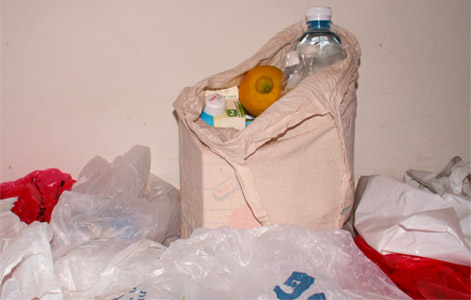
Due to this background, my first shopping tour in the small super market around the corner of my apartment in Tel Aviv was a big surprise. The cashier took all my things and stuffed them in several plastic bags. Taking her job seriously, she used at least 5 bags for the few things, to be sure that none of my bags will rip. Finally I ended up with 5 bags (one carried only my organic eggs, which by the way were wrapped in Styrofoam) for which I didn’t even have to pay a single cent.
It wasn’t that long ago when wild beasts roamed the earth. Lions, tigers, woolly haired mammoths and even elephants traipsed over the changing ecology of the Middle East up to the start of the early 15th century. Lions remain as the roaring yet watchful emblem of Jerusalem.
Now humans are the wild beasts that dominate, and in many cases, destroy, other species and their habitats. Man’s dominion has brought us to this environmental predicament, and only within the past couple of hundred years.
It is this wider picture that is addressed in Werner Herzog’s stunning documentary ‘Grizzly Man’, out now on DVD (and available to rent from The Third Ear stores country-wide). Ostensibly exploring the erratic and tragic life of Timothy Treadwell, a maverick young American, who found his life’s passion in being with and studying wild bears in Alaska. This he did for 13 summers, until one ate him and his girlfriend.
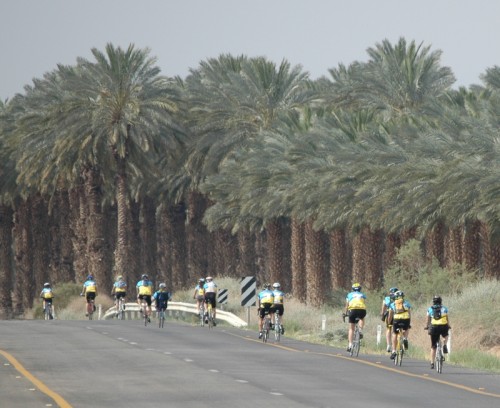
Being such a small place, you’d think Israel would be a simple place to get around on less than four wheels. But, alas, this is not the case since it’s cities and roads continuously choked with traffic. So it’s reassuring to hear that more Israelis are swapping their polluting automobiles for the most eco-friendly, not to mention wallet-friendly, mode of transport – the bicycle. Well, at least this is the case in Tel Aviv, where the number of people jumping on their bikes each day has risen by 300 percent in the last decade, according to the Yisrael Bishvil Ofanayim (Israel Bicycle Association or IBA).”Today some 7 percent of trips taken in the city are done on bikes. Recently this two-wheeled public has received real encouragement thanks to the announcement by the Transportation Ministry of an investment of NIS 50 million in the establishment of a national bike-trail infrastructure,” reported Ha’aretz. What’s more, the IBA are also campaigning for secure bike parking at railway stations as well as storage on trains themselves.
Ironically, for a planet that over 70% of it’s surface is covered by water, water is becoming quite a commodity. While it may be true that the black gold of 20th century is being phased out, the new liquid gold, it appears, is Blue Gold aka water. According to an article published in USA Today, “More than half of humanity will be living with water shortages, depleted fisheries and polluted coastlines within 50 years because of a worldwide water crisis.”
In attempt to stay ahead of the market the Technion– Israel Institute of Technology has created a Bachelors of Science in Civil Engineering – Water Resources and Environmental Engineering. This program “involves fields in which Israeli technology achieved a leading place world-wide” the university describes, “The water industry in Israel is one of the most advanced and complex systems in the world.”
Citizens and tourists rejoice: the Clean Coast Project of 2007 has ensured that we can hit those beaches in 2008. At least that’s according to the Israel Ministry of Environmental Protection, which reports that 80% of Israel’s beaches have been declared clean, with a mere 2% getting the dreaded rating of “dirty.”
This is is a massive jump from the start of the Clean Coast Project in 2005, when a whopping 27% of Israel’s beaches were declared clean.
Ronen Alkalay, coordinator of the Clean Coast Project in the Ministry of Environmental Protection says,”The integration of coastal cleanups by local authorities, assisted by a northeasterly wind, which cleaned the coasts and resulted in a calm sea emitting very little waste, along with the small number of visitors to the beaches, combined to bring about this favorable result – a clean coast.”
In previous articles, we’ve illustrated that religious Jewish practices such as Shabbat and Shmitta have the potential to affect the environment in a positive way. This makes us happy, as we at Green Prophet like when Jewish customs dovetail with the ideals of sustainability that we want to promote.
We therefore regret to report that Mikvah, or ritual immersion, is currently motivating some people to have a negative impact on one of Israel’s most endangered species, the orange salamander.
For all of us green writers, here’s a creative & green challenge that came my way this week: a new US journal; Hawk and Handsaw – the Journal of Creativity & Sustainability, is starting up and invites writers and artists of all kinds to get creative on their sense of place.
My head is already overflowing with reflections and recollections of place and belonging- five years spent in the west of Ireland, ruminating amongst lush green landscape, and trying to motivate unruly teenagers in a small-town drama group; time in Scotland, with highly motivated environmentalists munching on veggie haggis; space and adventure across the world’s deserts; and life here in Jerusalem, the centre of the universe (according to the 14th century Mappa Mundi, on display in Hereford Cathedral).
Better known as the centre for three world religions, Jerusalem is increasingly becoming the focus for environmental activities and innovation. The start of 2008 will see the city hosting the launch of the Forum on Judaism and the Environment, a new initiative to bring together professionals, organisations and activists working in the field of Jewish environmentalism in Israel and beyond.
The Forum is being launched by Ruach HaSviva, the Centre for Judaism and Environment at the Society of the Protection of Nature in Israel (SPNI), at a half-day conference on Monday 28 January in central Jerusalem.
“The project is designed to create bridges between the educators and activists working in the growing field of Jewish Environmentalism,” says Leiba Chaya, director of the SPNI’s environmental education program. Participants will be able to take part in a number of workshops focusing on themes including communities, Jewish environmental education and eco-tourism.
In a recent interview with this writer, Professor Pinhas Alpert, head of Tel Aviv University’s department of Geophysics and Planetary sciences, stated that “winters here in Israel are becoming warmer, with much less precipitation annually, and these extreme temperatures, at the minimum and maximum ends of the scale, also show a greater fluctuation between them.”Thats the view of the local expert; now here’s some facts from the wider scale: According to the IPCC (Intergovernmental Panel on Climate Change), at the current rate of carbon emissions, global average temperatures will rise by 2% by 2050.Sea levels may increase by up to 95cm by the end of the century. This would result in 18% of the country of Bangladesh being submerged. Other scenarios are also available for countries in the Western world, including online graphics of New York and London becoming underwater cities.
“Israelis are tremendously committed to the environment. We can move mountains if optimism motivates us.”
Alon Tal founded the Israel Union for Environmental Defense (IUED) in 1990 and has been working in public interest advocacy ever since. In 1996, he founded the Arava Institute for Environmental Studies, an advanced academic center where Israeli, Jordanian, Palestinian, and international students study together.
Alon was the Chairman of Life and Environment, Israel’s umbrella group for 80 environmental NGOs, between 1998-2004. He has taught environmental law at Tel Aviv University for 15 years and was recently appointed professor of environmental policy at Ben Gurion University in Israel and a visiting professor of Law at Otago University in New Zealand.
He has a small private practice where he offers pro bono representation for environmental NGOs.
One of our earliest and most popular posts to date is on cheap organic food in Israel. It got us wondering, what is our reader’s take on the organic food movement?Take Our Poll
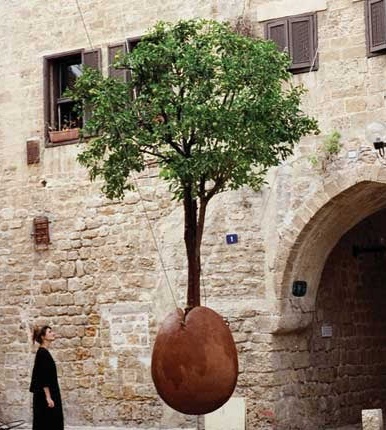
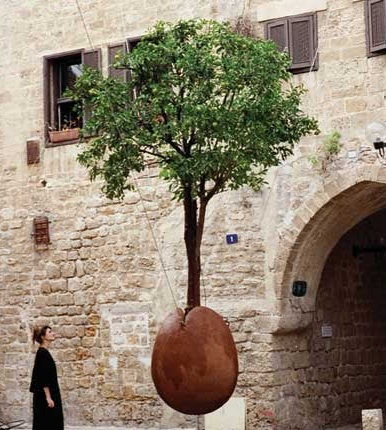
Oranger Suspendu. An environmental sculpture by Israeli environment artist Ran Morin. Hang in there.
Uprooting is a common theme in this part of the world: the Jewish Torah is compared to being a Tree of Life, and people who live in these parts are constantly struggling over land rights, and legitimizing why certain people should or shouldn’t settle here or there.
Green Prophet is not going to enter the political debate, but just offer Ran Morin’s sculpture as food for thought. Morin is an Israeli environmental artist whose works appear around the country.
He is most well-known, perhaps, for the 1993 Jaffa-based sculpture “Oranger Suspendu,” which is pictured above. We love it.
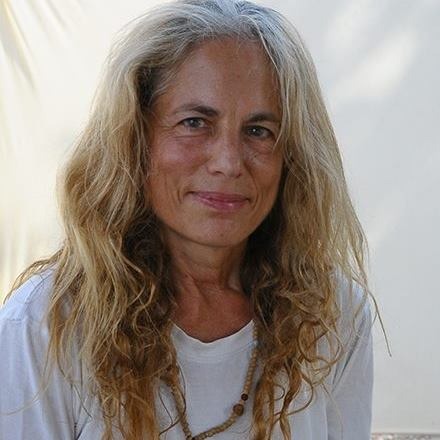
I found him once contemplating at the Austrian Hospice in Jerusalem. A pillar of quiet in a busy city of contradictions.
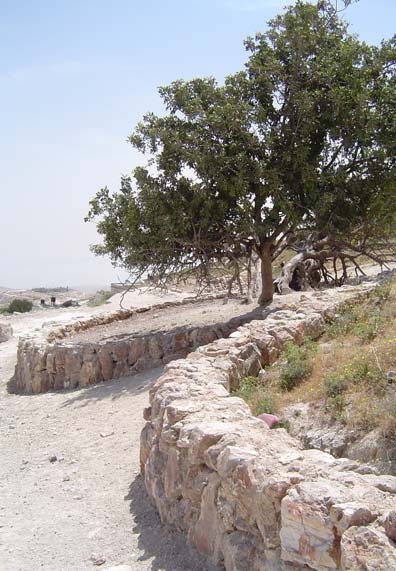
Ran Morin, whose work has been copied as burial runs by Italian designers, according to him in personal conversation (see Capsula Mondi) or also has built installations at the archeology site Ramat Rachel near Jerusalem, and has created an artist monument/sanctuary around a Moslem holy tree, the Cherub Tree of Isawyia.
The sacred Charub tree of Isawyia is the main symbolic relic of the village. Christian tradition claims that Jesus (Isa in Arabic) sat underneath this tree with his disciples. Moslems maintain that the tree was the meeting place of Saladin’s generals (1187), one of which was named Elmuadem Isa – hence Isa-wyia. The tree is believed to posses supernatural powers and can fulfill wishes, judge between opponents and even produce rain in years of draught.
Last time we were in Jaffa, the growing “Suspendu” sculpture was in a state of repair, with its roots trying to push through the pot. He told me later on that taking care of a tree like that is endless work. And for that no matter how much people offer him he will not replicate his work of art in any city around the world, or in any hotel lobby, etc. “It’s the responsibility of taking care of a living thing.”
But according to Wikipedia Morin has used hanging trees elsewhere: another one adorns the lobby of the Dan Eilat Hotel (finished in 1995), and a hanging maple tree can be seen in London’s Regent Park (1994).
We hope it’s still there down the street from our house in Jaffa and growing, despite not being able to lay roots. How many nomads and travellers out there have felt that pain?
“Can uprooted existence, established so definitely through international economics, communication and technology produce a new, lighter genuine aesthetic?” asks Morin, in his artist’s statement on the sculpture above.”My ‘growing sculptures’ do not try to answer these questions,” he says.
“They rather show a ‘rooted – uprooted’ state while going on living, much as we do, growing into an unclear future. Maybe a hydroponic one?
I want to share with Green Prophet a great site that encourages participants worldwide, not only here in Israel, or in the UK where it is based, but every computer-using sentient being anywhere, to cut down their energy output: be it water, waste, or carbon in general … and monitor their own reduction levels, and that of the entire user group.
The Guardian website has initiated a project called ‘Tread Lightly’ which gives us all the means to collectively and responsibly focus on one aspect of energy use for one week at a time, and pledge to cut down on that energy use.
The trick is of course to do that for longer than a week, but if it gets people into the habit, then all well and good. The weekly pledge gives several options: to reduce a little, a lot, or even not at all that particular week, with an email nudge delivered to your inbox a week later.
Greening is great! The best part is that when you green, you are not only taking a positive step towards rebuilding our environment, when done right there is great potential to save time and money as well. One of the major goals of greening is to reach a higher level of efficiency. How can I do this with less waste? Less waste = more money.
If it takes less energy to do, you’re giving off less greenhouse gases and you’ll have cheaper energy bills. If you can use fewer materials, you are using up less of our precious resources and there are less overhead costs. If you can recycle, there is less waste, and well, there is less waste. At least in theory those are the goals.
Poetry lovers take note: from January 8-9, Tel Aviv University will be hosting a conference on literature and the environment, entitled “Poetic Natures: The Environment, Literature and the Arts. ” Guests include US Poet Laureate Robert Hass, a National Book Award Winner and Una Chaudhuri, Professor of English, Drama and Performance Studies at New York University.
The conference is free and open to the public. The central topic of discussion will be environmental poetry in Israel and abroad.

























 Greening is great! The best part is that when you green, you are not only taking a positive step towards rebuilding our environment, when done right there is great potential to save time and money as well. One of the major goals of greening is to reach a higher level of efficiency. How can I do this with less waste? Less waste = more money.