“In the midst of uncertain time, renewable energy remains consistent and steadfast in its expansion,” said Francesco La Camera, IRENA’s Director-General. “A more decentralised energy system, with a growing share of renewables and more market players, is structurally more resilient.”
Health insurance is a regulated financial product. Insurers operate under binding contracts, overseen by state insurance commissioners, that legally obligate them to pay claims meeting policy terms. Policyholders who believe a covered claim was wrongfully denied have legal recourse through state regulatory channels.
The New Zealand Merino Company, now rebranded as Zentera, has quietly removed the phrase “world’s leading ethical wool brand” from its website, a notable change that comes after a disturbing investigation by PETA Asia-Pacific into the company’s ZQ-certified wool supply chain, PETA reports to Green Prophet.
Somehow vegetables with short seasons excite the imagination and appetite more sharply than produce that’s available all year around. Good Middle Eastern cooks have many recipes for delicate fava beans, and this turmeric-fragrant soup is one.
“In the midst of uncertain time, renewable energy remains consistent and steadfast in its expansion,” said Francesco La Camera, IRENA’s Director-General. “A more decentralised energy system, with a growing share of renewables and more market players, is structurally more resilient.”
Health insurance is a regulated financial product. Insurers operate under binding contracts, overseen by state insurance commissioners, that legally obligate them to pay claims meeting policy terms. Policyholders who believe a covered claim was wrongfully denied have legal recourse through state regulatory channels.
The New Zealand Merino Company, now rebranded as Zentera, has quietly removed the phrase “world’s leading ethical wool brand” from its website, a notable change that comes after a disturbing investigation by PETA Asia-Pacific into the company’s ZQ-certified wool supply chain, PETA reports to Green Prophet.
Somehow vegetables with short seasons excite the imagination and appetite more sharply than produce that’s available all year around. Good Middle Eastern cooks have many recipes for delicate fava beans, and this turmeric-fragrant soup is one.
“In the midst of uncertain time, renewable energy remains consistent and steadfast in its expansion,” said Francesco La Camera, IRENA’s Director-General. “A more decentralised energy system, with a growing share of renewables and more market players, is structurally more resilient.”
Health insurance is a regulated financial product. Insurers operate under binding contracts, overseen by state insurance commissioners, that legally obligate them to pay claims meeting policy terms. Policyholders who believe a covered claim was wrongfully denied have legal recourse through state regulatory channels.
The New Zealand Merino Company, now rebranded as Zentera, has quietly removed the phrase “world’s leading ethical wool brand” from its website, a notable change that comes after a disturbing investigation by PETA Asia-Pacific into the company’s ZQ-certified wool supply chain, PETA reports to Green Prophet.
Somehow vegetables with short seasons excite the imagination and appetite more sharply than produce that’s available all year around. Good Middle Eastern cooks have many recipes for delicate fava beans, and this turmeric-fragrant soup is one.
“In the midst of uncertain time, renewable energy remains consistent and steadfast in its expansion,” said Francesco La Camera, IRENA’s Director-General. “A more decentralised energy system, with a growing share of renewables and more market players, is structurally more resilient.”
Health insurance is a regulated financial product. Insurers operate under binding contracts, overseen by state insurance commissioners, that legally obligate them to pay claims meeting policy terms. Policyholders who believe a covered claim was wrongfully denied have legal recourse through state regulatory channels.
The New Zealand Merino Company, now rebranded as Zentera, has quietly removed the phrase “world’s leading ethical wool brand” from its website, a notable change that comes after a disturbing investigation by PETA Asia-Pacific into the company’s ZQ-certified wool supply chain, PETA reports to Green Prophet.
Somehow vegetables with short seasons excite the imagination and appetite more sharply than produce that’s available all year around. Good Middle Eastern cooks have many recipes for delicate fava beans, and this turmeric-fragrant soup is one.
“In the midst of uncertain time, renewable energy remains consistent and steadfast in its expansion,” said Francesco La Camera, IRENA’s Director-General. “A more decentralised energy system, with a growing share of renewables and more market players, is structurally more resilient.”
Health insurance is a regulated financial product. Insurers operate under binding contracts, overseen by state insurance commissioners, that legally obligate them to pay claims meeting policy terms. Policyholders who believe a covered claim was wrongfully denied have legal recourse through state regulatory channels.
The New Zealand Merino Company, now rebranded as Zentera, has quietly removed the phrase “world’s leading ethical wool brand” from its website, a notable change that comes after a disturbing investigation by PETA Asia-Pacific into the company’s ZQ-certified wool supply chain, PETA reports to Green Prophet.
Somehow vegetables with short seasons excite the imagination and appetite more sharply than produce that’s available all year around. Good Middle Eastern cooks have many recipes for delicate fava beans, and this turmeric-fragrant soup is one.
“In the midst of uncertain time, renewable energy remains consistent and steadfast in its expansion,” said Francesco La Camera, IRENA’s Director-General. “A more decentralised energy system, with a growing share of renewables and more market players, is structurally more resilient.”
Health insurance is a regulated financial product. Insurers operate under binding contracts, overseen by state insurance commissioners, that legally obligate them to pay claims meeting policy terms. Policyholders who believe a covered claim was wrongfully denied have legal recourse through state regulatory channels.
The New Zealand Merino Company, now rebranded as Zentera, has quietly removed the phrase “world’s leading ethical wool brand” from its website, a notable change that comes after a disturbing investigation by PETA Asia-Pacific into the company’s ZQ-certified wool supply chain, PETA reports to Green Prophet.
Somehow vegetables with short seasons excite the imagination and appetite more sharply than produce that’s available all year around. Good Middle Eastern cooks have many recipes for delicate fava beans, and this turmeric-fragrant soup is one.
“In the midst of uncertain time, renewable energy remains consistent and steadfast in its expansion,” said Francesco La Camera, IRENA’s Director-General. “A more decentralised energy system, with a growing share of renewables and more market players, is structurally more resilient.”
Health insurance is a regulated financial product. Insurers operate under binding contracts, overseen by state insurance commissioners, that legally obligate them to pay claims meeting policy terms. Policyholders who believe a covered claim was wrongfully denied have legal recourse through state regulatory channels.
The New Zealand Merino Company, now rebranded as Zentera, has quietly removed the phrase “world’s leading ethical wool brand” from its website, a notable change that comes after a disturbing investigation by PETA Asia-Pacific into the company’s ZQ-certified wool supply chain, PETA reports to Green Prophet.
Somehow vegetables with short seasons excite the imagination and appetite more sharply than produce that’s available all year around. Good Middle Eastern cooks have many recipes for delicate fava beans, and this turmeric-fragrant soup is one.
“In the midst of uncertain time, renewable energy remains consistent and steadfast in its expansion,” said Francesco La Camera, IRENA’s Director-General. “A more decentralised energy system, with a growing share of renewables and more market players, is structurally more resilient.”
Health insurance is a regulated financial product. Insurers operate under binding contracts, overseen by state insurance commissioners, that legally obligate them to pay claims meeting policy terms. Policyholders who believe a covered claim was wrongfully denied have legal recourse through state regulatory channels.
The New Zealand Merino Company, now rebranded as Zentera, has quietly removed the phrase “world’s leading ethical wool brand” from its website, a notable change that comes after a disturbing investigation by PETA Asia-Pacific into the company’s ZQ-certified wool supply chain, PETA reports to Green Prophet.
Somehow vegetables with short seasons excite the imagination and appetite more sharply than produce that’s available all year around. Good Middle Eastern cooks have many recipes for delicate fava beans, and this turmeric-fragrant soup is one.
It’s hardly surprising that “Survivor” is a hit: who doesn’t come home from work and immediately hunger to watch white trash in bikini tops hurling bleeped insults at each other over a picturesque campfire? Is it just us?
Anyway, it turns out that “Survivor” is not just the last refuge of the dregs of every culture; it is also an ecological hazard. And now the Israeli “Survivor” is taking heat for filming in a Dominican Republic nature reserve.
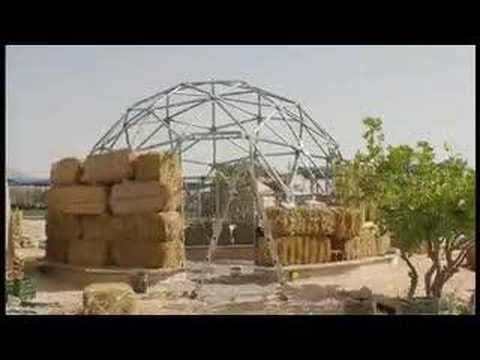
We’ve been to visit the straw bale legends Bill and Athena Stein in Arizona. Israelis are getting into their own groove building with strawbale.
Watch the time-lapsed video and the creation of a straw bale geodesic dome, at Kibbutz Lotan in the Arava Valley.
Lately, we are of the notion that it’s more green to build and rebuild in the city rather than develop new tracts of land, but if you must build that eco-village in the desert, an earth-friendly approach is key.
Israelis, as the saying goes, are like a cactus fruit, because they are prickly on the outside but sweet in the middle.
We kind of think Israelis are like bamboo too: strong as steel but soft and smooth. (If you are into eco-chic, you’ll know why we are talking about bamboo.)
Thanks to Designist Dream, we learn that Israelis are getting into bamboo, which is a material perfect for furniture and even kids toys. Those in the know consider bamboo to be one of the best alternatives to wood.Bamboo is “green” for a number of reasons. It is stronger than oak, the most durable hardwood, and it can withstand wear and tear.
In 1994, Jerusalem chef Johnny Goric cooked a lunch and dinner for Yassar Arafat, Shimon Peres and Yitzhak Rabin, during their peacemaking talks. He was also, more recently, the chef to King Abdullah II of Jordan.
But besides feeding kings and some of the world’s most influential leaders, he is also cooking in the name of peace. Goric is one of 25 Israeli and Palestinian chefs who belong to the organization, Chefs for Peace.
The chefs, all of the highest calibre in the region, have prepared gala dinners for special events around the world in Australia, Germany, Italy, Portugal, Singapore, and the United States.
They represent all three monotheistic faiths: Christianity, Islam, and Judaism; and hope through building menus, they can put bygones aside, and use food as a bridge for peace.
“Food by itself is a symphony played by many people,” Goric tells ISRAEL21c. “Whenever it comes to food, peace must be there. And when you eat in Israel – you eat all kinds of Mediterranean cuisine – humus, falafel, fish and seafood.
For years it has seemed that Israel and Thailand were enjoying a trade agreement that should keep both sides happy: we send Thailand our pushy and notoriously litterbug tourists, and they send us their illegal workers to scrub floors for half price.
But it seems that Israel has something else to offer Thailand in addition to its young, its daredevils, and its midlife crisis suffering thrill seekers–and that something is water technology.
Jerusalem, the Holy City for three religions, is often known as Jerusalem of Gold due to the yellowy-pink stones from which the buildings are cut. Until the winter that is. We’ve had heavy snowfall in the city this past 24 hours covering it in white and leaving schools, businesses and buses at a standstill (check the view from my balcony – left).Israel’s climate has gone a little crazy recently, with an exceptionally mild spell until mid-January, since when temperatures have dropped to a record low. The extent to which this is connected to man-made climate change remains speculation for now. But one thing scientists are more certain of is that the fragile and arid environment in Israel, and many of its neighbours, will be especially vulnerable to the fluctuations in global climate predicted in the future.
Kids in Beit Shemesh schools–religious and secular alike–will soon be learning about environmental issues. A new initiative on the part of Sviva Israel, a religious environmental NGO, is bringing discussion of ecological topics into the classroom.
In particular, kids will learn how to recognize their “ecological footprint” and be encouraged to tread lightly with some practical tips, such as how to recycle. Kids will present the ways in which they’ve reduced their carbon footprint before the class.
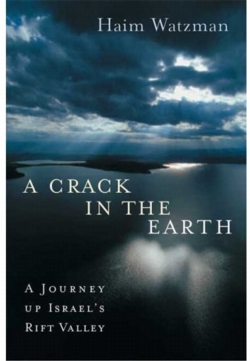
This recently published book’s full title is ‘A Crack in the Earth: A Journey up Israel’s Rift Valley,’ and it is just that; in 2004 Jerusalem-based writer and translator Haim Watzman took 2 weeks to travel up the Jordan Valley from Eilat in the south to Kiryat Shmonah in the far north, meeting a wide range of people intimately connected with the valley, and reflecting upon the environment of the diverse area.
The resulting fascinating and well-written travelogue chronicles the human ecology of this geological place. It doesn’t try to be a resource of the environmental issues there, and yet in his written meditations and recording of conversations, with Uzi Avner for instance, former chief archaeologist of the Israel Antiquities Authority in the Eilat region, Watzman succeeds in blending stories of rock formations, geological shifts, tales of ancient peoples told through their remains, and weaving in and out of all these, Israel’s ongoing struggle for survival and relations with its neighbours.
Being a mom at the best of times can be quite a challenge, so much to learn and so quickly, so when everybody is talking about being an eco-mum it can seem just like one more thing that is too much to take on.
Well I am here to help and to show you how it can actually make being a mum just that little bit simpler. So what are my creds for this task? Well I grew up on an organic farm in England and in a slightly crazy eco-house, later studying conventional farming and learnt all about agricultural chemicals, which was a real eye-opener.
I then did a full turn about and immigrated to Israel, slowly losing almost all my connections to a green lifestyle (11 years ago it seemed an entirely different world here in Israel), though cleaning with vinegar, lemon and essential oils I was a firm diehard.
But one can only ignore one’s roots for so long before they bite you in the “tush” and remind you that life is a definitely not just about me and mine…I became pregnant just under three years ago and felt it was not a question of what but of how; there seemed to be nothing available to keep up with my idea of giving my baby the healthiest environment.
In the end I enlisted my mum in England to help with the task.During my first few months I found it ever more frustrating: the idea that I had to send to England for the basics, such as organic cotton clothes, bedding, nappies & toiletries. Hence Tinok Yarok (Update 2020: company and link no longer active) was born. I started with a basic collection of organic cotton baby clothes for the first year and spiralled out to bring together everything green & eco for baby and family; and to let you know just how easy it can be!Ah, so where does an eco-mum come into it?
Well it goes like this: we live in a consumer driven society gone mad, all that seems important is to do it fast and cheap and pooh to the consequences. Eco-mum is about slowing down and taking a good look at what is really important, your child’s health and happiness, and this is surprisingly easy & would you believe very cost effective.So here goes for the first tip of the week – plenty more to come and feel free to ask questions, in fact do ask.
Nursery madness
All that new furniture and “essential” items you are all being told are necessary for your baby are NOT. Swap and borrow furniture from friends and family. You can even rent a crib in the beginning. Your baby really doesn’t care if the bed or change stand is new or that the clothes are hand me arounds.
Second-hand shops are opening everywhere around the country and the Middle East and there are great sites too that specialise in second hand items. Facebook has a lot of active groups now.
Think twice before you buy – who are you really buying it for and why? All this new furniture is putting a lot of strain on our world. Think about it this way, in 1999 the world’s population hit 6 billion, and with approximately 75 million babies being born each year, that’s a lot of beds, clothes, bottles etc, etc, being made, bought & thrown away.
Pregnant and eco-mom to be
Want to know what it’s like to be pregnant as a global nomad and a future eco-mom stuck between two countries? Read Krista’s story.
Israel was ranked #1 in the Middle East on Yale and Columbia’s 2008 Environmental Performance Index, a system which consists of variables that relate to environmental health and ecosystem vitality.
But in comparison to the rest of the world, we’re #49.
[youtube]http://www.youtube.com/watch?v=OmOW0z__AMI&rel=1[/youtube]We’ve been a little skeptical about the electric car project proposed by Shai Agassi. Israel relies still on heavily-polluting coal power plants; and a great deal of infrastructure will need to be put in place for this scheme to work.
Not to mention the fact that Israelis barely recycle.
That’s quite a jump from throwing trash out of one’s car to zipping along the highway in an electric one. Non?
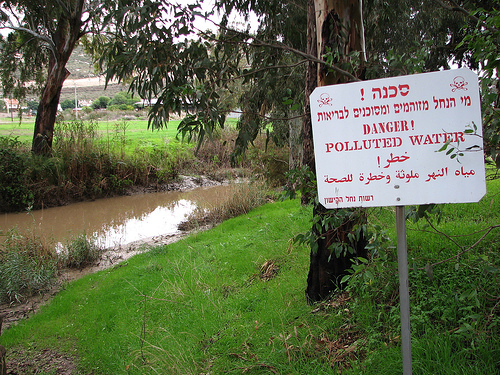
The Kishon River was once a notorious dumping ground for seven chemical plants, with the result that the entire ecosystem died and the river was even blamed for causing cancer in soldiers (though that has never been proven conclusively).
In recent years, the Ministry of Environmental Protection has initiated what they refer to as a “master plan” to clean up the Kishon River, starting with putting a firm grip on chemical plants that were dumping sewage into the river.
“Gie me a spark o’ natures fire, thats a’ the learning I desire:
Then, tho’ I drudge thro’ dub an’ mire at pleugh or cart,
my muse, tho’ hamely in attire, may touch my heart.”
Israel’s small but distinguished Scottish community may well be nursing hangovers and sore throats this week, after celebrating the anniversary of the birth of Scotland’s national poet, Robert Burns, which happily coincided with Shabbat, this past Friday, January 25th.
Burns, who was born in 1759 and died in 1796 (a mere 37 years later), has earned his mantle due to a wealth of poetry that encompasses romance, power and nascent nationalist politics, social justice, and a deep feeling for the natural world. He was born in the midst of a snowdrift in a tiny cottage in Ayrshire, South West Scotland, and although he achieved fame and some wealth for his writings in his lifetime (and a certain notoriety for his drinking and womanising), he never lost touch with his humble origins and the common touch.
Green Prophet took you on a whirlwind tour of a green kitchen party. Now we head to the bathroom. Some first steps in making the bathroom green and sustainably shiny, could start with natural cleaners on your tub, toilet and sink. You can buy them or make your own. We’ll talk in more detail about that later.
Give your drain a rinse once a month with baking soda and vinegar to keep your pipes unclogged; one of our readers recommends lemon juice on the faucets to pull away the stone.
The bathroom is where we see, smell and feel life. It is also one of the places where when we are scrubbing our bods, we consume an alarming amount of the world’s most precious resource, water.
An average shower uses about 30 gallons of water. That’s a lot of water going down the drain.
Delivering water to your home is an energy-depleting process. In some regions, half of all the electricity used by the city is spent pumping water to faucets. So not only are we wasting water when we are standing in the shower, we are also contributing to the burning of fossil fuels and global warming.
Reducing water use is the most important thing you can do to make your bathroom environmentally sound. Low-flush toilet tanks and water-saving showerheads are just some of the ways you can save water.
Over in the Middle East, Israeli facilities are equipped with the dual-flush toilets. The small button gets pressed for #1; the bigger one for #2. We hope you knew that already. More toilets like these are finding their ways into bathrooms in the United States in Canada along with the auto-flushing toilets which we hope you won’t choose.
Other simple actions can be taken to reduce your use of water. Simply turn the tap off when brushing the old teeth and when you are lathering in the shower.
The shorter the shower the better obviously, but thinking in the green direction doesn’t mean you need to forego taking that relaxing bath. Splishing and splashing with someone in the tub is not only a good way to share water, it is also a good way to get a back scrub!
Being creative with water in the shower
Put a plug in the drain while you are taking that shower and throw in some delicates and underwear that you don’t want to machine wash. Stomping around on your clothes in the tub is a good and efficient way to get them clean.
We’ve relied on this washing method while traveling, and during our first year in Israel without a washing machine; it works well and also gives you a little bit of exercise.
Those on a path to becoming seriously green in the bathroom can adopt a grey water system which prevents used water (except from the toilet) from going down the drain.
It can be a complicated thing to do; and even more complicated if you live in a rental unit. At our home, we’ve diverted the pipe from the washing machine to go straight into the garden. We use a plant-based bio-degradable clothes detergent (Ecover). So far the grape vine seems happy.
If you have any green bathroom tips, please send them our way.
Long before it was a fad Natalie Portman started a line of vegan footwear.
Natalie Portman has taken up design… big deal! Another hot actress designing clothes… This actually is a big deal. Sizzling its way through all the hottest fashion blogs is the actress’s Vegan footwear!
In previous posts we talked about a skirt that can save your life (Yael Mer’s evacuation skirt), a patch that can save your clothes. Here’s another Israeli going green…
Along with Te Casan, Natalie has created a line of shoes, which is now selling at Te Casan’s store on West Broadway. Te Casan, “’A Woman’s Path’,” the site explains, “is Gaelic and originates from the inspiration of a global name that represents no specific nation or language and refers to all women.”




 Israelis, as the saying goes, are like a cactus fruit, because they are prickly on the outside but sweet in the middle.