Home Blog Page 729

Cradle to Cradle or Cradle to Grave?

4
William Andrews McDonough is an American architect, designer and author. McDonough is founding principal of William McDonough + Partners, co-founder of McDonough MBDC as well as co-author of Cradle to Cradle: Remaking the Way We Make Things and The Upcycle: Beyond Sustainability—Designing for Abundance.
William McDonough is an architect who woke the profession up to the idea of designing with no waste.

Two of the most basic terms in the ecological and sustainable design and architecture fields are Cradle to Grave and Cradle to Cradle. They relate to the product life cycle from the raw materials (Cradle) to disposal (Grave). If you are in design school or architecture college or are thinking about an MBA in a sustainable field, you should know the book Cradle to Cradle. It’s a primer for sustainabilists. Well, for anyone in the design or product business.

What is Cradle to Grave

Cradle to Grave is a term used in life-cycle analysis to describe the entire life of a material or product up to the point of disposal. In other words, cradle-to-grave is a take, make, waste system. Making a plastic bottle by Coca Cola that has no intention of being recycled or which physically cannot be recycled or used is a product that goes from the cradle to the grave. Flip-flips that wash up onshore. Cradle to the grave. It gets more complex when we talk about cars, electronics, and large building projects. But architects today, especially in forward-thinking sustainable cities like Rotterdam are thinking about building materials that can see a new life after the current structure is demolished.

What is Cradle to Cradle

Cradle-to-cradle is the creation and qualification of a circular economy. It’s a way of designing and producing that honors all future generations by designing and manufacturing for next use, instead of end of life.

A model of industrial systems in which material flows cyclically in appropriate, continuous biological or technical nutrient cycles. All waste materials are productively re-incorporated into new production and use phases, such as “waste equals food,” according to William McDonough, the architect who conceived the concept.

William McDonough
William McDonough

The famous three Rs—reduce, reuse, recycle—are steadily gaining popularity in the home as well as the workplace. Reduction, reuse, and recycling slow down the rates of contamination and depletion but do not stop these processes.

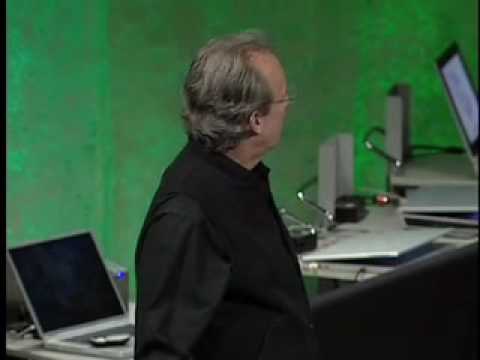
Watch a TED video of William McDonough below

Recycling is more expensive than it needs to be, partly because traditional recycling tries to force materials into more lifetimes than they were designed for. Very few objects were designed with recycling in mind. If the process is truly to save money and materials, products must be designed from the very beginning to be recycled or even “upcycled”—a term we use to describe the return to industrial systems of materials with improved, rather than degraded, quality.

Why Cradle to Cradle is more important

The notion of Cradle to Cradle conveys a message of “Do good” instead of “Do less bad.”

Here’s an experiment. Choose any of your favorite blogs/websites and skim their latest articles. How many of them are all about how to do less so it will have less of an effect on the environment?

The environmental message that consumers take from all of this can be strident and depressing: stop being so bad, so materialistic, so greedy. Do whatever you can, no matter how inconvenient, to limit your consumption. Buy less, spend less, drive less, have fewer children — or none.

About the technical metabolism

Aren’t the major environmental problems today — global warming, deforestation, pollution, waste — products of our decadent Western way of life? If you are going to help save the planet, you will have to make some sacrifices, share some resources, perhaps you can go without.

With a Cradle to Cradle mindset you don’t try to design a bottle from less plastic but rather design a bottle from materials that can fully enter a new life cycle either back to nature or back into the design process as a new product.

Biological nutrients will be designed to return to the organic cycle—to be literally consumed by microorganisms and other creatures in the soil. Products composed of materials that do not biodegrade should be designed as technical nutrients that continually circulate within closed-loop industrial cycles—the technical metabolism.
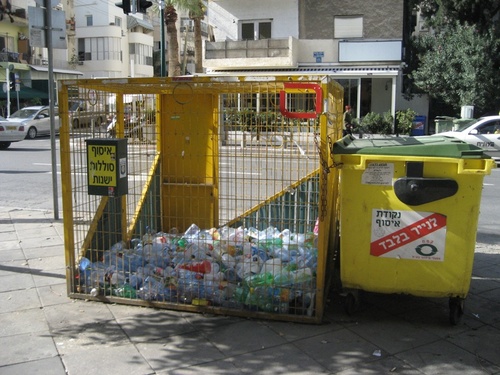
Recycling Bins Take the Form of Art in Tel Aviv

5

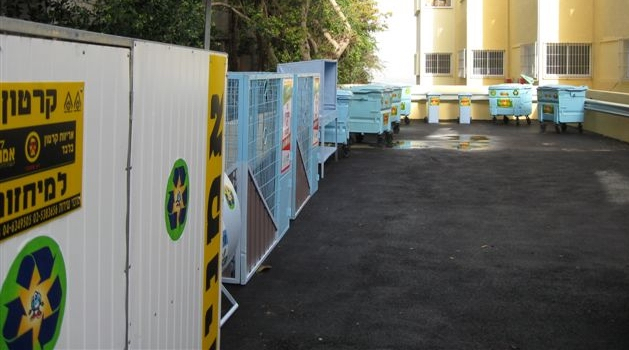
Tel Aviv recycling image
These yellow metal recycling cages can be seen along major arteries like Ben Yehuda and Dizengoff streets here in Tel Aviv. Some are strategically placed in front of supermarkets which make them user friendly and in turn gives more of an incentive to recycle.

When I first saw these cages the logistics of putting the bottles in was easier to grasp then getting the bottles out. My question was answered one day when I spotted a “super truck” operated by the L.D.S. Recycling Industries taking care of business. This truck is in fact a vacuum cleaner that is designed especially for the function of bottle removal.

Recycling and Deifying Donkey Dung in Israel

The Christmas season in Europe is often silly season for the world’s media outlets, when they outdo each other to find the strangest, weirdest and oddball news story to give people an extra sparkle to their celebrations.

Strange shaped vegetables, or bagels that bleed are the sort of stories that crop up. Despite the crisis in the South of Israel, the BBC managed to find its own silly and strange story in the Holy Land, close to the Galil. Dung, from horses, donkeys and cattle, has for many centuries and across many countries and cultures, been used both as a fuel for heat and as a fertiliser for agriculture.

This is one of the most basic, and successful, forms of recycling that there is. Reusing animal waste, which is generally made up of green plant matter, is extremely green. So green that many herders collect it as an essential item, and might look at you strangely if you commented on it!

Menachem Goldberg, who runs a visitors centre at Kedem, has come up with the extra-ordinary idea of preserving pieces of donkey dung within a plastic cube, that is inscribed with holy writings from the Talmud. Mr Goldberg says that the idea came to him from the Talmudic phrase: (and I quote) “Let the Messiah come…may I be worthy to sit in the shadow of his donkey’s dung”. Make of this what you will!

Comments welcome, and any visitors to Kedem, please confirm this craziness for us.

This Greenhouse grows kids into flowers

2

the greenhouse israel education

Inspired by the Green Kindergarten initiative made by the Israeli government, I dug up this story I’d written earlier in the year on a unique environmental education center called The Greenhouse:

Magical kingdoms and secret gardens don’t necessarily have to stay in the realm of fairy tales any more, proves an Israeli initiative – The Greenhouse – which for over 30 years has been conducting a unique socio-environmental project.

greenhouse

Started by a disenfranchised artist, Avital Geva, in the late ’70s, Geva decided to try and solve society’s problems a different way, through a living greenhouse. Today hundreds of school-age children participate in one of any number of projects.

A special angle to the Greenhouse, or “Hamama” as it is known in Hebrew, is that it naturally involves kids from the Wadi Ara region – both Jewish and Arabs – in building coexistence projects, without them having to realize it.

noam geva the greenhouse israel photoSays Geva’s son Noam, a guide at the Greenhouse: “In The Greenhouse, we don’t speak about coexistence, but we are doing it. Arab and Jewish kids work together and through their mutual projects, they create something good.

“The children, who are young, don’t know about the conflict and they don’t care about it really,” he adds.

An Intuitive Approach to Green Peace-Building

Noam Geva and the other four guides at The Greenhouse intuitively work with the kids, and also autistic youth, on helping them find “their inner greenhouse” muse.

A child could tell Noam Geva that she is interested in cameras. Geva said in this case, he might propose that she build an underwater movie project for filming the fish; the child would need to learn all aspects of realizing the project from developing blueprints to learning the technical aspects of underwater photography.

Giving Green Life Skills to Autistic Youth

The guides also work with autistic youth in their early 20s, to give them basic gardening and life skills. They learn how to grow spices and paint flowerpots, and help sell some of their wares through Ein Shemer Kibbutz near Hadera, where The Greenhouse is located.

While the broad-brush lessons taught to the kids are never explicit, says Geva, the kids learn along the way, as a matter of course, about the environment, new technologies and co-existence.
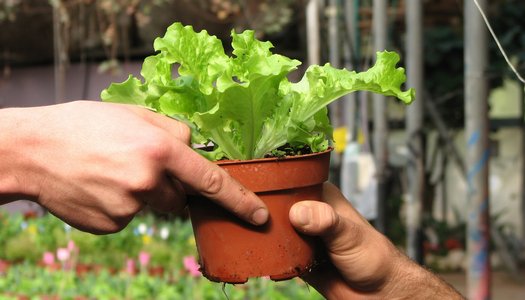
lettuce-greenhouse

“Everyone,” says Geva, “can find his level of research, thinking and doing. But doing is always the key.”

Today, the Greenhouse is a non-profit organization that runs on donations as well as a small amount of money from Israel’s Ministry of Education. So appealing was the concept that leaders from a school in San Diego have come to study the Greenhouse concept in order to implement some of its ideals in the alternative Californian education system, High Tech High.

“Their dream is to build a place like The Greenhouse,” says Geva modestly.

The Greenhouse attracts the brightest youngsters from the region. They come from about 13 different schools, and in some cases cooperate with scientists from agricultural and industrial research institutions in Israel.

welding-greenhouseAmong the environmental practices learned, the students study sophisticated methods of recycling water and finding alternative substrates for soil. Projects that span various disciplines including agriculture, biotech and art, are encouraged.

Like a real-world Secret Garden, Geva admits that the Greenhouse is a magical place. The proof is in the results: amid fish ponds and lily pads, plant nurseries and scientific equipment – and art installations – young Israelis from all walks of like are feeding their souls and minds.

playing in the greenhouse pool kids photo

Through learning how to balance water, fauna and flora, relations between human beings can be better balanced, says The Greenhouse website. “Nothing similar can be found in Israel, or the world,” it adds.

tractor-greenhouse israel photo

Israeli Tots At 82 Kindergartens To Learn Green ABC's

1

green-kindergarden-israelIn a special ceremony, held in Bar-Ilan University earlier this month, some 48 green kindergartens located in the Tel Aviv, Jerusalem, central and southern districts of Israel were certified “green.”

An additional 34 kindergartens were certified earlier in the month, on December 3 in Haifa, 8 of which came from the Arab sector, reports the Ministry of Environmental Protection website. This is good news to our ears. 

In all, 82 Israeli green kindergartens were certified in 2008, compared to 32 in 2007. But what does it take to make Israeli tots green? Do the ganenets feed them organic food? Do they learn about recycling? Maybe they plant trees? 

Israel's First Municipal Reuse Center Sounds Like The Salvation Army

1

salvation army in israel photo

Collecting everything but the kitchen sink, and well, maybe even that, Israel gets its first municipal center for “recycling and rational resource use,” announces the Ministry of Environmental Protection last week on Christmas Day. (Do they mean “national” or “rational?” We’re a little confused. Maybe lost in translation?)

Moving on –– Located in Haifa, the center spans 1,000 square meters, and is intended to collect a wide range of waste and household products for reuse and recycling. Such products include: furniture, electrical appliances, food, toys, books, house and kitchen wares, carpets, lamps and mattresses.

Sounds a lot like the Salvation Army, Goodwill, or a gemach if you ask me.

Lebanon, Jordan, Iraq, Israel and Jordan Compete For Wonders of the World: Get Your Vote On!

1

lebanoncavesSeveral Middle Eastern countries are competing to have their natural treasures listed on the new “Seven Wonders of the World” online competition. Some friendly competition for a change?

The Lebanese are lobbying that their majestic cave complex will make the list. The Jeita Grotto (pictured above), sits in a river valley near Beirut, and is currently ranked 24th out of 77 on the list of “New 7 Wonders of Nature”.

“The Jeita cave is considered one of the largest and most beautiful caves in the world, with an impressive diversity of rock shapes and colours,” said Nabil Haddad, the cave’s general manager in Newsx.com.

Other sites in the Middle East include Wadi Rum in Jordan, Israel’s Ein Gedi oasis, the Red Sea corals shared by Jordan, Israel and Egypt, the Dead Sea, and the vanishing Mesopotamian Marshes in Iraq.

According to Newsx, activists and visitors alike are eagerly waiting the results, which will be announced on New Year’s Day, according to the website. Twenty-one finalists will be announced next July 21.

“Voting will continue throughout 2010 and into 2011. During this time, the New7Wonders World Tour will visit each of the Finalists to allow them to present themselves to the voters across the globe,” the competition’s website says.

Your country doesn’t have to make the list to be considered a “Wonder,” but we like the initiative because it draws attention to sites worth saving.

::New 7 Wonders website

Dianne Onstad's Whole Foods Companion, A Charming and Chock-Full Book

1

With winter upon us, now is the perfect time to get cozy with a pile of books. The latest in our eco-reads book review series is a great food and cooking reference – the Whole Foods Companion.

whole foods book cover dianne onstad imageWhole Foods Companion is a dip-your-toe-in book rather than a cover-to-cover book: it’s great for delving into when you need a quick hit of information, and like any good reference or guidebook, once you’ve got a page open you’ll inevitably be delighted by the other random bits and pieces you find on the page.

It’s set up like a dictionary or encyclopedia – an alphabetical listing of ingredients, organized into groups by type (fruits, grains, spices, etc.).

While that description may lead you to believe this volume is dry and staid, nothing could be further from the truth. It’s charmingly written and chock-full of helpful and interesting information.

Each foodstuff has several sections: a general introduction, tips on selection and storage, culinary uses, and health benefits. Broader entries, like apples or peas, provide details on different varietals. By-products (peanut butter in the entry for peanuts, say) are also included whenever they are relevant.

Na Laga'at Brings Slow Food Farmer's Market to Jaffa

4

The Slow Food movement brought a farmer’s market to the Tel Aviv Port (or, namal) this past summer, helping city dwellers enrich their salads and dishes with some great local (and carbon-emission low) produce.  Now, to enrich our winter soups, the Slow Food movement, the Jaffa Port, and non-profit organization Na Laga’at are all joining forces to bring a farmer’s market to the Jaffa Port tomorrow, Friday December 26th.

The market will feature not only a variety of fresh produce sold directly from the farmers themselves, but also independently produced food items such as cheeses, tahina, halva, and more.

Within the framework of the farmer’s market, a tasting menu of dishes from some of Tel Aviv’s finest restaurants – Katit, El Babud, Carmela Banachala, Eucalyptos, Azora, and others – will be offered as well.

U.S.-Israel Binational Cleantech Forum: Creating a Strategy for the Future of Cleantech

3

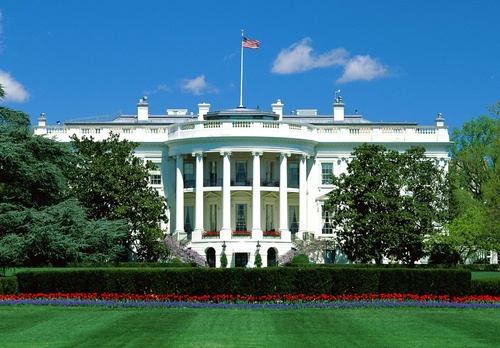
white-house

Miya president and CEO Baruch Oren and B. Gaon Holdings Ltd. Chairman Moshe Gaon have presented a new forum: The U.S.-Israel Binational Cleantech Forum, which they announced at the Israel America Chamber of Commerce Conference in Washington. The goal of the forum is to create a cohesive network that connects environmental organizations to businesses and political organizations that can implement cleantech solutions.

The forum will meet twice a year, once in Jerusalem and once in Washington, and will engage in public relations, lobbying of the U.S. government and Congress, and the establishment of joint business ventures. Members of the forum will comprise figures from government, environmental organizations, industry, academia, and financial institutions.

In an exclusive interview with Globes Online, Gaon explains that the impetus behind his new initiative is based on his perceptions of the cleantech industry as a whole:

There’s a lot of activity, but no leadership, and everyone is operating alone, each country for itself, each company for itself. There are huge differences between industrialists and environmental organizations, and everyone is remote from the funds. Financing for academe is almost non-existent.

Gaon also adds that the forum will focus on the development of existing infrastructures rather than seeking to build new ones–an imperative during this time of crisis.

Water is an especially grave concern for the forum, as Gaon reveals that Israel’s water crisis could be dealt with now, if Israel’s government were to deal with the problem efficiently.

Eco-Rabbi: Parshat Miketz – Making all of the Years Years of Plenty

0

wheatJoseph was sent down to Egypt by his brothers to remove him from the picture. Their father had favored Joseph and his brothers were not too happy about that. Upon arriving in Egypt Joseph found success wherever he went.

Originally he was sold as a slave but very quickly he found himself in charge of his master’s house. Due to unfortunate circumstances Joseph found himself in jail, but there too he was promoted to a position in charge.

This week’s segment begins with Pharoh having a dream about 7 stalks of healthy grain being consumed by 7 stalks of sickly looking grain and 7 healthy, fat, cows being consumed by 7 sickly looking cows. Pharoh is puzzled by his dream and asks all of his advisers what it means but no one can provide a satisfying answer. Finally the wine steward remembers his former cell-mate, Joseph, and how he had accurately provided a solution to his own dream.

Sharing this information Joseph found himself whisked out of jail to stand before the King.

Clean Tech Incubators from Israel and California Sign Water Deal

0

water california israel cooperation photoBad news about low water levels in Israel, are so frequent, the details stark, that I am starting to avoid reading such stories. Some good water news, for a change:

Technology incubators from Israel and California plan on working together to build water technologies of the future. Israel’s Kinarot-Jordan Valley Technology Incubator has signed a cooperation agreement with California’s Claude Laval Water and Energy Technology incubator (WET for short), housed on California State University’s Fresno campus, reports Globes.

Israelis have been doing a lot of California dreaming lately, and not long ago a number of entrepreneurs in water, energy, and agriculture returned from America’s West Coast, we detailed earlier.

Israel's Innowattech Harvests Wasted Energy from Trains, Planes and Automobiles

6

Innowattech electricity roads israel photo

 No stone is left unturned in our desperate search for energy sources to wean us from our dependence on fossil fuels.  Sources of primary renewable energy, like solar, wind, and geothermal are the primary focus, but some overlooked sources are also getting attention, because every little bit counts.

We’ve seen reports on generating electricity from stationary workout bikes, dance club floors and Japanese subway stations.  Now we cover the Israeli company of Innowattech, which developed a technology to harvest mechanical energy from roadways, railroads and runways and convert it into electricity.

Non-Kosher Turkeys Are Going To The Wolves in Tel Aviv

0

city-safari-zoo-hyena1It’s holiday time, joked Prof. David Eilam. He and the head of Tel Aviv University’s Zoology Department Prof. Micha Ilan escorted me around Tel Aviv’s City Safari on foot today.

It was dinner time for three wolves who were carrying around butchered turkeys, rescued apparently, from the garbage.

According to Eilam, animals that die on route to the slaughterhouse are not deemed kosher.

They are given to the university’s zoo, and make “recycled” feed for the animals.

Open to the public (you need to call in advance), the staff at the zoo can give an interesting and environmental perspective on animal conservation in Israel and the Middle East.

Beside one of the nation’s busiest highways and next door to the country’s 2nd largest city is a six-acre zoo, home to jackals, fat sand rats, a pack of wolves, pink flamingos and more.

tel aviv university city zoo photo

It is one of two university zoos existing in the world –– the other one is in Germany.

Upon entering the zoo you get the laid-back feeling of being in a Kibbutz (Israel’s version of a commune). With a phone call and a small fee of about $5 you can get a tour of Israel’s indigenous animals as they roam freely around the zoo.

Some animals like the snakes, birds and mongooses (which sneak in) come and go as they please.

A nature lover and teacher in Tel Aviv built the zoo 70 years ago. Back then its mandate was to be able to educate future generations on the importance of nature conservation. Today, the University attracts and sponsors youths from Israel’s marginalized communities to spend a day at the zoo.

You too can Safari in the middle of the city.

2008 a Big Year for Israel Cleantech Investments, Says Ernst & Young

0

Israel cleantech investments solar energy

Before the economic crisis made the question of investments something of a joke, venture capital investments in green technology worldwide saw a huge increase in 2008. Compared to the same investment period in 2007, venture capital investments increased by 82%, totaling $4.6 billion.

While America still leads the pack in investments in green technology, there has also been significant growth in Europe, China, and Israel. In Israel, venture capital investors have heavily favored solar companies and water treatment technologies. This has been true of investments in Israeli cleantech as a whole: the vast majority of investments ($4 million out of a $5 million total) have poured into only two companies: established solar companies Solel and Luz II, which already have facilities in various parts of the world. And of course, another huge recipient of investments was Shai Agassi’s Project Better Place, which raised $200 million in its first round of funding.

But Ernst & Young also reports that we will witness a sharp downturn in investments in light of the economic crisis. It remains to be seen whether government incentives and the profits derived from renewable energy ventures can salvage the next year in cleantech investing.

::Greentech Media

See more Green Prophet articles about cleantech in Israel:

REVA Electric Cars May Soon Be for Sale in Israel
Hillpoint Energy’s Israeli Design Team is Soon to Announce Wind Turbine Design
Quick Guide to Israeli Solar Energy Companies