
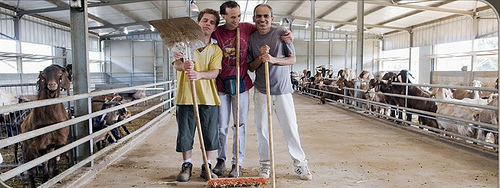
(Working on the organic goat farm at Kishorit, the largest organic goat farm in Israel that sells its “fair trade” milk to Harduf, the largest organic food supplier in Israel.)
People born with mental deficiencies, or those afflicted later in life, are usually handed the short end of the stick. Facilities to accommodate needs and to help one cope in society are improving, but they fail to give those in need the advantages that “normal” people just take for granted. But not at Kishorit, a new village built on the ruins of a decaying kibbutz, in Israel.
A new model for treating the mentally disabled based on the Israeli commune idea has emerged over the last decade from the ruins of a crumbling kibbutz.
Called Kishorit, the village in northern Israel has become a utopia for about 150 people with varying degrees of mental handicap, who have all found a home for life.
Some have autism, Asperger’s, or schizophrenia, but as much as they can, they are all steering their own careers, social time, family life, and destiny. They don’t focus on what disability they have, but on what they can do.
Members run and operate a TV station, and create films, they’ve built the largest organic goat farm in Israel, possibly the entire Middle East; they plant, tend to and eat food from their organic garden, and are developing lines of toys, which last year were sold to Baby Gap.

 Global warming and climate change, which we know is








 Ever since American talk show host Oprah Winfrey announced that her website





 Syria has not had an environmental ministry for over five years; and the new one, to be headed by a woman, Kawkab al-Sabah Mohammad Jamil Dayeh, will have the assistance of the President himself who has become more interested in the state of his country’s environment.