Home Blog Page 709

Fridge Voyeurism in Tel Aviv

5

fridge-voyeur-israel-photo

Are you an organic food addict? Or do you insist on eating food that grown locally, but pesticide-ridden, to spare food miles (or to serve an ideology?)

As food production is a major source of greenhouse gas pollution (Read: Global Warming), eating locally, and consuming less meat is one way we can do our part.

Following a worldwide trend, where people are opening up their fridge to show people what’s in their fridge (and on their palette) today I will expose myself and show you what’s in mine. It feels a bit like opening my underwear drawer to strangers, but here goes:

fridge-voyeur-tel-aviv-photo

CONTENTS (Door on right): Bio eggs, butter, organic strawberry jam, milk, mustard, sundried tomatoes, pomegranate concentrate, goat’s milk yogurt, V8, tehina, capers, guava juice, orange juice, batteries (not for eating!), coconut juice, goat’s yogurt, and the old Canadian maple syrup (thanks Mom!).

SOURCE: There are a number of imported items here like the V8 from North America and the juice from Egypt. The jam is from the United States. Phoeey on me, but it looked so good. And the pomegranate concentrate, I think is from Turkey, while syrup is from Canada. All the milk products are produced locally and bought at Eden Teva market or local non-organic shops. Milk costs about $1.50 a liter in Israel (non-organic), the organic yogurt about $3 a bottle.

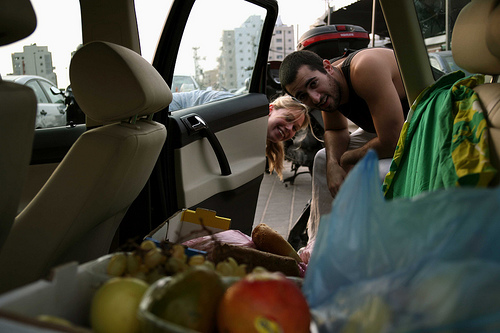
fridge-voyear-photo

CONTENTS: (from top to bottom, left to right) organic lentil sprouts, organic goat’s cheese, chessick fruit, soft regular white cheese 5%, organic red cabbage part of a weekly CSA veggie box delivery (choose from a list of CSAs here if you live in Israel); more cheese including a Rockfort goat’s cheese, Syrian dates, spicy lettuces, cabbage, parsley, green onions, carrots, leaks, tomatoes, radishes, cucumbers, and spinach.

SOURCE: Vegetables come from an organic farm, which delivers a box of whatever’s in season, once a week. Some of the cheese is from Eden Teva market, a health food store in Bnei Brak; some cheese is from Arab supermarket on the corner nearby my house.

Reducing food miles is important to me from an environmental perspective. I try to eat locally produced food, and things which are in season.

fridge-voyeur-israel

CONTENTS: It being Passover in Israel means that a lot of the bread products you might see here other times of the year have been cleaned out, eaten or burned, as per Jewish custom. Moving on, there is some sort of white fish, hamburger organic and regular, rice (stored in freezer to keep the bugs out), and a strange kind of sheep tail fat (bottom right) for making a Bukharian food known as Osh Pollo.

It is wrapped like that because someone (on their request) was supposed to “smuggle” it to the US where no such sheep tail fat can be found. It stays frozen in the meantime. (As a once a week meat-eater, Osh Pollo is very yummy and highly recommended.)

SOURCE: The frozen products come from Eden Teva Market, a health food store, a regular grocery store, and the sheep tail fat, a local market. Normally you won’t find so much meat in the freezer, as I tend to buy it when I want it. I have no idea how much meat costs per kilo, because I buy it so rarely. The organic hamburger, enough to feed 4, cost about $25 for the box, times 2 what you see above.

Want to know more about fridge voyeurism? Read this past Green Prophet post on a fridge in Jerusalem.


Turning A Cement Truck Into Giant Soil Cleaning Technique

lego-cement-mixer-photo

Byproducts from the electronics, fuel, chemical and defense industries can be far from benign. Toxic heavy metals like cadmium and lead can seep into our food chain and cause cancer. And if found in the soil, these dangerous materials can render parks off-limits and real estate worthless.

For environmental, health and financial reasons, new solutions are needed to help clean industrial chemicals from America’s soil.

Now, an innovative Tel Aviv University soil-cleaning technique, which turns a cement truck into a giant mixer, may change things for industry and environmental specialists. Prof. Amos Ullmann and Prof. Neima Brauner of TAU’s Faculty of Engineering and Prof. Eliora Ron of the Faculty of Life Sciences, in cooperation with Israeli researcher Dr. Zvi Ludmer, are working on a new cleaning agent that binds to and whisks dangerous materials away from the soil, leaving desirable minerals intact.

“My colleagues have developed a system that literally washes the soil,” says Dr. Michael Gozin of TAU’s School of Chemistry. Their top-secret formulation, now in the early stages of research and development, will make it possible for truckloads of contaminated earth to be cleaned in a cement mixer. The compound not only leaves life-sustaining nutrients in the soil, but it’s also biodegradable and environmentally safe

El Salvador Copies Israel's National Forestry Model To Combat Environmental Destruction

3

tree-planting-israel-woman-jnf-photo

There is only one nation in the world that has a net gain of trees over the past 100 years. While other countries, developing and developed, have been actively harvesting and lobbing trees down in the name of progress, Israel’s national organization the KKL-JNF (Keren Kayemeth LeIsrael – Jewish National Fund) has made it a national priority to plant trees in Israel, and to look after them.

Decades before tree planting became a hippy’s dream summer job in Canada, and a responsible thing to do for the environment, Israelis were already making it a national priority, calling on Jews from the Jewish Diaspora or people who wanted to support the Holy Land, to donate money to help plant trees.

That’s why today around the hills of Jerusalem, there are forests planted by nations from all around the world, such as the US, Canada and Mexico. Even America’s Kennedy Family visited Jerusalem and planted a living monument, trees in the name of past President John F. Kennedy, there. The Yad Kennedy monument, outside of Jerusalem, overlooks the very spot where the trees were planted, the John F. Kennedy Peace Forest.

Over the years, Israel’s KKL-JNF foresters have earned international acclaim for the work they do. They select drought hearty-species to cope with the arid land in Israel. And due to their expertise in forestry and fighting forest fires, Israel’s KKL-JNF has a number of cooperation projects with countries all over the world, including Australia and Spain.

Can't Take The Heat of Global Warming? Rafael Reuveny Says Ecomigration Drastic Measure to Survive Climate Change

3

eco migration africa photo

Why would a prominent Israeli-born professor at Indiana University decide to change his research emphasis from economics and political science to climate change and ecomigration? And to move from Israel to the United States?

Ecomigration is not an entirely crazy idea, and some western people have already started planning and moving to the most suitable locations for the best post-climate change scenario. 

Perhaps the answer to this professor’s career switch lies in what may be our eventual destiny on this planet, especially in light of global warming and climate changes.

“This is an absolutely rational way to do things,” said Reuveny, who moved from Israel to Indiana with an eye on environmental concerns. “When it comes to climate change, we tend to forget about it being better to be safe than sorry and say it is not going to be a problem,” he said in a recent Washington Post story.

Israeli Government Starting To Address Water Crisis With Low Flow Faucet Aerators

7

watering grass photo

A few weeks ago I posted that Israel’s water crisis is so bad that water might be rationed soon. I also mentioned that part of the problem Israel has had with addressing its growing water needs has been due to the insufficient handling of the Israel’s water plan by the government. Since my post, both stories have developed further.

Counting on Lightning to Predict Hurricane Intensity

lightning-weather-vane-photoHurricanes are Earth’s most deadly storms, causing tremendous devastation and loss of life around the globe every year. There is some evidence that the number and intensity of hurricanes may also be changing as a result of global warming.

Until now hurricanes had been somewhat a mystery, due to them spending most of their lifetimes over the tropical oceans, where few people live, and few measurements are available to study these monstrous storms.

However, recent advances in global lightning detection systems have allowed scientists to remotely measure the electrical “pulse” of hurricanes from thousands of kilometers away.

In a paper to appear on 6 April in Nature Geoscience, Prof. Colin Price or Tel Aviv University, together with Prof. Yoav Yair and Dr. Mustafa Asfur of The Open University of Israel, have discovered a surprising connection between lightning activity and hurricane intensity. They’ve also, as we’ve reported earlier, been able to use the “flash” to predict the flood.

Green Your Holiday

0

seder-plateWith the holiday season around, kids underfoot, family everywhere, now is actually the perfect time to do some greening. Collect the kids and do some projects to recycle throwaways. Also, with everyone around it’s a good time to discuss how to make your lifestyle more efficient and green.

Exploring Human Apathy In The Film 'The Age Of Stupid'

age of stupid film poster trailer photo

‘The Age of Stupid’ is an ambitious new Independent British green documentary.

As a fellow filmmaker and activist, I salute director Franny Armstrong and her dynamic team for the passion and vision shown in creating this film, pulling together funding from diverse and various sources, creating the ‘Not Stupid’ brand and the big campaign that is promoting the film.

I’ve been following the film’s progress over the last few months as the team prepared for its launch (which was held in a portable solar cinema in London recently), got politicians and ‘green’ celebrities on board, launched YouTube teasers, a ‘Not Stupid’ campaign to advance the issues raised by the film, and enticed supporters with Franny’s frantic and funny emails from her film-related travels and hectic life. Finally I got to see it this week in Cambridge, UK, and a Q&A with campaign co-ordinator, Daniel Vockins, followed the screening.

The plot, or small plot around which the core of the film hangs, centres on the archivist (played by actor Pete Postlethwaite), who in the year 2055 has created a archive of humanity in a tower in the sea

Jews Celebrate "Solar Seder" in the Arava Desert at Kibbutz Lotan

lotan-solar-seder-jews-photo-passover

Just a few hours after Jews of all stripes gathered at the Western Wall in Jerusalem to celebrate “Birkat haChama” – the blessing of the sun – Aria Penkava slid a tray of kosher-for-Passover cookies into a solar oven to slow-cook using focused heat energy from the sun.

“The sunrise was glorious this morning,” said Penkava, “but we wanted to not only bless the sun but actually use its energy to do something constructive and creative.”

Penkava, 20, is a recent graduate of Kibbutz Lotan’s 6-week “Green Apprenticeship” program, which combines coursework in permaculture design, organic farming and ecovillage design. To her, the timing of Birkat haChama coincided perfectly with the seder for the first night of Passover.

Along with several other Green Apprentices who are

Council for a Beautiful Israel Trains Palestinian Teachers on Environmental Education

1

As we’ve mentioned often here at Green Prophet, nature knows no boundaries.  The environment, therefore, can provide a powerful incentive for collaboration amidst conflict.

Last week, in yet another example of cross-border environmental cooperation, the Council for a Beautiful Israel brought 25 Palestinian teachers and educators to their educational center in Tel Aviv for special training in environmental education.

The training was modeled after previous cooperation between the Council for a Beautiful Israel and the Towns Association for Environmental Quality, Agan Beit Natufa, a leading environmental organization among Israel’s minority Palestinian (Arab-Israeli) sector.

Increasing Khamsini or Sharav Heat Waves Could Signal Global Warming in the Middle East

11

sand-storm cairo photo

For those of us who live in the Middle East, those hot dry heat waves known as khamsini (in Arabic) or sharav (the Hebrew term) appear to be becoming more frequent, as well as more intense.

They also seem to be occurring during times of the year when they ordinarily are not supposed to – such as in what should be the winter rainy season.

A khamsini heat wave or dust storm as often occurs along with the heat wave, is usually characterized by intense dry heat, often accompanied by high winds. Temperatures can rise into the 40 degree celsius range and can be so intense that it can be actually dangerous to venture out of doors due to the intense heat and large amounts of dust the often come along with it.

A recent article in the Jordan Times mentioned that dust and sand storms caused by khamsini conditions were so bad that a number of roads were considered to be dangerous

Second International Conference on Water to Commence in Ramallah, Palestinian Authority

2

With the regional water crisis weighing so heavily on everyone’s minds, it’s no wonder that the Palestine Academy for Science and Technology and the Palestinian Water Authoirty have teamed up to host the 2nd International Conference on Water: Values and Rights.

The conference, to be held in Ramallah from April 13-15, will bring together academics, scientists, decision-makers, and more from a variety of sectors, and will feature prominent speakers from the Palestinian Territories, the United States, and the United Kingdom.

The conference will also address a variety of themes related to water management, water rights, and other aspects of water politics, as well as special themes including:

  • The “Palestinian-Israeli Water Dispute,”
  • “Cooperative Water Projects between Israel and Palestine: Pitfalls, Successes, and Lessons Learned,”
  • “The Impact of Climate Change on Water Resources Management,”
  • the “Red Sea-Dead Sea Conveyance Project.”

For more information, visit the conference website: http://www.waterrightsconference.org.

More water and the Palestinian Authority:
Water Relationship Possibilities Between Israel and Gazans In Better Days
FoEME to Hold Conference on Shared Mountain Aquifer
A Green Prophet Finds West Bank In Water Crisis Too!

Shut Down the New Coal-Fired Power Plants, Says Israel's New Environment Minister

2

ashkelon-coal-power-plant beach israel photo

Israel has a new government, and this also means a new environment minister. The new one, Gilad Erdan actually sounds like he’s learned something about the environment before taking on the post. The hot news is that he has applied to Israel’s Acting Government Secretary to convene an emergency government session to discuss his demand for freezing plans for a coal fired power plant in Ashkelon, reports the Ministry.

In parallel, he’s called on the Minister of National Infrastructure to submit an updated plan for electricity production based on recent changes in the economy and on similar plans worldwide.

In his request, Minister Erdan notes that the plan for a coal-fired power station in Ashkelon calls for two new coal fired units,

Could Urban Beekeeping Renegades Buffer Bees From Colony Collapse Disorder?

13

apiary beehives

On a sunny Saturday afternoon in mid-February, a small group of New Yorkers—beekeepers, environmentalists, and a handful of honey aficionados—huddled together in an empty SoHo office building for a local honey-tasting session.

If this had been Portland or San Francisco, it wouldn’t have been a notable event—just a harmless gathering of honey connoisseurs. But in New York, where they may be hydroponics, bees are classified under section 161.01 of the health code as “wild animals,” and are just as illegal to own in the city as lions, cougars, alligators, or polar bears. So a local honey-tasting event is, in many ways, an act of political defiance.

True, there aren’t squad cars going around inspecting buildings for beehives on any given day, but the law can be invoked by a frightened neighbor who calls “311” to report a neighbor keeping buzzing colonies on the roof.

Even so, the threat of a $2,000 fine certainly hasn’t deterred New York’s underground enclave of beekeepers.

At the SOHO tasting, some 30 people were huddled around a large table, holding tongue depressors to dip into an assortment of honey containers. While some of the honey had come from Europe and New Zealand, the true stars of the tasting were local keepers from the West Village, the Bronx, and Brooklyn.

Some of the big, established local beekeepers were at the center of the room, sharing years of wisdom—how to get hold of a swarm of one’s own, how to keep bees on rooftops—and relishing their minor celebrity. Local beekeeping, after all, has become a bold new frontier in the overlapping worlds of environmentalism and food activism.

In the United States, nearly one-third of the country’s crops depend on bees for pollination, yet nearly one-quarter of the country’s honeybees have vanished in recent years, due to Colony Collapse Disorder (CCD) and other factors that are still unclear. The dearth of bees has quickly become alarming—according to a recent piece in the magazine Edible Manhattan, one urban farmer recently had to hand-pollinate his crops due to a lack of bees.

Saskia Cornes, an author who has written about New York City’s beekeepers, tells me that beekeeping has gained traction in recent years because of “a nice confluence of sorts between Colony Collapse Disorder and a renaissance of local foods.”

For one, New York City’s bees are mostly free of disease, which makes them invaluable in countering the outbreak of CCD. What’s more, beekeeping has become a popular way for New Yorkers to support local agriculture even if they don’t have much green space for a garden.

“Beekeeping suits New York because we don’t have yards,” Cornes explains. Recently, a variety of urban-beekeeping courses have sprouted up, like those offered by the The New York City Beekeepers Association. A beekeeping “meetup” group was launched in 2006 and according to the Gotham City Honey Coop, has been growing rapidly since.

The honey itself, meanwhile, is becoming wildly popular. Many beekeepers, honey advocates, and holistic healers believe eating local honey is the best remedy for allergies, since it provides a low-level (and delicious) exposure to local pollens. And there’s the fun of identifying local flavors: Honeybees usually travel two or three miles each day pollinating rooftop gardens and plants before returning home to make honey with the flavors of the flora they’ve visisted. A few honey tasters at the SoHo tasting swore they could detect the Bronx in the South Bronx honey, and one claimed to have tasted a hint of Tenth Street in a Manhattan variety.

All of this enthusiasm has spurred organizations such as Just Food, as well as other bee activists from various organizations, to work with city council member David Yassky to introduce legislation that would license residents as beekeepers, so that they could nurture and grow the local bee population, as well as assist nearby farms in dire need of pollinators. Back at the SoHo honey tasting, anticipation hung in the air as attendees discussed the future legalization of beekeeping.

Esther M., one of the SoHo honey-tasters, said the whole thing was like being “part of a secret society.” She insisted that she felt a strong connection to bees, and saw their vitality and health as the future to a healthy New York.

On the other hand, she added, she couldn’t help but think that the South Bronx variety “tasted like pollution—like buildings, concrete and dirt.” She preferred the honey from Fort Greene.

Jordan's Environment Society A Middle East Model for Environmental Protection

jordan guard petra environment photoCountries in the Middle East should take notice that the Hashemite Kingdom of Jordan is making great efforts to improve Jordan’s environment as well as that in the region.

One of the foremost environmental societies in the Kingdom is the Jordan Environmental Society, which was established in 1988, during the reign of King Ab dullah’s father, King Hussein.

Like the SPNI in neighboring Israel, the Society is a non-governmental and non-profit organization whose propose is to improve the environment and improve its basic elements.

These elements not only include ones like air, water, soil and animal life, but human beings too.