“In the midst of uncertain time, renewable energy remains consistent and steadfast in its expansion,” said Francesco La Camera, IRENA’s Director-General. “A more decentralised energy system, with a growing share of renewables and more market players, is structurally more resilient.”
Health insurance is a regulated financial product. Insurers operate under binding contracts, overseen by state insurance commissioners, that legally obligate them to pay claims meeting policy terms. Policyholders who believe a covered claim was wrongfully denied have legal recourse through state regulatory channels.
The New Zealand Merino Company, now rebranded as Zentera, has quietly removed the phrase “world’s leading ethical wool brand” from its website, a notable change that comes after a disturbing investigation by PETA Asia-Pacific into the company’s ZQ-certified wool supply chain, PETA reports to Green Prophet.
Somehow vegetables with short seasons excite the imagination and appetite more sharply than produce that’s available all year around. Good Middle Eastern cooks have many recipes for delicate fava beans, and this turmeric-fragrant soup is one.
“In the midst of uncertain time, renewable energy remains consistent and steadfast in its expansion,” said Francesco La Camera, IRENA’s Director-General. “A more decentralised energy system, with a growing share of renewables and more market players, is structurally more resilient.”
Health insurance is a regulated financial product. Insurers operate under binding contracts, overseen by state insurance commissioners, that legally obligate them to pay claims meeting policy terms. Policyholders who believe a covered claim was wrongfully denied have legal recourse through state regulatory channels.
The New Zealand Merino Company, now rebranded as Zentera, has quietly removed the phrase “world’s leading ethical wool brand” from its website, a notable change that comes after a disturbing investigation by PETA Asia-Pacific into the company’s ZQ-certified wool supply chain, PETA reports to Green Prophet.
Somehow vegetables with short seasons excite the imagination and appetite more sharply than produce that’s available all year around. Good Middle Eastern cooks have many recipes for delicate fava beans, and this turmeric-fragrant soup is one.
“In the midst of uncertain time, renewable energy remains consistent and steadfast in its expansion,” said Francesco La Camera, IRENA’s Director-General. “A more decentralised energy system, with a growing share of renewables and more market players, is structurally more resilient.”
Health insurance is a regulated financial product. Insurers operate under binding contracts, overseen by state insurance commissioners, that legally obligate them to pay claims meeting policy terms. Policyholders who believe a covered claim was wrongfully denied have legal recourse through state regulatory channels.
The New Zealand Merino Company, now rebranded as Zentera, has quietly removed the phrase “world’s leading ethical wool brand” from its website, a notable change that comes after a disturbing investigation by PETA Asia-Pacific into the company’s ZQ-certified wool supply chain, PETA reports to Green Prophet.
Somehow vegetables with short seasons excite the imagination and appetite more sharply than produce that’s available all year around. Good Middle Eastern cooks have many recipes for delicate fava beans, and this turmeric-fragrant soup is one.
“In the midst of uncertain time, renewable energy remains consistent and steadfast in its expansion,” said Francesco La Camera, IRENA’s Director-General. “A more decentralised energy system, with a growing share of renewables and more market players, is structurally more resilient.”
Health insurance is a regulated financial product. Insurers operate under binding contracts, overseen by state insurance commissioners, that legally obligate them to pay claims meeting policy terms. Policyholders who believe a covered claim was wrongfully denied have legal recourse through state regulatory channels.
The New Zealand Merino Company, now rebranded as Zentera, has quietly removed the phrase “world’s leading ethical wool brand” from its website, a notable change that comes after a disturbing investigation by PETA Asia-Pacific into the company’s ZQ-certified wool supply chain, PETA reports to Green Prophet.
Somehow vegetables with short seasons excite the imagination and appetite more sharply than produce that’s available all year around. Good Middle Eastern cooks have many recipes for delicate fava beans, and this turmeric-fragrant soup is one.
“In the midst of uncertain time, renewable energy remains consistent and steadfast in its expansion,” said Francesco La Camera, IRENA’s Director-General. “A more decentralised energy system, with a growing share of renewables and more market players, is structurally more resilient.”
Health insurance is a regulated financial product. Insurers operate under binding contracts, overseen by state insurance commissioners, that legally obligate them to pay claims meeting policy terms. Policyholders who believe a covered claim was wrongfully denied have legal recourse through state regulatory channels.
The New Zealand Merino Company, now rebranded as Zentera, has quietly removed the phrase “world’s leading ethical wool brand” from its website, a notable change that comes after a disturbing investigation by PETA Asia-Pacific into the company’s ZQ-certified wool supply chain, PETA reports to Green Prophet.
Somehow vegetables with short seasons excite the imagination and appetite more sharply than produce that’s available all year around. Good Middle Eastern cooks have many recipes for delicate fava beans, and this turmeric-fragrant soup is one.
“In the midst of uncertain time, renewable energy remains consistent and steadfast in its expansion,” said Francesco La Camera, IRENA’s Director-General. “A more decentralised energy system, with a growing share of renewables and more market players, is structurally more resilient.”
Health insurance is a regulated financial product. Insurers operate under binding contracts, overseen by state insurance commissioners, that legally obligate them to pay claims meeting policy terms. Policyholders who believe a covered claim was wrongfully denied have legal recourse through state regulatory channels.
The New Zealand Merino Company, now rebranded as Zentera, has quietly removed the phrase “world’s leading ethical wool brand” from its website, a notable change that comes after a disturbing investigation by PETA Asia-Pacific into the company’s ZQ-certified wool supply chain, PETA reports to Green Prophet.
Somehow vegetables with short seasons excite the imagination and appetite more sharply than produce that’s available all year around. Good Middle Eastern cooks have many recipes for delicate fava beans, and this turmeric-fragrant soup is one.
“In the midst of uncertain time, renewable energy remains consistent and steadfast in its expansion,” said Francesco La Camera, IRENA’s Director-General. “A more decentralised energy system, with a growing share of renewables and more market players, is structurally more resilient.”
Health insurance is a regulated financial product. Insurers operate under binding contracts, overseen by state insurance commissioners, that legally obligate them to pay claims meeting policy terms. Policyholders who believe a covered claim was wrongfully denied have legal recourse through state regulatory channels.
The New Zealand Merino Company, now rebranded as Zentera, has quietly removed the phrase “world’s leading ethical wool brand” from its website, a notable change that comes after a disturbing investigation by PETA Asia-Pacific into the company’s ZQ-certified wool supply chain, PETA reports to Green Prophet.
Somehow vegetables with short seasons excite the imagination and appetite more sharply than produce that’s available all year around. Good Middle Eastern cooks have many recipes for delicate fava beans, and this turmeric-fragrant soup is one.
“In the midst of uncertain time, renewable energy remains consistent and steadfast in its expansion,” said Francesco La Camera, IRENA’s Director-General. “A more decentralised energy system, with a growing share of renewables and more market players, is structurally more resilient.”
Health insurance is a regulated financial product. Insurers operate under binding contracts, overseen by state insurance commissioners, that legally obligate them to pay claims meeting policy terms. Policyholders who believe a covered claim was wrongfully denied have legal recourse through state regulatory channels.
The New Zealand Merino Company, now rebranded as Zentera, has quietly removed the phrase “world’s leading ethical wool brand” from its website, a notable change that comes after a disturbing investigation by PETA Asia-Pacific into the company’s ZQ-certified wool supply chain, PETA reports to Green Prophet.
Somehow vegetables with short seasons excite the imagination and appetite more sharply than produce that’s available all year around. Good Middle Eastern cooks have many recipes for delicate fava beans, and this turmeric-fragrant soup is one.
Wind farms, like this one in the Israeli-occupied Golan Heights, may soon be common in Syria.
About 90 percent of Syria’s electric power comes from thermal power plants fueled by heavy fuel oil and natural gas; and the country is now looking into using forms of renewable energy to provide its increasing need for energy. Various projects dealing with solar and wind energy, as well as bio mass as a fuel source, were mentioned in powergenworldwide.
Syria is a member of the 145 strong International Renewable Energy Agency (IRENA) group of which a number of Middle Eastern countries now belong. Projects dealing with renewable energy in which Syria is either currently engaged in or planning to be involved in include a proposed tender for two wind turbine parks to generate a total of 130 MW; a program to install solar roofs on kindergartens attached to government buildings; the installation of two kinds of solar water heaters in both private and public buildings, including the Al Mwassat Hospital in Damascus; and the installing of photo voltaic solar panels in rural areas, which already provide about 80 kwh of electricity.
Architect Marks Barfield is to design a £13 million “eco” mosque on a 0.4 hectare brownfield site in Cambridge.
England’s historic city of Cambridge, with its world-famous university and idyllic countryside, will soon count a mosque amidst its stunning skyline of spires. But this isn’t just any old mosque. In fact it is the first-purpose built mosque in the city which also happens to be environmentally-friendly!
After years of dealing with overcrowding at various small sites across the city, the growing Muslim community decided that it was time to take action. By the summer of 2008, a strip of land and an old warehouse has been purchased and plans for the new mosque were underway. However rather than simply building a mosque as quickly as possible, it was decided from the very start that the mosque would follow environmental sustainability principles.
Wait, what? Whales in the desert? Fossils of earliest suborder of now extinct whale sheds new light on evolution.
Even though human population expansion and over-exploitation of natural resources has accelerated the rate at which climatic change wreaks havoc, nature has always been in flux. Few things drive this concept home more concretely than a boat load of whale fossils in the desert. This is what was just reportedly found in Egypt.
Lebanon is eager to replant their cedars – a national symbol. But a sustainable, community-wide vision is in need.
The Hebrew bible is replete with references to the cedars of Lebanon, and uses them as a metaphor for steadfastness, might and great stature. The cedar trees for the construction of King Solomon’s Palace and the First Temple in Jerusalem purportedly came from the once mighty cedar forests of the Jabal Niha area in south Lebanon.
Jewish congregations around the world sing Psalms 92 on Friday nights, as part of receiving the Sabbath (the Jewish day of rest). One line of the psalm goes – tzadik ketamar yifrach, keerez balvanon yisgeh….’the just person will flourish like a palm, grow tall like a cedar of lebanon.’
But now the referent of this biblical metaphor, which has continued to grow in Israel’s northern neighbour for the last 3000 years, is in danger.
Green babies are being born all over the UAE. Coming soon to a hospital near you? [image via: Gulf News]
When it comes to setting green patterns, there is no doubt that it is better to create eco-friendly habits early in life. No different than other forms of education, or even good habits such as eating healthy, being “green” with your baby or young child can teach them how to be responsible adults. It also shows that you care about their future, and want them to have a healthy planet to thrive on. A few months ago, the Abu Dhabi Corniche Hospital started an initiative across several hospitals in the United Arab Emirates to encourage mothers to use eco-friendly products for their newborn babies.
“Borders, Territory and Conflict in a Globalizing World” was the theme at a conference held in Israel. Experts deliberated on ethnicity, power relations and technology. Dr. Gotlieb emphasizes that such issues must be linked to the environment.
The conference engaged specialists from Europe, the US, India, Canada, Russia, Israel and elsewhere on a variety of subjects relating to changes in the world political order as a result of globalization. Familiar geographical concepts such as territory, borderlands, states and geopolitics were reexamined in light of developments that have taken place in the post-9/11 world.
In his keynote address, Prof. Alexander Murphy of the University of Oregon set the conference’s tone with a discussion of “Territory’s Continuing Allure.” He noted that the contemporary nation-state system is often incongruous with the societies they supposedly represent. Consequently, substate and extra-state “identity communities” – ethnic and linguistic groups — continue pressing for self-determination and recognition. These aspirations challenge existing states and the system that sustains them.
Ethnic conflict and borders were a major focus of the conference. Among the cases discussed was Abkhazia and other “unrecognized” republics in post-Soviet space. IGU vice president Prof. Vladimir Kolossov of the Russian Academy of Sciences and Prof. John O’Loughlin of the University of Colorado, Boulder described the uneasy relationship between the Abkhaz majority and the Georgian minority in state-building process following the territory’s secession from the Republic of Georgia.
Visitors to Israel’s best fruit and vegetable markets already know the country’s two most famous landmarks: The Carmel Market in Tel Aviv, which winds down from trendy Sheinkin Street right down the Mediterranean the Sea.
And Jerusalem’s Machane Yehuda market, which anthropologically speaking, is most interesting on Friday afternoons as religious Jews shop frantically before the Sabbath. There you can find fruits, nuts, meat, veggies, good hummus, fish, clothing, and sweets. Also look out for the crazy Kabala juice man.
When you’re stuck in the middle of a crowded, noisy city like Cairo, where waste piles up on the side of the street, and you can’t manage to peel back what you hope is a mirage of decrepit buildings to reveal the earth below, let the hawksbill turtle inspire you.
Undisturbed by light pollution from beach development projects, such as Urjuan in Qatar, and following an ancient wisdom dialed into their DNA, they lay their eggs and follow the moonlight back to the ocean from whence they came.
A new study suggests that introducing babies to milk before 2 weeks of age can prevent milk allergies later. “Lactavist” Hannah points out its flaws and dangers of such studies.
For decades, the World Health Organization and medical associations around the world have recommended exclusive breastfeeding for the first six months of a baby’s life. Breastmilk provides babies with all their nutritional needs, and contains antibodies and other substances that protect babies from infection. Numerous studies show that early introduction of formula increases the risk of illness and hospitalization. Yet when a faulty Israeli study sponsored by the Israeli Milk Council found an increased risk of dairy allergy among exclusively breastfed babies, lead researcher Jacob Katz recommended offering cow’s milk to babies within two weeks birth.
Get romantic at the dump! Hiria garbage dump tries to attract visitors this summer with outdoor movie screenings and activities for the whole family.
Once upon a time, it was common to spend summer nights watching a movie outdoors. Remember that scene in Grease at the drive-in, when Danny took Sandy out to watch a movie and eat popcorn under the stars? Unfortunately, drive-ins and outdoor movie screenings have disappeared for the most part. But Hiria, central Israel’s garbage dump that has been greenifying its image in recent years, is bringing the outdoor movie screening back this summer. The catch? The catch is pretty obvious. The events are all at Hiria… a garbage dump.
Social housing can be eco-friendly too, in Syria, Lebanon, and Tunisia [image courtesy of seir+seir]
Syria says no to plastic bags, Lebanon is pushing for more sustainable transportation, and Tunisia makes good shakshuka. But what do these three countries have in common? They are all participating in the So’Eco program under the auspices of the Invest in Med project spearheaded by the European Commission. At the end of the program, in March 2011, Syria, Lebanon, and Tunisia will each have a host of newly-minted eco-builders who will apply their knowledge to social housing.
They’re already going eco: Hanging the clothes to dry, naturally, in Hebron. Image via andydr
Hebron (or Hevron) is a West Bank city run by the Palestinian Authority which is famous for being an ongoing powder barrel in the Israeli-Palestinian conflict and an ongoing source of unrest between Israelis and Palestinians. But nowadays, when the economy in the Palestinian Authority is booming, the Palestine Polytechnic University in Hebron is a source for peacetime renewable energy projects, such as the first solar power electric car developed by its students and research.
Henna has existed in the Middle East as well as areas of Africa and Asia since the time of the ancients, so it is definitely a tried and tested process for all different hair types. Of course it is not limited to dying hair, it is also used on skin, fingernails as well as leather, silk and wool. But when it comes to dying your hair, there are a few things you should take into account.
How to henna your beard red if you aren’t a natural ginger
To begin with, if you are used to getting your colour from a bottle, you should be aware that this process is completely different. While there are several colours available which are all known today as henna, the truth is that natural henna, which comes from a plant called lawsonia inermis contains a property called lawsone and this turns your hair a red-brown colour, depending on your natural colour.
The colours known as black and neutral henna actually come from completely different plants, however the dye process is the same. Just be careful when you are buying your henna products, if they are labelled “compound henna” this means that it is not purely natural and are actually combined with various metallic salts which can damage your hair.
Henna itself is one of the natural ways to protect your hair. It penetrates your hair, preventing dandruff and split ends and is a natural way of making it shine. Once you have decided what colour you want, make sure you have enough time put aside because this is a slightly lengthy procedure, like many others which are purely natural.
In the Middle East, you can usually buy henna in a local shuk or market. Just ask around. Best to ask people with experience on where the best henna can be found.
How to henna your heard or beard red:
1. You need to start by making a paste. Take the henna in its powder form and make a thick paste by adding lemon, orange or grapefruit juice.
2. Leave this to sit over night.
3. Then when you are ready to start applying it, add some more lemon juice, or some herbal tea to make it about the consistency of yoghurt. It will feel like coating you head in a thick layer of icing, but don’t be afraid to really cake it on.
It might look strange, but wrapping your head in plastic is the next step, try it out!Image via pretendtious
4. Now comes the amusing part. You need to wrap your head in shrink wrap, for between 2 and 4 hours. While it will feel heavy, it is actually very soothing and is a natural way of ridding yourself of headaches and letting yourself relax. The final step is to rinse out the henna, which can take a bit of soaking and then shampooing normally. Be careful you do not get any henna on your skin. The dye is powerful.
The colour that you are first faced with is not the colour which will remain. As the henna reacts with the air, the colour will change, so it is only 3 days later that the colour will truly settle.
Enjoy nature’s own hair dye, but make sure you wear gloves, remember, henna also dyes skin and you don’t necessarily want to walk around for the next month with red hands!
Libyan bargain hunters look to scoop up shares of BP. Should the world’s environmentalists be concerned? Image of Libyan president al-Gaddafi via Daily Mail
News that doesn’t bode well for the environment? Rich Libyan oil barons are vying for a controlling stake in British Petroleum (BP) the UK oil company leaking billions from the Gulf oil spill off the coast of Florida. Libya, who already had a deal in the works with BP for offshore drilling off the coast of Libya, look to increase their oil wealth clout even more by purchasing a sizable stake into the British oil giant.
Education puts Cairo one step towards getting rid of its nemesis: solid waste.
Within a 3 minute walk down Cairo’s streets, an environmentalist is bound to have an apoplectic fit: litter lies everywhere. Tiny trash bins – rare jewels – overflow with containers and water (read more about Cairo’s tap water) bottles that will live on long after the residents who used them are gone. And the Nile itself – that mighty river, the longest in the world – carries human debris north to the hapless dumping grounds that is the Mediterranean.
The numbers are overwhelming: the country’s current population is at least 80 million, while 16 million people spill out of the capital city’s cramped confines. Meanwhile, ecooptionsegypt.com, a blog committed to sustainability in Egypt, lists only 6 NGOs involved with environmental issues.

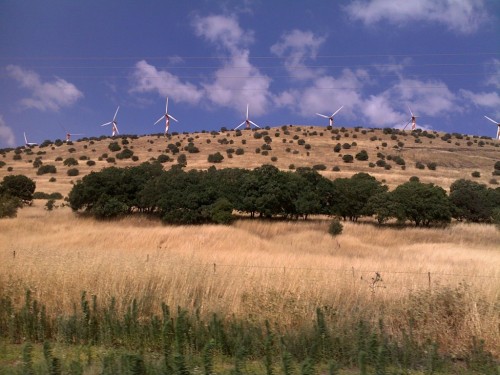 Wind farms, like this one in the Israeli-occupied Golan Heights, may soon be common in Syria.
 Wait, what? Whales in the desert? Fossils of earliest suborder of now extinct whale sheds new light on evolution.
  Lebanon is eager to replant their cedars – a national symbol. But a sustainable, community-wide vision is in need.
 “Borders, Territory and Conflict in a Globalizing World” was the theme at a conference held in Israel. Experts deliberated on ethnicity, power relations and technology. Dr. Gotlieb emphasizes that such issues must be linked to the environment.
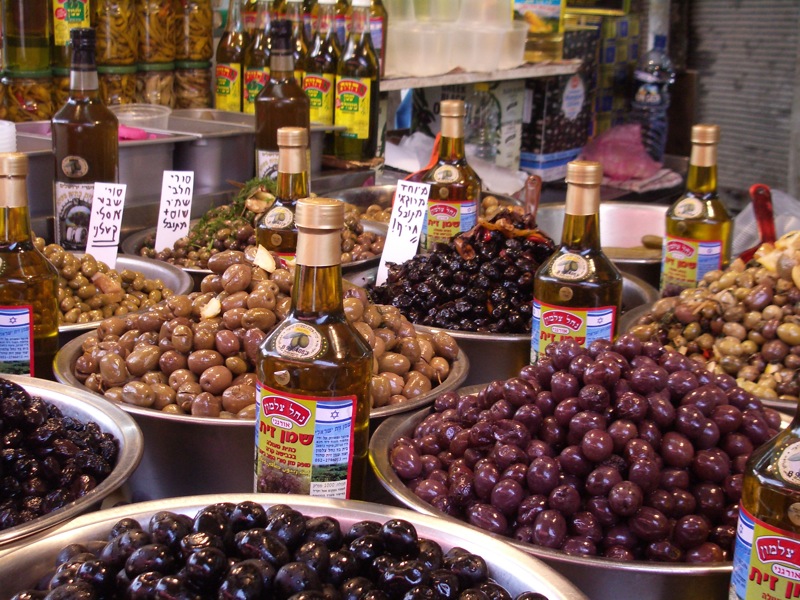 Tel Aviv Carmel Market. Above image via
 When you’re stuck in the middle of a crowded, noisy city like Cairo,

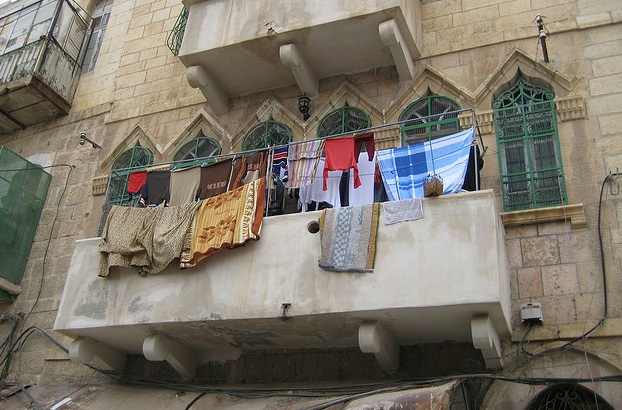 They’re already going eco: Hanging the clothes to dry, naturally, in Hebron. Image via
  Who would have thought that nature could provide such vivid hues? Here you see the strength of “redbeard” henna.


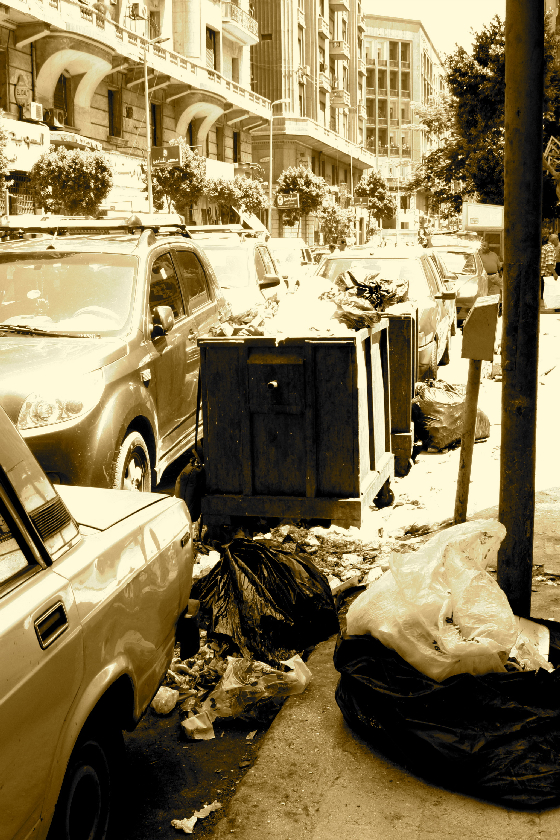 Education puts Cairo one step towards getting rid of its nemesis: solid waste.