It's sea turtles which may in the end save islands in the Seychelles. They may also better help us understand climate change. Like rings on a tree, scientists have found a way to read sea turtle shells and how they are impacted by climate change tells a story.
For centuries, the Sámi shaman drum was one of the most powerful sacred objects in northern Europe, and one of the most feared by church and state. If ISIS looks bad to us today for its religious fundamentalism, Christians were just as fervent.
In a real emergency, romance takes a back seat to physics, panic, and how fast 150 people can squeeze through a narrow tube. The Federal Aviation Administration says every aircraft must be evacuated within 90 seconds. That’s the gold standard. But new research suggests that in the real world, especially as we age, that number might be more aspirational than achievable.
Research from the Wildlife Conservation Society (WCS) and the University of Queensland, published in Ocean & Coastal Management, found that nearly three out of four marine protected areas (MPAs) worldwide are exposed to sewage pollution.
At a time when climate anxiety can feel abstract and overwhelming, and being Jewish something people may need to hide in big cities, Adamah Los Angeles is trying something different: turning Jewish values into local climate action with dirt-under-the-fingernails practicality.
It's sea turtles which may in the end save islands in the Seychelles. They may also better help us understand climate change. Like rings on a tree, scientists have found a way to read sea turtle shells and how they are impacted by climate change tells a story.
For centuries, the Sámi shaman drum was one of the most powerful sacred objects in northern Europe, and one of the most feared by church and state. If ISIS looks bad to us today for its religious fundamentalism, Christians were just as fervent.
In a real emergency, romance takes a back seat to physics, panic, and how fast 150 people can squeeze through a narrow tube. The Federal Aviation Administration says every aircraft must be evacuated within 90 seconds. That’s the gold standard. But new research suggests that in the real world, especially as we age, that number might be more aspirational than achievable.
Research from the Wildlife Conservation Society (WCS) and the University of Queensland, published in Ocean & Coastal Management, found that nearly three out of four marine protected areas (MPAs) worldwide are exposed to sewage pollution.
At a time when climate anxiety can feel abstract and overwhelming, and being Jewish something people may need to hide in big cities, Adamah Los Angeles is trying something different: turning Jewish values into local climate action with dirt-under-the-fingernails practicality.
It's sea turtles which may in the end save islands in the Seychelles. They may also better help us understand climate change. Like rings on a tree, scientists have found a way to read sea turtle shells and how they are impacted by climate change tells a story.
For centuries, the Sámi shaman drum was one of the most powerful sacred objects in northern Europe, and one of the most feared by church and state. If ISIS looks bad to us today for its religious fundamentalism, Christians were just as fervent.
In a real emergency, romance takes a back seat to physics, panic, and how fast 150 people can squeeze through a narrow tube. The Federal Aviation Administration says every aircraft must be evacuated within 90 seconds. That’s the gold standard. But new research suggests that in the real world, especially as we age, that number might be more aspirational than achievable.
Research from the Wildlife Conservation Society (WCS) and the University of Queensland, published in Ocean & Coastal Management, found that nearly three out of four marine protected areas (MPAs) worldwide are exposed to sewage pollution.
At a time when climate anxiety can feel abstract and overwhelming, and being Jewish something people may need to hide in big cities, Adamah Los Angeles is trying something different: turning Jewish values into local climate action with dirt-under-the-fingernails practicality.
It's sea turtles which may in the end save islands in the Seychelles. They may also better help us understand climate change. Like rings on a tree, scientists have found a way to read sea turtle shells and how they are impacted by climate change tells a story.
For centuries, the Sámi shaman drum was one of the most powerful sacred objects in northern Europe, and one of the most feared by church and state. If ISIS looks bad to us today for its religious fundamentalism, Christians were just as fervent.
In a real emergency, romance takes a back seat to physics, panic, and how fast 150 people can squeeze through a narrow tube. The Federal Aviation Administration says every aircraft must be evacuated within 90 seconds. That’s the gold standard. But new research suggests that in the real world, especially as we age, that number might be more aspirational than achievable.
Research from the Wildlife Conservation Society (WCS) and the University of Queensland, published in Ocean & Coastal Management, found that nearly three out of four marine protected areas (MPAs) worldwide are exposed to sewage pollution.
At a time when climate anxiety can feel abstract and overwhelming, and being Jewish something people may need to hide in big cities, Adamah Los Angeles is trying something different: turning Jewish values into local climate action with dirt-under-the-fingernails practicality.
It's sea turtles which may in the end save islands in the Seychelles. They may also better help us understand climate change. Like rings on a tree, scientists have found a way to read sea turtle shells and how they are impacted by climate change tells a story.
For centuries, the Sámi shaman drum was one of the most powerful sacred objects in northern Europe, and one of the most feared by church and state. If ISIS looks bad to us today for its religious fundamentalism, Christians were just as fervent.
In a real emergency, romance takes a back seat to physics, panic, and how fast 150 people can squeeze through a narrow tube. The Federal Aviation Administration says every aircraft must be evacuated within 90 seconds. That’s the gold standard. But new research suggests that in the real world, especially as we age, that number might be more aspirational than achievable.
Research from the Wildlife Conservation Society (WCS) and the University of Queensland, published in Ocean & Coastal Management, found that nearly three out of four marine protected areas (MPAs) worldwide are exposed to sewage pollution.
At a time when climate anxiety can feel abstract and overwhelming, and being Jewish something people may need to hide in big cities, Adamah Los Angeles is trying something different: turning Jewish values into local climate action with dirt-under-the-fingernails practicality.
It's sea turtles which may in the end save islands in the Seychelles. They may also better help us understand climate change. Like rings on a tree, scientists have found a way to read sea turtle shells and how they are impacted by climate change tells a story.
For centuries, the Sámi shaman drum was one of the most powerful sacred objects in northern Europe, and one of the most feared by church and state. If ISIS looks bad to us today for its religious fundamentalism, Christians were just as fervent.
In a real emergency, romance takes a back seat to physics, panic, and how fast 150 people can squeeze through a narrow tube. The Federal Aviation Administration says every aircraft must be evacuated within 90 seconds. That’s the gold standard. But new research suggests that in the real world, especially as we age, that number might be more aspirational than achievable.
Research from the Wildlife Conservation Society (WCS) and the University of Queensland, published in Ocean & Coastal Management, found that nearly three out of four marine protected areas (MPAs) worldwide are exposed to sewage pollution.
At a time when climate anxiety can feel abstract and overwhelming, and being Jewish something people may need to hide in big cities, Adamah Los Angeles is trying something different: turning Jewish values into local climate action with dirt-under-the-fingernails practicality.
It's sea turtles which may in the end save islands in the Seychelles. They may also better help us understand climate change. Like rings on a tree, scientists have found a way to read sea turtle shells and how they are impacted by climate change tells a story.
For centuries, the Sámi shaman drum was one of the most powerful sacred objects in northern Europe, and one of the most feared by church and state. If ISIS looks bad to us today for its religious fundamentalism, Christians were just as fervent.
In a real emergency, romance takes a back seat to physics, panic, and how fast 150 people can squeeze through a narrow tube. The Federal Aviation Administration says every aircraft must be evacuated within 90 seconds. That’s the gold standard. But new research suggests that in the real world, especially as we age, that number might be more aspirational than achievable.
Research from the Wildlife Conservation Society (WCS) and the University of Queensland, published in Ocean & Coastal Management, found that nearly three out of four marine protected areas (MPAs) worldwide are exposed to sewage pollution.
At a time when climate anxiety can feel abstract and overwhelming, and being Jewish something people may need to hide in big cities, Adamah Los Angeles is trying something different: turning Jewish values into local climate action with dirt-under-the-fingernails practicality.
It's sea turtles which may in the end save islands in the Seychelles. They may also better help us understand climate change. Like rings on a tree, scientists have found a way to read sea turtle shells and how they are impacted by climate change tells a story.
For centuries, the Sámi shaman drum was one of the most powerful sacred objects in northern Europe, and one of the most feared by church and state. If ISIS looks bad to us today for its religious fundamentalism, Christians were just as fervent.
In a real emergency, romance takes a back seat to physics, panic, and how fast 150 people can squeeze through a narrow tube. The Federal Aviation Administration says every aircraft must be evacuated within 90 seconds. That’s the gold standard. But new research suggests that in the real world, especially as we age, that number might be more aspirational than achievable.
Research from the Wildlife Conservation Society (WCS) and the University of Queensland, published in Ocean & Coastal Management, found that nearly three out of four marine protected areas (MPAs) worldwide are exposed to sewage pollution.
At a time when climate anxiety can feel abstract and overwhelming, and being Jewish something people may need to hide in big cities, Adamah Los Angeles is trying something different: turning Jewish values into local climate action with dirt-under-the-fingernails practicality.
But what exactly is an ecotarian? The name sounds simple enough – someone who eats based on ecologically sustainable principles. Yet the definitions are fairly diverse.
Nabil Hirbawy from Siwa, Egypt lost an eye to his craft, but that hasn’t dampened his passion for carving salt rock into beautiful works of art!
Nabil Hirbawy was polishing off a small salt sculpture when a small piece of it struck him in the eye, leaving him partially blind – not only physically, but also to the dangers of the craft that has left deep scars on his hands. “I love it,” he says of his work in the Siwa Oasis near Libya.
Salt creates all kinds of havoc in the oasis. Otherwise fresh water springs are destroyed when they run into lakes so thick with salt, a light brush with the water leaves behind crystals. Because of it, locals are restricted to growing dates and olives and other crops that can withstand the region’s saline soil. But in a classic case of turning lemons into lemonade, a small cottage industry has emerged from this would-be curse.
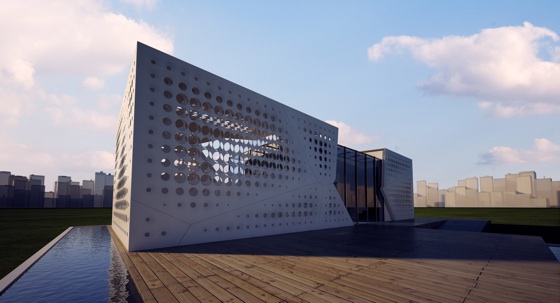
Students from the American University of Cairo designed SLIDES – a solar-powered modular home that is slated to compete in next years Solar Decathlon, but lack of financial support could keep this groundbreaking project from being realized.
Never before has a North African or Middle Eastern team won the opportunity to showcase the best in homegrown eco-architecture and clean tech – mostly because they have lacked the developmental tools to compete with more privileged European schools. And now that we do have a group of exceptional students with the requisite dedication and skills to see this project to the end, it is very possible that a lack of funding will prevent them from making it to Spain next year. Are we going to let that happen?
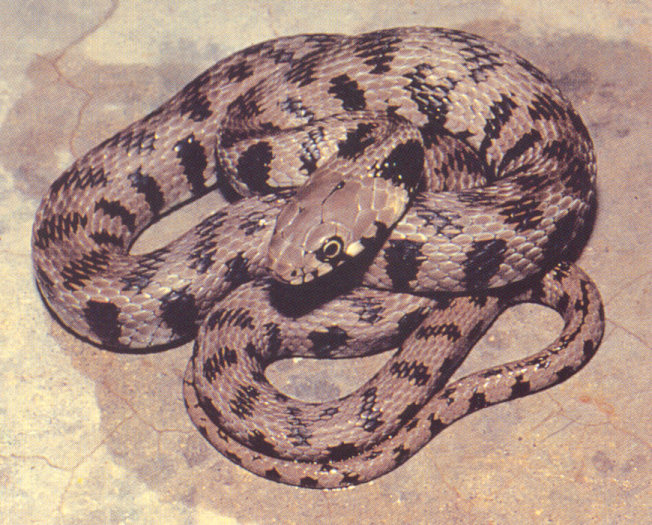
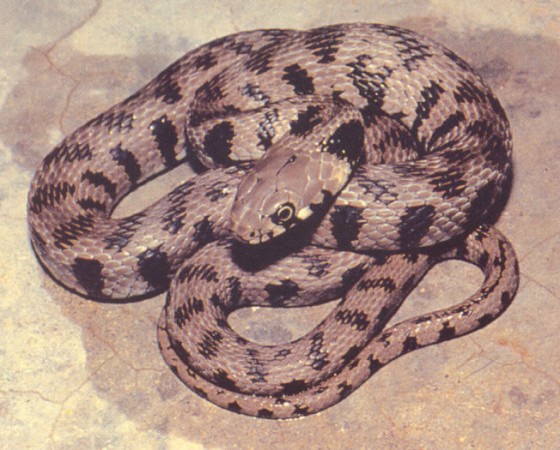
This Cyprus grass snake is now an endangered species
First a severe water crisis threatened to create a dire peril to both people and animals in Cyprus. Then we revealed a crisis gripping the island’s song bird population with over one million songbirds killed to make a popular pickled food dish. Now the common Cyprus grass snake, natrix natrix cypriaca in Latin, is on the verge of extinction due to a combination of the ongoing water crisis and the fact that government authorities simply do not seem to care. Cyprus News reveals that this snake species is endangered due to habitat loss near lakes like the Xyliatos reservoir and the Paralimni lake that is drying up, and loss of food sources such as toads and frogs that are disappearing along with the water.
Dutch Docklands proposes floating islands as an alternative to developing Dubai’s “The World” artificial islands
We can’t think of anything more unfortunate than getting stuck with an artificial island (like this one that Israel proposes to build off Gaza). But investors who bought one of 300 “countries” off the coast of Dubai will be happy to know that Dutch Docklands from the Netherlands is proposing to create floating islands as a more sustainable option to the “World’s” artificial islands.
Devastating to marine environments out of which they are scraped together, artificial islands are also costly to develop. But in an exclusive interview with Emirates 24/7, Dutch Dockland’s CEO Paul van de Camp reveals that investors who purchased water masses along with their landmass now have a building option that won’t require any additional infrastructure to build.
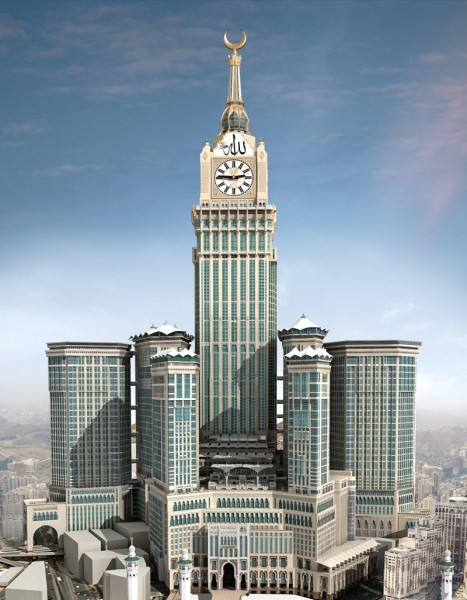
The hideous Mekkah Clocktower may have been the final straw – officials now state that any additions will be more in tune with traditional architecture
It seems that the powers that be in Mekkah (Mecca) are finally listening. After widespread complaints that Mekkah was beginning to resemble Las Vegas with its preference for gargantuan and gimmicky buildings, luxury hotels and tacky malls, it has announced that in the future any additions will be ‘of reasonable height’ and will be more in tune with the traditional architecture of the region. Hopefully that will rule out anything similar to the Mekkah Clocktower which is one of the tallest buildings in the world and stood out like a sore thumb with its decidedly European influences (London’s Big Ben?) in the middle of Saudi Arabian desert.
Guest writer and Oxford student Will Todman describes the mood in Lebanon following the announcement that Jeita Grotto failed to secure a spot as one of the new 7 Natural Wonders of the World.
Lebanon’s hopes of having its candidate, Jeita Grotto, declared one of the new 7 Natural Wonders of the Worldwere crushed as the winning list was announced on Friday night. The Lebanese disappointment was echoed across the Middle East as the region’s other two finalists, the Dead Sea of Israel, Jordan and Palestine and the Bu Tinah Island in the United Arab Emirates, also failed to make the final cut.
The campaign ignited an interest in the natural phenomenon in Lebanon with millions of votes being recorded as the Lebanese cave was pitted against other finalists such as the Amazon rainforest and Australia’s Great Barrier Reef. The telephone company ‘Alfa’ alone reported that 3.7 million text message votes had been sent in support of the cave by its users.
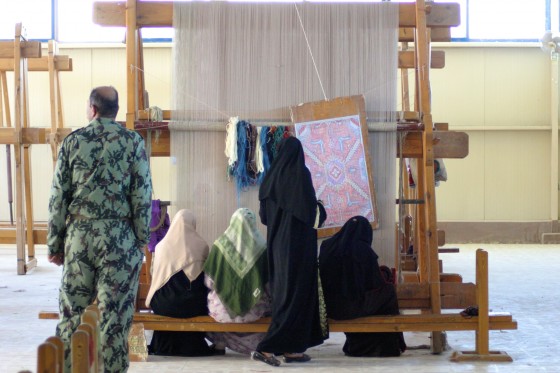
These women in the Siwa oasis near Libya are trained in the traditional craft of weaving Kleem (rugs). Tafline takes a rare inside look at their work.
You might have already read about the first part of our journey where our bus kept breaking down on the road to Siwa. When our host Yehia secured permission from the Egyptian army manager for us to take photos at the carpet factory in Siwa, my traveling companions and I lost no time. Veiled women are usually exceptionally camera shy so this opportunity was at once unusual and exhilarating.
Of course, the women were less thrilled than we, so when they turned away from our peering lenses, I put my camera away.
But before that, I was able to capture a scene that will give our readers a unique glimpse into a world that few people get to see. “The Productive Unit for Environmental Industries” in the Siwa oasis near Libya is working to revive a dying heritage. (See our story on Bokja in Beirut to understand why traditions are important).
It isn’t easy to communicate with the people at the carpet factory in Siwa. Had I known that behind this ambiguous sign – “The Productive Unit for Environmental Industries” – sat a group of women who earn an income for their families by weaving rugs in the traditional way, I would have visited with a translator. But I had no way of knowing that and our trip here was not planned.
Even so, I was able to extract a few crucial details, and pictures tell a compelling story too. Mr. Khaled Amam, the army manager who oversees the day to day running of the factory, shares an easy camaraderie with the weavers who were very curious about our clicking entourage. Many of the women stopped working, others carried on.
Kleem making has a long history in this region, and rugs developed here used to be shipped to different parts of the world, but globalization and capitalism has diminished the viability of this industry and the skills traditionally passed from women to women were at risk of extinction.
Dr. Eng. Shereif A. Temraz, Prof. Assistant, Faculty of Specific Education, Alexandria University-Egypt says that “The significance of the popular heritage (folklore) in studying of the design is…linked to our roots and ammunition against the cultural invasion aiming to deprive us from our Egyptian entity and the future of the traditional crafts.”
For the last 15 years, dozens of women have been trained to use longstanding symbols such as circles, representing the completion of life, and triangles that show the link between earth and sky, in unique designs woven with weft and warp technique.
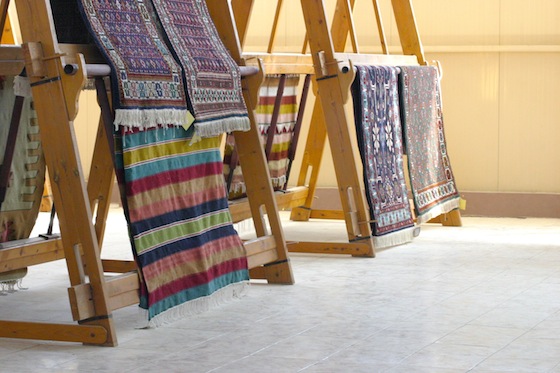
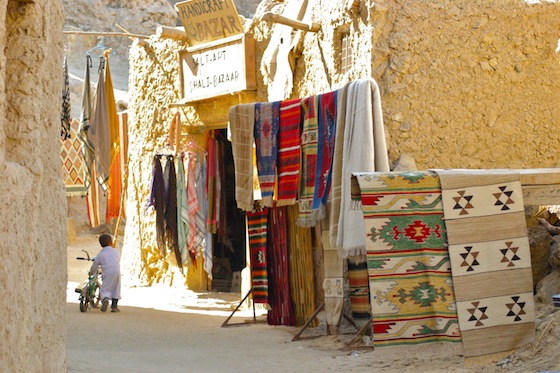
Siwa carpets on display
Roughly 25 weavers and their families currently benefit from this cottage industry, though it is unclear who initiated it, who funded that initiation, and whether the project continues to receive outside help. What is clear is that these rugs, along with bags and other accessories, are sold in the factory, in downtown Siwa, and in Cairo, Alexandria, and other commercial centers scattered throughout the country. Mr. Aman said that the women receive a small stipend in addition to commissions on rugs sold, so it may be that the project is self-sustaining by now.
The Wikipedia definition of sustainable development is as follows: “a pattern of resource use that aims to meet human needs while preserving the environment so that these needs can be met not only in the present, but also for generations to come (sometimes taught as ELF-Environment, Local people, Future).”
While it won’t make them rich, this effort to empower the weavers of Siwa is an inspiring example of sustainable development. Last year we wrote about an Egyptian photographer’s efforts to draw attention to the way in which unsustainable development and tourism threatens the unique culture of this beautiful oasis town. Let this post be a testament to their resilience.
I see that solar panels are now commonplace on rooftops in Barcelona
European countries, especially Spain are becoming stronger on green projects like renewable energy and recycling. This was the impression I received while on a recent trip to the Spanish coastal city of Barcelona, where recycling efforts and water conservation are widely practiced and solar energy is also gaining in popularity. Spain has been a leader in solar energy projects, and recently Spanish companies have partnered with those in the Middle East, such as the one with Abu Dhabi’s Masdar renewable energy company and Spain’s Torresol Energy using concentrated solar energy plants incorporating concentrated solar power (CSP).
But as a tourist, I was more interested to see what private citizens are doing there to both conserve energy and resources, as well as create energy from renewable sources. These are some examples that the Middle East can pick up on. Come with me on my tour.
Israelis discuss the problem of getting nuclear neighbors.
In a small region like the Middle East, a single country’s decision to build nuclear power can easily spill over borders.
At a panel last Monday, Israeli energy experts spoke on the risks and benefits of nuclear power, noting that even if Israel avoided the risks of nuclear, the country would have to shoulder the burden should a neighboring country choose to develop nuclear power. Israel’s nuclear energy program has been “in a state of ambiguity” for years due mostly to security, human health and environmental concerns.
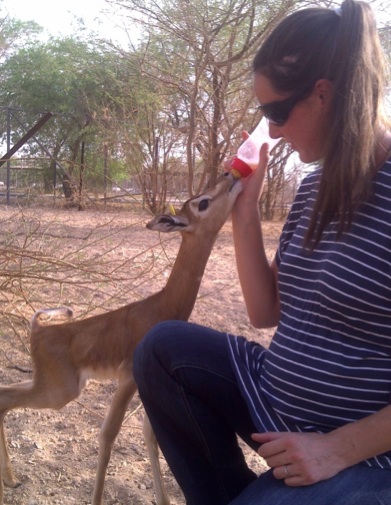
His mother passed away at birth. Now zookeepers at the Al Ain Zoo in Abu Dhabi are asking the public to give this baby gazelle a name. No Splashypants please!
Remember Mr. Splashypants the whale that was named during an online Greenpeace campaign? Like it or not, that’s what voters chose for the whale now being tracked as part of the Great Whale Trail Expedition. Picking up on naming competitions as a way to educate people about animals, zookeepers at an Abu Dhabi zoo are hoping to create some positive publicity for gazelles. Can you name this baby orphaned Mhorr gazelle pictured above?
This was the plan: leave at 8pm Friday night from Turgoman station in Cairo. Arrive in Siwa at 5.30am and meet my friend Gwen from France at the Siwa Inn Hotel. Bestow copious hugs and kisses before finding Vivek, a Couchsurfing buddy who traveled from Alexandria. And then, after introducing my friends, relax in this beautiful oasis just 30 miles east of Libya before taking the Sunday overnight bus back to Cairo.
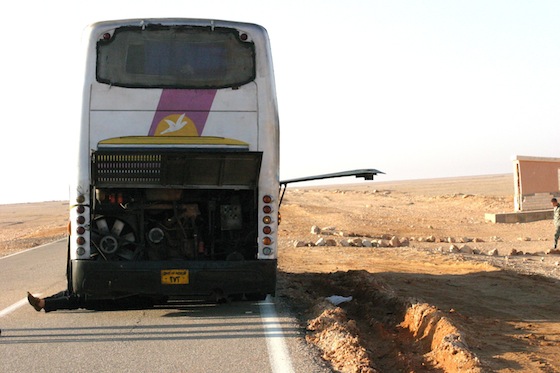
Expect delays. The bus kept breaking down on the way to Siwa
Here’s what really happened: the bus showed up with a broken belt, but I and a handful of other passengers, including a couple from Sicily, climbed on anyway. We were driven to a greasy junkyard, where we were given a bus that I was sure had not seen the light of day in months but that pacified a group of now grumpy Egyptian passengers. Finally, three hours behind schedule, bus #2 with the wheezy engine finally hit the road… and then broke down the following morning one hour shy of our destination!
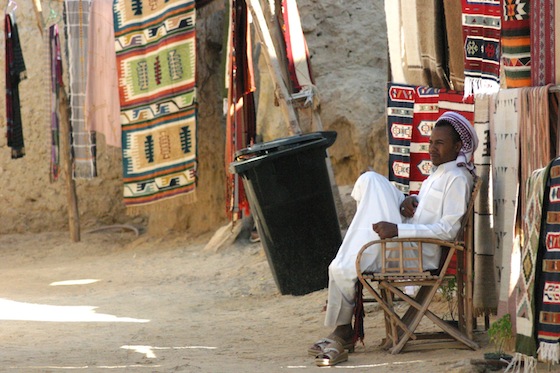
Siwa market
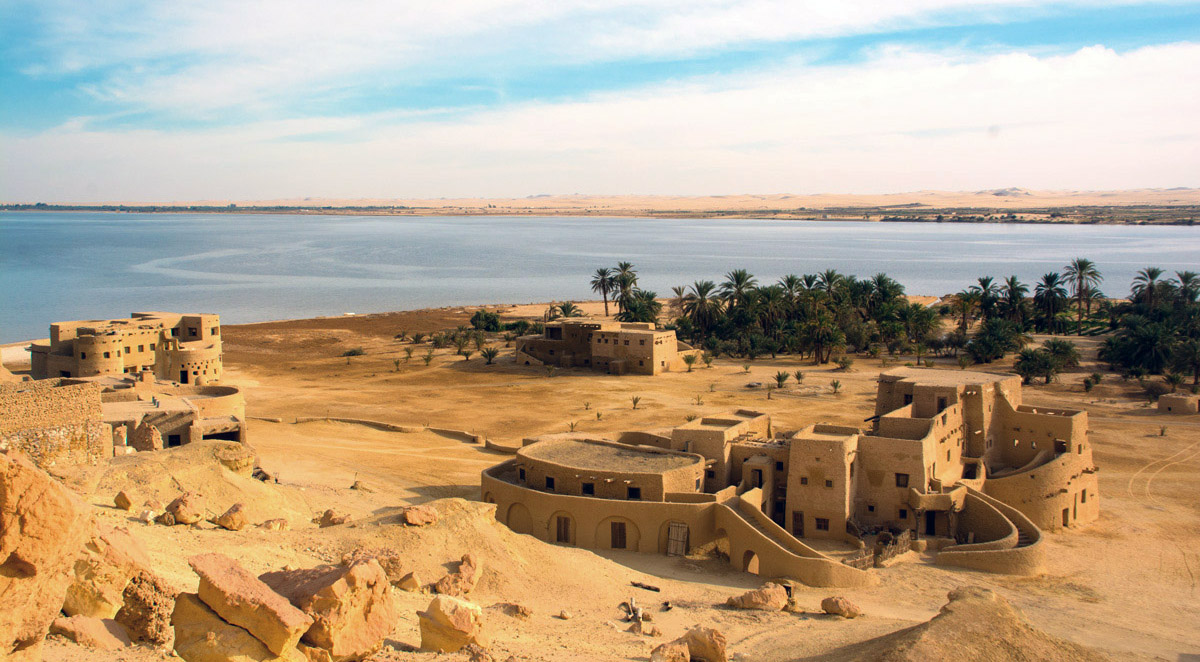
Siwa is a colorful, sleepy town that lies in a depression roughly 30 feet below sea level. In the summer, fair-skinned people need not come by. But in November, the sun eases off during the day and the evenings are cool enough for a camp fire.
The area is known for its dates, olives, olive oil, and a few other cottage industries. It is also renowned for its green building techniques (more on all of this to come). Because of its remote and tranquil location 350 miles away from the hustle and bustle of an increasingly-tense Cairo, it has become a popular destination. But this isn’t necessarily great for the locals, who are beginning to face serious water shortages. Although there are signs of destructive tourism operations, we received a rare look at the same soporific inner workings that have sustained this community for hundreds of years.
The population currently stands at roughly 23,000, comprised mostly of Berbers. While they share the same gentle, hospitable attitude of the Berbers that Karin and I met during our respective stays in Morocco, the Siwi language here is distinctly different.
Gwen and Yehia, a prominent local man whose 19 brothers and sisters (from two mothers, I should add) own a lot of agricultural property in and around Siwa, came to my rescue at the side of the highway at 9am on Saturday morning. Bus #3 showed up two minutes later, but we didn’t care. We left that bus in our dust!
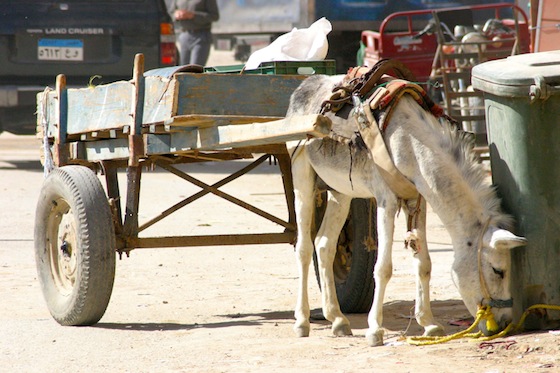
It’s easy to lose track of time wondering among the dusty streets alongside donkeys and tuk tuks, watching young boys and men completing their daily chores, or else sipping sugary chai in the shade.
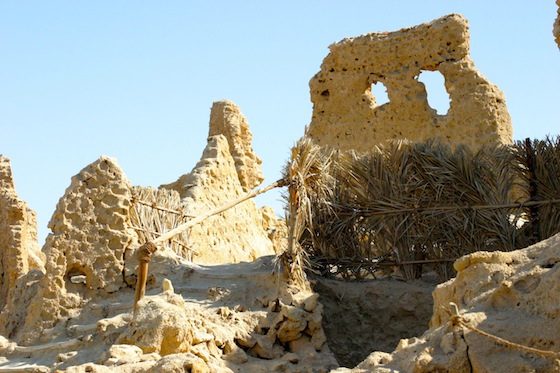
A short climb up the melted Shali fortress made of mud-brick and salt provides a wonderful sense of perspective. From the top, there are views of two small salt lakes, a valley full of leafy green palms used for pretty much everything, and the necropolis or mountain of the dead rises in a lumpy mound on the outskirts of town.
The planned group of three turned to six: the couple from Sicily joined our party, I called them Juicy and Crunchy, Vivek met Pierre from Quebec on his bus, Gwen spent the day meandering through town with us before leaving on Saturday night, and then there was me.. happy as can be away from the city again.
Stay tuned over the next few days for a peek at a group of woman in Siwa who make carpets under the army’s watchful management, the man who lost an eye to salt crafts, Siwa’s veteran green builder, and the man who makes olive oil that is good enough to drink…
We speak to Fazlun Khalid who set up The Islamic Foundation For Ecology And Environmental Sciences about the highs and lows of over two decades of work
The link between Islam and the environment is slowly gaining recognition amongst the wider public and The Islamic Foundation For Ecology And Environmental Sciences (IFEES) may have something to do with that. Over the last two decades, the UK-based organization has been reaching out to Muslims and non-Muslims alike about the role that faith can play in environmental protection. IFEES has worked particularly hard to highlight the Islamic teachings on nature and have set up their EcoIslam newsletter and published various green guides with that aim in mind. The organization has also campaigned to end dynamite fishing in Zanzibar and encourage tree planting in Indonesia through Islamic teachings. I caught up Fazlun Khalid who established the charity to talk more.
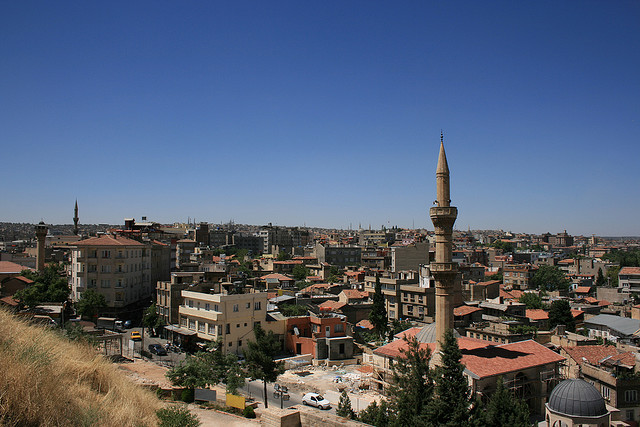
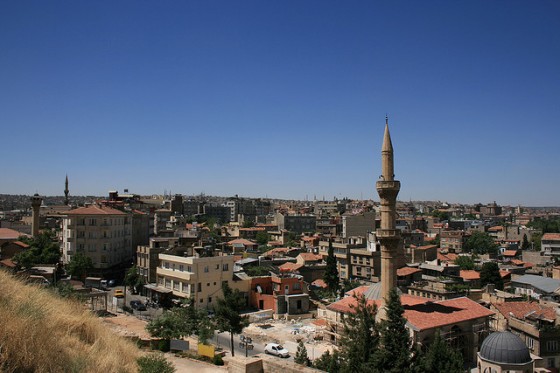
Gaziantep is the only city in Turkey with its own climate change action plan.
Everything from sustainable agriculture to waste-to-energy technology will be on the agenda today, as dozens of mayors, academics, and NGO representatives assemble in Istanbul for the 2011 Sustainable Cities conference, a project of Turkey’s Regional Environment Center. Municipalities often accomplish environmental goals more swiftly and efficiently than national governments, according to Barış Baykan, author of a recent study on the Turkish government’s lackluster efforts to reduce carbon emissions.
While participants learn how to draft and fund environmental action plans in their respective cities, we’ll take a look at the most sustainable towns and cities in Turkey today.
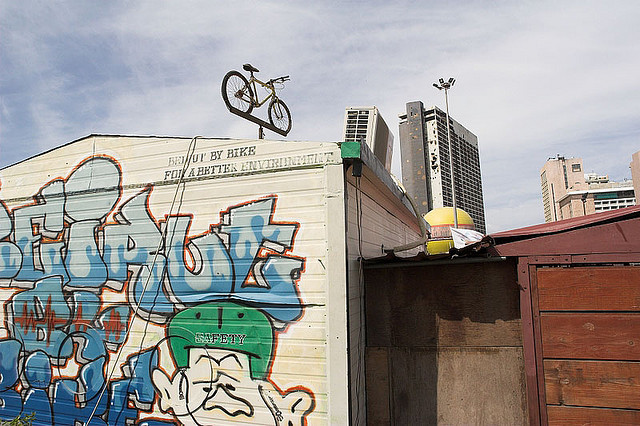
In a tweet a couple weeks ago (yes, he tweets), Prime Minister Najib Mikati wrote that “the example of Vélib’ rental bikes in Paris is interesting for Beirut to be more ecologically/pedestrian friendly and reduce traffic. Agree?!”

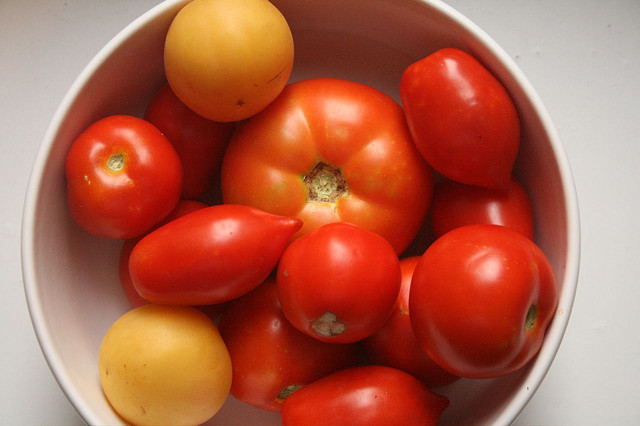
 Is the eco-friendly food movement getting even more complicated, or are ecotarians simplifying matters?