Before promoting sustainability progress, companies must ensure their initiatives are genuine and measurable. Today’s audiences are increasingly skeptical of vague environmental claims, particularly as awareness of “greenwashing” has grown.
Sydney is best known for the Opera House and the Harbour Bridge. If you’re looking to enjoy dinner with views of these landmarks, here are some great options.
It's sea turtles which may in the end save islands in the Seychelles. They may also better help us understand climate change. Like rings on a tree, scientists have found a way to read sea turtle shells and how they are impacted by climate change tells a story.
For centuries, the Sámi shaman drum was one of the most powerful sacred objects in northern Europe, and one of the most feared by church and state. If ISIS looks bad to us today for its religious fundamentalism, Christians were just as fervent.
Before promoting sustainability progress, companies must ensure their initiatives are genuine and measurable. Today’s audiences are increasingly skeptical of vague environmental claims, particularly as awareness of “greenwashing” has grown.
Sydney is best known for the Opera House and the Harbour Bridge. If you’re looking to enjoy dinner with views of these landmarks, here are some great options.
It's sea turtles which may in the end save islands in the Seychelles. They may also better help us understand climate change. Like rings on a tree, scientists have found a way to read sea turtle shells and how they are impacted by climate change tells a story.
For centuries, the Sámi shaman drum was one of the most powerful sacred objects in northern Europe, and one of the most feared by church and state. If ISIS looks bad to us today for its religious fundamentalism, Christians were just as fervent.
Before promoting sustainability progress, companies must ensure their initiatives are genuine and measurable. Today’s audiences are increasingly skeptical of vague environmental claims, particularly as awareness of “greenwashing” has grown.
Sydney is best known for the Opera House and the Harbour Bridge. If you’re looking to enjoy dinner with views of these landmarks, here are some great options.
It's sea turtles which may in the end save islands in the Seychelles. They may also better help us understand climate change. Like rings on a tree, scientists have found a way to read sea turtle shells and how they are impacted by climate change tells a story.
For centuries, the Sámi shaman drum was one of the most powerful sacred objects in northern Europe, and one of the most feared by church and state. If ISIS looks bad to us today for its religious fundamentalism, Christians were just as fervent.
Before promoting sustainability progress, companies must ensure their initiatives are genuine and measurable. Today’s audiences are increasingly skeptical of vague environmental claims, particularly as awareness of “greenwashing” has grown.
Sydney is best known for the Opera House and the Harbour Bridge. If you’re looking to enjoy dinner with views of these landmarks, here are some great options.
It's sea turtles which may in the end save islands in the Seychelles. They may also better help us understand climate change. Like rings on a tree, scientists have found a way to read sea turtle shells and how they are impacted by climate change tells a story.
For centuries, the Sámi shaman drum was one of the most powerful sacred objects in northern Europe, and one of the most feared by church and state. If ISIS looks bad to us today for its religious fundamentalism, Christians were just as fervent.
Before promoting sustainability progress, companies must ensure their initiatives are genuine and measurable. Today’s audiences are increasingly skeptical of vague environmental claims, particularly as awareness of “greenwashing” has grown.
Sydney is best known for the Opera House and the Harbour Bridge. If you’re looking to enjoy dinner with views of these landmarks, here are some great options.
It's sea turtles which may in the end save islands in the Seychelles. They may also better help us understand climate change. Like rings on a tree, scientists have found a way to read sea turtle shells and how they are impacted by climate change tells a story.
For centuries, the Sámi shaman drum was one of the most powerful sacred objects in northern Europe, and one of the most feared by church and state. If ISIS looks bad to us today for its religious fundamentalism, Christians were just as fervent.
Before promoting sustainability progress, companies must ensure their initiatives are genuine and measurable. Today’s audiences are increasingly skeptical of vague environmental claims, particularly as awareness of “greenwashing” has grown.
Sydney is best known for the Opera House and the Harbour Bridge. If you’re looking to enjoy dinner with views of these landmarks, here are some great options.
It's sea turtles which may in the end save islands in the Seychelles. They may also better help us understand climate change. Like rings on a tree, scientists have found a way to read sea turtle shells and how they are impacted by climate change tells a story.
For centuries, the Sámi shaman drum was one of the most powerful sacred objects in northern Europe, and one of the most feared by church and state. If ISIS looks bad to us today for its religious fundamentalism, Christians were just as fervent.
Before promoting sustainability progress, companies must ensure their initiatives are genuine and measurable. Today’s audiences are increasingly skeptical of vague environmental claims, particularly as awareness of “greenwashing” has grown.
Sydney is best known for the Opera House and the Harbour Bridge. If you’re looking to enjoy dinner with views of these landmarks, here are some great options.
It's sea turtles which may in the end save islands in the Seychelles. They may also better help us understand climate change. Like rings on a tree, scientists have found a way to read sea turtle shells and how they are impacted by climate change tells a story.
For centuries, the Sámi shaman drum was one of the most powerful sacred objects in northern Europe, and one of the most feared by church and state. If ISIS looks bad to us today for its religious fundamentalism, Christians were just as fervent.
Before promoting sustainability progress, companies must ensure their initiatives are genuine and measurable. Today’s audiences are increasingly skeptical of vague environmental claims, particularly as awareness of “greenwashing” has grown.
Sydney is best known for the Opera House and the Harbour Bridge. If you’re looking to enjoy dinner with views of these landmarks, here are some great options.
It's sea turtles which may in the end save islands in the Seychelles. They may also better help us understand climate change. Like rings on a tree, scientists have found a way to read sea turtle shells and how they are impacted by climate change tells a story.
For centuries, the Sámi shaman drum was one of the most powerful sacred objects in northern Europe, and one of the most feared by church and state. If ISIS looks bad to us today for its religious fundamentalism, Christians were just as fervent.
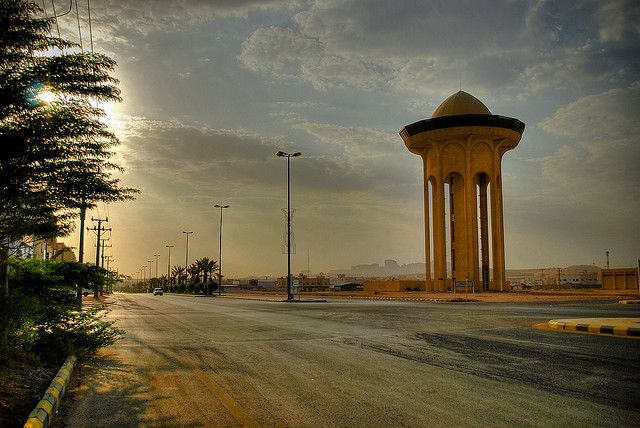
Once the region’s climate skeptic, Saudi Arabia is slowly shifting towards a more progressive stance ahead of the climate summit in Qatar
It’s not long now till the climate summit follow up to Durban, is held in Qatar later this year. And in response to the eyes that will be soon focusing on the Middle East, it appears that climate skeptics are being pushed away to the sidelines – if temporarily. In Saudi Arabia, the notoriously climate skeptic Mohammed Al-Sabban has been replaced by the well-respected Khalid Abuleif as the leading voice at the climate negotiations for the country. Kelly Rigg at HuffPost argues that this and a recent speech by the oil minister shows that Saudi may finally be prepared to play “a more progressive and less obstructionist role in the negotiations.”
South Africa, among the biggest emitters of greenhouse gases worldwide, plans to introduce its own price on carbon next year.
The Treasury said this week that South Africa, which is the continent’s biggest polluter, plans to introduce a carbon tax on annual emissions for all the industrial sectors responsible for greenhouse gas emissions, including electricity, petroleum, iron, steel and aluminium, to reduce greenhouse gases.
The Fukushima disaster forced 150,000 people to flee their homes – a year later, radioactive contamination is still keeping them away
In the lead up to the first anniversary of the Fukushima nuclear accident, Greenpeace have published a report looking back at the incident. As well as documenting the legacy of the nuclear disaster, they insist that now is the time to demand a renewable and nuclear-free future.
With various countries in the Middle East considering the nuclear option, I think its important that we look carefully at the impact and implications of the nuclear accident in Fukushima. Jordan, for example, has plans to build a 1,000 megawatt (MW) nuclear reactor by the end of the next decade and Israel insists it has mastered how to build a ‘safe nuclear reactor’ in the desert. In fact, Greenpeace campaigners in Jordan are planning a protest against their government’s nuclear plans to coincide with the Fukushima anniversary this March.
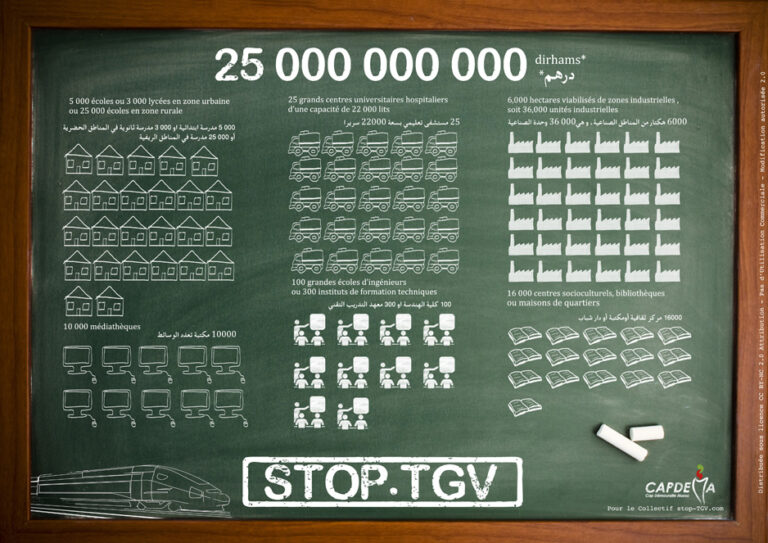
This graphic shows other ways to spend the $2.4 billion planned for what critics call Morocco’s luxury high speed rail project
A group of Moroccan Non-Government Organizations have launched the Stop TGV campaign in protest of Morocco’s $2.4 billion high speed rail project. The TGV line is expected to link up Casablanca with Tangiers by the end of 2015, reducing travel time from 5h45 to 2h10. Proponents of the project say that it will boost the economy, improve tourism traffic, and have a trickle down effect through improved infrastructure and job creation, but critics claim that high speed rail is a luxury that Morocco can ill-afford.
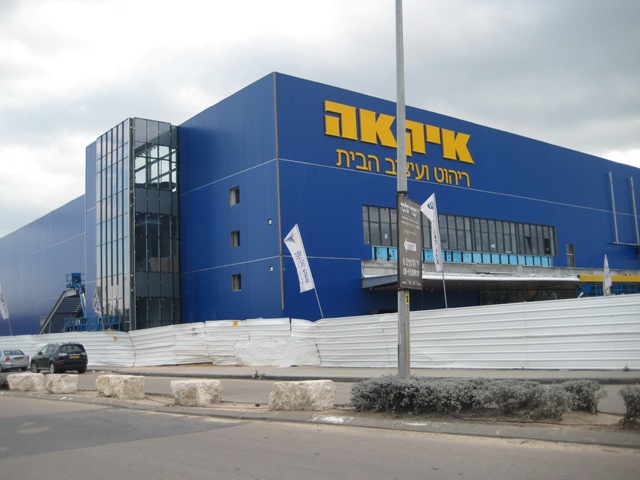
IKEA Israel’s Blue-Yellow buildings also have a green policy
IKEA’s blue and yellow store motifs have become familiar to households all over the world, including the Middle East with stores in Israel, Kuwait, Saudi Arabia and the UAE. IKEA’s Israel stores have been serving the public since 2001, and have introduced environmental policies into both the products it sells there, such as ceasing to sell incandescent light bulbs. These environmental friendly policies also hold true in regards to the bags used to carry purchased items home as IKEA stores in many countries, including Israel, now do not give plastic bags to customers in a policy to not only save money but be more green as well.
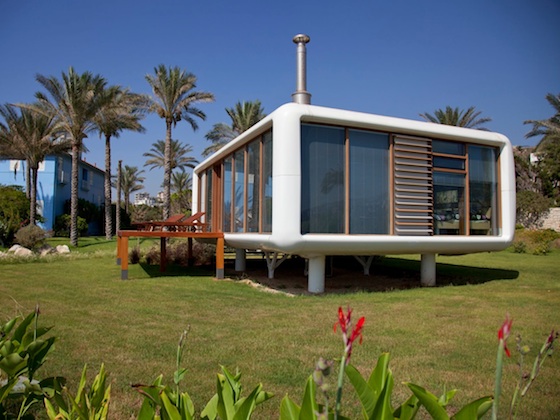
This lovely prefabricated LoftCube home is perched on a pretty piece of land just north of Beirut in Lebanon
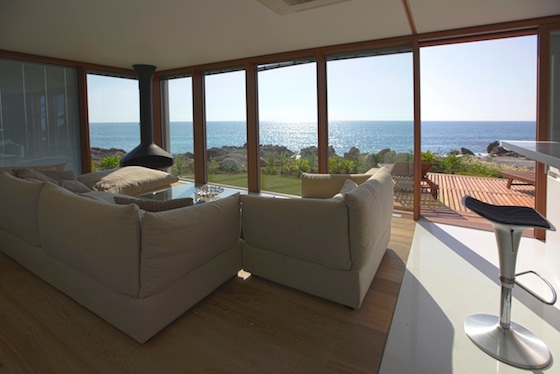
Nearly a decade ago Werner Aisslinger aspired to design a temporary, minimalist domicile that would suit the nomadic lifestyle while still retaining all of the aesthetics that contemporary society seeks. Voila! the 420 square foot LoftCube was born. Since 2004, the ultimate home for nomads has popped up in gardens and on rooftops all over the world: in Spain, Belgium, Canada, and now in Lebanon. Mark Doumet’s sleek home has 360 degree views of the Mediterranean Sea and is installed just a short ride north of Beirut. And as the country’s official LoftCube distributor, he encourages visitors.
Prefab construction has become increasingly popular in the last decade or so.
By manufacturing modular pieces in the factory and then transporting the intact structure to its destination site, designers significantly reduce waste materials and also cut down on carbon emissions associated with shipping.
The LoftCube can be transported in either two truck loads or in two shipping containers. It is wrapped in glazing that permit all kinds of light and ventilation and most of the interior is finished in Corian to create a breezy, comfortable home.
Heating and cooling systems can be customized in accordance with each buyer’s eco-ethos, and the facades and finishes are also flexible.
LoftCubes are exceptionally mobile; homeowners whose jobs require them to change their location – as often happens in the 21st century – can easily dismantle their home and move elsewhere. It goes up in 5 to 7 days and comes down in 1 to 2 days.
But they aren’t cheap. Unlike earth bag homes, which can be constructed for under $5,000, these can cost from 40,000 and 80,000 EURO, depending on the distance between the buyer and the factory. Now that AirBnBs are a thing, we bet they’d be a tad more resilient to Lebanese winters than a geodesic dome tent.
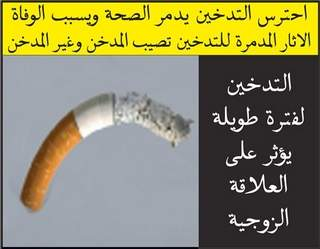
Translated from a poster in Jordan: “Smoking for a long period of time affects marital relations.”
I’m not “blowing smoke” when I rave about Amman. No need, because Amman generates enough smoke on its own. This city rivals onions in making eyes water. Blame diesel fuel. Trucks, cars, buses blast chewy plumes of black exhaust. Heavy equipment on uncontrolled worksites add to the smog. Now introduce the smokers of cigarettes, cigars and arghileh.
Smoking’s entrenched in Arab culture. (My doctor lit up during our consult.) Cabbies puff with abandon, businessmen chainsmoke through meetings. Tobacco’s cheap in Jordan, a virtual give-away. A pack of smokes costs under 3 bucks (compared to $8 in NYC, $12 in Dublin). Hookah – or hubbly-bubbly – is an essential part of Ammanian café culture; patrons flock to restaurants offering unique settings for enjoying the pipe. Arghileh is on most menus.
In 2005, Jordan and Egypt ratified the World Health Organization (WHO) Framework Convention on Tobacco Control, a treaty aimed at nipping tobacco use . Follow-on action has been at a slow drag. Jordan’s Public Health Law incorporated anti-smoking controls in 2008, but enforcement didn’t start until 2009. Smoking was banned in fast-food restaurants in 2010, but other businesses in the public realm were given a grace period to adapt. Smoking is now taboo in all public areas. Airport terminals in Cairo and Amman are no-smo-zones: but smoke rings their entry points (drivers, passengers, meeters and greeters cluster outside to light up).
Every year in Namibia, 86,000 Cape Fur Seal pups are butchered to death and only one man has the contract to turn their fur into so-called fashionable apparel. We had pictures of what’s going on but Google banned the page for it being too graphic.
The Turkish and Australian based company Hatem Yavuz named after the owner Hatem Yavuz controls roughly 60 percent of the world’s seal market and processes 130,000 seal pelts every year in his Istanbul factory. Yavuz also has a hand in the Canadian seal market and claims to be proud of what he does. In an interview that spurred a flurry of hate mail, Yavuz told 7 News in Australia that “it’s a job. If I don’t do it, someone else is going to do it.” He is called the King of Seal Killers.
Green Prophet recently caught up with Pat Dickens, founder of the Seals of Nam, a non-profit organization that has been campaigning to end Namibia’s annual seal cull on the Cape Cross Seal Reserve. A popular tourist attraction, every year between July and November the sands of the reserve are stained pink from the blood of seal pups as young as seven months old.
Men with clubs and picks enter the seal colony early in the morning. The traumatized animals squeal and run away, often regurgitating their mother’s milk in terror. Their skulls are crushed and their throats slit. Several reports show that blows to their head often only render the animals unconscious.
These remains are cleaned up before tourists show up in what is a heavily regulated area.
Dickens has gone through all of the appropriate channels to appeal to the Namibian government to cancel its contract with Yavuz, which is valid until 2019, as it stands in direct contravention to the Animal Protection Act of 1962 that makes it unlawful to “overload, overdrive, override, ill-treat, neglect, infuriate, torture or maim or cruelly beat, kick, goad or terrify any animal.”
He appealed to the Namibian ombudsman Adv. John Walters, which speech has since been followed up with a series of delay tactics. Several animal rights organizations have become involved and Jane Goodall and other celebrities have made public statements against this terrible practice.
Meanwhile, the Humane Society released a report which shows that the so-called seal-culling industry, which only employs 81 people in Namibia, benefits the Namibian economy 300 times less than live seals and eco-tourism would.
Since The Seals of Nam have not made progress “the nice way”, they have elevated the stakes of their campaign.
The activist organization recently sent a formal appeal to the world’s largest tourism fair taking place in early March, ITB Berlin, to bar Namibia’s attendance, and a series of other public protests will take place throughout the world in order to increase awareness of what has become the world’s largest seal harvest.
They have also called for a boycott of all major industries that contribute to Namibia’s Gross Domestic Product (GDP) including Namibia Breweries, De Beers, and Namibia Air.
Dickens, who quit a lucrative corporate career, sold his bike, and cashed in his pension to protect Namibia’s seals from the likes of Yavuz, told Green Prophet that the Wildlife Defense Society (WDS Namibia) recently announced their official support of the boycott, despite the enormous fiscal ramifications it could have for their own country.
Bloody Money from seals
But the odds are stacked against the seals since the King of Seal Killers makes a lucrative living from his business. One seal fur coat sells for Aus $30,000 – “enough to buy a car,” he boasted in an interview with 7 News.
Yavuz is from Turkey but Cape Fur Seals are listed as a UN-CITES Endangered Appendix II species and the United States, Mexico, the European Union, and Russia have subsequently banned all seal products in protest.
The world’s most expensive bottle is encrusted in Swarovski crystals and costs a mere $2,600.
Earlier today we poked a little fun at Dubai Mall’s conspicuous consumption, leaving us with a tinge of guilt. After all, shouldn’t we feel compassion for our Emirate neighbors whose oil-wealth has veiled the absurdity of their white gold Mercedes, their global warming park, and their soaring towers? Maybe, but then we saw this bottle of water that costs $52.28 over on Journal Arabia and all our guilt fell away. And that’s cheap compared to Blingh20’s most expensive bottle of water, which you can get for a mere $2,600!
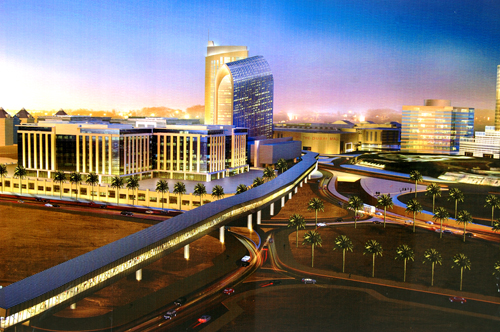
Maybe it’s because the American couple have spent so much time in Dubai, where there’s loads of gold, diamonds, and other bling to be found. In any case, the following images come straight from their personal blog, Journal Arabia, and capture the essence of excess better than anything I’ve seen so far. Check out renders of the new pedestrian bridge that will connect the Dubai Mall metro stop with the mall itself (somewhat belatedly). It will be nearly 1km long.
This amazing moat bridge parts waters in the Netherlands like Moses and the Red Sea!
Thanks to theological scholarship (or in my case, thanks to MGM and Charlton Heston) everyone knows how Moses split the Red Sea. Architects have now imitated that miracle with a sunken eco-bridge that allows safe pedestrian passage through far less-daunting waters. Four hundred years ago, a network of fortresses was built across the Netherlands to protect against Spanish and French invaders.
Their moats were interlinked, creating a water-based defense known as a “waterline” that could be manipulated to create islands of safety during turmoil. The moat surrounding 17th Century Fort de Roovere was the simplest of safeguards: a calm and controlled channel too deep to wade across, yet too shallow for arms-laden boats.
A recent reconstruction of the fortress and its regional waterline required new access routes for workers and materials, so last year this noble defense was finally breached. Read on for three more inspiring and miraculous eco-design ideas worth spreading.
Sweat and Sahara sand had forced my eyes closed so that, even as I stood in front of one of the seven wonders of the ancient world, I saw nothing. My eyelids were a back-lit sandy-orange in the sun’s glare. I pried them open and squinted up at the shapes the pharaohs and their slaves had conjured out of the desert 4500 years ago. The Great Pyramid of Cheops towered over the camels and tour buses on the outskirts of Cairo. It was a sight I will never forget and yet in the beginning I saw nothing.
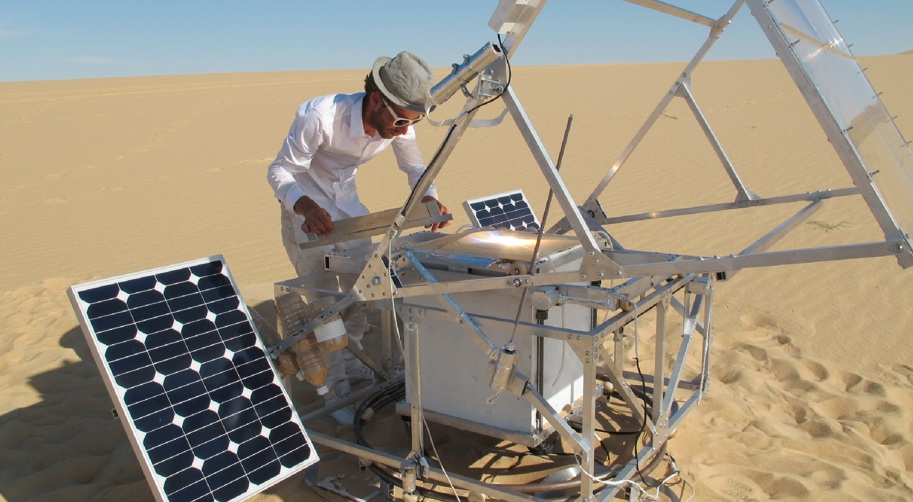
Visitors often see the desert in this way, as an endless stretch of sun and sand and nothing. But when German-born 3D Designer Markus Kayser first set his eyes upon the Egyptian desert, he saw possibilities. He imagined harnessing the resources which existed in great abundance here, sunlight and sand. And here he talks with Green Prophet about his 3D printer that runs on sun and sand.
Edible wild plants are healthy vegetables that are free for the picking. Here are two of our favorites growing now in the Middle East, with recipes.
Our monthly seasonal produce posts always carry forager’s notes for those who follow the Middle Eastern tradition of eating wild greens. See our latest seasonal post with a list of many wild edibles. With this winter’s relatively abundant rains, wild edibles are growing out of every crack in the sidewalk and filling up neglected gardens and fields.
Take nettles. Take them carefully though, because they sting. A good way to harvest this assertive vegetable is to cut the stems with scissors, then still holding the stem with the scissors, drop it into your collecting bag. Handle the nettles with kitchen gloves to avoid getting stung once you get them into the kitchen. We’ve written about nettles before, and here’s a post with some different tips on cooking them.
Why go through all that trouble? Well, nettles are amazingly high in iron, calcium and vitamin K, among other nutrients. And they taste good, especially cooked with rice. Nettle’s flavor is uniquely dark, a little reminiscent of dried seaweed.
A delicious tonic soup: 2 cups chopped nettles, 1 medium onion, 1 chopped tomato, 1/2 cup raw rice and 2 cups water. Add a bay leaf, 2 cardomom pods, 1/2 teaspoon ground turmeric and salt and pepper to taste. Cook, covered, over medium heat till the rice is very soft – about 1/2 hour. Blend, and before serving, stir a little good butter or cream into the soup.
Collect nettles before their seeds have matured, while the leaves are broad and dark green. I dry them for eating year around, tying small bunches together and hanging them upside down till leaves and stems are dry and crisp.
Herb Drying Tips
When drying herbs, make small bunches so that air will circulate between the leaves, drying the individual leaves and stems entirely. Crowded into big bunches, parts will remain damp and go moldy.
A nourishing overnight nettles infusion: 1 tsp. dried or fresh nettles per cup of boiling water, covered and allowed to stand 8 hours. This nourishes kidneys and raises your hemoglobin. Keep it covered while infusing and strain before drinking.
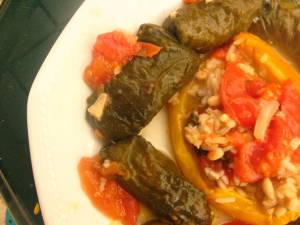
Velvety-soft mallow leaves are a springtime treat in the Middle East, usually stuffed as grape leaves are and presented in neat rolled-up little packages. Tramping around an abandoned lot in search of wild edibles, I recently saw a little old lady with the head kerchief and hennaed braid typical of old-fashioned Moroccan grandmothers.
Maybe Middle Eastern grandmas have always known how good for you mallows are, being as rich in Vitamin C as oranges. They’re also full of a soothing demulcent property that’s good for the skin and the digestion. And they’re high in iron as well. I like to chop big leaves into ribbons and cook them the way I do spinach or Swiss chard. Or saute a good handful with onion and a little red bell pepper and stuff an omelet with them. Mallows are easy to handle. I dry them for future cooking also.
Here is a plateful of mallows I recently stuffed, along with an extra half bell pepper.
Small, tender mallow leaves fit into almost any salad. Their taste is almost neutral, just sort of green. Children have always loved picking the mature seed pods, called “cheeses” in English, for the crunch and for the fun of eating something wild. I throw a handful into my salads too. And finally, the lovely flowers make a soothing tea for coughs, and a good facial rinse for any skin type. Make according to the instructions for nettles tea, above.
So go forth and walk the land. Your wild veggies are waiting for you.
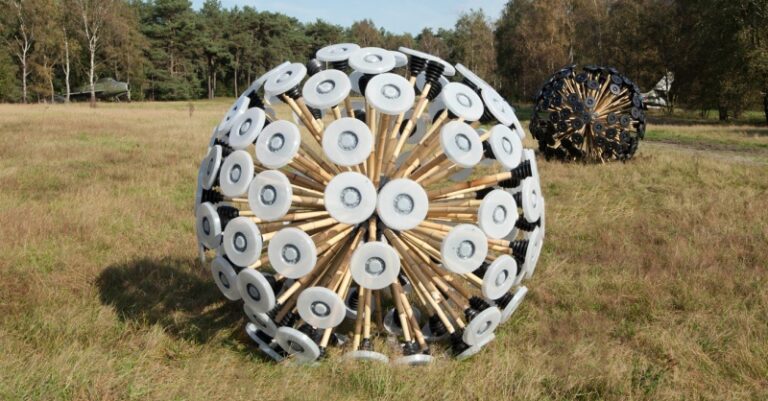
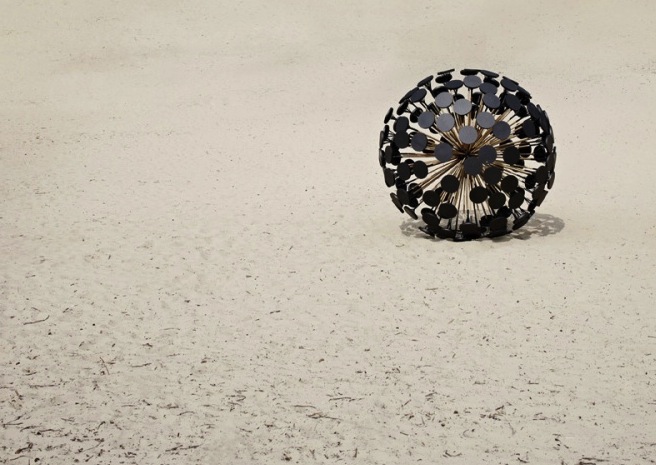
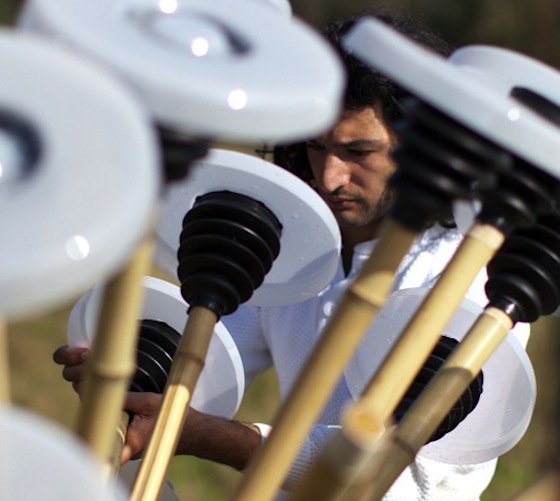
Afghani minesweeper, made from bamboo, powered by the wind
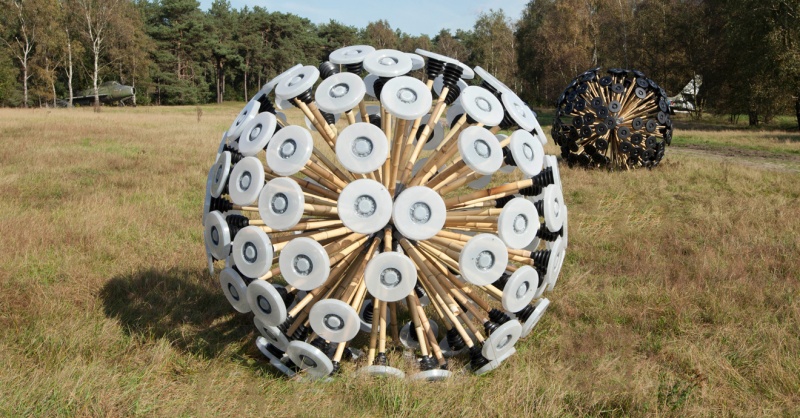
There are more land mines in Afghanistan than there are people, so Massoud Hassani turned a childhood toy into an extraordinary wind-powered bamboo mine sweeper that destroys and tracks them. Made out of bamboo and biodegradable plastic, the rolling Mine Katon’s arms self-destruct when they hit and simultaneously destroy a land mine. Equipped with a GPS chip, this incredible design also maps out which land mines in the country have been wiped out so that local Afghanis know which areas of the country are safe.
Afghani designer Massoud Hassani transformed a childhood toy into a giant bamboo minesweeper powered by the wind.
Toys into tools that save lives
Massoud Hassani recalls on his personal blog childhood memories of making wind-powered toys and chasing after them in areas of Afghanistan that were pocked with destructive land mines.
Many of his friends were killed or seriously injured when they accidentally encountered one of humanity’s most destructive inventions.
Twenty years later, as a student of Design Academy Eindhoven in the Netherlands, Hassani scaled up his childhood toy by twenty times and equipped it with tools that literally save lives.
Afghani designer Massoud Hassani transformed a childhood toy into a giant bamboo minesweeper powered by the wind.
Sniffing out land mines
Although Afghanistan only has 10 million land mines on record, Hassani says there are many more – up to 30 million in a country with a total population of 26 million.
It is uncertain whether government agencies in the country have commissioned the ingenious minesweeper, but Hassani will be available to talk about this and other designs at the upcoming Design Indaba in Cape Town that starts on February 29, 2012.
According to Design Indaba, the talented designer from Afghanistan will also discuss his latest project, “a series of cooking products called “Silk Cooking” inspired by Afghan traditions.”
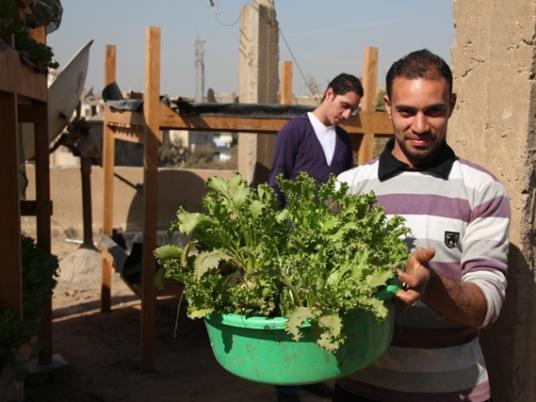
Urban farming in Egypt has soared. Read about Schaduf – a soilless solution taking root in Maadi.
Two Egyptian brothers have received enough donations to set up three rooftop farms in Maadi – a once wealthy suburb of Cairo. Due for full installation by April, these won’t be any old farms. Sherif and Tarek Hosny have developed closed-loop, vertical hydroponic systems that use recycled water and mineral nutrient solutions to grow cheaper, healthier produce.
Designed to become a secondary source of income for poor families living in the less-privileged areas of Maadi, where many expatriates and wealthy Egyptians seek shelter from Cairo’s bustling urban center, Schaduf’s farms have great potential to scrub the neighborhood’s polluted air and give struggling families a much-need fiscal boost.

 Once the region’s climate skeptic, Saudi Arabia is slowly shifting towards a more progressive stance ahead of the climate summit in Qatar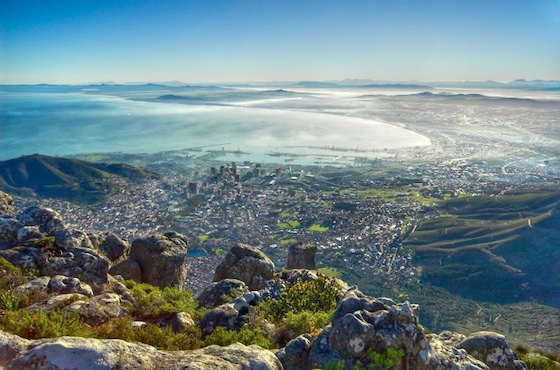










 Why go through all that trouble? Well, nettles are amazingly high in iron, calcium and vitamin K, among other nutrients. And they taste good, especially cooked with rice. Nettle’s flavor is uniquely dark, a little reminiscent of dried seaweed.