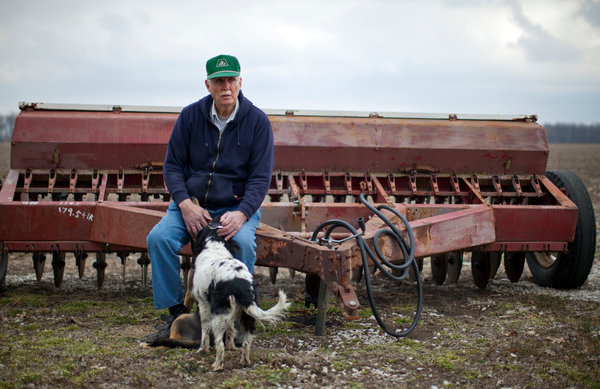
Vernon Hugh Bowman, farmer vs Monsanto, billion dollar seed and biotech company.
It sounds like something from a book about the perils of the future, a future that is strangely today reality: The seed-engineering company Monsanto genetically engineers seeds to have desirable traits that make them hearty or the plants resistant to the effects of herbicides like Roundup. But when farmers buy and use these seeds they must sign away rights to use the seeds of future generations. After all, Monsanto is investing in the biotechnology (the company reasons) and it needs to ensure future business for its investment.
Holding back the use of one’s self-made seeds sounds almost as bizarre as bottled air in the Lorax, or the bottling of water. But in the case of water, bottled O2 and seeds: these things do happen in our polluted world.
Environmentalists typically are against the practices of Monsanto, claiming that there are certain inalienable rights people and farmers have when they buy seeds. Some farmers in Egypt have resisted Monsanto’s GM maize, while a new company from Israel called Morflora claims to have a new way of washing seeds to avoid Monsanto’s ethical problems altogether. But farmers need to think about their future, and profits. They buy Monsanto seeds because in some markets it is the only way to stay relevant.
So far Monsanto has been a winner in cases against farmers it has taken to court who have gone against the company’s terms, recounts a recent story in the New York Times. Now an American farmer Vernon Hugh Bowman, from Indiana has gone against Monsanto by using soy seeds produced by his crop. The trick: he bought his own seeds back from a grain elevator which sells the seeds for animal food.
According to the Times article: “the 75-year-old farmer from southwestern Indiana will face off Tuesday against the world’s largest seed company, Monsanto, in a Supreme Court case that could have a huge impact on the future of genetically modified crops, and also affect other fields from medical research to software.”
Bowman pleads that he honored Monsanto’s agreement and didn’t use the seeds from his harvest and noted that the contract he signed didn’t make provisions for him buying the same seeds back from another party. He told the NYT that he didn’t want to pay Monsanto huge sums of money for their soy seeds because he planted his crop late in the season, after the wheat harvest, and that it was bound to fail.
He lost to a district court hearing in 2007, and had to pay Monsanto more than $80,000 for infringing on patents owned by the company.
But now Bowman who is planning to fight till the end says, “I was prepared to let them run over me, but I wasn’t getting out of the road.”
Once the beans are sold to the grain elevator, Bowman claims that Monsanto has no more rights to them. And this is what he is bringing with him to court.
He is being helped by lawyers working pro bono.
The question about patenting living organisms has long been considered immoral, but it is the only legal tool in place that can support and grow the biotechnology industry, proponents for the industry argue.
Sources say that any Supreme Court ruling on this new case could have monumental impacts on the biotechnology industry.
I have to note that the seeds in question are ones Monsanto produces to make crops tolerant to Roundup (a Monsanto product ), a strong herbicide that kills weeds but not the crop. Roundup has also been linked to birth defects and God knows what else. Were more farmers to return to permaculture methods of farming, ones that use organic-friendly and natural pesticides, and sometimes heirloom seeds, all this business of Monsanto would be irrelevant.
Yet when I say this people I know who argue for genetic engineering they say GMOs are the only choice for feeding a hungry world. What do you say?
Image of Vernon Hugh Bowman via the NYT
Update 2013: United States Supreme Court patent decision in which the Court unanimously affirmed the decision of the Federal Circuit that the patent exhaustion doctrine does not permit a farmer to plant and grow saved, patented seeds without the patent owner’s permission. Vernon lost.


 Farmers and consumers face a new kind of chemical terror: pesticides. Since it is very difficult to detect the presence of toxic chemicals in various crops, an Israeli organization has deployed a failsafe method to root out the threat using the same kind of equipment used by America’s Central Intelligence Agency (CIA) and Federal Bureau of Investigation (FBI) to protect citizens against chemical warfare.