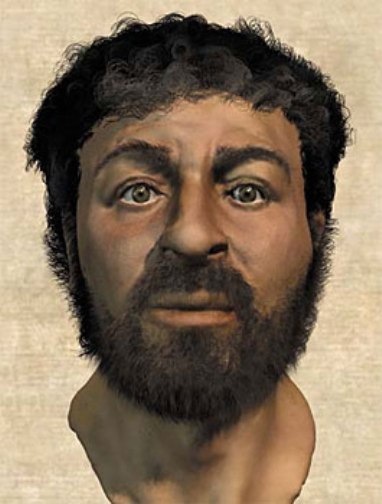
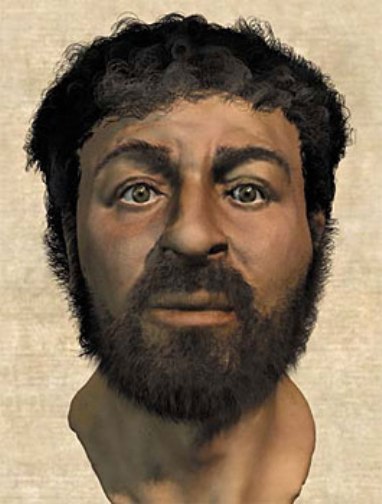
If Jesus had a Facebook account, this could be his profile picture. So says Richard Neave, a medical artist famed for reconstructing legendary faces from antiquity. (See the reconstructed face of Ramses II here). With a team of Israeli archeologists and British scientists, he recreated what they claim is the most accurate image of Jesus.
For Christ’s sake, is this for real? Short, black, kinky hair wrapped around thick features? A swarthy man looking awfully well fed?
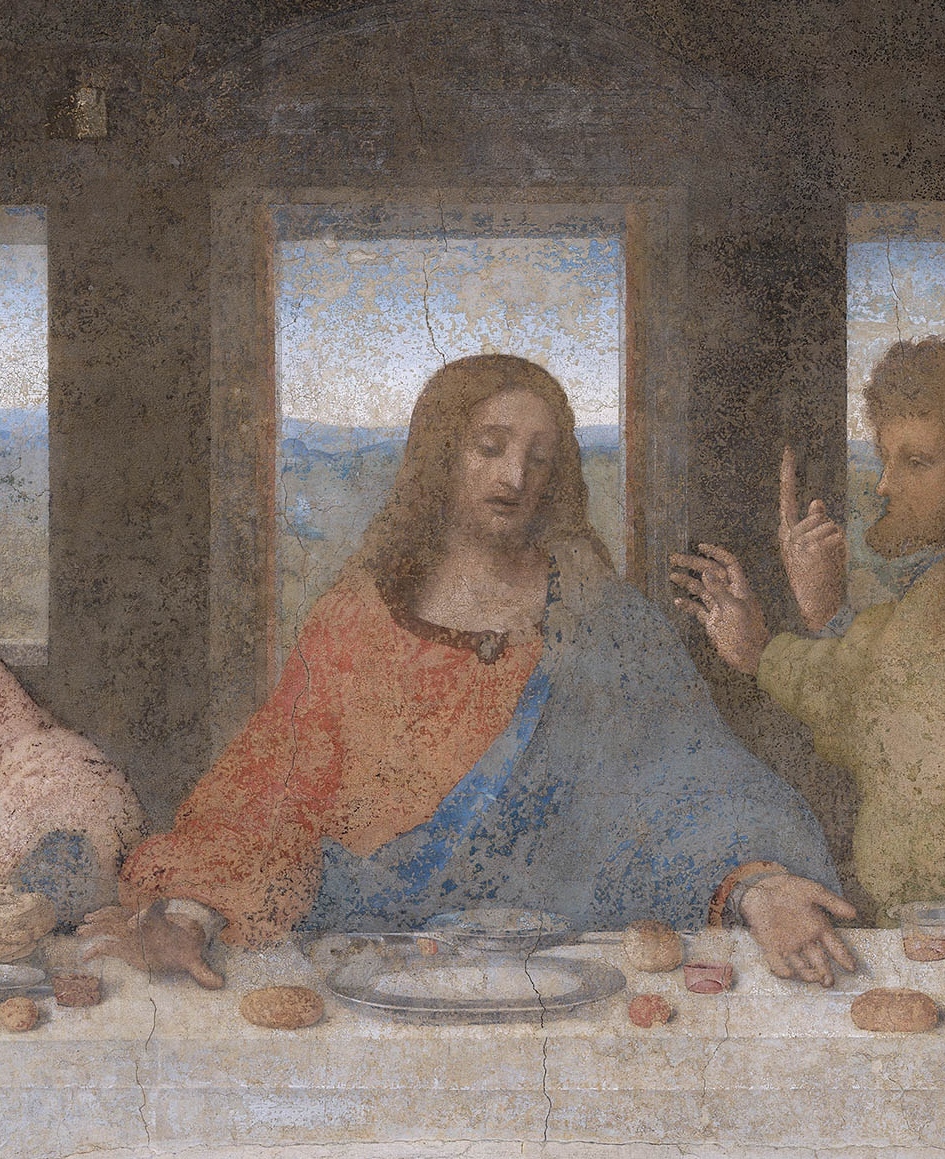
Western culture paints a far different picture of a tall, slim man with flowing locks threaded with golden highlights. He has light-colored eyes set in a pale face that sprouts wispy facial hair. It’s a look rocked by 1970’s musicians, think Neil Young, George Harrison, even Frank Zappa.
And he’s scrawny like Russell Brand, not brawny like Russell Crowe.
That’s not only an industrial-age Western view – the mosaic portrait below is from Istanbul’s Hagia Sophia.
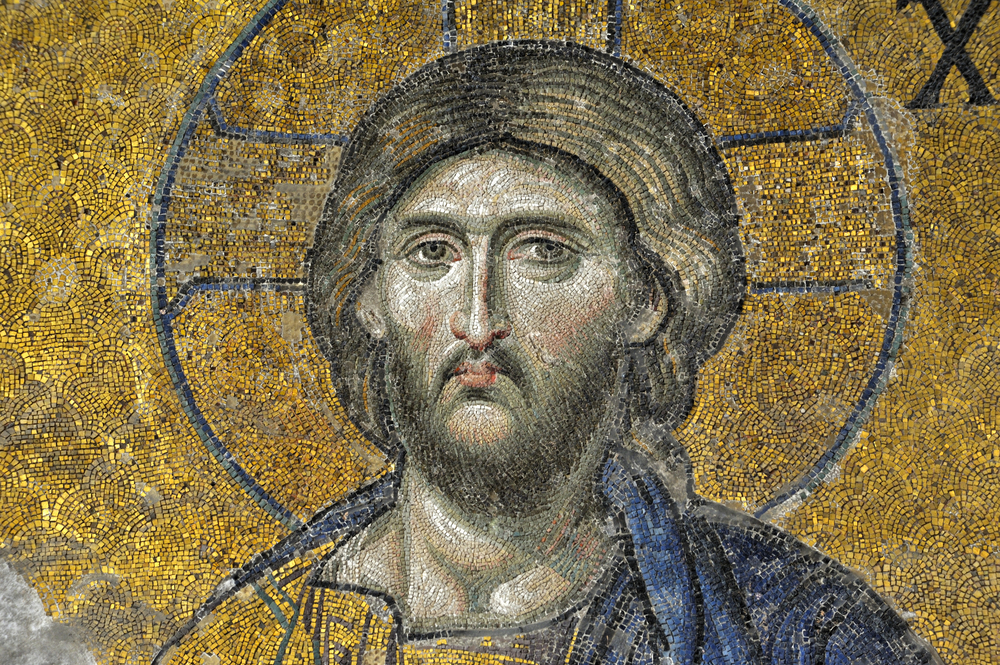
“The fact that he probably looked a great deal more like a darker-skinned Semite than westerners are used to seeing him pictured is a reminder of his universality,” Charles D. Hackett, director of Episcopal studies at the Candler School of Theology in Atlanta, told Popular Mechanics, “And [it is] a reminder of our tendency to sinfully appropriate him in the service of our cultural values.”
 The New Testament doesn’t describe Christ’s appearance, no contemporary drawings of him have ever been found. But there are clues.
Recall the Gospel of Matthew: when Jesus was arrested in the garden of Gethsemane, Judas Iscariot had to point him out because the soldiers couldn’t tell him from his disciples. It’s logical that he would have looked like the Galilean Semites of his era, and not a white-boy rock and roller.
Neave and his research team started with Semite skulls from near Jerusalem, where Jesus lived and preached. Tapping into forensic anthropology – the same scientific toolkit used to solve crimes – Neave used special software to determine the thickness of soft tissue at key areas of the face, making it possible to re-create the muscles and skin overlying a representative Semite skull.
 Results, verified against anthropological data, were used to digitally reconstruct the face. Next, researchers cast a skull, applying layers of clay matching computer-specified facial tissue, topped with simulated skin. The nose, lips and eyelids were modeled in accordance with underlying muscles.
Neave’s team turned to drawings found at archeological sites dated to the first century to determine Christ’s hair and coloration. Clues indicated that Jesus had dark eyes and hair, and that, in line with Jewish tradition, he was bearded.

Analyzing skeletal remains, archeologists established that Christ’s contemporaries averaged a smidge taller than 5 feet and weighed about 110 pounds. They theorize that after years of outdoor work, this most famous carpenter would have been muscular with a weather-beaten face.
Neave emphasizes that his re-creation is simply that of an adult man who lived in the same place and at the same time as Jesus. Alison Galloway, professor of anthropology at the University of California in Santa Cruz, told Popular Mechanics, “This is probably a lot closer to the truth than the work of many great masters.”
Images of Christ in order of appearance from Popular Mechanics; Christ from Hagia Sophia mosaic; Wikipedia; Catholic Tradition; and Wikimedia Commons






![Softwheel uses inner suspension arms to re-invent the wheel for bikes and chairs [video]](https://www.greenprophet.com/wp-content/uploads/softwheel-suspension-bike.png "Softwheel uses inner suspension arms to re-invent the wheel for bikes and chairs [video]")








![The mailman is a drone in this Middle East country [video]](https://www.greenprophet.com/wp-content/uploads/drone-mail-united-arab-emirates-660x4361.png "The mailman is a drone in this Middle East country [video]")