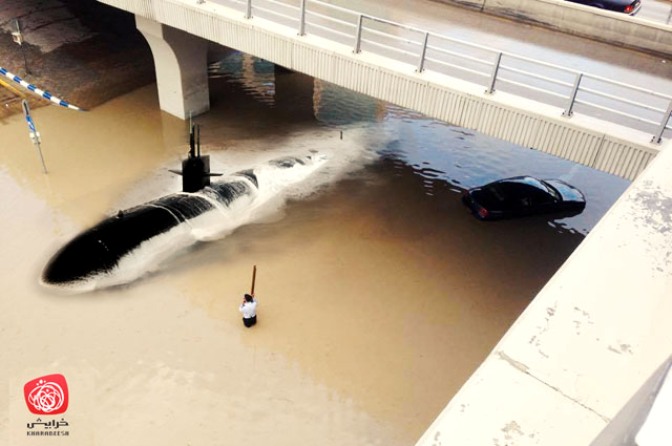
 Social media websites are awash with pictures of flooded underpasses and traffic snarls caused by exceptionally heavy rainfall in West Amman, Jordan. The skies ripped open late yesterday morning, quickly dropping several inches of rain across the capital city, overwhelming storm sewers and turning roads into raging rivers. I was there – it was a remarkable reminder of nature’s power, especially in this 4th-most-water-starved nation on earth.
Jordan municipalities flooded with criticism following record rain
Jerusalem’s on fire, but these “enemies” put faith in ecology
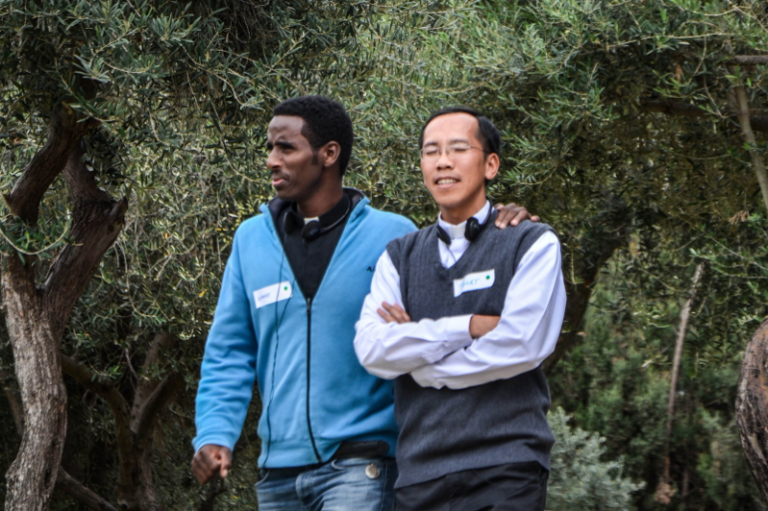
Jerusalem’s been boiling over with violent and deadly conflicts over the last half a year. But faith leaders intent on ecological ideals as a peace bridge have met again at the the Faith and Ecology conference in Jerusalem last week.
Green Prophet has attended meetings in the past (see our coverage from 2011) and a photo of our founder Karin Kloosterman, below, at the event in 2012.
And we are happy to hear that the annual event is still building trust and those much-needed green bridges between Jews, Muslims and Christians in the Holy City.

Yonathan Neril, a Jewish rabbi, started the idea of using green faith as a lever for peace about five years ago. Since, his organization the Interfaith Center for Sustainable Development aspires to bring the “enemies” of Jerusalem together to create peaceful initiatives.
He also creates green teaching tools to help faith leaders inspire their devoted.
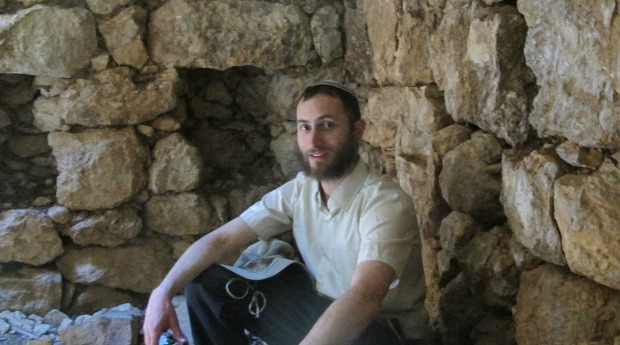
Neril is the leading drive behind the regular conference and the initiative of bringing faith and green together in Jerusalem.
In 2007, this is the very same reason why Kloosterman founded Green Prophet.
Specifically in the Holy Land, members of the three Abrahamic traditions all share the importance of being stewards of creation.
Because Jerusalem is a gate to heaven
The recent conference happened last week, where over 100 clergy, seminary students, and others and provided tools and inspiration to expand faith-based environmental teaching and action.
Rabbi Michael Melchior, former Member of Knesset (israel’s parliament) and co-founder of the Knesset environmental caucus, said that “the holy city of Jerusalem sometimes goes astray to points of violence, but really we can make it a gate to Heaven.

“The world really belongs to God, and all of us are temporary residents in this world, which we have been given to take care of.”
Speakers included Jerusalem-area priests, rabbis, imams, and a scientist, such as Bishop William Shomali, the Latin Patriarchate of Jerusalem, Rabbi Yuval Cherlow head of Yeshivat Hesder Petach Tikva and Dr. Nurit Hashimony Yaffe from the Academic College of Tel Aviv-Yafo.
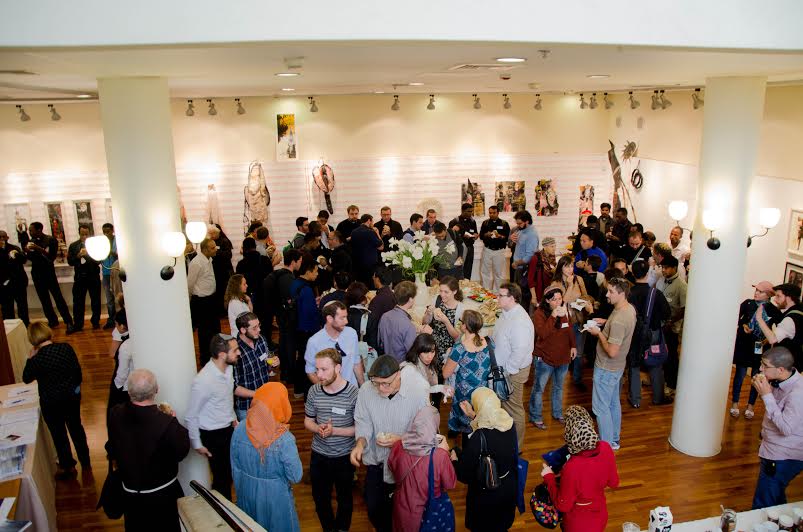
The group participated in interactive workshops, an outdoor session, and a video session featuring pre-recorded addresses from the Dalai Lama, Archbishop Desmond Tutu, and Rabbi Lord Jonathan Sacks.
Part of the event was dedicated to generating action plans within each faith community, which resulted in commitments for continued collaboration on the environment.
This event was part of the United Planet Faith & Science Initiative, which brings faith and science leaders together to catalyze shifts in society to address climate change. It is part of a series of events in late 2014 taking place on three continents in New York, Jerusalem, and Lima.
The events coincide with UN climate talks and aim to generate tangible environmental action within faith-based communities.
The Conference was held at the Mishkenot Sha’ananim Conference Center in Jerusalem, and was co-organized by the Konrad Adenauer Foundation, the Interfaith Center for Sustainable Development, and the Salesian Pontifical University.
More on greening pilgrimages:
Cyclone Nilofar is Oman’s new meteorological nemesis
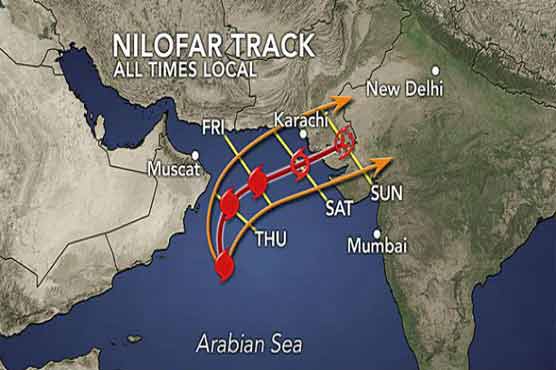
Although the tropical cyclone Nilofar has been veering away from Oman’s coast downwind towards Pakistan and India, it had inundated the infrastructure of several areas in the country, including Muzra, Dabab, Al Khabourah, Al Seeb, Al Khoud, Rusayl, Jalan, Sur and Al Ashkara.
Nilofar is a Persian baby name and it means lotus or water lilly.
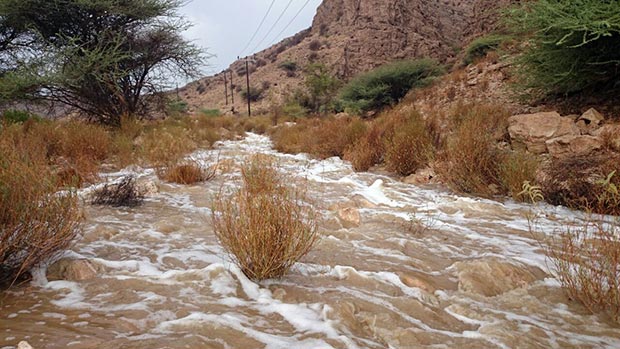
Flooded valleys have claimed the lives of three people already, including a child, while another person was reported missing. The silver lining is that five people were rescued after their vehicle was swept away by flash flooding in Wadi Hoqain, wilayat of Al Rustaq. The numbers of those injured or stranded without power, and the dollar value to the damages are yet to be determined.
The cyclone had crept some 450 kilometers closer to Masirah Island, before deviating towards Pakistan’s Karachi and India’s Gujarat. India’s Meteorological Department has predicted the storm will bring winds of up to 130 km/h (80 mph).
In response, The Royal Oman Police issued multilingual pictorial advisories to the public to remain safe and to avoid crossing overflowing valleys.
However, and given the country’s history of exposure to cyclones, the Omani authorities have yet to enhance its emergency response protocols, and rethink its infrastructure preparedness for such events, specially in rural areas.
A brief recent history of Oman’s meteorological disasters include:
-
Cyclone Keila in 2011: 14 fatalities were reported, most of them caused by drowning due to floods
-
Cyclone Phet in 2010: 24 fatalities were reported, most of them caused by drowning due to floods, and a reported incident of electrocution in surging water
-
Cyclone Gonu in 2006: 50 fatalities were reported
Let alone the hundreds went missing, hundreds of thousands affected, and billions of dollars lost in damages to property, and the halting of oil and gas coastal and off-shore operations.
Images via The Frontier Post, Rthmc
Carved ghost turnip head way scarier for Halloween
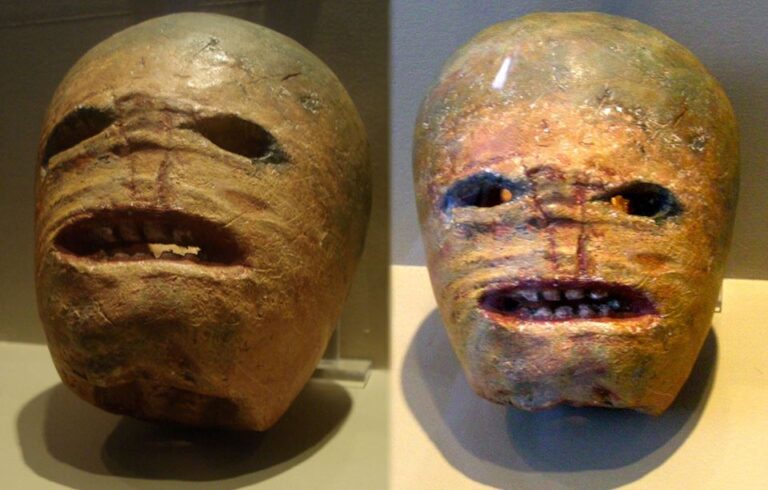
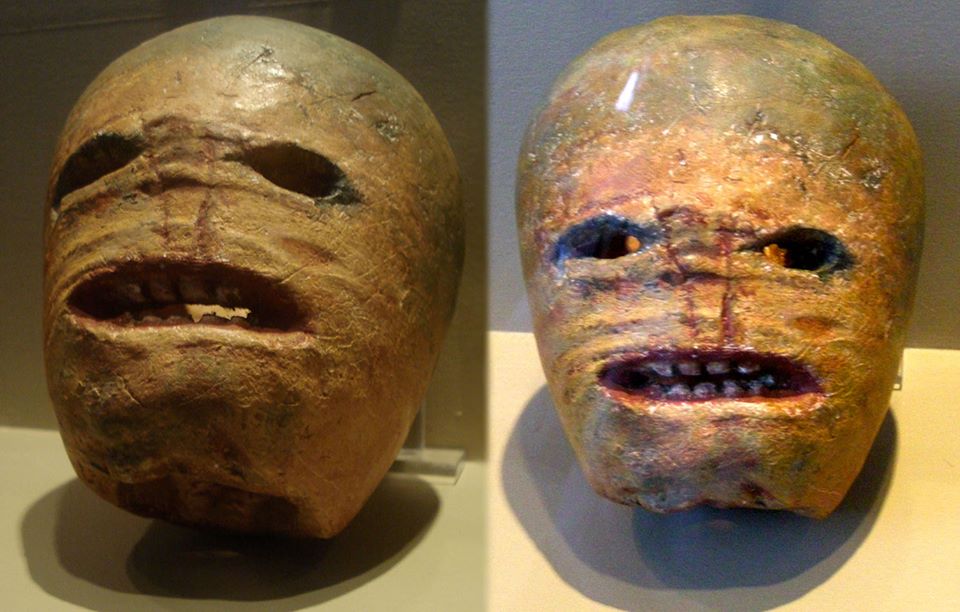 There are calls for Halloween to be banned in the Middle East and other parts of the Muslim and Christian world where this ancient solstice tradition is misunderstood. Halloween of today is a mutt of a holiday. It combines ingredients from stone-age Celts Irish and Scottish Catholics, native American harvest festivals and marketing from candy and decoration companies.
Samhuinn is Scotch gaelic for the month of November, the traditional end of Celtic summer. This time marked the boundary between light and dark, life and death, good and evil. It was believed that the veil between this world and the next was thinnest at this time of year.
Fires were lit to guide spirits of the dead through the transition and chase away the bad spirits. This pagan holiday was so intertwined with Celtic traditions that the Roman Catholics couldn’t crush it, so they adapted it and adopted it as “All Soul’s Day” or “All Saint’s (Hallows) Day and the night before, “All Hallow’s Eve” we now know as Halloween.
Carved turnips way more frightening than pumpkins
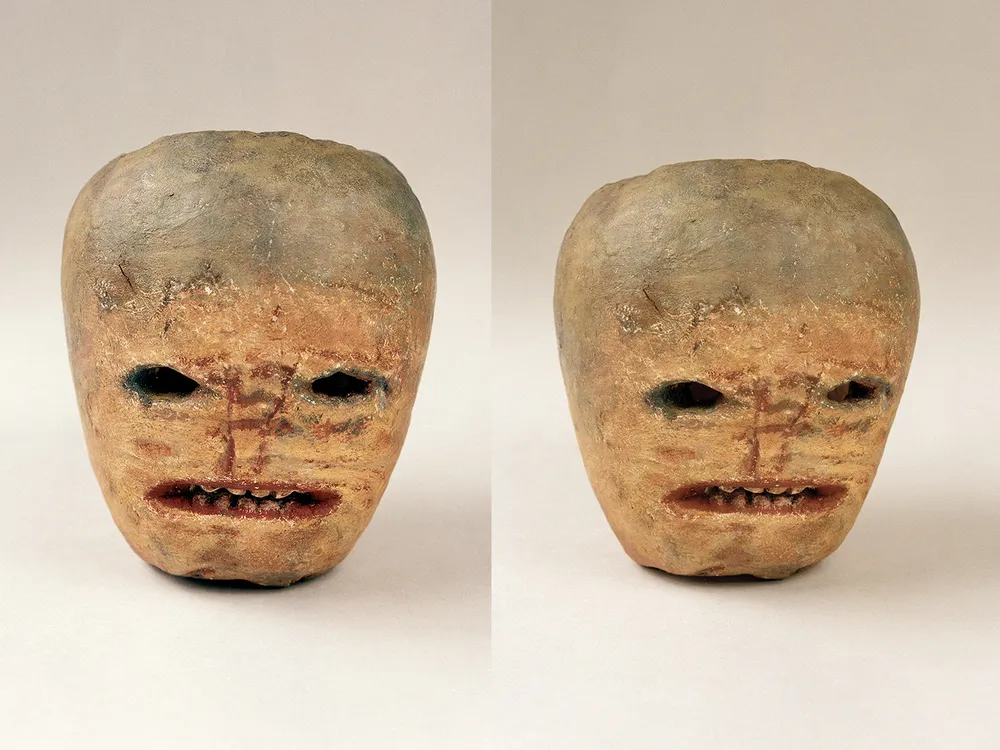
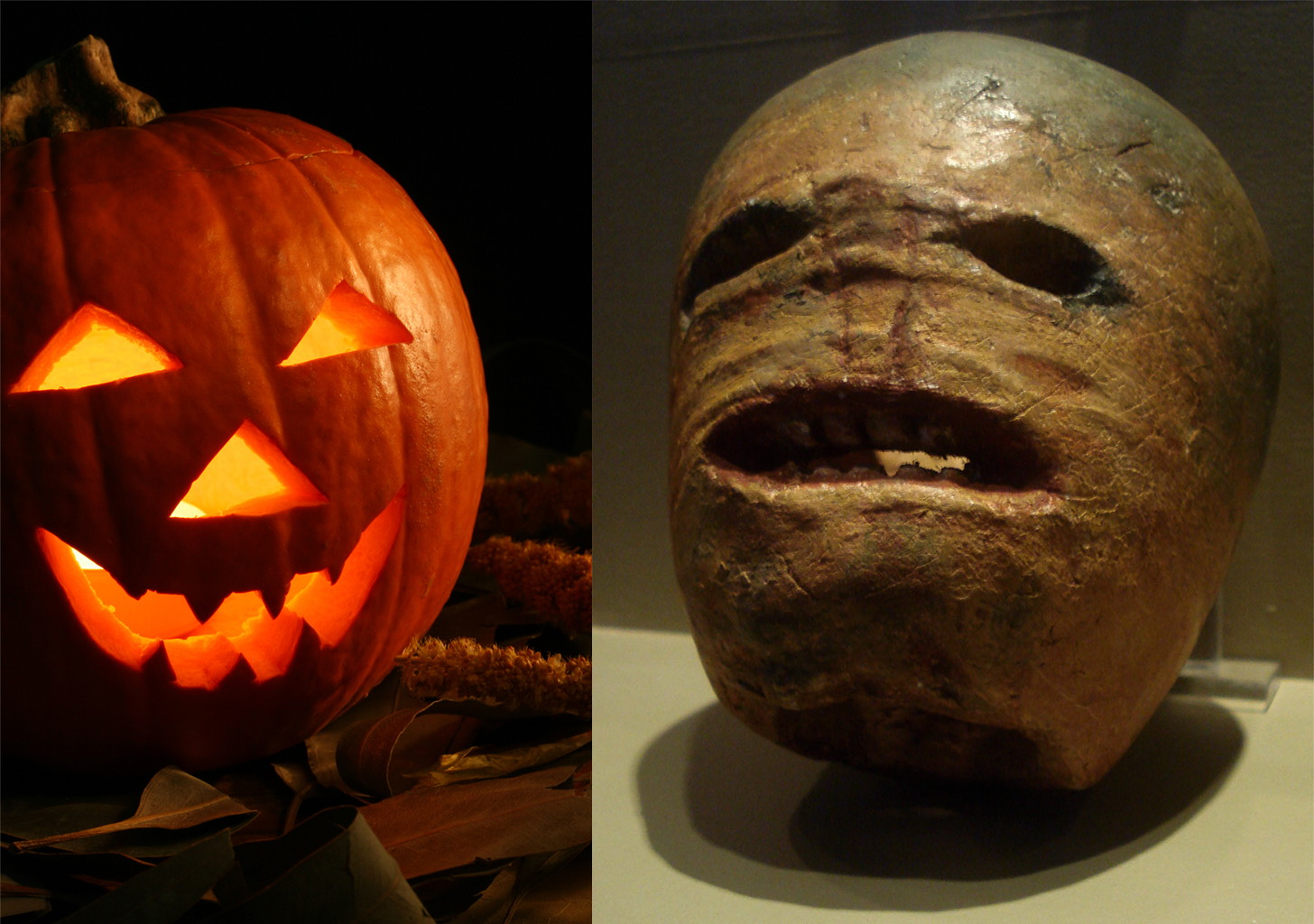
Christian fires burned on hilltops where pagan fires had burned for 1000 years. The Irish made lanterns out of turnips (see photo above) to guide ‘Stingy Jack’ and other wandering souls caught in the netherworld while warding away the evil spirits with frightening masks and Jack O’ lanterns made from carved turnips.
But when Scottish and Irish people emigrated to America, they found that turnips weren’t as plentiful in the new world as pumpkins — a traditional native American harvest food.
Add Aztec chocolate, cheap plastic decorations, costumes and customs from around the world and you have modern Halloween.
This strangely modified holiday has only recently been re-imported to the Celtic regions where it was born. Now it is enjoyed around the world as far away as Japan and China by those who don’t read too much into a melting-pot tradition which celebrates nothing more than a chance to pretend to be someone else for an evening.
And if you are wondering about the picture above: Photo of Jack O’Lanterns, carved from turnips from the National Museum of Ireland, Museum of Country Life, Castlebar, Co Mayo
Halloween goes green with fantastic DIY costumes you can recycle (PHOTOS)
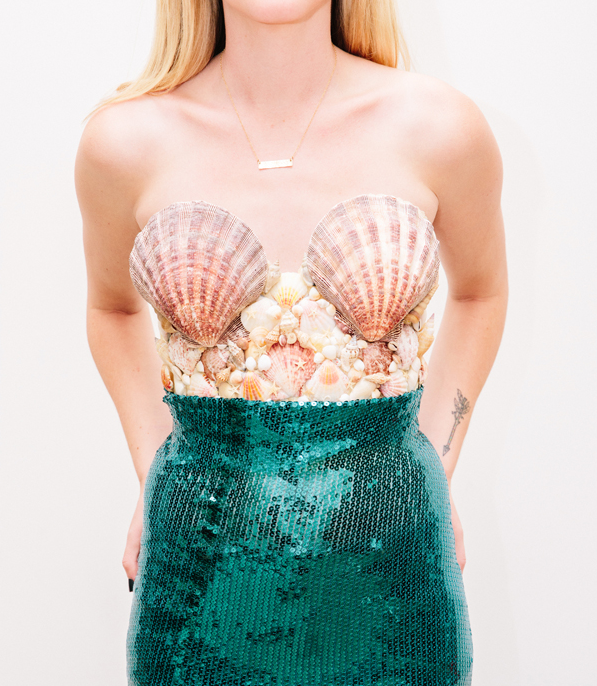
Halloween landed on a Friday this year, meaning your “I have to work tomorrow” excuse for not dressing up becomes as flimsy as a ghost. So, with a few hours to prep before tonight’s parties begin, how do you devise a spooktacular costume without buying more polyester (most likely shipped over from China) to crap up the planet?
Here in Jordan, the government just banned all Halloween festivities, fearing backlash from fundamentalist groups who view the celebrations as Satanic and homosexual.
The home ministry issued a statement explaining that all holiday activities are forbidden to prevent a repeat of the rioting that occurred during the last two Halloweens.
So while I can’t use any of the following ideas for fancy-dress-on-a-shoestring in Amman; nothing is stopping you from making the holiday “Hallow-GREEN”. Buy some tools if you don’t have any at home and get creating!
American celeb Lauren Conrad is a self-proclaimed Queen of Halloween. Park aside her shameless self-promotion, and I’ll admit I’m sort of loving her do-it-yourself mermaid costume which can be whipped up pretty quickly with a bucket of shells and a glue gun. (That’s her get-up in the image above – she shares a step-by-step process for making the costume on her blog.)
Cardboard ballgown

A similar time investment can produce a cardboard ballgown like the one above – but you’ll have to improvise as the website that offered instructions has spookily disappeared!

A simpler solution is a garbage bag dress, a la multi-disciplinary artist Robin Barcus Slonina (pictured above).
She creates site-specific, interactive “dress” sculptures in a project entitled “States of Dress”. Drive home a point about plastic pollution without saying a word (and help clean up after the party too).
Dress like acid rain!

I may steal this stunner for a future year – what a spectacular depiction of acid rain! it could be easily recreated from plastic bags and cut up clear bottles. What’s scarier than environmental degradation?
Be Mother Nature Herself?
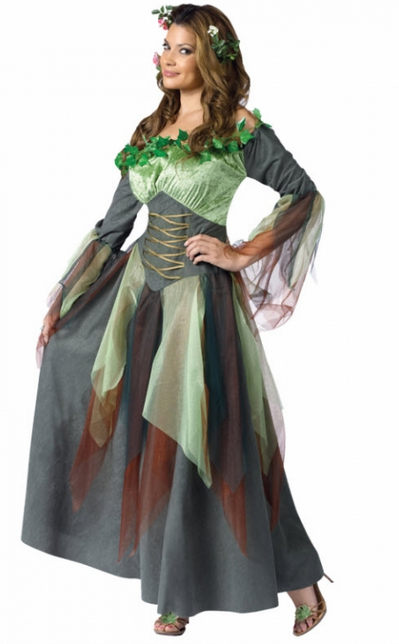
Dress up in a women’s mother nature costume
Dress up like a Renaissance painting

I stumbled across Dutch photographer Hendrik Kerstens who creates stunning portraits using everyday objects. Do your head up like his Renaissance “painting” -simple make-up and some rolls of toilet paper can morph you into a work of art.

Or use bubble wrap to transform yourself into a medieval beauty. His images might inspire you to pull the vent duct from your dryer (you should be air-drying clothes anyhow!), pop a dishtowel on your head and make yourself into a modern-day Rembrandt.

But let’s be practical. You need a costume now. Yesterday’s news can be tonight’s prize-winner if you craft a classic witch’s hat out of newsprint.

Or opt for long tresses made from the same stuff. The folks at Martha Stewart Omnimedia can get you stylin’ in paper curls in about the same time as a real hair appointment.

And we haven’t forgotten the kids. Pull a pair of plastic bottles from your recycling bin and make a jet pack for your tiniest rocketeers.
Rockets from soda bottles

And here’s a no-sew ballerina tutu that takes minutes to make with plastic shopping bags.
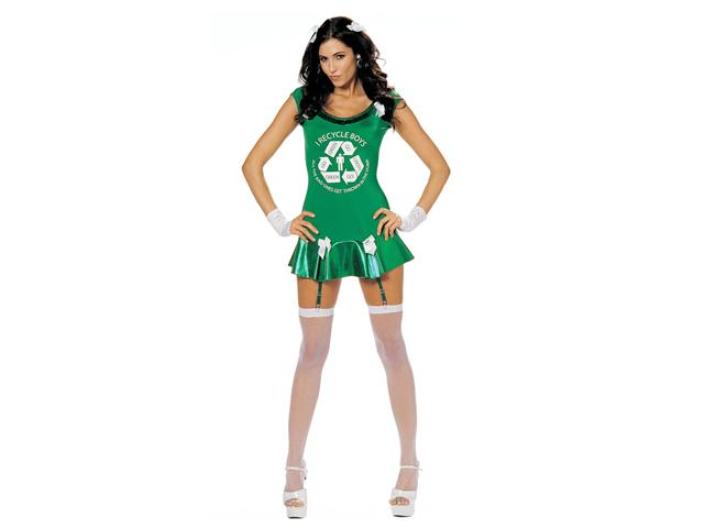
 Inspiration abounds online. Get cracking, don’t delay – or you may be stuck in the lines at the party store, left with this cringe-inducing “sexy environmentalist” costume. The image is as awful as the concept – the message on the dress reads, “I recycle boys” and “Recyclers do it twice”. Suddenly Jordan’s ban makes a certain sense.
If you do craft your own costume? Just be sure to drop the duds in the recycling bin when the party’s over.
Images and their sources are: Lauren Conrad mermaid; cardboard hoop skirt; Robin Barcus Slonina; acid rain “Goddess of Depression” costume; three Hendrick Kerstens portraits; witch hat; newsprint wigs; bottle rockets; plastic tutu; and sexy environmentalist by jezebel
6 things “green” businesses should know about barcodes

All round the globe and most importantly the business world, the use of barcodes has been emphasized in areas other than the traditional stock identification. Barcodes are more than just codes anymore. They can help us trace materials, sources of production and pollution, and even help sustainable businesses manage stock.
But the way we use barcodes is changing. Do you have a green business? Sustainable or otherwise, every business should be ready to embrace these existing changes and be ready to either innovate in the line of barcodes or also embrace any future innovations that will hail from the barcode.
Know that every business should be aware of a number of things about barcodes. These are:
1. Barcodes for product identification.
Even if you are producing honey or fair trade handmade goods: From the inception barcodes were more or less designed for this role. It is important that each and every business finds it necessary to put product identification on its products. Product identification is important in the following ways. First it puts the business in a position that it is aware of what it holds as stock. Using barcodes to identify your products will entail that no single product can the premises, unless it has been passed through the barcode scanner. This is only done when an item has been sold.
Second is that the same product identification will help in the management of inventory, this is by the essence that barcodes can be generated with date tags. This will ensure that only those products that came first are put on the counters for sale first.
According to Entrepreneur Magazine, “For buyers, it gives you access to more information that removes the shopping inertia,” Muse says.
2. Barcodes for asset management.
In many organizations, asset management is something that has been presenting a lot of challenges. Barcodes present a simple solution to this where every thing is put on track from the identity of the assets, the control of use for the asset, the responsibility liable of the assets (should something go wrong or get spoilt) and the movement of the asset. Using barcodes for your assets will imply that a business can easily identify its asset, as the barcode tags act like names in its asset inventory system.
Therefore the business is practically aware of how many assets it has and can to a spot check of the asset any time with ease. According to an article in Entrepreneur Magazine, controlling the use of the asset is also made easy with the barcode; a business can tag this on basis of time, such as it is made clear that the authority to use a business asset is not granted after business operating hours.
It is important to note that the act of identifying products using barcodes can come in handy in case the business asset is lost or stolen, or products are not used with counterfeit goods or slave labor.
The recovery of the assets is simplified and more so once the asset has been recovered, identifying and claiming the asset, as belonging to the business is made easier. With the use of barcodes that are unique to the business of which this can be proved easily.
3. Barcodes for order management.
In most emerging businesses and already existing ones, the issues of stock quantity management have been causing a lot of problems. Not managing stock correctly can result in a lot of supply chain waste. The main issue at hand being that management will try not to hold too much in stock versus the fear of running out of stock. Services like the Shopify barcodes can be integrated to the inventory system to clearly tell the management from time to time when they have reached their reorder levels and when they need not order a particular item.
4. Barcodes for service management.
There are businesses that put a lot of emphasis on the value of service being rendered to them mostly by their own staff. Measuring service is something that cannot be done easily as it is subject to personal liking and individual character. The most probable way to put a measure on this is if we track the quantities of the materials they use. Businesses can use barcodes for this and actually put value to the cost of materials an individual is using to finally come up with a cost of service.
5. Barcodes for marketing.
Barcodes, especially QR codes, can be used as a marketing campaign. From billboards and advertising windows it is no lie that QR codes are gaining popularity in advertisements all around the world. According to Entrepreneur Magazine, Mike Podlesny of Burlington, N.J., used QR codes on bumper stickers in order to promote his gardening business, Mike the Gardener Enterprises Generating barcodes.
Businesses should also explore the option of generating their own barcodes. There are websites that offer this immediately rather than fully opting for the purchase of the same, which is also highly advised.
6. Guiding consumers and supply chain customers on the how to scan barcodes.
If a business chooses to use barcoding advertisement as part of their marketing campaigns, it is important to ensure that their consumers or customers in the supply chain are all around trained or guided on how to scan these codes.
Secret gardens planted by Syrian refugees in Jordan
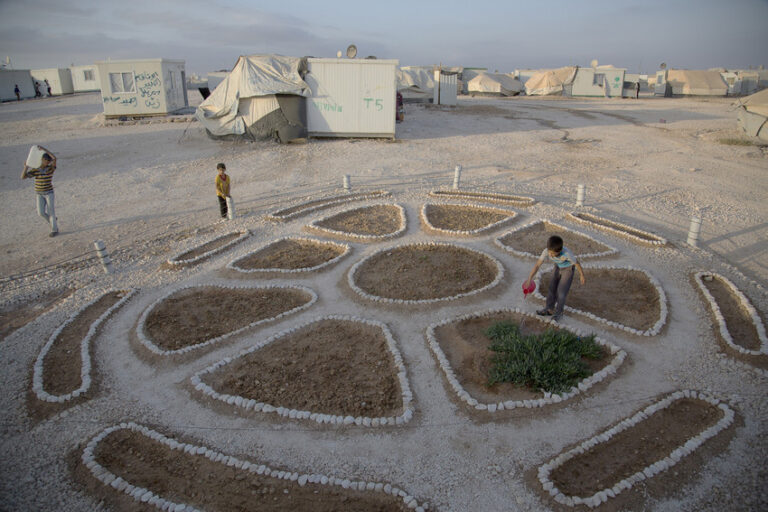
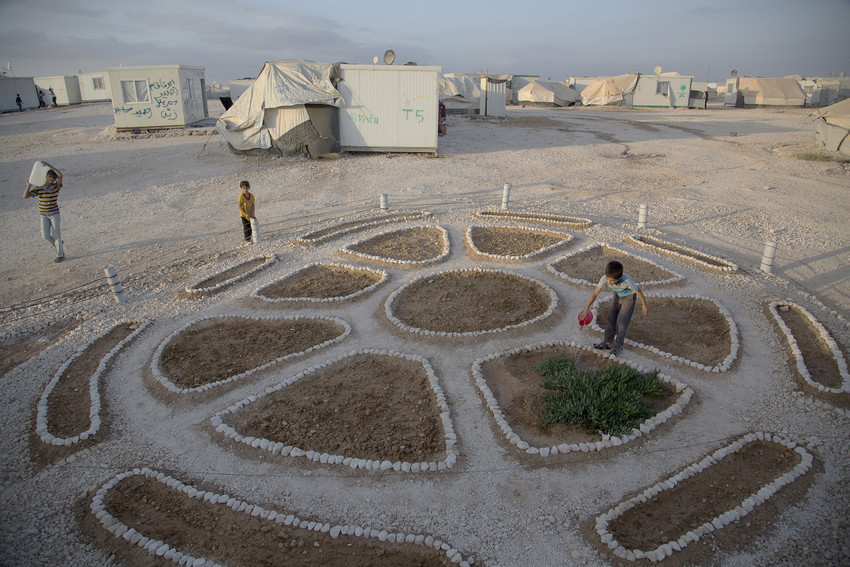
Mostly we hear stories of pain and tragedy from Syrian refugee camps. But the Za’atari Syrian refugee camp in Jordan, a place where Green Prophet’s Laurie Balbo is knitting together and flying hope, there are new sprigs of hope.
The non-profit organization Save the Children is teaching some of the camp’s 800,000 refugees how to garden. The group is giving the Syrian refugees who have fled their homes during the civil war in Syria to Jordan, lessons on landscaping and gardening.
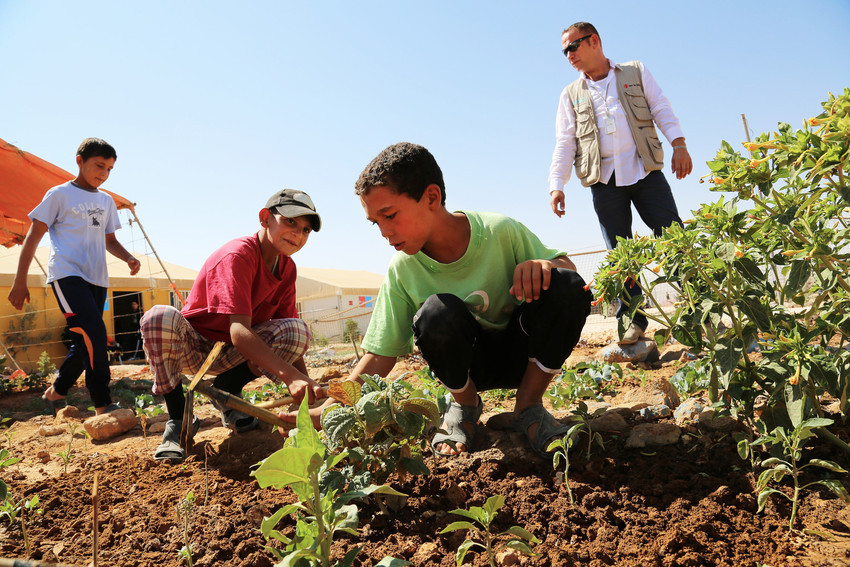
“Gardening allowed them to make something with their hands, and gave them a sense of accomplishment. We have seen an incredible change in them,” said Mohammad Abu Farah, the gardening teacher from Save the Children.
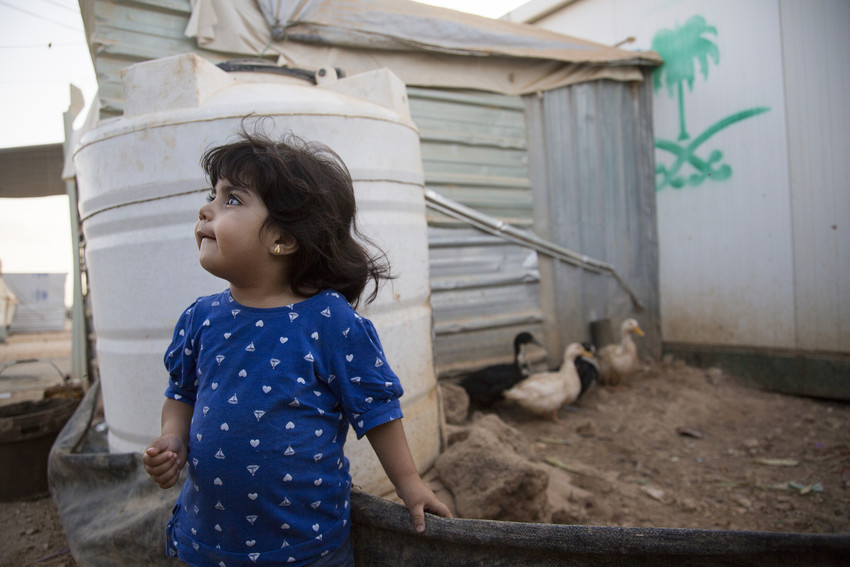
Scroll down to see all the inspiring photos taken from Save the Children. Giving people the tools to be self-sufficient is not only good for political refugees. One day in the not so distant future climate refugees may be also facing the same questions on how to be self-sufficient. Urban farming, hydroponics, aquaponics, and permaculture are great things every child needs to learn at school and apply on the home front, whether one is struggling for survival or is privileged to be able to buy food from the grocery store.
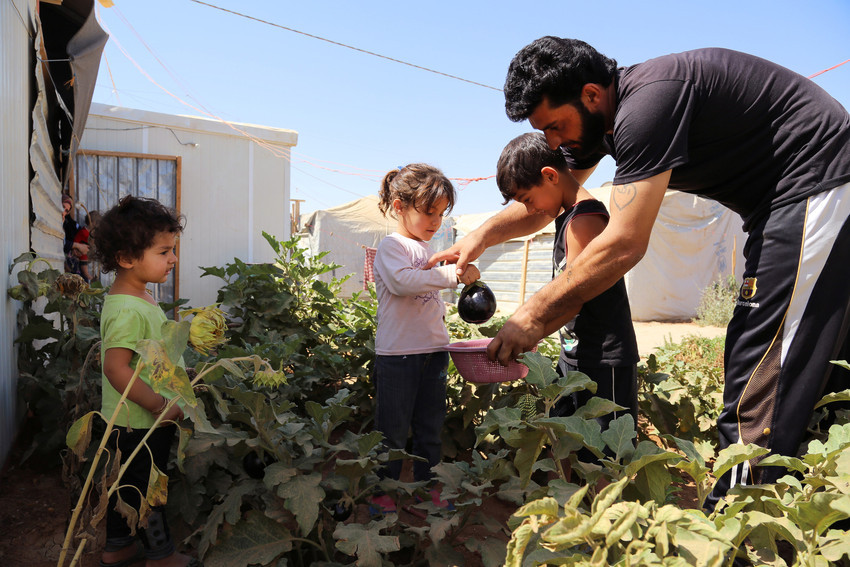
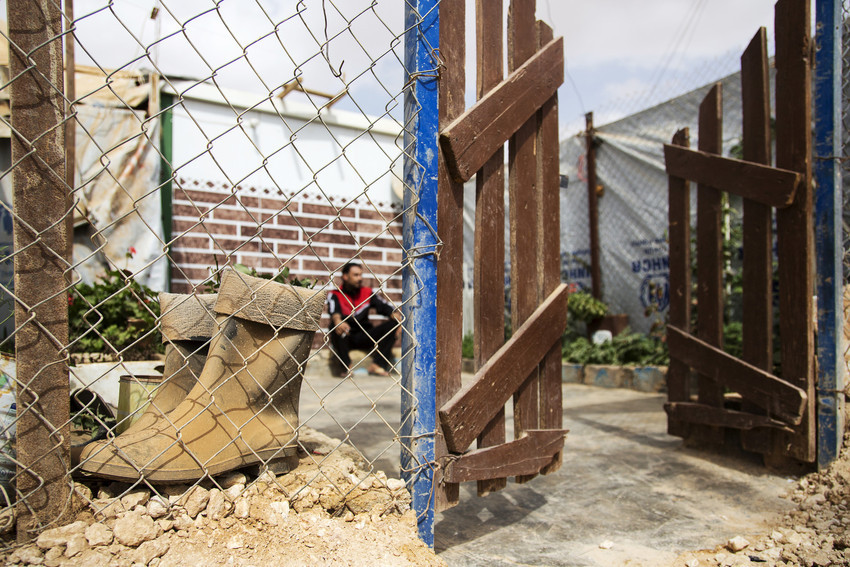
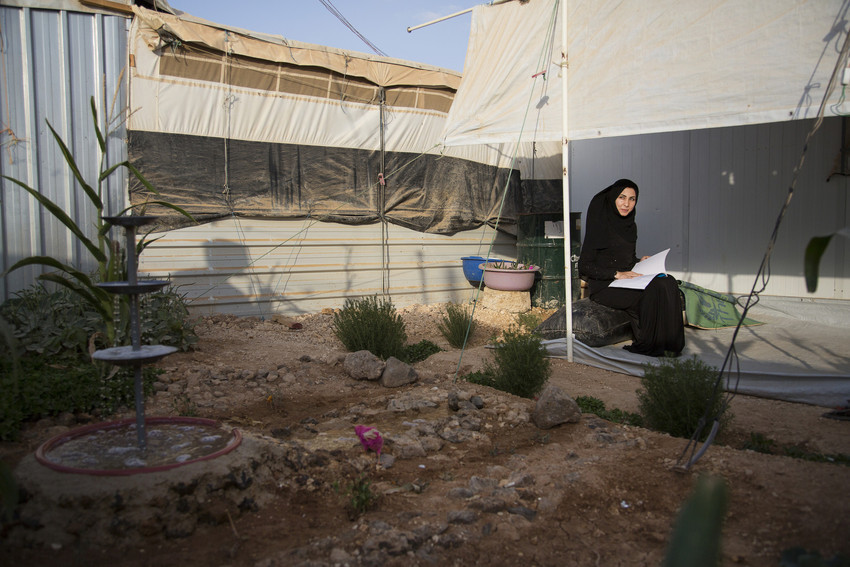
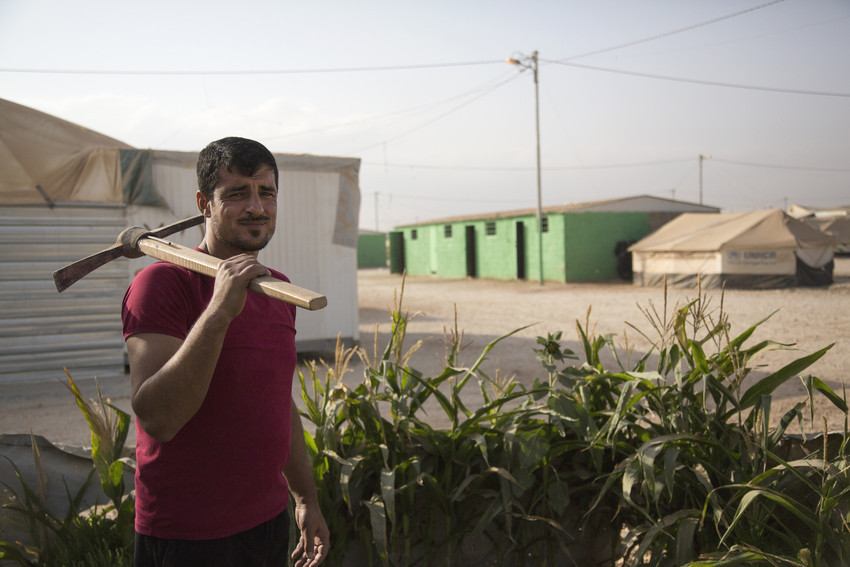
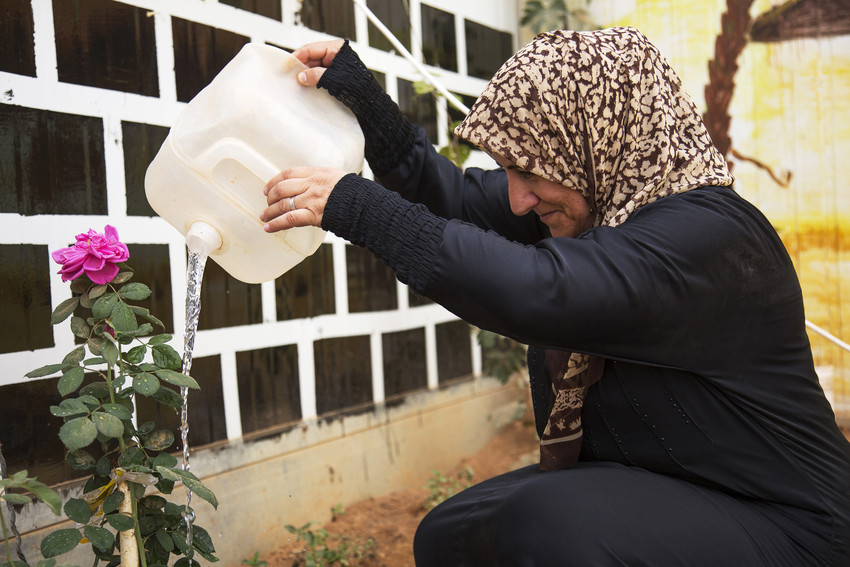
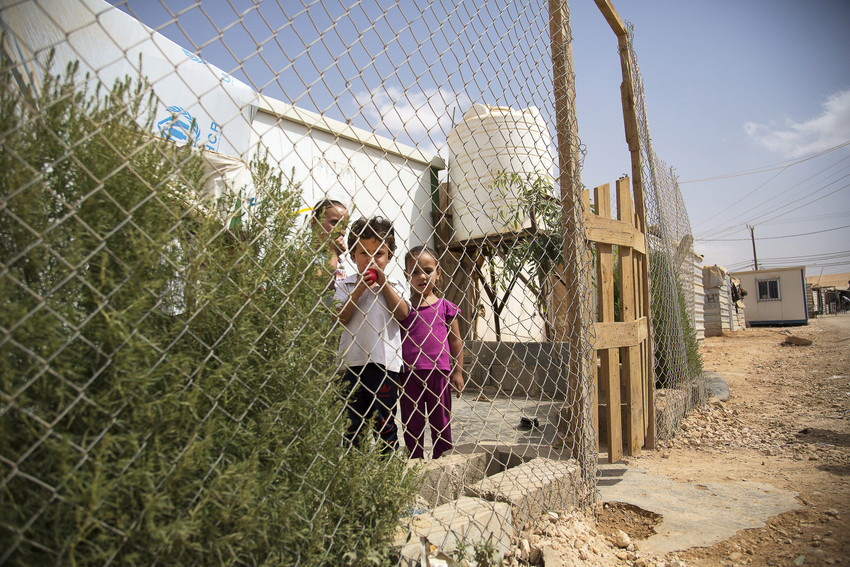

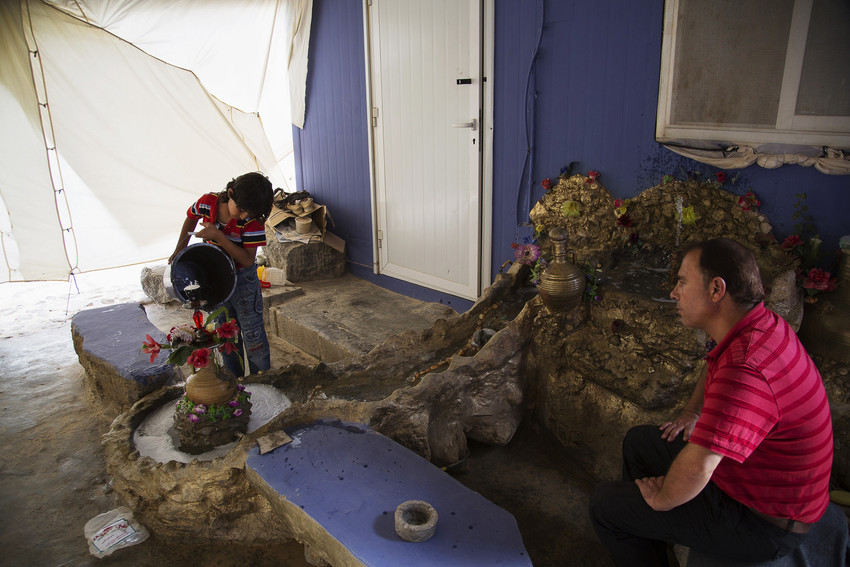
One question though for Save the Children: there are winter rains to sustain the gardens in Jordan in the upcoming months. What will happen to the water-parched refugees come spring and summer when water from Jordan is limited? Will there be plans for irrigation, greywater reuse?
All images via Save the Children
Nanoflow’s Quant is a $1 million car that runs on salt


Nanoflowcell technology’s Quant e-Sportlimousine is fast. Its 920 horsepower engine can accelerate this sleekly luxurious car from 0 to 100mph in 2.8 seconds. Its maximum speed is 217.5 mph. Nanoflowcell, maker of a new kind of battery, claims this electric car has a range of 373 miles with a full tank. And when it does run low on fuel, you’ll need to refuel it– with saltwater.
The Quant saltwater powered car made its debut at the motor show in Geneva Switzerland. Wait a minute, a saltwater powered car?
Shouldn’t we take claims of cars powered by water, salt, cold fusion or potatoes with– a grain of salt? Isn’t this too good to be true? Will the region surrounding the Dead Sea soon be the richest in the world?

With a price that may exceed one million dollars, the Quant won’t directly compete with Tesla. But the Quant is real and has already been approved for use on some public roads in Europe.
There is one catch. Like the batteries in electrics car and the gasoline in internal combustion engines, the salt electrolyte is only a convenient way to store energy in the Quant e-sportlimousine. Flow batteries replace conventional electrodes with ionized fluids.
Quant could run on desalination brine
In the case of this car, that fluid is salt water. Certain parts of the world face a surplus of salt water and the waste from the Mideast’s desalination plants will be more concentrated brine.




Conventional electric cars can use wind, solar, nuclear or hydroelectric power from utility grids. Its two achilles heels are energy storage density and re-fueling time.
Ordinary gasoline has more than five times the energy storage density of the best lithium air batteries. Electric car recharge times have dropped from half a day to as little as 30 minutes but this is still much slower than pumping gasoline. Electric car companies such as Israel’s Better Place tried to sidestep this problem with battery exchange stations.
Gasoline cars use solar energy but if we were to be fair, their recharge time is fas slower. The gasoline in ordinary cars was “charged” with solar energy over the course of millions of years. It’s only the fact that we found so much of it precharged that allows us to ignore that and avoid that long recharge cycle.

The world needs something that combines the best characteristics of gasoline and electric car energy storage. The flow battery in the Quant e-sportlimousine has some of these characteristics. Refueling would have the familiarity, speed and convenience of refueling a gasoline-powered car. It doesn’t solve every environmental problem in the world, but the flow battery technology behind the Quant e-limousine could become a valuable tool in the world’s transportation and energy infrastructure.
Photos from Nanoflowcell technology
الإسراف الخليجي في ظل الجوع العالمي – إلى متى؟
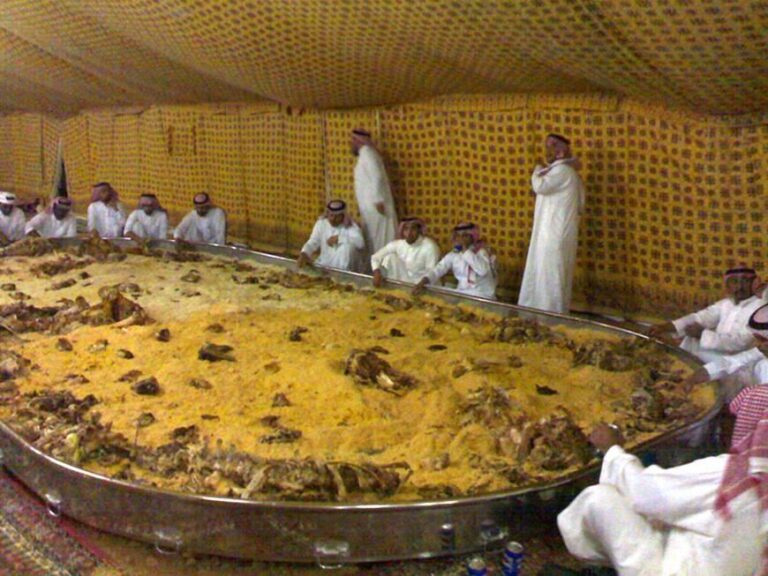
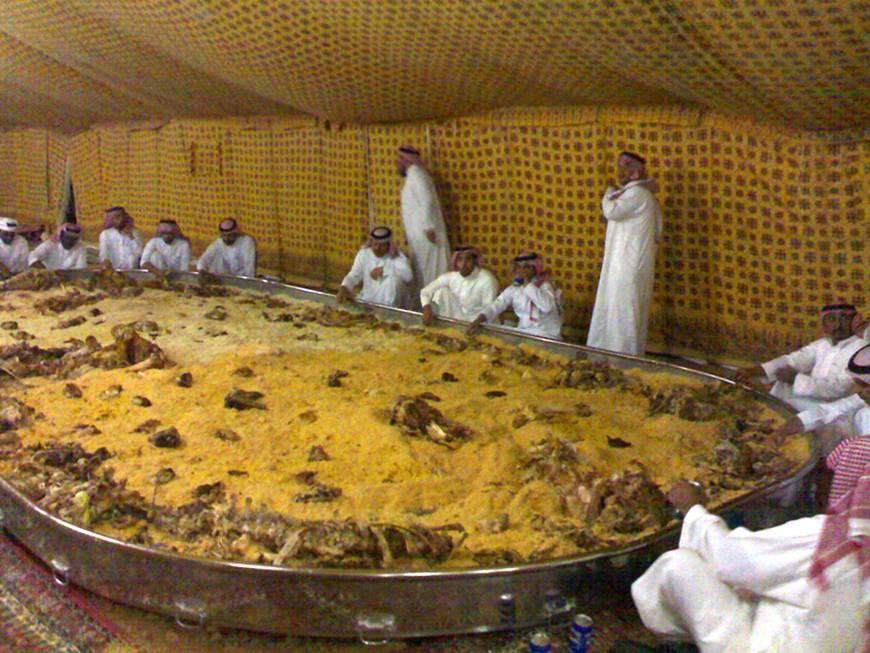
يلتهم سكان دول مجلس التعاون الخليجي ما يعادل 3,700 وحدة حرارية يوميا، مما يجعلهم الأوائل على مستوى العالم في التخمة – بينما يتضور جوعا 805 ملايين نفس، على أقل تقدير. هذا التفاوت الهائل سيؤدي إلى انتشار حالة عدم الاستقرار في المنطقة على نطاق أوسع، تحذر ديبورا ويلرـ الباحثة في شؤون سياسية الشرق الأوسط في كلية البحرية الأمريكية، و أحذ أعضاء اللجنة المختصة التي اجتمعت مؤخرا في جامعة جورج ماسون خارج واشنطن في القمة العالمية للأمن الغذائي و الصحي
يقول كينيث راينرت، و هو مستشار للبنك العالمي و منظمة التجارة العالمية و وزارة التجارة الأمريكية: سيزداد تعداد سكان هذا الكوكب ملياري نسمة بنهاية العام 2050، و مليار آخر في نهاية العام 2100، ليتضخم المجموع إلى 10 مليارات نفس، و ذلك وفقا للأمم المتحدة. و يضيف: سيكون نصيب أفريقيا مليارا واحدا من هذه الزيادة، و مليار آخر من نصيب آسيا – و كلتا القارتين تعانيان من نقص حاد في المواد الغذائية الأولية. و ما هو أسوأ من ذلك، يضيف: أكثر الدول التي ستشهد معدلات نمو سريعة في تعداد السكان هي ذاتها التي أكثر ما تعاني من نقص في الغذاء و سوء التغذية. و على النقيد الحاد، هنالك دول مجلس التعاون الخليجي الغنية بالنفط، كدولة قطر على سبيل المثال، و التي يبلغ معدل دخل الفرد فيها 100,000 دولار سنويا، و التي يعتبر سكانها المليوني نسمة الأثرى عالميا. و طبعا، إذا ما استثنينا العمال الأجانب في الدولة، فسيقفز هذا المعدل إلى 690,000 دولار للفرد سنويا
مكتفون بالنفط، مهددون بالغذاء
أما الباحثة ويلر ترى أن استقرار المنطقة الغذائي الحالي ما هو إلا الهدوء الذي يسبق العاصفة، و تصرح: تعتمد هذه الدول في أكثر من 90 بالمئة من الأوقات على الأسواق العالمية للحصول على طعامها و شرابها. فالكويت، على سبيل المثال، تستورد 98 بالمائة من غذائها، و قد يكون هذا منطقيا الآن من منظور اقتصادي، و لكن الاعتماد كليا على السوق العالمي لن يكون بدون معوقاته في المستقبل
الأمن الغذائي و النهم في منطقة شحيحة مائيا – دروس في الاستدامة من الخليج العربي. هذا كان عنوان محاضرة ويلر في الجامعة، حيث أظهرت مجموعة من الصور، و منها صورة لمطعم دين & ديلوكا الفاخر في مدينة الكويت، و الذي يعد الأكبر مساحة من سلسلته في المنطقة، و أخرى لمحل الحلويات تشيز كيك فاكتوري، و قالت: لقد قمنا بتصدير أسوأ عاداتنا إلى الخليج، و هم مسرورين جدا بها. دول الخليج هي البؤرة المثالية لدراسة الأمراض غير المعدية، إذ يمتلكون أسرع معدل لنمو الإصابة بالسكري على الإطلاق في العالم، عدى أن منطقتهم شحيحة بالمياه – و لكنهم يستطيعون اخفاء هذه الظاهرة حتى حين بفضل عوائد النفط
قامت ويلر، و هي استاذة علوم سياسية، ببحوث في العديد من دول الشرق الأوسط، من بينها الكويت و عمان و قطر و السعودية و الأردن و مصر و تونس و سوريا و المغرب و إسرائيل و الإمارات. و تختص في مجال انتشار تكولوجيا المعلومات و أثرها على العالم العربي، و تبحث أيضا في قضايا الاختلاف بين الجنسين و الصراع الفلسطيني – الإسرائيلي. و قد علقت على موضوع التخمة في الكويت مؤخرا قائلة أن 70 بالمئة من البالغين و 48 بالمئة من المراهقين يصنفون من أصحاب الوزن الزائد أو ممن يعانون من البدانة
التهديد الغذائي و التطرف
و تكمل ويلر: كلما زاد ثراء هذه الدول، زاد استهلاك سكانها – المشكلة تكمن في أنها لا تنتج أيا من ما على موائدها، و بالرغم من الثروة النفطية التي تسمح لهم بالعيش بمستوى يفوق أثرهم البيئي، فإنه بدأت تظهر علامات لا تنبئ بخير. أخشى أن يؤدي التفاوت الكبير في الاستهلاك إلى زلزال كالذي حصل في تونس، إذ كانت عربة خضرة بمثابة القشة التي قسمت ظهر البعير. و أضافت: هذه الدول هشة، وفي حال انهيارها ستشهد موجة تطرف عارمة
و تقبع كل من الكويت و قطر و السعودية و الإمارات في ذيل قائمة الدول من حيث الاستدامة، و تحديدا من ضمن العشرة بالمئة الأواخر من القائمة. و قد شهدت هذه الدول نمو هائل في تعداد السكان – أكثر بثلاثة أضعاف المعدل العالمي، بينما شهدت أيضا هبوطا حادا في معدل وفرة المياه العذبة. و تعتبر هذه الدول أيضا من أكثر الدول إسرافا في الغذاء، إذ تنتج 150 مليون طن سنويا من نفايات الأغذية. و تعتبر أيضا هذه الدول الأكثر إنتاجا للانبعاثات الحرارية على مستوى الأفراد. و من هذا المنطلق نستطيع أن ندرك لماذا ارتفعت فاتورة استيراد الأغذية لدول الخليج بنسبة 105 بالمئة منذ العام 2010. و يتوقع الخبراء أن تنفق دول الخليج مجتمعة 53 مليار دولار سنويا على الأغذية حتى العام 2020
و أضافت ويلر قائلة: يدرك الناس في الخليج أن تكلفة الحياة في ازدياد، بينما حكوماتهم يقومون برفع الدعم في المقابل – هذا قد يؤدي إلى اضطرابات اجتماعية في أماكن كنا نحسبها آمنة، و هذا يثير قلق واشنطن. و أضافت أخيرا: أخشى أن يتحول أي غضب شعبي إلى تعاطف مع المجموعات المتطرفة في المنطقة
Sologic’s solar eTree that keeps on giving


Many ecologists identify with it, but there is something sad about Shel Silverstein’s The Giving Tree, about a tree that gives to a young boy until its bitter end. A parable about how us humans treat nature? Could there be a better kind of giving tree in store?

An Israeli solar power integration company called Sologic envisions a different kind of tree for societies, the eTree. This concept “tree” solar energy sculpture they developed for social good is a hybrid station for the wayward urban traveller.

The eTree produces energy, cools and provides water for humans and pets, gives off Wifi signals, adds connectivity to a community, provides shade, offers a charging point, gives rest along the way and light at night.
Each one costs an estimated $100,000.

It’s not a revolution much beyond putting solar panels on a backpack, as far as I see it, but it’s a nice new way to envision how we should be interacting with and creating the public space.
While I would much rather take refuge under a real tree along my travels, and could really forego most of the options (like water for dog, charging station, connectivity to Wifi and interacting with my fellow man) I think that this prototype is a good step forward for how we design energy needs into smart cities of the future.
The developers imagine it across a whole pile of landscapes including along Israel’s National Trail.
Video of solar eTree
The eTree is now standing at the Ramat Hanadiv public gardens in Zichron Ya’acov and it is reported that versions are going up in Nice and China.
The company regards the eTree as a social innovation project. The installation includes charts about how much energy is being generated (not unlike the airport in Morocco we visited – we also met the company Naps Oy who integrated the solution in Finland!), and provides geographical information about the place.
Sologic was founded six years ago to provide solar energy to residential and commercial buildings.
The eTrees are a new project and were designed by Yoav Ben-Dov over 18 months. Each one is made with metal, and glass solar panels which produce 1.4 kW of energy per hour.
A concrete block holds the innards of the station in place hopefully long enough to keep hoodlums away.
Grow your own food in Dubai and plant $2,700 in your pocket!
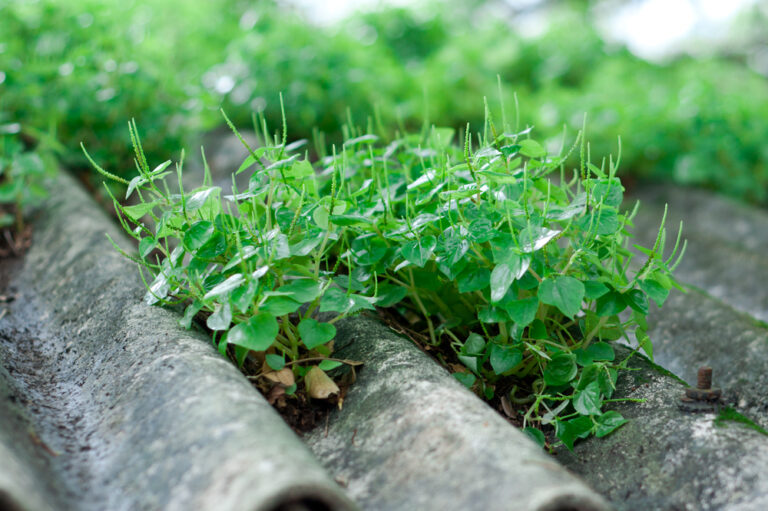
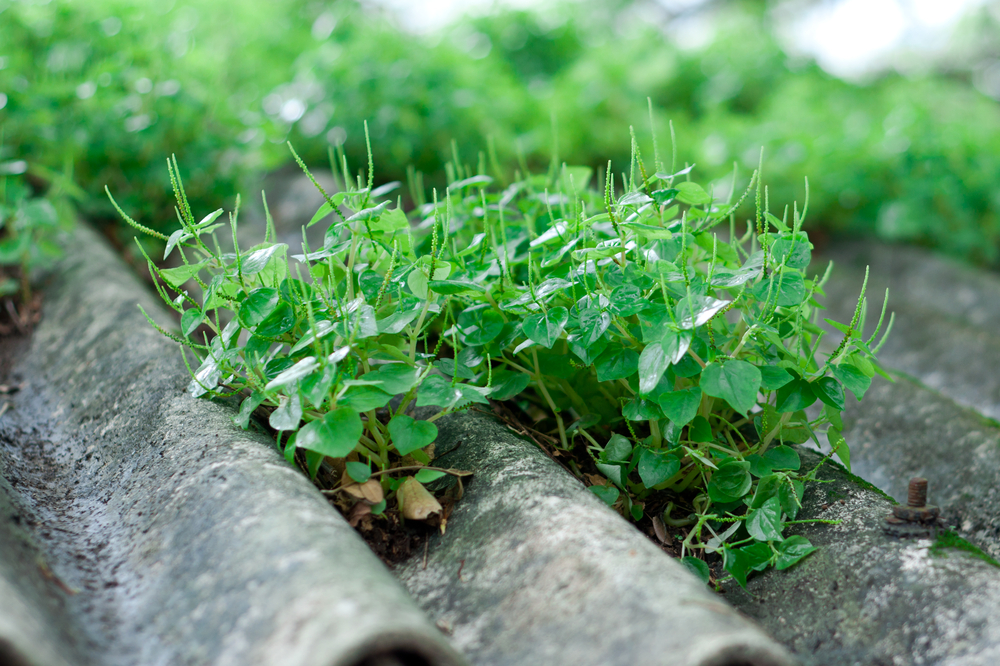 Dubai Municipality teamed up with spice giant Eastern Masala and Jaleel Holdings to launch a new project that aims to pass on a message of healthy living, encouraging residents to create home gardens to grow vegetables, herbs and fruit.
Rosetta attempts comet landing to study our distant past


Almost exactly one year ago Green Prophet revealed that King Tut’s jewelry contains ancient comet dust. Now the ancient Egyptians will leave their mark on a passing comet as a spacecraft named after an Egyptian obelisk takes a selfie before attempting a soft landing on a comet.
How vegan demand for agar is killing Morocco’s red seaweed

The quinoa craze turned what was once a cheap, nourishing staple diet for Bolivians and Peruvians into an unaffordable grain for many of the poor locally. Read here about the dirty secret of quinoa. The appetite of western culture, and fanatic vegetarianism has increased demand for quinoa stratospherically: in 2013 the price of quinoa tripled from 2006 prices.
Prices have risen to such an extent that the poorer populations of Peru and Bolivia can no longer afford it and instead substitute for cheaper imported junk food. In Lima, quinoa now costs more than chicken and outside the cities land is increasingly being turned into quinoa monocultures.
Gaga for agar-agar
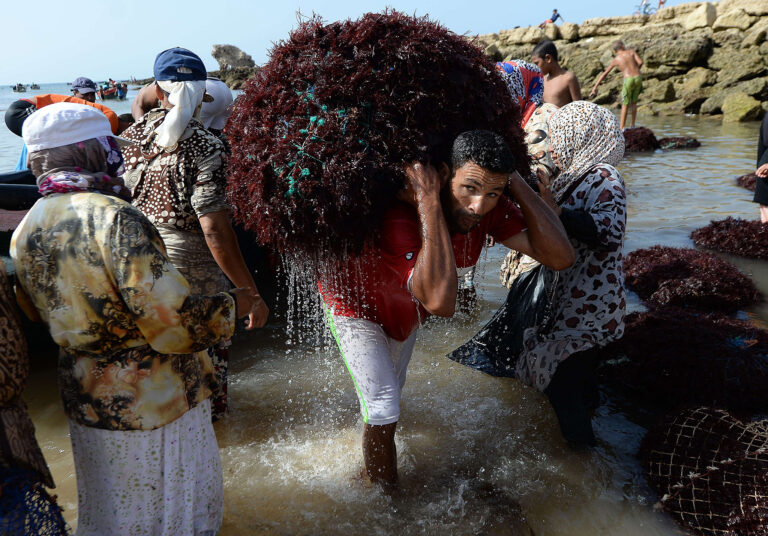
A similar story is happening in Morocco, El Jadida, with “red gold” a mineral rich seaweed used to produce agar- agar a natural gelling agent popular with cooks and professional chefs, used in pharmacology and cosmetics and an alternative to animal-sourced gelatins for vegetarians and religious groups that ban pork.
Over in Japan, agar is used for sauces, soups, jellies, and desserts. In the Western world, it is used as a gelling and stabilizing agent by meat and fish canneries, and in baked goods, dairy products, and candies as well.
In 2010 over exploitation pushed the fishing ministry to place quotas restricting its harvest, and today rising demand and falling supply has resulted in increasing export prices.
Agar-agar is an important gelling agent for people who cannot consume pork products, like Jews and Muslims. But it is also a staple for vegans.
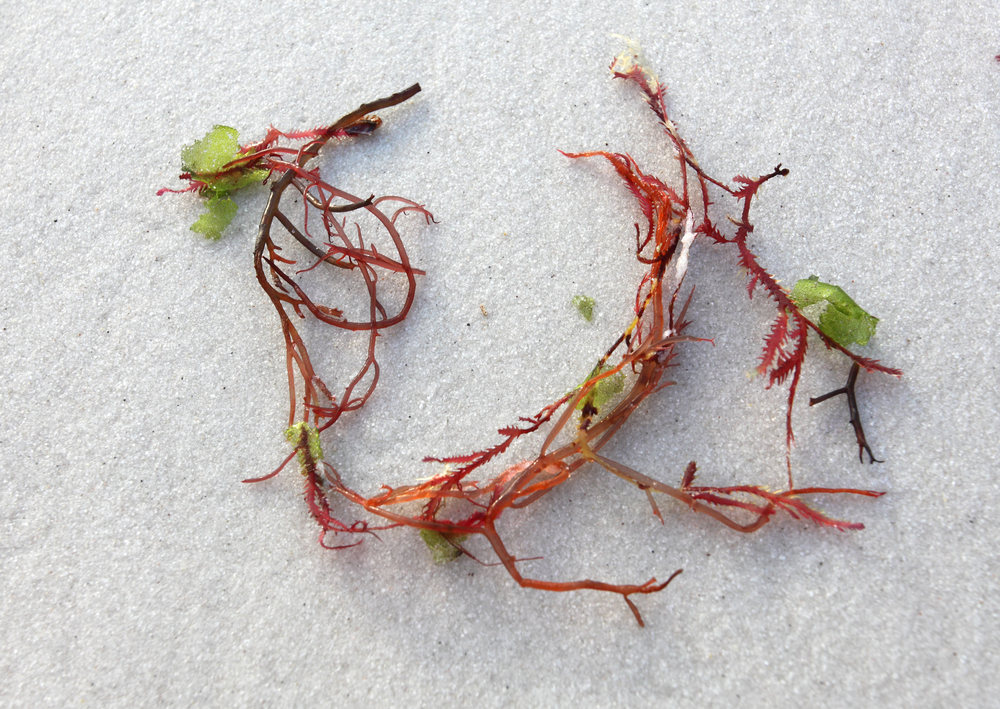
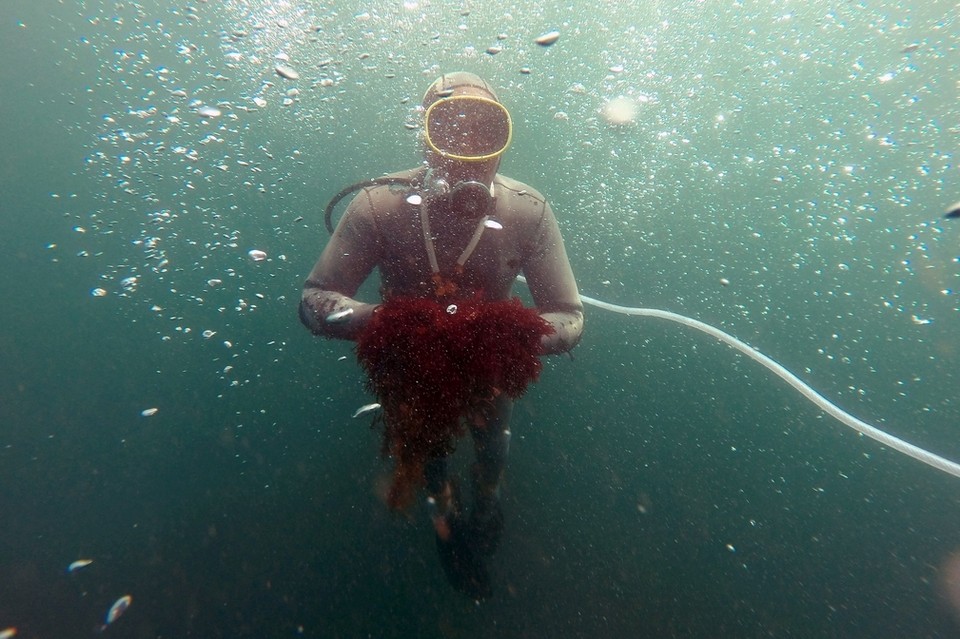
Yet fishermen and are not seeing the economic benefits from these rising prices, research has shown that fishermen often sell the produce half the price pre-established by the quota and are forced to dive deeper, with dangerous consequences in the hope of finding this increasingly scarce, expensive “gold” (which by the way, currently sells at 0.4 USD per Kg- so not really gold) .
Killing Morocco’s ecosystem and society
Aside from the negative social consequences, overharvesting seaweed also has obvious negative to the local marine ecosystem. Seaweed plays a major role in marine ecosystems , in fact they are considered “keystone species” since they are one of the first organism in marine food chains.
They provide nutrients and energy for animals, either directly when fronds are eaten, or indirectly when decomposing parts break down into fine particles and are taken up by filter-feeding animals. Seaweeds also act as filters by taking up nutrients and carbon dioxide from seawater reducing local coastal eutrophication and ocean acidification.
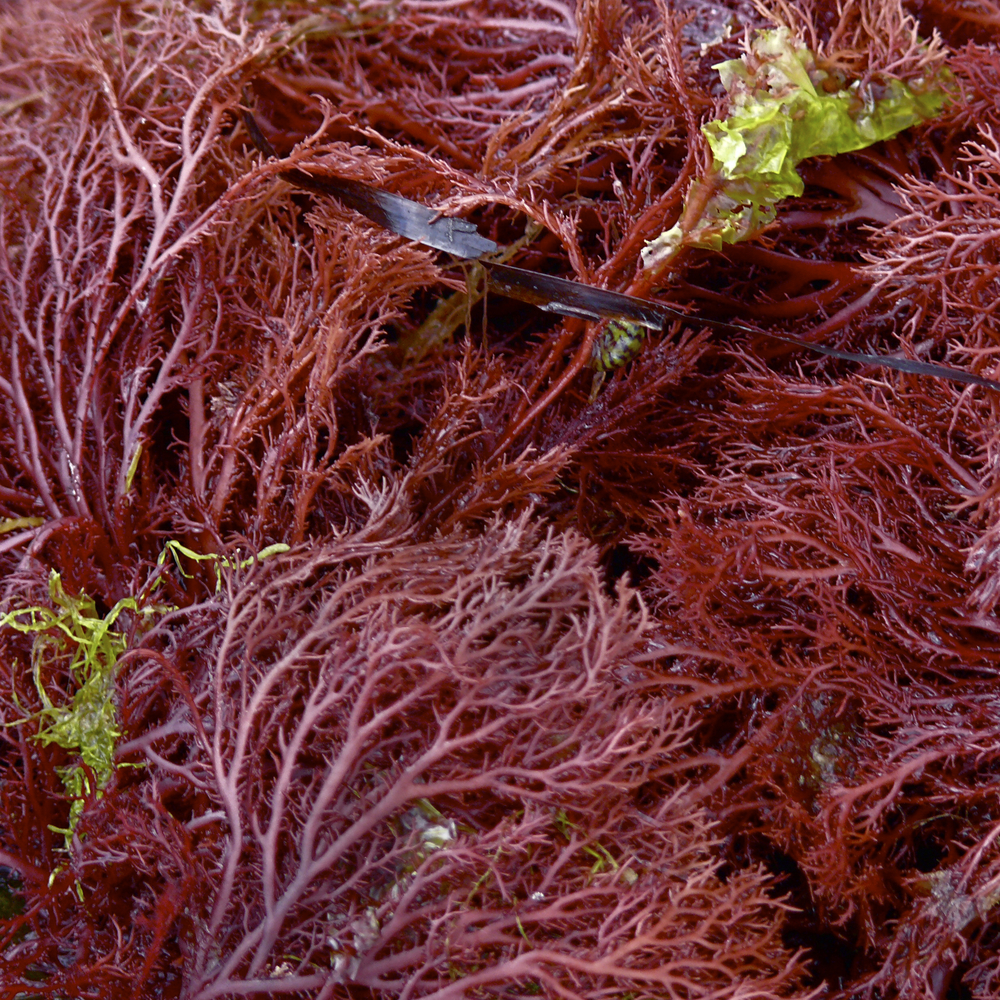
What was once ordinary red algae, has now become “red gold” with negative consequences on the fishermen and the environment.
We have to remember that nowadays crazes have a more significant impact than in the past. Globalization, increasing communication streams, increasing population, and rising incomes and the concomitant increase in purchasing power means that the decisions we make today have a larger ripple on effect on populations and environments that are far from our sight.
Using exotic foods, supplements and medicine to fulfill health habits, or becoming fanatic about not using certain produce may not be the answer to a more sustainable, global economy.
Looking at your own country’s tradition, local crop and seed wealth and medicinal herbs is just as efficient at supporting health and has a marginal and sustainable impact on local economies. Like always, balance is the key and the solution lies right next to you.
Image of Red gold seaweed harvest in Morocco by Fadel Senna; image of agar red seaweed from Shutterstock
Gulf gluttony and global hunger: How long can the party go on?
WASHINGTON — Inhabitants of the oil-exporting sheikhdoms and emirates of the Persian Gulf wolf down an average 3,700 calories a day —leading to the highest rates of obesity on Earth — even as at least 805 million people, one-ninth of the world’s population, go hungry.
Such huge disparities will ultimately lead to widespread unrest, warns Deborah Wheeler, a professor at the U.S. Naval Academy who specializes in Middle East politics.
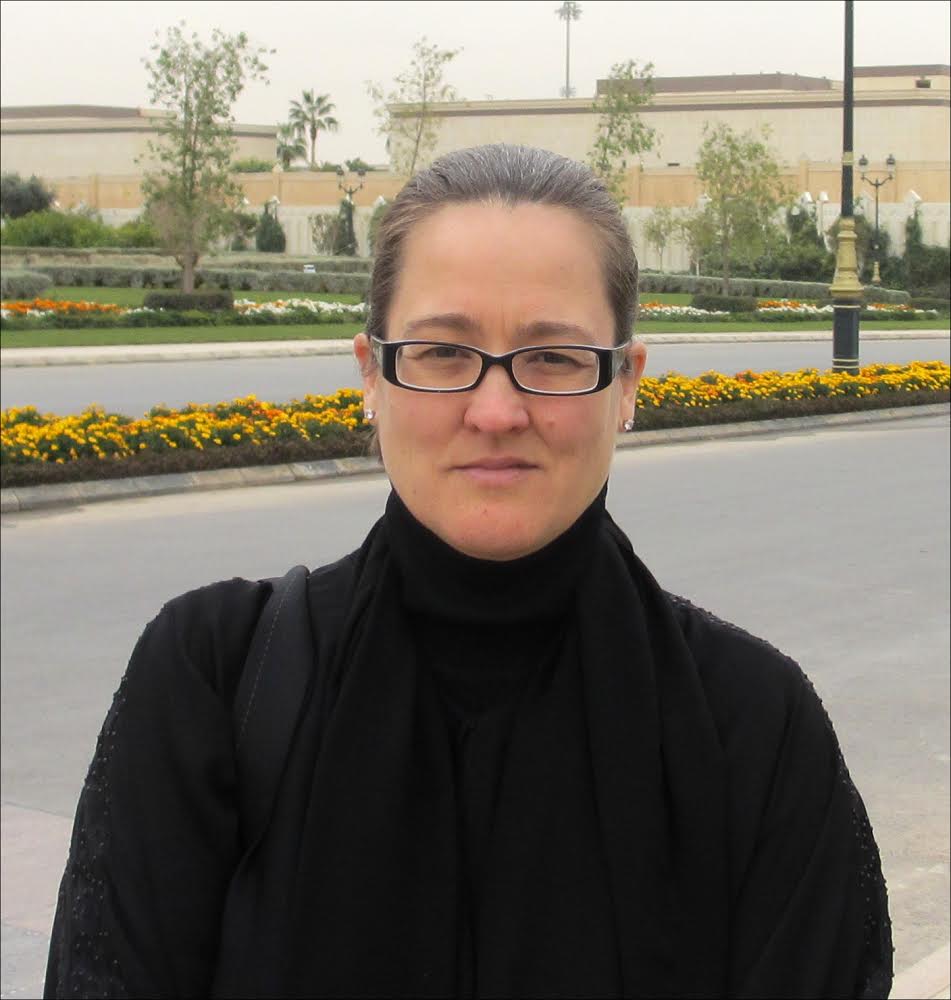
Wheeler (pictured below while on research in Kuwait) was one of a dozen experts meeting Oct. 16 at Virginia’s George Mason University, just outside Washington, for a summit on global food security and health.
“The United Nations says we will add two billion people by 2050 and an additional one billion by 2100, for a total world population of around 10 billion,” said GMU public policy professor Kenneth A. Reinert, a frequent consultant for the World Bank, the World Trade Organization and the U.S. Department of Commerce. “Approximately one billion of these additional individuals will reside in Africa, and another one billion in Asia. Both Africa and South Asia are currently basic goods-deprived environments.
Even worse, he said, “the majority of countries whose population growth is expected to be fastest in the future are precisely those showing inadequate food consumption and high levels of undernourishment.”
At the other extreme are a handful of small Arab states in the Persian Gulf that owe their mind-blowing wealth entirely to oil and gas. Qatar’s annual per-capita income exceeds $100,000, making that country’s 2.1 million inhabitants among the world’s wealthiest. Excluding migrant workers who form the vast majority of Qatar’s population, per-capita GDP jumps to nearly $690,000.
Oil rich but very food insecure
Yet Deborah Wheeler, a professor at the U.S. Naval Academy, sees dark clouds on the horizon.
“These countries depend more than 90 percent on the global food market to eat and drink,” she said. “Kuwait imports 98 percent of what it eats and drinks. It makes sense for them to import. But relying on that global market is becoming increasingly problematic.”
Wheeler, whose presentation at GMU was titled “Food Security and Gluttony in a Water Scarce Region: Lessons in Sustainability from the Arabian Gulf,” showed her audience a photo of the glitzy new Dean & DeLuca gourmet food emporium in Kuwait City. At 21,500 square feet, it’s the largest Dean & DeLuca franchise in the Middle East.
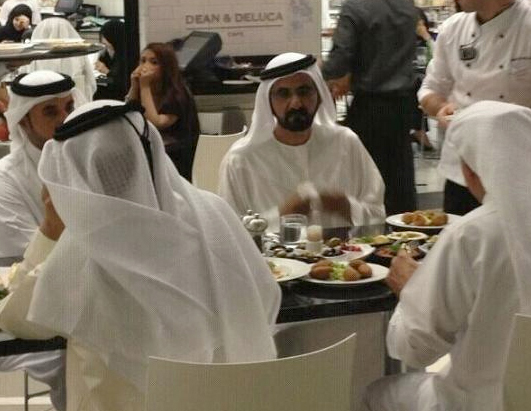
Another image was of the new Cheesecake Factory outlet at a Kuwait City mall.

“We’ve sent all our worst habits to the Gulf, and they are very happy to have them,” she said. “The Gulf countries are a perfect lab for studying non-communicable diseases. Diabetes is growing faster here than anywhere else on the planet, yet they’re in a water-scarce region — and it’s oil wealth that allows them to mask this problem.”
Wheeler, a political scientist, has done research in Kuwait, Oman, Qatar, Saudi Arabia, Jordan, Egypt, Tunisia, Syria, Morocco, Israel and the United Arab Emirates. She specializes in information technology diffusion and its impact on the Arab world, as well as gender issues and the Palestinian-Israeli conflict. She said that in Kuwait, 70 percent of the adult population, and 48 percent of all adolescents, are either overweight or obese.
Food insecurity could lead to radicalization
“As we know, as GDP goes up, consumption is transformed. These are rich countries and they eat like rich countries. The problem is, they don’t produce anything they eat,” she warned. “In spite of having all that oil wealth, which allows them to live way beyond their ecological footprints, we’re starting to see cracks. How did the Tunisian revolution start? A vegetable seller set himself on fire. That led to a transition.”
Wheeler added: “These countries are so fragile. As soon as they collapse, we’re going to see massive Islamization.”
RELATED: Gulf States land grab for food production in Africa
In fact, Kuwait, Qatar, Saudi Arabia and the United Arab Emirates rank in the bottom 10 percent of the world’s sustainable nations. All of these countries have seen population growth exceeding three times the global average, yet during the same time there’s been a rapid decline in the amount of available fresh water.
These countries are also among the biggest food wasters in the world, producing 150 million tons of municipal garbage a year. In addition, they release more carbon into the atmosphere on a per-capita basis than anyone else. Yet they don’t produce anything, which is why the Gulf Cooperation Council’s food import bill has jumped by 105 percent since 2010; experts estimate that the six GCC nations will spend a combined $53 billion a year on food by 2020.
“These people lead highly consumptive lifestyles that are ultimately dangerous to public health,” Wheeler said.
It’s no wonder diabetes is through the roof in Kuwait, Qatar and the UAE; citizens of the GCC nations consume an average 3,700 calories a day. They also have the world’s highest per-capita water consumption, even though their countries are among the driest on the planet.
“People are aware of the fact the cost of living is increasing rapidly. And what are their governments doing? They’re cutting subsidies. This leads to public protests in places where we don’t expect it,” she said, adding this is why Washington needs to be concerned. “Last summer while I was in Kuwait, there were public demonstrations in support of Islamic State. They’re upset with their government, and any movement that looks like it might sweep that existing government out of the way will get their support.”
Image of Sheikh Mohammed Bin Rashid Almaktoum from 965malls; top image of kabsa mandi from Saudi Arabia from UCAELI
مستثمروا أبوظبي يبحثون عن مبتكري تكنولوجيا المياه