Home Blog Page 229

5 benefits of greening your business

1

image-worker-gaza-deaf-restaurant

Going green is the latest business tends that paving the way for a corporate and social change. A green workplace and green business operations have numerous benefits for business owners. Using green strategies in your business can improve efficiencies, save you money, reduce waste and build your public image. Both large corporates and small businesses can convert their existing operations into entities that support sustainable use of resources wherever possible. Here are five benefits of implementing green strategies in your business.

#1 Save Money and Reduce Waste

green money, greenwash, green washing, money laundering on laundry line

Improve the overall operating efficiency of your business by going green. You can trim out excessive and unnecessary overheads and costs by turning to green practices. Creating a paperless environment is an example of a green practice that eliminates waste. Instead of paper records that take up space, or the need to print documents, all of your customer information and business forms are stored in the cloud and not on paper.

The money that you spend on implementing a paperless CRM solution will pay for itself. Use sustainable suppliers for ink cartridge refills, instead of throwing the entire cartridge away, offer employees car allowances for hybrid vehicles, and set up your business to run on a solar energy system, rather than the electrical grid.

#2 A Green Workplace

Sharifi House, nextoffice, tehran, Iran, Iranian architecture, transformer house, rotating house, rotating rooms, daylighting, energy efficiency, modular design, iranian architects

Running and maintaining your business location requires the use of cleaning products that are harmful to your environment. Do an audit of all of your suppliers and change any that do not offer environmentally-friendly cleaning products. Keep your offices clean but don’t harm the environment while you are doing it. Remember to recycle any waste that is generated by your company and dispose of all organic waste in accordance with environmental regulations and procedures.

#3 Positive Public Image

We live in the twenty-first century, and business needs to provide leadership to the communities it serves. Take the high-road and set the initiative by going green. The public will see your company as an environmentally responsible entity that cares about the environment that it operates in and serves. While image should not be the primary motivating factor to go green, it’s interesting to note that companies that do make the change, experience higher profits and better user engagement from their target markets.

#4 Take Advantage of Tax Breaks

State and federal laws on emissions have presented companies with challenges that they will need to overcome in reducing their carbon footprint. Companies such as General Electric and FedEx have instituted programs and green technologies that reduce their emissions and allow them to meet compliance with the state regulations.

Incentives and tax rebates are also available at state level. In certain states, such as Florida, companies that produce and sell renewable electricity to the local communities are offered tax breaks on their operations. All businesses in the state of Florida are also exempt from sales tax related to the purchase and maintenance of renewable and sustainable energy systems and technologies. The IRS will allow deductions on hybrid green vehicles and other expenses that are related to environmentally-friendly business practices.

Tax rebates are also available for corporate responsibility programs that have an environmental initiative. This program allows corporates to give back to the community and receive a reward for creating a positive social impact for change.

#5 Create Sustainability

landscape with beautiful sunset and dry field

The ultimate goal of implementing a green business strategy is not to improve profits or take advantage of tax breaks. The primary objective of a green business initiative is to create a sustainable environment that is conducive to growth and efficient management of natural resources for the future. Climate change is affecting living conditions all around the world. By standing up and claiming responsibility, companies can make the changes they need to operate effectively and efficiently while reducing the impact they make on the environment.

The Final Thought

Going green with your business has numerous advantages for your financial health and your public image. Financial institutions are also likely to provide capital to companies that support an environmentally friendly initiative, making funding a green tech company easier than a traditional business model. Research into grants and government incentives available in your industry. Learn how you can take advantage of government programs to help your company make the change to a green future.

Sustainable and quality interactions in customer relationship management Tools

0


Satisfy All Customers with The Best Care

Smart business owners know that the customer must be treated with the best care. This doesn’t matter if you run a regular business or one with sustainable goals in mind. This philosophy should apply from the initial contact to the design of the product or service to the final sale. The best interactions usually elicit a sincere show of appreciation from client. This fact means that quality service has been rendered. A customer may end up requesting to speak to a supervisor to give a compliment about a customer service representative. A company can help to ensure that workers are providing the same level of service to all customers by using the right tools to make interactions uniform.

Train All Workers To Provide The Same Level Of Customer Care

Salesforce provides a great Customer Relationship Management (CRM) software tool that assists business owners with keeping customer care at a consistent level. An executive can specify that a set script is used during each call to the company. Trainers can also teach new workers skills to effectively navigate the software. Employees will use the same materials on each call. A consistent level of customer care starts with a well-trained worker. Employees will have the confidence to handle all types of calls to the business.

Capture Important Information During Each Contact

A company establishes their core values via the treatment of the client. A customer may become frustrated when they must give the same demographic information on each call. The Salesforce system allows the customer service representative to capture data into the computer during the first contact with the client’s permission. The business owner may also choose to integrate telephone technology that identifies callers based on phone numbers previously used to contact the call center. Demographic data capture will help establish smoother follow-up calls. The information also assists the business with providing quality customer care during a follow-up.

Increase Sales with Quality Follow-up Customer Service

The ability to contact customers will begin with the first call. Customer service representatives should ask permission to contact clients about new products or to verify their satisfaction level with a previous call. The software has fields for workers to leave notes about the call. An account may also be designated as verified to callback. Some customers may decline this follow-up option. Scripting can also be included in the system to help guide a representative to getting a positive response to a follow-up question. The sale may end up being closed during a second or third contact call.

Use A Versatile Solution to Assist Clients

A mobile solution will give field representatives the tools that are needed to effectively close sales. Employees can track sales activity via a mobile device while going to different appointments. This data helps to prevent unnecessary calls to clients who have recently purchased a product or service. Customer Relationship Management software must also be flexible enough for a business to tailor it to their requirements. Field workers can excel at their job with a quality software product. A versatile software solution will help to define a great relationship with the customer. Global businesses are built by cultivating successful relationships with targeted clients.

In Canada, PieBird gives honeybees sanctuary

0

Honey is a magical elixir. Mystical even. And our love for it goes way back to the earliest signs of advanced civilization. Archeologists have found pots of it in ancient tombs in Egypt placed there as a gift to the gods because it was so loved.

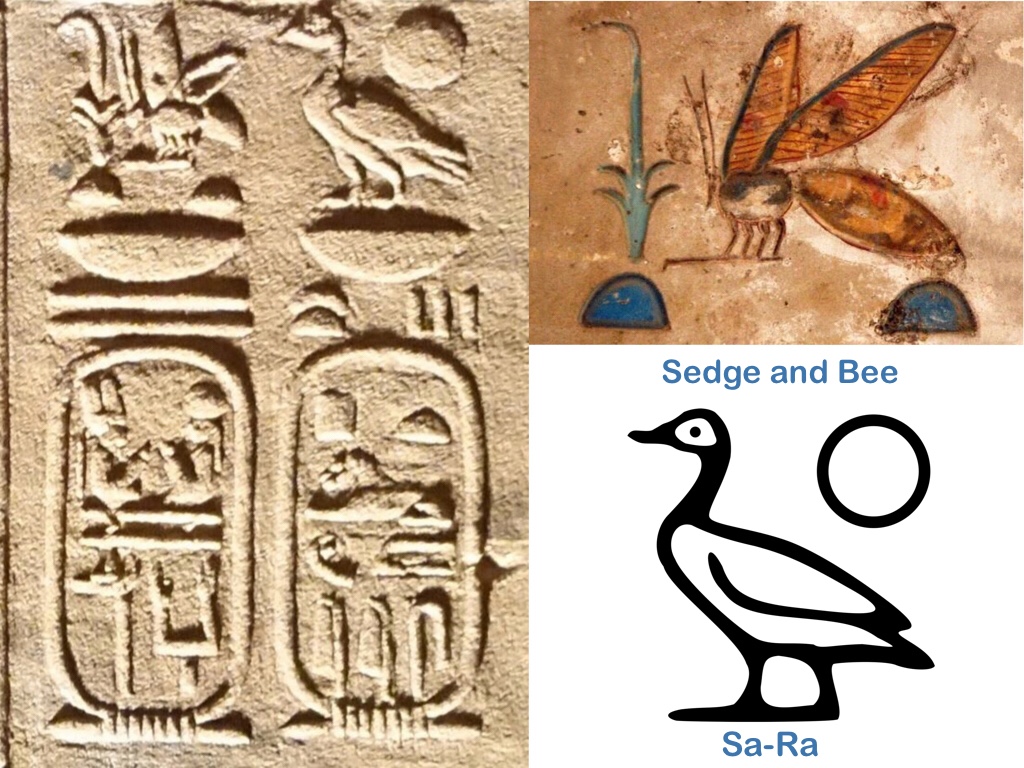
The ruler of Egypt was called the “S/He of the Sedge and Bee” – The sedge was the symbol for Lower Egypt, while the bee stood for Upper Egypt.

Honey experts and beekeepers I’ve met say that honey can last forever, well at least 3,000 years –– the world’s oldest sample, which is still perfectly fine for us to eat.

So there is no doubt that with news of honey health benefits as a natural immune system protector in your tea, and as a great energy source –– that we have learned to love and revere our honey, seeking out new flower blossom flavors, sources, stories and recipes we can share.

What’s clear is that we love honey. Agreed? Then it seems almost inconceivable, evil even, that the world’s honeybees are facing a massive breakdown, with hive die-offs left, right and center from Bee Colony Collapse Disorder. Everywhere we turn we face another disaster story –– and companies trying to profit from fixing it. Plenty of articles can be found online about how without the bees as major pollinators our food system would collapse.

But is this the whole story? That we’ve messed up our planet, and because of neonics and climate change and our voracious appetite, bees are kicking the bucket?

Related: Syria’s beehive houses keep the shade

This summer I visited a couple of bee farms. One conventional, and one very much out of the ordinary – in a good way (jump to PieBird if you are from the BuzzFeed era and can’t read more than this). First, I took my kids to Board’s Honeybee Farm in Ontario where we learned about how they are working with local farmers to keep the fields and bees healthy. But the bees they are raising are not local. They are imports from Italy. And they need to be replenished regularly, especially after the winter.

They even had stickers advertising Flow Hives, those automatic honey collector hives, making it super easy for anyone to be a beekeeper. The Boards are good people who give to the community, and they make great honey and honey products, and we buy them all the time.

While I’d done their tour out of the old school bus before (always time to update my bee know-how), this time I was listening harder and asking more questions and learned something not talked about much: that the biggest “bee” pollinators on our planet are not the honeybees, but another group of bees entirely and they are called solitary bees. These are bees who do not build hives. Some 70% of them live in holes in the ground. Others find way to burrow into small protective spaces. A way to save them is by leaving parts of your lawns un-mowed, building nests for them, and by planting wildflowers that they love.

For instance, a single red mason bee solitary bee is equivalent to 120 worker honeybees in the pollination power it provides. This was news to me. And why isn’t this story getting out?

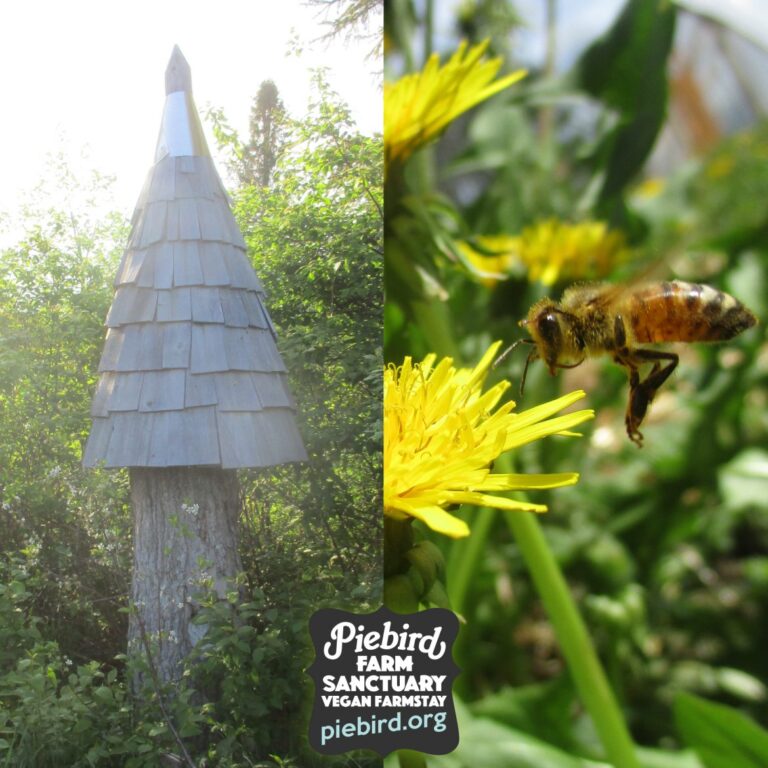
“Our love for honey has led to us wanting to save the thing we are exploiting,” are words I was told by my new and dear friend Yan, part of an extraordinary couple to Sherry Milford, both living in Nipissing, Ontario. There they run an animal sanctuary and vegan farmstay + bed and breakfast called PieBird, and among the goats they comb, and chickens and ducks they tend to (without eating their eggs), they run a honeybee sanctuary.

Yan builds greenhouses that you can buy. He flat packs and ships.

It’s a sanctuary for honeybees, where the bees are allowed to do their thing, where the queens can come and go as they like, and no-one but the baby bees are eating the honey. I’ve known for years that vegans don’t eat honey, an idea that sounded absurd until I talked with Yan.

“Humans can learn a lot from our bee friends,” he tells me. See him in the video below.

I urge you to support the honeybees by supporting people like Yan and Sherry at PieBird. They offer sanctuary to honeybees, but more importantly they are an essential voice for the bees. Together, they live a life of a legend, while operating their small paradise about 4 hours north of Toronto. Sherry and Yan walk the walk, and talk the talk.

A video that I love about them from a few years back:

https://www.youtube.com/watch?v=0p3ce16_mzU

WHAT CAN YOU DO TO SAVE HONEYBEES?

Sponsor a hive, of course, or some other animals via [email protected]. And if you can’t support their important mission with your cash, share this story and support some solitary bees. Over on GrowWild in the UK, you can learn how to create habitat for solitary bees, like the one pictured below. It’s a great project to start in cities and obviously for kids, while you teach them about the bees.

solitary bee home

I am not suggesting that we all stop eating honey today to protect honeybees for tomorrow. I am not that radical, though I am inclined to become a vegan only until I remember how much I love cheese. But maybe as we eat it, on holidays or whenever, remember that when it comes to cheese, meat or eggs — there are animals who are serving us. And that most industries are not protecting the welfare of the animals they exploit. Find honey that’s been gathered and prepared with some ethics in mind, preferably not the big supermarket pasteurized honey. Not sure? Take our honey test here.

If you want to be part of the solution educate yourself: get online and find a beehive to visit (read about the day Miriam toured an apiary and got swarmed!), donate to a bee sanctuary (Piebird is a great one –[email protected]) – ask Yan if you can adopt a hive in the name of one of your loved ones! Buy organic fruit and veggies free from pesticides (neonicotinoids or neonics especially) when you can, and start building habitat for solitary bees. Or, you could always be a rapper like this guy.

::PieBird

Simple solution for Middle East road rage

0

We’ve all heard about the crazy Middle East driver right? Or the drifters in Saudi Arabia that purposefully steer into crowds for thrills? Middle East driving is bad. And fatal, killing more people than the ongoing conflicts. New study suggests more can be done at work to keep drivers safe: The more one conflicts with their colleagues, the greater the risk that they will drive unsafely, according to the University of Haifa:

Drivers who develop negative relationships may suffer from various covert and overt reactions, communications obstacles, limited access to information, and a lack of social influence promoting safety. Accordingly, they will find it harder to model safe behaviors, the researchers explain.

Traffic accidents at work account for 14% of all injuries in road accidents in Israel, and 90 to 95% of these accidents are caused by human error. Numerous studies have been undertaken to examine wreckless behavior by drivers, focusing on demographic characteristics such as sex, age, personality, and psychological condition. In the current study, published in Accident Analysis and Prevention Journal, doctorate student Renana Arizon-Peretz and Prof. Gil Luria of the Department of Human Services at the University of Haifa sought to examine for the first time whether relations in the workplace influence driving.

The study included 83 professional drivers and 30 assistant drivers who belong to four industrial organizations in Israel. The drivers’ average age was 39, with average seniority of 6½ years at work and seven years as drivers. Unsafe driving behaviors were measured using a special technological system called IVDR, which provides an objective measurement of the driver’s behavior by means of a computer and sensors installed in the vehicle.

The results of the study show that the more central the drivers’ position within the network of negative team relationships – in other words, the more they tend to engage in negative interactions with their peers – the greater their tendency to drive unsafely, by comparison to drivers located at the margins of these networks. Conversely, the more central the drivers’ position within the network of work friendships (the more friendships they have with their peers), the lower the tendency to drive unsafely.

Drifting in Saudi Arabia at 200km/hour. Solution? Get a decent job punks! 

“In reality, individuals sometimes develop conflicted relationships with some work colleagues, and close friendships with others,” the researchers added. “In these instances, we found that the positive relationships compensate for the negative ones, thereby moderating the link to unsafe behavior.”

The researchers explain that much of the information about safety hazards is exchanged between peers during informal conversations over a coffee in the kitchenette, during a telephone conversation, or simply during chats in the corridor. “When you are close to someone, you’ll tell them about problems you encountered or heard about from other colleagues. In that way, you help them avoid or cope with the risks. Conversely, if you are in a conflict with someone, you might even deliberately choose not to share vital information with them, in order to make it harder for them to cope with a potential danger.”

“Managements of organizations should attach importance to drivers’ social abilities during staff recruitment. It is also important to diagnose the informal relationships in the team, address problematic relationships, and develop friendship networks between teams. Such actions can help reduce the rate of traffic accidents at work,” the researchers concluded.

Ecoraider gives you an aura of bug protection

0

ecoraider protection against bugs

For anyone who has been following my summer adventures –– this year I spent 6 weeks in the middle of the bush, on 200 acres –– you’ll also know how gnarly the bugs have been this winter. It’s been extra wet, then extra warm. When we had good days the doors and screens stayed shut. But on those bad days where we forget, and it got too hot, everyone in the house suffered – from the bugs!

The natural choice would be for me to go online, if I can connect to the Internet in the bush (not always possible!), and concoct some natural formula myself. With no time for experimentation or risk, thankfully EcoRaider contacted me this summer wanting to help me with my plight.

The company based in the US carries a natural bug spray against bed bugs, and it’s for that which the company may be better known. My step-son in Brooklyn has faced the annoying effects of bed bugs, once when he was away and had a border staying at his house. It’s not fun decontaminating your house with toxins you later need to live with.

But for me Ecoraider was to be used as a mosquito repellent. Made from natural materials such as citronella, I sprayed it around the door frames of the bedrooms of our old cabin. So many of the windows have broken or torn screens, or wide spaces below the doors. It’s virtually impossible to keep the bugs away. It’s challenging for me because I have two little kids and their sweet tasting blood is a first for when the bugs come to town.

Because the summer in the north this year was humid and hot, I couldn’t keep the windows closed at night. In need of repairs, our window screens suffered –– and so did we –– from the bugs getting in. So I sprayed the Ecoraider all over them too. It compensated for where we lacked.

It seemed to work well just before bed, creating what I call an aura of protection in the upper rooms, when we needed it for sleep. I can’t keep kids sleeping comfortably under a mosquito net because they toss and turn too much, so the Ecoraider was a good option when I didn’t want to put materials on their body (the kids usually say no anyhow, no matter how natural) and for when I don’t want to burn candles. The house is an old wooden homestead so the fewer flames I need to light in the middle of nowhere, the better.

I also took the product to my friend Cathy’s lodge. She has a 10,000 square foot lodge, very open concept with doors and windows open all day. There was no way to protect any room from the rapid bugs this summer… so again, at night before bed, before the bugs could “fly” the stairs and find us, I sprayed an aura of the bug spray at the top of the stairs, on the floor by the top of the stairs, and all around the frames of the bedroom doors.

The kids still had some bug bites on their cheeks in the morning, but I believe the spray helped us in those crucial first hours while falling asleep. It’s like Chinese water torture, anyone knows – if you are trying to sleep with a mosquito buzzing around your head. Apparently you can spray the stuff on mosquito breeding grounds as well. For us, this summer the whole forest was bug territory, but inside the spray saved the day.

::Ecoraider

IKEA catches on to insect protein for food

0

flying spark insect meal

Flying Spark, a new insect-protein producer, will join the first “IKEA Bootcamp” startup accelerator. The launch of this unique boot camp generated more than 1,200 applications from 86 different countries, but just 10 start-ups will join the IKEA product development center in Sweden next week.

Flying Spark is a new food-tech company focused on all-natural protein extracted from the Mediterranean fruit fly for human consumption. This safe, sustainable ingredient is high in protein, calcium, iron and potassium and, unlike meat, it is odorless and virtually cholesterol-free.

flying spark insect meal

“We are excited to join the IKEA accelerator and to have the opportunity to learn how to work with a giant retailer like IKEA,” says Eran Gronich, co-founder & CEO of Flying Spark. “This will completely enhance our product development and how we progress. IKEA will mentor and work with our team toward eventually collaboration between the companies to develop a product and hopefully to launch it at IKEA’s restaurants.”

flying spark insect meal

In just one more generation, the world population will surpass 9 billion, with about half suffering from inadequate nutrition. One of the primary reasons IKEA chose Flying Spark is because of the mission of co-founders Eran Gronich and Yoram Yerushalmi: to create a high-quality protein ingredient packed with essential minerals, raised and harvested according to sustainable principles. Fruit fly farming requires minimal water and almost no land. The flies harvest themselves with no human intervention, which allows for clean farming. “This constitutes a forward-thinking and innovative way to help the world redress hunger and malnutrition,” states Gronich.

flying spark insect meal

The idea behind IKEA’s collaborative boot camp effort is what the company calls, “Co-creating a better, everyday life.” The mission is to encourage start-ups that are working to solve some of the world’s most pressing problems. IKEA owns and operates 389 stores in 48 countries. Its income from foods last year was an estimated €2 billion.

From a small base of product launches tracked, the use (by CAGR) of edible insects grew more than 58% from 2011 to 2015, according to global research group Innova Market Insights. Overall, most products are in the cereal/energy bars category (32%) but 12% are in meat-substitute products. Cricket is the most commonly used insect, found in 56% of products tracked, typically in whole form or as a flour. 54% of products tracked feature the claim “high/source of protein.”

“Millennials want to create a more sustainable world, to make it a better place for all of us, and they are willing to add insect flour to their food to help achieve this goal, notes Gronich.”

The high demand for sustainable protein, combined with innovative technology, has driven strong support for Flying Spark. The company has raised $1 million with the help of the Israel Innovation Authority and The Kitchen, a food-tech incubator sponsored by the Strauss Group (one of the largest food conglomerates in Israel). Over the last 12 months, Flying SpArk has made significant inroads toward building the infrastructure and technologies integral to developing its products.

Archeologists discover how silo thinking made people rich

0

pottery, archeology, israel

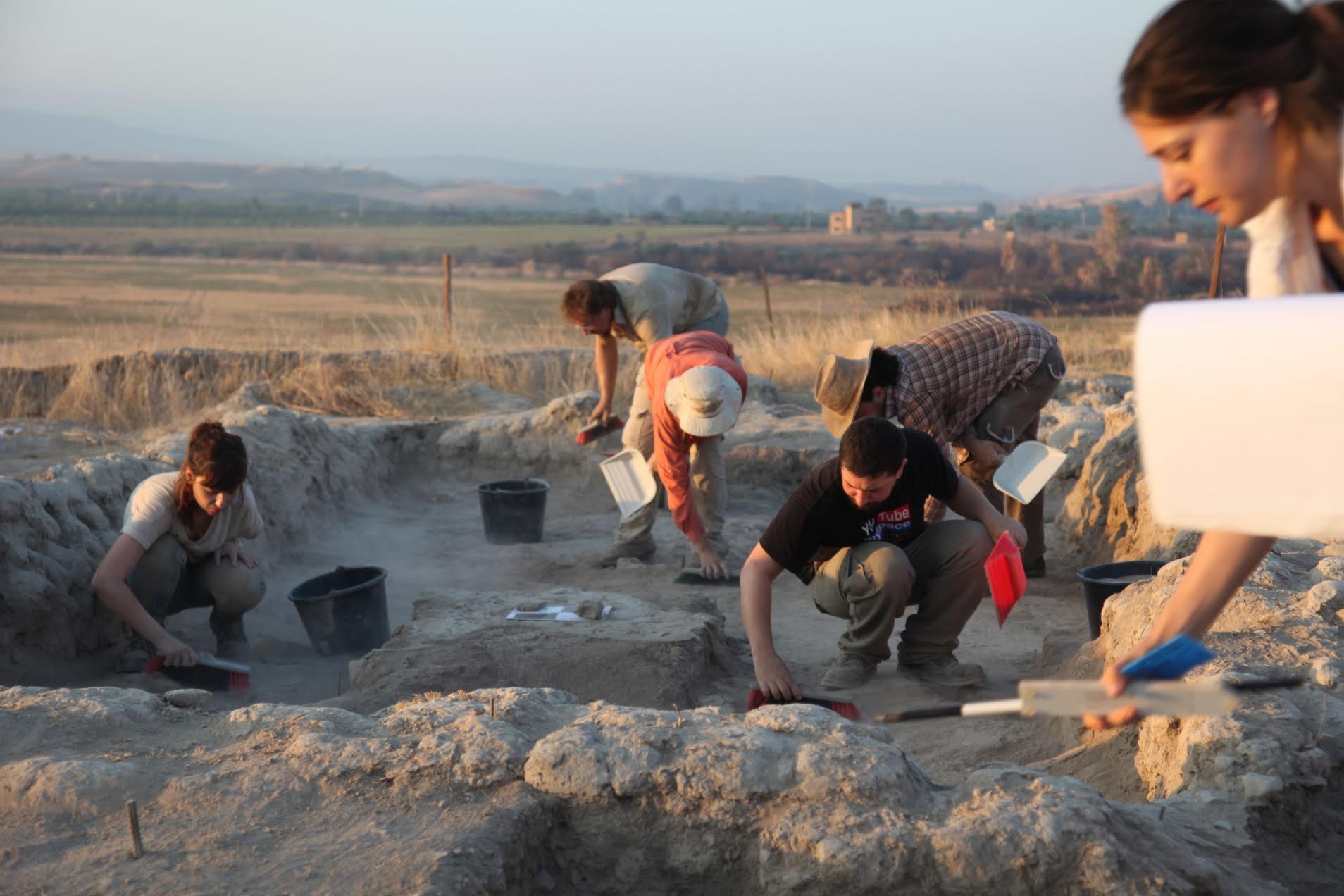
The oldest evidence of food storage rituals has been found by researchers from the University of Haifa and the German Archaeological Institute  in Berlin during excavations at the prehistoric site of Tel Tsaf, in Israel. An unusual pottery vessel illuminates how people climbed social statuses fast.

The vessel, which is over 7,000 years old, reveals for the first time the ritual and political significance of large scale food storage in the Ancient Near East.

Tel Tsaf provides first hand evidence of the early connection between food storage on a large scale and the observance of a ritual associated with the successful storage and preservation of agricultural yields,” explains Prof. Danny Rosenberg of the Zinman Institute of Archaeology at the University of Haifa, who heads the research project at Tel Tsaf together with Dr. Florian Klimscha from the German Archaeological Institute in Berlin.

Tel Tsaf archeological site is located in the Jordan Valley, at the Jordan River and Israel’s border with the Kingdom of Jordan. The site was first documented in the late 1940s and has been excavated since the late 1970s, and later in 2004-2007. Since 2013, Rosenberg and Klimscha lead a multidisciplinary project at the site, one that focuses on the site’s economy and its ancient environment, with the assistance of an international team of experts and the use of advanced scientific methods.

Of the unique findings at Tel Tsaf, notable are the numerous silos used for large-scale grain storage, found in the courtyards of the buildings. The silos are evidence of the storage of food on a scale not previously documented at sites from this period. “The wish and ability to store food certainly constitutes an important step in the transition of humans to societies characterized by more complex social organization. It also seems that Tel Tsaf’s location near a major water source such as the Jordan River is no coincidence, considering the site’s potential to accumulate such a large amount of crops,” the researchers noted.

“The significance of storage for development of complex societies is evident by later testimonies from our own region, but even more so from Mesopotamia and Egypt, where complex, pre-state and state level societies emerged and engaged in the intensive storage of food, as an essential condition for the development of a social hierarchy. However, with the exception of Tel Tsaf, we have not yet found evidence of mass food storage in the region from 7,500 – 6,500 years ago in our region.”

Prof. Rosenberg explains that there has been a debate among researchers for many years concerning the early emergence of societies characterized by social and economic elites – a phenomenon that is frequently associated in our region with the Bronze Age. However, no evidence has previously been found showing that large-scale food storage in earlier societies was accompanied by social or ritual acts intended to ensure the successful storage and distribution of produce.

During the excavation season at Tel Tsaf two years ago, researchers found numerous pottery shards in a room situated in the center of a cluster of silos and cooking installations. The fragments appeared to belong to a single vessel. After painstaking work, they managed to reassemble the fragments, and were surprised to find a unique miniature vessel with a height of around 20 centimeters and a small window-like aperture on its side. “All the pottery vessels we are familiar with from this period have an opening on the top, facing up, just like most pots and cups in any modern kitchen. But this vessel is dome shaped, closed on the top, and covered with red-painted clay balls, whose significance is unclear to us,” Prof. Rosenberg notes.

The researchers believe that the vessel is actually a model of the silos themselves: “This vessel is not “functional” and was found in a building that was used for intensive storage, on the floor, in a room surrounded by numerous silos similar to those we are familiar with from archeological and ethnographic records from various parts of the world. We can hypothesize that this vessel was associated in some way with the silos, and particularly with the act of storage. From later evidence, we know that humans created vessels symbolizing larger storage structures, and indeed pottery vessels similar to this one, though larger, appear a few centuries later in our own region, used for secondary burial.

The size and characteristics of this vessel, together with the archeological context in which it was found, reinforce our assumption that this vessel symbolized the silos and was probably used in a ritual setting, perhaps as part of the ceremonies that preceded the placement of grains of wheat and barley in the silos, or their removal from storage,” the researcher explained.

The connection between the growth of food storage capacity and the human cycle of life and death is well known to researchers from various sources, including later findings from the Ancient Near East. “Tel Tsaf offers a glimpse into a unique time capsule, with excellent preservation of organic remains and other archaeological findings that reflect a thriving community practicing long-distance trade. Putting together all these findings, the picture reveals an increasingly strong connection between ritual and intense food storage and consumption.

We believe that the economic prosperity reflected by the astonishing findings from Tel Tsaf was accompanied by notable changes in the way the community of Tel Tsaf organized itself, and by rituals and ceremonies that were practiced in order to ensure that this prosperity will last. The model silo found in Tel Tsaf would seem to be one of the best examples of the connection between the wish to store large amounts of agricultural crops in order to gain social and economic advantage and rituals aimed to sustain and ensure economic prosperity” Rosenberg and Klimscha concluded.

Fermenting fish to reduce cholesterol

0

fermented fish cholesterol

Fermenting is all the rage, from lemons, to bread to pickles. It’s good for gut health, the immune system and your soul. A new study from Asia finds that compounds in a fermented fish paste used as a condiment in Indonesia efficiently inhibit an enzyme involved in cholesterol synthesis, which can help reduce bad cholesterol.

It might sound and smell disgusting to a western palate, but researchers from Sriwijaya University in Indonesia tested the effects of various peptides filtered out of bekasam, a fermented fish paste used in Indonesian cooking, on the enzyme HMG-CoA reductase. They found two peptides inhibited the enzyme.

HMG-CoA reductase catalyzes the conversion of HMG-CoA to mevalonic acid, a necessary step in cholesterol synthesis in the body. Previous studies have reported that some fermented fish products can block this enzyme’s activity.

The team prepared bekasam from carp fish that was gutted, washed and soaked in a culture of the bacterium Lactobacillus acidophilus for 30 minutes. The fish were then removed from the culture, mixed with salt and rice, and fermented for seven days. An extract was derived from the resulting bekasam by mixing it with distilled water, centrifuging it, and then filtering it through a tiny membrane. The filtrates were separated according to their molecular size.

china water fishing bamboo boat
A bioactive compound known as lovastatin, found in high concentrations in the extract, successfully inhibited HMG-CoA reductase in an experiment designed to test the enzyme’s activity. Another peptide with a larger molecular weight was also found to inhibit HMG-CoA reductase with high efficiency.

During the fermentation process, bacteria help break down proteins into peptides and amino acids. “The use of Lactobacillus acidophilus as a starter culture in the fermentation of bekasam increases the bioactive compounds of HMG-CoA reductase inhibitors,” write the researchers in their study.

The team next plans to develop a cholesterol-lowering supplement from bekasam, says Rinto of Sriwijaya University’s fisheries technology program, who co-authored the study.

Raven’s magical vegan cookies, ghee optional!

0

vegan cookies, Raven's cookies, spelt flour almond health snacks, almond flour, nettles green, health bar, cacao nibs, living water

Raven Littleone is my new best friend. To some I call her my half-guru (her partner Peter being the other half), or my mentor. She and Peter Steel, also known as Grampa Gnome, live in the middle of the forest, off the grid using solar power, and wood, and somewhere in a remote part of Ontario, Canada in a region called Nipissing. Up until now, this sounds a bit like a nuts story. But Raven and Peter are living a perfectly balanced and normal life in rural Ontario, with 2 dogs and 2 cats, where they steward the land and precious water around them.

While they don’t have a lot of company, if you come to visit, it is likely Raven will offer you one of her cookies and a big glass of spring water, they call Living Water. Peter will cover you in glitter. You can’t escape it. There is something so regular and good about Raven’s cookies, and don’t think for a second that Raven is like a grandmother or anything like that baking you cookies to make you feel cosy.

Yes she’s a nurturer, but she’s our contemporary. One of us. We are ageless. But we like to eat well, and with her cookies you get a nice snack or breakfast if you are on the run in the city, and even if you are in the middle of the forest or desert meditating. Forget about Soylent. Eat real food cooked by loving hands, your own or by someone who loves you.

After baking her cookies for the first time, and then taking a bite, I felt my spine align. Good things were happening in my body, and I listened to them. Can you prove it scientifically that Raven’s cookies are the bomb? Who cares. Read the ingredients below and make your own call.

Raven forages for mushrooms and greens and whatever her forest offers. That’s part of what makes replicating her magical cookie recipe so difficult. But even without her concoction of wild greens and mushroom flour, I still managed to make a pretty delectable cookie.

This is going to be a recipe I take with me to old age, tfu tfu tfu as we say in the Middle East. This is one that I have already printed out and stuck into a place for keeping things worth keeping. Normally I experiment when I bake, and the results aren’t always palatable. This week when I told my husband B that I had made Raven’s cookies he asked me if they tasted like falafel, because indeed the last batch of cookies I made (for a local mini-Burning Man a couple of weeks ago) tasted like falafel. I’d tried to use as little sugar as possible, by using a bit of silan, which turned out to be 50% sugar anyway, and they came out sort of bleh.

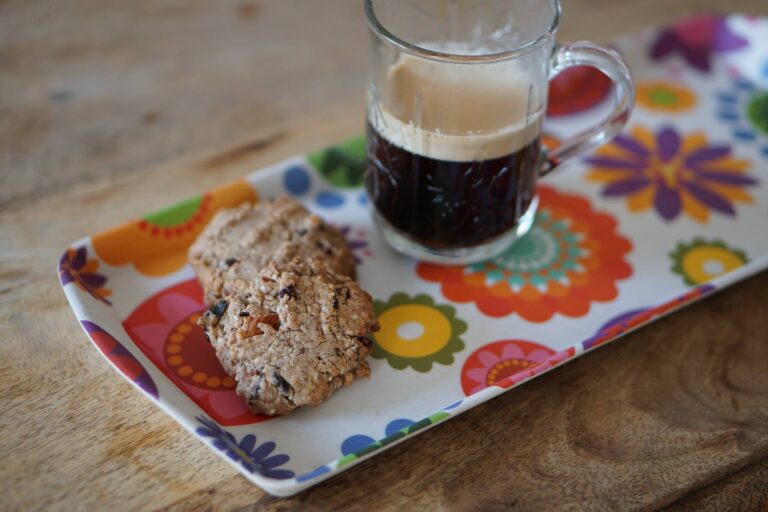
But Raven’s cookies taste buttery, crunchy, and with the cacao nibs, and toasted bits of almonds poking out, as sensually satisfying as a cookie can taste. Let’s do this. Bake with me. This recipe is for 15 cookies. Raven says she usually doubles it, as I did, and it makes about 26 to 30 depending on how you scoop it.

INGREDIENTS FOR RAVEN’S COOKIES – makes 15 cookies
(double this recipe to get 30 or so cookies)

1 cup almonds
1 cup oats or buckwheat
1 cup spelt flour
2 tbsp green powder (in-season dried plants like nettle & mix together to make green powder + dry wild mushrooms & powder.) *recipe turns out fine without this
1 tsp cinnamon
½ tsp sea salt or kelp
1 tsp liquid vanilla
½ cup maple syrup
½ cup almond oil or sunflower oil
¼ cup of cacao nibs
¼ cup of dried fruit (dates, prunes, tiny raisins, sundried tomatoes, currants…)

METHOD

Chop almonds + grind oats into flour using a mixer, blender, or processor (I use a Vitamix), but Raven uses a hand grinder.

In large bowl add spelt flour, almond/oat mixture and the rest of the dry ingredients.

Quickly add the wet ingredients. Raven suggests losing less maple syrup (like 1/3 of a cup) and then add more if you need more wetness.

Mix together.

Add cacao nibs, and chop up dried fruit into sizes that match your nibs. Stir into mixture.

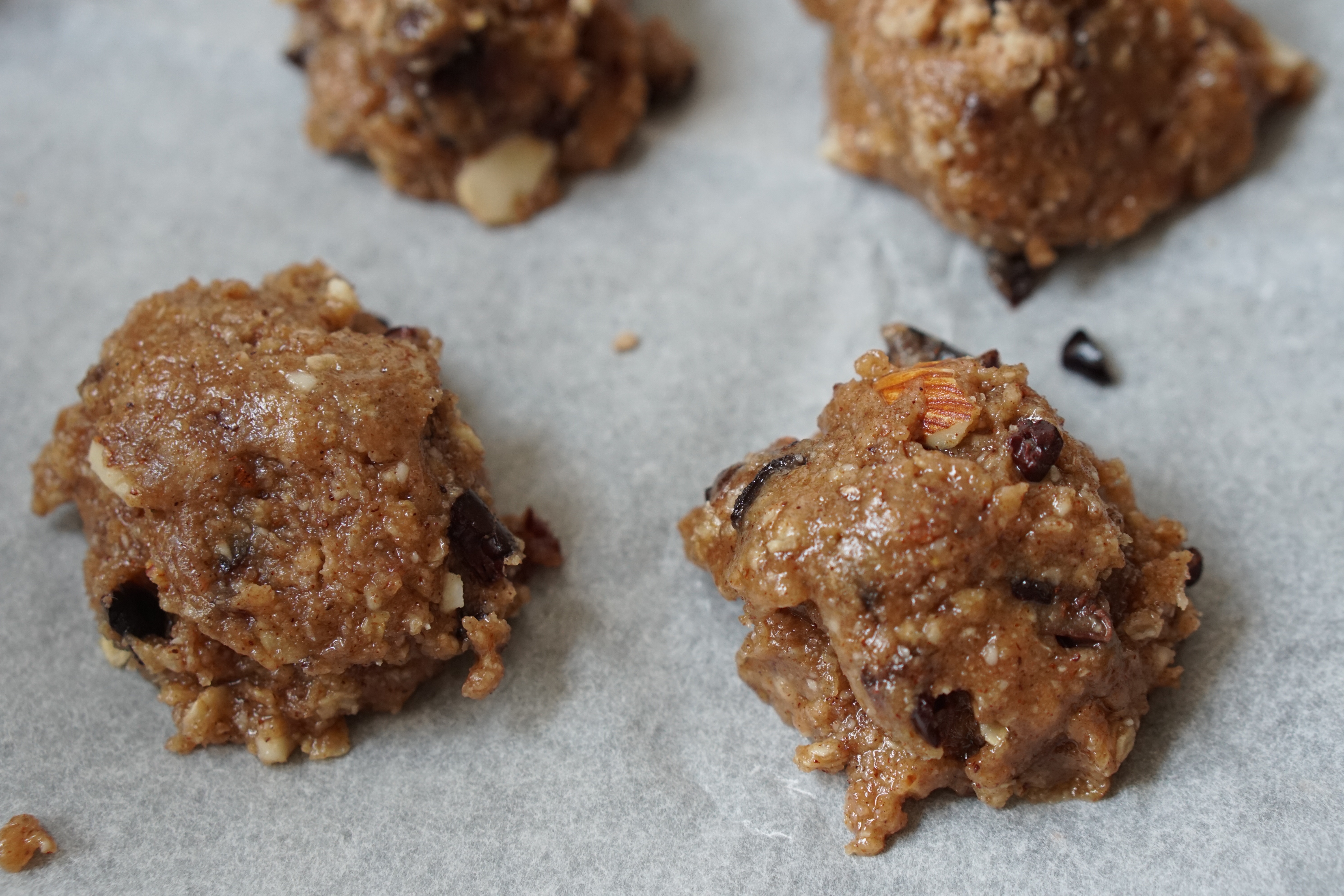
Scoop 2 tbsp of cookie dough onto oiled cookie sheet. Or use parchment paper. Raven says you can drop jam into the center of the cookie.

Cook at 350 degrees (about 175C) for 12 to 15 minutes. About halfway through the baking process, open the oven and flatten the cookies with the back of a wooden spatula to get some of the air out of them. When toasted to your liking, take them out and let them sit on the counter on the cookie sheet without touching. No touching or they will break apart. These cookies aren’t glued together with eggs or a lot of gluten so hang on a bit so they settle. When cooler to the touch transfer your cookies to a rack to cool completely. Once cool put ‘em in a jar. They won’t last long.

Raven serves them with a large spoon of homemade ghee (see ghee below). Can I say, pure heaven?

Want to reach out to Raven? Email her [email protected]

Are monster hurricanes and typhoons fueled by global warming?

0

The full effects of Hurricane Irma have still to be realized; as this monster storm has already left a trail of unprecidented devistation in the Caribbean with small island communities being almost totally damaged. Huge “super typhoons” in the Pacific ocean basin have recently caused similar mayhem in the Philippines, Taiwan, coastal China and Japan. With all of this in mind, and particularly following Hurricane Harvey, which caused massive damage and flooding in coastal Texas areas, are these storms being fueled by global warming?

The answer appears to focus on the fact that the waters of both the Atlantic and Pacific ocean basins are simply warming up. This increase in sea water temperatures is causing Arctic ice to melt even more rapidly than previously thought; and as a result, is literally rocking world weather.

Concerns about the effects of global warming on world weather patterns are not anything new. Numerous scientific articles as well as “doomsday prophecy” movies about this subject have been around for some time now. One good example of a futuristic world ravaged by global warming was an American television film entitled The Fire Next Time, first screened in April, 1993.

The two part TV movie portrayed an American landscape in the year 2017 plagued by ozone depletion and global warming.

This was resulting in frequent monster hurricanes in the Caribbean and Gulf of Mexico, massive forest and brush fires in California and other western states; and scorching temperatures and drought in most of the Continental USA.

What brings this message home is that we are now in the year 2017, with much of what was prophesied in 1993 now becoming reality.

Already, four hurricanes: Harvey, Irma, Katia and Jose have now been formed in the Atlantic Basin in the past month alone, with three of them now active. Jose, a Category 3 storm, is coming close on the heels of Irma, with its final path and destruction still to be determined. A massive brush wildfire is still burning in California’s Los Angeles area, with a state of emergency being declared for 3 LA area counties.

On top of all this, large areas of the American west and southwest are still under critical drought conditions. Taking all of this into mind, is the current state of global warming and climate change that much different than that predicted back in 1993?

May Israeli heat wave

Or maybe our new knowledge and fear of these events are due to social media?

Other parts of the world, including Spain, Portugal, and many locations in the Mediterranean basin are now experiencing severe drought conditions with much of the Middle East suffering the “worst drought in 900 years”, according to NASA .

The Fire Next Time? It really appears to be happening now.

More on the effects of climate change:

New effects of climate change are a drastic warning. will President Trump listen now?

It’s not the tide. It’s not the wind. It’s us.

NASA calls Middle East drought “worst in 900 years”

Drink like an Egyptian with this cold hibiscus tea brew

0

hibiscus tea, also known as red tea, red sorrel, Jamaica sorrel, rosella, soborodo (Zobo drink), Karkadi, roselle, and sour teaEgyptians aren’t as well known for their food as let’s say the Turks, or the Lebanese, and now modern Israel, but if there is one singular thing I love about Egypt, it’s their tea. I first tasted Egyptian tea in Sinai, where it’s known as Karkadey tea, and the Israelis translate this to hibiscus.

But the tea is made from flowers from the family Hibiscus sabdariffa. The flowers aren’t the same as the large hibiscus plants you see in cities. But it’s resembling more of a rose hip, after the summer flower fades and a small bulb is left behind.

Hibiscus tea, also known as red tea, red sorrel, Jamaica sorrel, rosella, soborodo (Zobo drink), Karkadi, roselle, and sour tea, however you call it is good –– hot or cold.

It’s worth getting ahold of some of the hibiscus flowers that look a lot like rose hips (now is a good time to forage for rose hips).

ibiscus tea, also known as red tea, red sorrel, Jamaica sorrel, rosella, soborodo (Zobo drink), Karkadi, roselle, and sour tea

Bud like most great traditional products, when they come to the US they are over sweetened. So if you can’t get to a Middle Eastern market and want to make some iced or hot hibiscus tea, we’ve got your back. It’s great for birthday parties or any kind of party. And if you want real flowers to accompany you, try Roses Only. The flavors from the deep magenta flowers, come out dark red, potent and delicious. Full of antioxidants and lowering blood sugar, take care of your diet at the same time.

Egyptian Hibiscus Flower Ice-Tea
This recipe is straightforward and a good tea that will impress your guests. They will ask for refills if you get it right.

INGREDIENTS

    • 1 cup of hibiscus flowers
    • 2 cups of water
    • 2 Tbs of honey, maple syrup or your favorite sweetener
    • ½ green apple, red will also do
    • 2 inches of fresh ginger, that’s going to spicey!
    • 1 cup of boiling water
INSTRUCTIONS
  1. Soak your hibiscus flowers in water and sweetener overnight or for at least 4 hrs.
  2. Drain the hibiscus, and discard the dried flowers.
  3. Add ginger to boiled water, and keep it covered for 15 minutes as it steeps.
  4. Remove cover from the pot and add green apples.
  5. In each cup, add ¼ cup of ginger/apple mix.
  6. Add the concentrated hibiscus, and then lots of ice and mix them all together.
  7. Serve immediately and keep leftovers in the refrigerator.

Yum!

Cut spending, making these life events more eco and efficient

0

money united arab emirates puzzle, art, UAE

Are you facing a major life event? Are you interested in the many things you can do to keep your finances in order during this time? Are you concerned about the impact that this event could have on your credit score? There are many major life events that have the potential to change your financial situation forever. Adding to this, if you don’t take the right approach, it could also have a negative impact on your credit score. With this in mind, it’s time to review five major life events during which you should attempt to cut spending. By taking this approach, your finances will remain in order and you won’t have to worry about damaging your credit score.

1. Wedding

Many people believe that having a dream wedding means spending as much money as they can get their hands on (even if it means running up a high credit card bill). This doesn’t have to hold true. There are many ways to plan the wedding of your dreams (and a simple green wedding in nature!), all without going overboard in regards to how much you spend. Don’t let your wedding spending get out of control. You know your budget and you need to stick with it from start to finish.

2. A Baby

Let’s face it, there is nothing more exciting than bringing a baby into the world. Of course, this can also be a big expense. If you’re going to make things work from a financial perspective it’s imperative that you keep a close watch on your spending. The cost of diapers, formula, healthcare, and other expenses can quickly add up. Try reusables, nursing and making your own baby food.

3. Moving

There may come a point when you need to pick up and move to a new city, state, or country. Some people do this while they are still in college, such as for an internship, while others are faced with a move later in life. As excited as you may be about your big move, don’t get too far ahead of yourself. You need to be careful that you don’t bite off more than you can chew from a financial perspective. Moving isn’t cheap, so it’s imperative that you plan in advance. Or get your friends to help instead of paying for costly movers.

4. New Job

Starting a new job has a way of improving your outlook on the future. This is particularly true if you didn’t enjoy your last job. Regardless of how much money you will be making, here’s something to remember: You need to get your feet wet before you let your new job have too much of an impact on your finances. For example, just because you are making more money doesn’t mean you should run out and spend, spend, spend. You need to keep a level head during this time, as you don’t want to risk making a costly financial mistake. Making a move to a job that involves less commuting time, is the most efficient and eco way to go. Leaving you more time for gardening and the simple things in life.

5. Divorce

While you hope you never have to go through this major life change, it’s possible that it could come into play at some point in the future. Divorce will most definitely impact your finances, so you need to plan in advance for anything that could happen. Many people before you have let their divorce ruin their finances. As a result, they had to spend a lot of time to fix credit once they were on their own. You don’t want to let this happen to you. The second you know you are going through with the divorce process is the second you should turn your attention to your finances. This means many things, including keeping a close eye on your credit report and credit score. We don’t know of any eco-divorce. Help us out if you have any ideas.

Conclusion

There are many major events that you will face at some point in your life. Some of these are fun and exciting, while others can be quite disappointing. Even when you have a lot going on in your life, you should never overlook the impact an event is having on your finances. If you let a major life event drag down your credit score, you’ll have a lot of catching up to do in the future.

Have you faced one of these major life events in the past? How did you make your way through it without overspending and/or damaging your credit score? Share your personal strategy and tips in the comment section below.

Creating lifestyle changes for human and environment sustainability

1

floating home

The environment is only half of what sustainability really is. Sustainability is marketed as an action that you do towards the environment. While it is easy to understand, it forgets the key player in this cycle.

There is a need to make drastic changes on how we care about the environment, thus the policies governing the environment. Sustainability is Human, Social, Environmental and Economic. The human factor in sustainability includes the care for the health of the human body. We need to further understand this before moving on to other pillars.

Human Sustainability

How else can you take care of the environment when you are not conscious of what you put in your body? The protection of the environment is a part of human health care. It is a push and pull process, so to speak. When we patronize packaged goods or foods that are grown with the help of pesticides, that means you are harming your body and you encourage the harm of the environment because of the pesticides.

To help in overall sustainability, humans need to make drastic changes on themselves before anything else. Here are some steps you can take to ease your way into a sustainable being.

  1. We know exercise is a key factor in keeping a healthy body but neglect it just the same. When we exercise, there are biological things that happen to our body. For one, it removes toxins, keeps blood and oxygen flowing, muscles working, etc. Without exercise, the organs that need the stimulation deteriorate.
  2. Healthy Snacking. Do not underestimate the power of snacking. A candy bar or two; Cheetos once in a while; cheesecake with coffee during break, these are all the temptations that make human sustainability a sham. Start by identifying a healthy snacks list. Good healthy snacks in essence, are healthy homemade snacks. Contrary to popular belief, snacks aren’t just sweets. They can be a combination of farm produce such as fruits, vegetables, and ethically manufactured snack favorites such as snack bars. For so long, we have been combating problems on diabetes, unstable blood pressure, sugar dependence and so on. Good healthy snacks can just be the key to solving this.
  3. Eat less meat. Most of us are meat lovers and rarely eat vegetables and fruits, so this step takes a lot of commitment. What we need to understand about meat is that it undergoes through processes that requires a lot of energy. It uses fossil fuels, gallons of water, animal feed, grazing land, and a lot more. If the demand for meat dwindles even for a bit, think about the energy and resources we save.
  4. Go zero waste. Going zero waste is almost impossible especially when you’re used to seeing single-use plastic at home, groceries, malls. You don’t want to add to that. When you start eating right, fill up kids’ tummies with good healthy snacks, such as fresh fruits and vegetables from your local farmer, you reduce the waste you need to throw away because you can actually use the peelings as organic fertilizers for any kind of plant.

Commitment to Sustainability

The desert in the Middle East might not be the best picture of a thriving planet but it has its own role in sustainability just as we humans have a responsibility to it. The only way to create a big impact on sustainability efforts is to ensure that implementers understand the whole cycle—that it starts with being a healthy promoter and enactor.


Nissan’s Leaf to upstage Tesla!

0

Nissan-leaf-tesla

Despite Nissan and Tesla EV cars not having a presence yet in the Middle East, both companies appear to be making concerted efforts to produce more affordable electric cars with longer driving ranges. These efforts have come about despite low oil prices which have made high fuel consuming vehicles more popular again; regardless of  the increasing effects of global warming and climate change.

Nissan, whose increasingly popular Leaf EV debuted in December, 2010, has a new model, the Leaf 2 ,that made its 2018 model debut on September 6 ( above photo). This newly designed model is touted as having an improved battery pack and an increased driving range of 150 miles (240 km) as compared to the earlier Leaf model with around 107 miles (172 km). Tesla Motors, which first entered the EV car market in 2008 with high priced sport models, is now putting its efforts into producing a more affordable family car, the Model 3 which debuted in July, 2017.

The Model 3 (photo) has a much higher driving range than the Leaf, with claims of 220 miles (354 km) on a full battery charge. It also is much more attractive than the original Leaf model, which many say is rather “boxy” in appearance. This is one reason why Nissan is promoting the new Leaf model as the “Tesla Model 3 killer”, with completely redesigned styling to make it more appealing to buyers looking for style as well as being environmentally friendly.

nissan leaf tesla electric car, sexy models 2017, best reviewed automobile

New Leaf purchasers in North America can expect to begin receiving delivery near the end of 2017; while purchasers in Europe can expect to begin receiving their cars in early 2018.

For the most part, however, wannabe buyers in the Middle East will continue to be “Leafless”. This goes for Tesla’s Model 3 as well. The previous concerted effort towards introducing fully electric cars into the Mid East came with the now defunct Better Place company, whose Renault Fluence EV model and network of “battery swapping’ stations ended its tenure in Israel in early 2013, after selling less than 1,000 cars. Some of these models can still be seen on the roads there, however; giving an indication that their owners are “not stranded yet”. A new book by Brian Blum details the horror of being a car owner in such a situation.

Read more on electric cars in the Middle East:

Driverless Tesla electric car will test run on Israel’s Better Place grid

Better Place car owners: Not stranded yet

The Middle East will remain “leafelss” as Nissan puts electric efforts elsewhere


How to Make a Green/Eco-Friendly Garage

2

dilapidated garage

Most people in the Middle East do not own a garage. It’s an American or Canadian thing. And over there the garage has historically been the most under appreciated room in the home. But after a revival kick-started by makeover shows and an increased value placed upon them by prospective buyers, garages are now a major focal point. One of the ways to make your home the hottest property on the block is to renovate your garage, and one of the best ways to do that is to make it green. It’s a way to make a new guest room, a tiny home AirBnB, a couchsurfing space (or stay in a cave!) or a home office.

Stay in Petra, in an underground cave with this Bedouin

Eco-friendly garages can increase the value of your home while decreasing your carbon footprint; they can make your space more livable while also doing your bit for the environment. And thanks to these straightforward tips, this process has never been easier.

Change Lighting

Most modern American homes now have energy saving lightbulbs fitted. It’s becoming the standard, and so it should, because these lights are just as good and they cost as much as 75% less! The problem is, even new homes that have made the switch have yet to convert the garage, where it’s common to have a number of different light fixtures.

Some 12% of all of the energy used in your home is through your lighting. That adds up over the course of a year and when you consider that your garage is a big open space and requires a lot of light, it takes up a large percentage of that 12%. So, make the switch to LED and CFB bulbs. They are cheap to buy and they will also save you a lot of money on your energy bills every year.

This is especially helpful if you use your garage as a workroom, a playroom or anything else that requires you to spend a lot of time in there. Because obviously the more time you spend in there, the more the lights are on and the more money you stand to save. Workrooms can also benefit from lower voltage wall lights that light up your working space and nothing else.

Get Rid of Toxic Chemicals 

The garage is a haven of toxicity. We keep all kind of poisons in there under the guise of paints, cleaning fluids and more. Things like anti-freeze can kill small animals and children in very small doses; paints contain an array of toxic chemicals; and cleaning products can cause harm even when they are breathed in. The garage is often used as a dump for all of these, somewhere to get them out of the way, but they can still cause harm and they still serve to create a toxic environment.

Either keep them safe and out of sight, or look to swap them for organic, natural products. There are cleaning products that work just as well, but don’t contain any toxic ingredients, and there are paints that contain very little VOC, which is one of the main harmful chemicals.

There is a natural alternative for most of the harmful substances that the average American stores in their garage, so be sure you look into these.

Insulate the Garage Door

A lot of the heat in your home is lost through your garage door. When it comes to energy, we’re a very wasteful nation on the whole, and this is one of the areas where we take things to the extreme. But it’s also something that is very easily remedied.

Garage Door insulation kits can be bought cheaply online, with retailers like GarageDoorNation supplying the US with the tools they need to turn their old, metal, heat-sapping garage door into an energy-efficient one. It’s not just about heat either. On those blisteringly hot summer days when you turn the AC all the way up, that garage door is responsible for allowing a lot of heat into your home and letting all of that cooling air out.

Insulate the Walls

Don’t just insulate your door, give the walls the same treatment. With a little insulation you can turn cold, unforgiving walls into something that holds the heat in the winter and allows for the spread of cool air in the summer. You can do as little or as much as you like, knowing that the better the job and the bigger the spend, the more money you will save in the long term.

You should also wrap pipes, protect ductwork and do all you can to prevent energy loss through the ceiling. Besides resolving energy loss issues, you have storage possibilities on the ceiling you can utilize. The websites associated with matters like ToolsDiary may help to learn in-depth knowledge regarding this.

Fix Cracks

Even the smallest crack can cause a significant loss of energy from your home and the garage is where you will find the most cracks and holes in the average American home. These are in the walls, the door and even the floor. A quick inspection and a little filler is all you need to fix these, but doing so will help to lock more energy into your garage and, by definition, your home.

A few cents in filler could save upwards of $50 every year!

Conserve Water 

The average American wastes as much as 40 swimming pools of water every year. That’s a lot of water, and a signify amount of that goes on washing cars and watering the lawn. But you don’t need to waste freshwater on these simple jobs and can do just as good of a job with rain water collected in a barrel.

By setting up a simple funnel system to the roof of your garage you can catch all of this water in a large barrel, conserving it to use on your yard and your car. You won’t need to worry about water conservation during droughts and you can also help to reduce your household’s water usage.

Conclusion

Once your garage is 100% eco-friendly, then you can look forward to reduced energy bills and to a safer environment for your children and pets. You will need to spend a little time and effort in the beginning, but the increased value in your home, as well as the reduced bills and the extra peace of mind, will make it all worthwhile.