Afghanistan’s irrigation network gets an eco upgrade

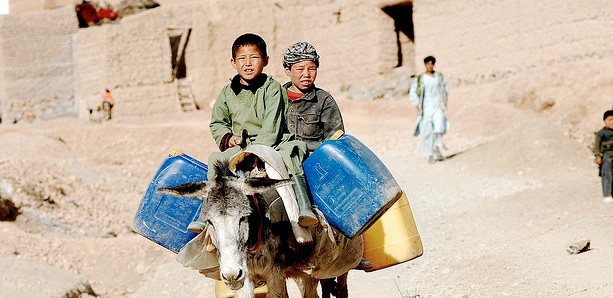
afghan boys carrying water on donkeyWorld Banks funds new irrigation project for Afghans.

The UN Food and Agriculture Organization is boosting its technical support for rehabilitation of Afghanistan‘s dilapidated traditional irrigation systems, in a bid to help farmers increase crop production. The initiative also aims to improve the knowledge and skills that farmers need to run and maintain irrigation systems.

The UN organization has signed a $27.7 million agreement with the Afghan Ministry of Energy and Water to provide technical assistance, including expertise and training for implementation of the Irrigation Restoration and Development Project (IRDP). This comes after decades of war in Afghanistan and migration away from rural areas have contributed to the degradation and neglect of the country’s irrigation system.

The lack of efficient irrigation facilities has left many farmers without sufficient water for agriculture, including the production of wheat, the country’s main staple food crop. But in recent years, the country’s Ministry of Energy and Water has placed a priority on water resources development within its National Development Strategy.

“The irrigation systems had suffered over the past three decades, not only because of a lack of investment, but also because people were moving away from the rural areas, leaving no one to maintain the systems or transfer indigenous skills to the younger generation. When there was a flood, for instance, there was no one to repair or clean up damaged canals or dams. So farmers in rural areas were not able to get enough water to cultivate their fields. As a result, they produced fewer crops,” said Pasquale Steduto, head of FAO’s Water Development and Management Unit.

The project is primarily funded by a grant from the World Bank with an additional contribution from the Government of Afghanistan. It builds on experience gained from FAO’s implementation of the Bank’s Emergency Irrigation Rehabilitation Project, which was completed in December 2011.

That emergency project strengthened the capacity of the Ministry’s Project Coordination Unit to plan and manage the rehabilitation of irrigation systems. The new six-year restoration and development project plans to follow up by designing and developing small storage dams, in addition to rehabilitating irrigation systems.

It will also complete development of hydro-meteorological networks and services to monitor weather conditions, water flow and water quality issues, and will include training in operation and maintenance of the networks.

Better irrigation, more crops

FAO will help the Ministry of Energy and Water by training personnel and assisting in the use of modern design and management methods. The initiative will also train farmers in improved water management practices, and operation and maintenance of irrigation systems.

The overall project objective is to increase agricultural productivity and production in the project areas, in line with the Afghanistan National Development Strategy.

The rehabilitation of irrigation schemes around the country are expected to cover a total irrigated area of about 300 000 ha, increase irrigated areas by about 15 percent, lead to an increase in the crop yield of around 20 percent, and benefit around 230 000 households.

“Wheat is the most important crop for Afghanistan because for 80-100 percent of the population, it is the number-one staple crop. And roughly 80 percent of the land which farmers cultivated is tilled for wheat. So any reduction in the production of wheat means a shortage of food. It directly affects the food security situation in Afghanistan,” said Steduto.

::FAO


Hot this week

How Renewable Energy is Revolutionizing the Way We Power Our World

Solar has become the star of the transition thanks to modular hardware and straightforward installation. It fits dense cities and remote towns alike. Many companies are turning to rooftop arrays and carport systems - and exploring commercial solar installation as a practical way to lock in future savings.

How does one start prepping?

Faced with an extreme winter storm this year, Americans wonder how to be prepared for catastrophe. Miriam has lived through wars in the Middle East - so she's prepared on giving you a guide to prepping.

Fishermen sue tire manufacturers on behalf of the salmon

A federal trial in San Francisco has brought US tire manufacturers, fishing groups, and environmental scientists into court over a chemical most drivers have never heard of — but which scientists say may be silently reshaping aquatic ecosystems.

Listening to Water: Tarek Atoui’s Next Work for Tate Modern

Born in Beirut, Lebanon in 1980 and now living in Paris, Atoui has spent years building instruments that don’t sit comfortably in concert halls. Many of them involve water, glass, and ceramics — materials that react to sound instead of simply producing it.

Leading Through a Dual-Energy Transition: Balancing Decarbonisation with Energy Security

Experience in one area of the energy industry isn't enough to guarantee readiness across all the others. That's where a structured program like an MBA in energy can come in. Today's advanced curricula explore energy economics, finance, policy, and strategic management alongside the technical subjects. And when pursuing an energy MBA online, professionals can skill up and retrain without having to step out of the labor market -- an important perk at a time when skilled professionals are already in short supply.

Topics

How Renewable Energy is Revolutionizing the Way We Power Our World

Solar has become the star of the transition thanks to modular hardware and straightforward installation. It fits dense cities and remote towns alike. Many companies are turning to rooftop arrays and carport systems - and exploring commercial solar installation as a practical way to lock in future savings.

How does one start prepping?

Faced with an extreme winter storm this year, Americans wonder how to be prepared for catastrophe. Miriam has lived through wars in the Middle East - so she's prepared on giving you a guide to prepping.

Fishermen sue tire manufacturers on behalf of the salmon

A federal trial in San Francisco has brought US tire manufacturers, fishing groups, and environmental scientists into court over a chemical most drivers have never heard of — but which scientists say may be silently reshaping aquatic ecosystems.

Listening to Water: Tarek Atoui’s Next Work for Tate Modern

Born in Beirut, Lebanon in 1980 and now living in Paris, Atoui has spent years building instruments that don’t sit comfortably in concert halls. Many of them involve water, glass, and ceramics — materials that react to sound instead of simply producing it.

Leading Through a Dual-Energy Transition: Balancing Decarbonisation with Energy Security

Experience in one area of the energy industry isn't enough to guarantee readiness across all the others. That's where a structured program like an MBA in energy can come in. Today's advanced curricula explore energy economics, finance, policy, and strategic management alongside the technical subjects. And when pursuing an energy MBA online, professionals can skill up and retrain without having to step out of the labor market -- an important perk at a time when skilled professionals are already in short supply.

From Green Energy to Healthy Societies: Why old systems thinking is becoming relevant again

Across the Middle East and North Africa, large investments are being made in green hydrogen, renewable energy, water infrastructure and sustainability. Most of these efforts are discussed in the context of climate change, decarbonization and economic diversification. That framing is important, but it may not capture their full value.

We saw peace – an interreligious encounter deep in our eyes

They came from Israel, Palestine, Jordan, Iraq, Yemen, Morocco, Tunisia, Lebanon, Egypt… There are Sunni Muslims, Shiite Muslims, Jews (Orthodox and Reform), Orthodox Christians, Coptic Christians, Protestant Christians, Druze, Baha'is, a Scientologist.

Can biochar reduce ‘Forever Chemicals’ in food if it’s used in farms?

Biochar is produced by heating organic material in a low-oxygen environment so it does not burn. This process, known as pyrolysis, transforms plant matter into a stable, carbon-rich material.

Related Articles

Popular Categories