Arab World and Med Region More Vulnerable to Climate Change

climate change arab worldIf Egypt’s Nile Delta is flooded by rising seas, half of its population will be at risk.

We’ve written about the topics dealing with the effects of climate change in the Middle East before on Green Prophet, and will undoubtedly write about it again. The sad truth is that the Middle East and much of the Mediterranean region, is becoming more vulnerable to the effects of climate change. Whether this involves severe water problems, often caused by government apathy; wheat and other grains dying from rising temperatures and less rainfall, or an increase in bed bug biting in  the UAE. The Arab World is becoming more vulnerable to the effects of climate change.

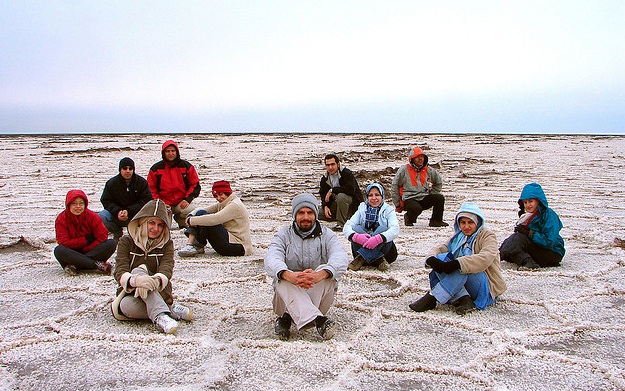
Dry lake bed in southern Cyprus

The seriousness of climate change in the Arab World was pointed out recently in an article in the news site ArabBusiness.com, in which it was noted that powerful dust storms in Iraq, freak floods wreaking havoc in Saudi Arabia and Yemen, and rising sea levels eroding Egypt’s coast are all sure signs that countries in the Middle East are some of the most vulnerable to the effects of climate change.

This is certainly nothing new as the Middle East has never been an area that has received ample rainfall. With one of the fastest growing populations in the world, especially in countries like Egypt, people living in the Arab World by the year 2015 will have to survive on less than 500 cubic meters of water a year each, against a world average exceeding 6,000 cubic meters per head, according to Mohamed El-Ashry, former head of the Global Environment Facility.

Five hundred cubic meters of water per person per annum is barely enough to survive on, much less maintain a decent quality of life. Although desalination is now widely used in Saudi Arabia, and in the Gulf States, especially in Dubai and Abu Dhabi, strict measures of water conservation and recycling, such as those now being considered in Abu Dhabi will now have to become the norm.

After all, if a small country like Israel, with a population of 7.5 million can reclaim 75% of its sewage waste water then why can’t Arab countries do the same? The ravages of climate change will not go away soon; and the sooner that Arab countries take more measures to conserve water, the better off they will be.

According to a UN Development Program (UNDP) research paper, as quoted in Arabianbusiness.com:

“For a region that is already vulnerable to many non-climate stresses, climate change and its potential physical and socio-economic impacts are likely to exacerbate this vulnerability, leading to large-scale instability.”

Hotter, drier weather already worsens water scarcity in the Middle East. And unless more effort is made by countries in this region, increased political instability and mass population migrations will soon become the norm in the Arab World.

::Almasryalyoum

Read more on Climate Change affecting the Middle East:

12 Million Egyptians to be affected by climate Change

Climate Change Killing the First Crops in the Cradle of Civilization

Is Middle East Taking Climate Change Seriously?

Arab World in Water Crises Reports Jordanian Journalist


Maurice Picow
Maurice Picowhttps://www.greenprophet.com/
Maurice Picow grew up in Oklahoma City, U.S.A., where he received a B.S. Degree in Business Administration. Following graduation, Maurice embarked on a career as a real estate broker before making the decision to move to Israel. After arriving in Israel, he came involved in the insurance agency business and later in the moving and international relocation fields. Maurice became interested in writing news and commentary articles in the late 1990’s, and now writes feature articles for the The Jerusalem Post as well as being a regular contributor to Green Prophet. He has also written a non-fiction study on Islam, a two volume adventure novel, and is completing a romance novel about a forbidden love affair. Writing topics of particular interest for Green Prophet are those dealing with global warming and climate change, as well as clean technology - particularly electric cars.

Hot this week

The Lote Tree of the Utmost Boundary, explained

In Islamic tradition, there is a point where creation ends — a boundary that marks the limit of what any created being can reach. That boundary is called Sidrat al-Muntahā, often translated as “the Lote Tree of the Utmost Boundary.”

The Air Tea Kettle creates a new way to meet plants and herbalism

Air Tea is a new technology. Instead of drinking tea, you inhale herbal vapor through warm air extraction. There is no water and no combustion. The warm air releases essential oils that are often lost in hot water and digestion.

Why Health Systems Are Reaching a Turning Point

Health emerges from a continuous energy and material flow from water through food to human physiology. Technical energy systems support this cycle through water treatment, agriculture, and infrastructure.

Sustainability That Sells: How Profit and Purpose Come Together in the Hive

Whether you are a commercial grower, hobbyist beekeeper or retail equipment supplier, this system opens a new income stream with minimal environmental impact.

The Fitness App Revolution: Building the Future of Wellness Through Strategic Development

In an era where smartphones are ubiquitous and health consciousness is at an all-time high, the fitness industry has undergone a radical digital transformation. Fitness applications have moved far beyond simple pedometers, evolving into comprehensive wellness platforms that serve as personal trainers, nutritionists, and community hubs right in our pockets.

Topics

The Lote Tree of the Utmost Boundary, explained

In Islamic tradition, there is a point where creation ends — a boundary that marks the limit of what any created being can reach. That boundary is called Sidrat al-Muntahā, often translated as “the Lote Tree of the Utmost Boundary.”

The Air Tea Kettle creates a new way to meet plants and herbalism

Air Tea is a new technology. Instead of drinking tea, you inhale herbal vapor through warm air extraction. There is no water and no combustion. The warm air releases essential oils that are often lost in hot water and digestion.

Why Health Systems Are Reaching a Turning Point

Health emerges from a continuous energy and material flow from water through food to human physiology. Technical energy systems support this cycle through water treatment, agriculture, and infrastructure.

Sustainability That Sells: How Profit and Purpose Come Together in the Hive

Whether you are a commercial grower, hobbyist beekeeper or retail equipment supplier, this system opens a new income stream with minimal environmental impact.

The Fitness App Revolution: Building the Future of Wellness Through Strategic Development

In an era where smartphones are ubiquitous and health consciousness is at an all-time high, the fitness industry has undergone a radical digital transformation. Fitness applications have moved far beyond simple pedometers, evolving into comprehensive wellness platforms that serve as personal trainers, nutritionists, and community hubs right in our pockets.

A Brief History of Basil From India to Italy

Beloved, fortunate, sweet, and royal; an herb with a long and storied history in Asia and across the world. Called by many names, basil has featured in previous Green Prophet articles, so enjoy another serving, a brief history of basil.

How Renewable Energy is Revolutionizing the Way We Power Our World

Solar has become the star of the transition thanks to modular hardware and straightforward installation. It fits dense cities and remote towns alike. Many companies are turning to rooftop arrays and carport systems - and exploring commercial solar installation as a practical way to lock in future savings.

How does one start prepping?

Faced with an extreme winter storm this year, Americans wonder how to be prepared for catastrophe. Miriam has lived through wars in the Middle East - so she's prepared on giving you a guide to prepping.

Related Articles

Popular Categories