
“The future,” says Elon Musk, “is going to be weird.”
Sounds logical, given the billionaire entrepreneur’s typical far-seeing plans, like creating a station on the moon.
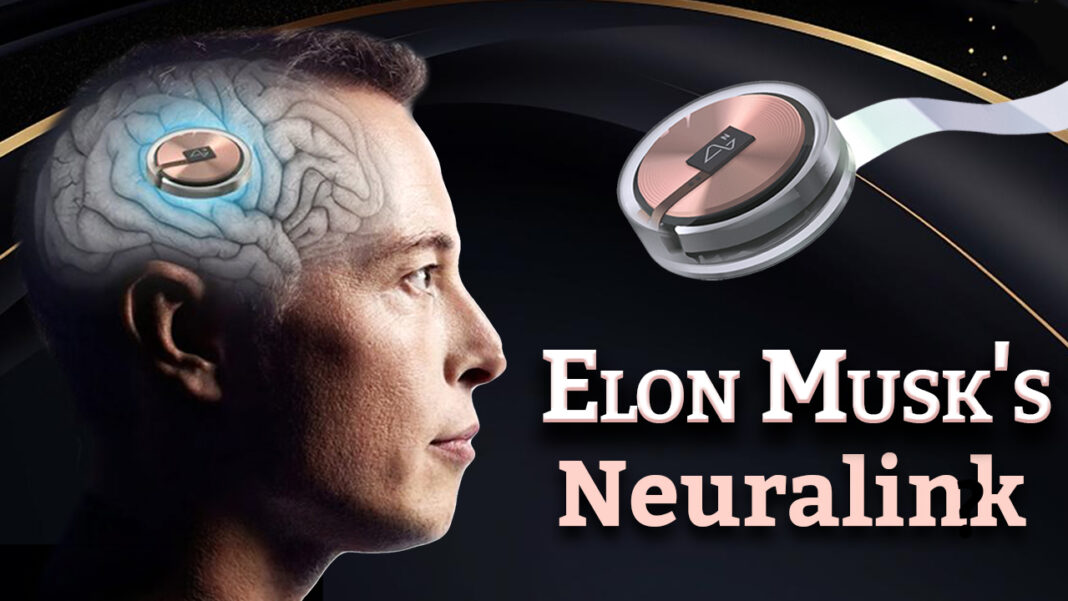
But now Neuralink, a company founded by Musk in 2016, has successfully implanted a chip in a human brain. It’s a brain-to-computer interface technology (BCI) called “the Link.” It records and decodes brain activity, passing neural signals on to devices.
Current goals are to treat neurological disease like Parkinson’s and restore autonomy to people with severe physical limitations by controlling exoskeletons and prosthetics. There’s also huge potential to improve cognitive abilities such as memory, attention, and languages.
Even the power to communicate silently via thought alone isn’t out of vision: telepathy, in other words.
The Link has already granted speech to a man made mute by ALS; allowed people paralyzed by spinal cord injury to control a cursor and use their computer to not only play video games but also to study and work, or manipulate a robotic arm – by power of their thought.
Musk foresees a BCI placed in the visual cortex that will allow the blind to “see” their surroundings in real time. The project is called “Blindsight.” Theoretically a blind person will be able to see at high resolution at multiple wavelengths.
Musk says, “You can be like Geordi La Forge in Star Trek and see in radar, infrared, and ultraviolet. Superhuman capabilities. Cybernetic enhancement, essentially.”” He also sees a time when, thanks to BCIs implanted in a person’s brain and spinal cord, corresponding Optimus robotic devices developed by Tesla will replace the functions of missing limbs.
Tesla has already developed a functioning robotic hand whose appearance is designed to mimic the human hand. Potentially, an Optimus robot may restore full body functionality, such that a person will “inhabit” the robot.
Yes, the future does look weird.
How it works
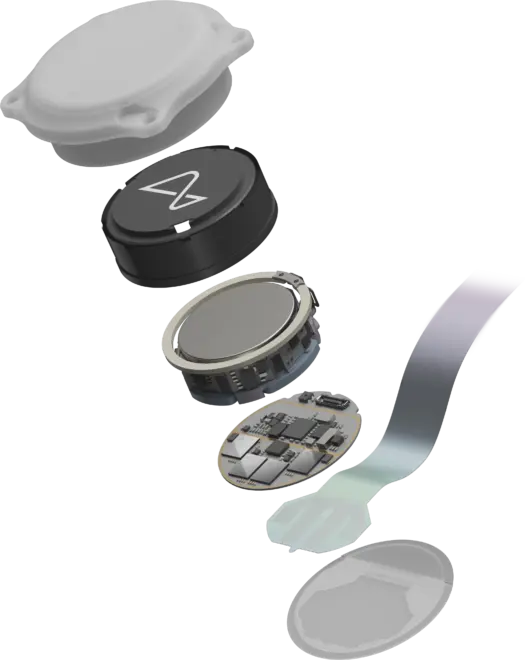
The link between brain and computer is a coin-sized implant. It records neural activity via 1,024 thin, flexible electrode threads inserted into the brain. Neurons are the nerve cells that send messages all over the body to drive nearly all human functions. Where there’s neural damage due to ALS, stroke, or injury, the brain’s signals to, for example, pick up a cup, don’t transfer to the muscles. One of the Neuralink engineers, Skylar Granatir, compares this to a severed internet cable.
“With the BCI, you bypass this (interrupted) pathway completely. You can read directly from your brain to a device that will do the thing you want to do.”
In other words, the BCI makes a bridge that goes past damaged brain areas to the computer or other device that serves you in real time.
The United States Artificial Intelligence Institute defines how a Neuralink BCI works:
“The fundamental principle of Neuralink’s brain-implant technology is a mixture of neuroscience, robotics, and artificial intelligence.
The implant has over 1,000 electrodes linked by ultra-thin threads, which are implanted in the motor cortex of the brain. These threads pick up the electrical activity of the neurons and relay it to the external devices.
How The System Works
When one wants to move or do something, the brain triggers electric signals.
The Neuralink implant identifies these signals by using electrodes.
The neural data gets transmitted wirelessly to a computer.
The commands are decoded by machine learning algorithms.
Those commands are then able to govern digital systems such as a cursor, keyboard, or robotic device.
Since the implant is far too dependent on AI models and AI algorithms, the system gets better as it becomes accustomed to trends in the neural activity, and the interaction becomes smoother over time.”
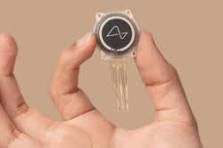
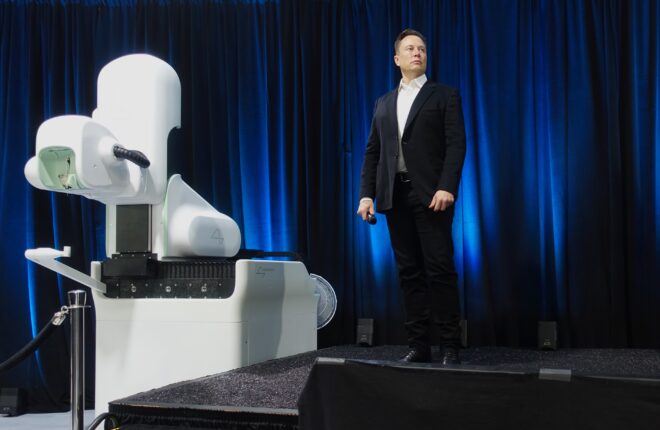
The electrode threads are too fine for human hands to handle without damage. To ensure their precise precise placement in the brain, Neuralink developed a specialized roboic surgeon that inserts these micro-threads into the cerebral cortex, the area of the brain containing functions like learning and emotion.
A chip within the implant processes thought signals and transmits them to a digital device through a standard Bluetooth connection.
Currently 21 humans with limited, some with even no physical functionality, are undergoing clinical trials. Surgery – implanting the BCI in the brain – requires only minutes, and causes almost no discomfort. The patient goes home the next day. Neuralink claims there has been no sign of damage to the brain since clinical trials began.
Competition
Neuralink has competitors. Several other companies have been developing surface electrodes offering similar technology for decades. One in particular, Paradromics, uses platinum-iridium microwire electrodes and a hermetically sealed titanium alloy body, as opposed to the flexible polymer threads and plastics in Neuralink’s implant. We have a post on Neuralink’s rival here.
Called “Connexus,” the Paradromics BCI is water tight, which is critical for the salty and warm environment of the body. Neuralink doesn’t claim that advantage. In addition, the Connexus electrodes have a longer longevity as compared to Neuralink’s.
On their website, Pardomics states,
“Platinum-iridium is a medical-grade metal alloy that has been used in implants (like pacemakers and deep brain stimulators) for decades without corrosion or significant degradation. By choosing robust materials, Paradromics aims for its electrodes to last for many years or even decades inside the brain. This focus on durability directly tackles the implant lifespan issues, giving Paradromics an edge in achieving the 10+ year functional lifetime that many BCI users expect.”
The goals of these breakthrough technologies are to reduce suffering and enhance human capabilities. Musk even hopes to explore and expand consciousness. Another of Musk’s concerns is to mitigate the risks of unchecked AI.
Criticism
From Wikipedia:
Neuralink has faced substantial criticism over its animal testing practices. Between 2018 and 2022, at least 1,500 animals—including monkeys, pigs, and sheep—were used in experiments, with reports of complications leading to euthanasia in some cases. The Physicians Committee for Responsible Medicine filed complaints with the U.S. Department of Agriculture, prompting an investigation. Neuralink has said that animal testing followed regulatory standards and was necessary for development.
In human trials, the first patient’s implant experienced partial thread retraction in 2024, reducing the number of functional electrodes, though software updates restored much of the lost performance.
Bioethicists have raised concerns about informed consent, long-term patient support, and the absence of trial registration on ClinicalTrials.gov for some studies.
Broader ethical debates include risks of hacking, loss of privacy, and potential misuse of neural data. One person left a cry from the heart under the YouTube Neuralink update: “For the love of everything, make it so it can NEVER. EVER. stream ads directly into our brains.
Altogether, it’s clear that the lives of clinical trial participants have improved amazingly. One participant, disabled by ALS and unable to communicate for four years movingly says,
“Neuralink has given me a purpose. We work together to make this thing (the BCI) better. Maybe I can’t cure ALS, but I can participate in research, I can give feedback. It will give us back a voice.
“It would be a total waste of who I am if I didn’t do all the good I possibly could before I check out to be with the Lord. That’s the number one reason I’m doing this – because I’m doing good for others, and that’s the best thing of all.”
Others, who have regained a part of independence via their computers, are returning to studies and work abandoned when paralysis set in. Some mention the joy of having a purpose again.
So how about this weird future? Are you optimistic about the advances in medicine, health care, and disabled people’s quality of life that BCI offers, or are you worried that cyborgs will overtake control of the planet? I confess to both.