New advances on making aquaponics a valid business

Farmed Here builds high-tech hydroponic farms run by software

Climate change poses a severe threat to food production, making it imperative to find sustainable methods that complement natural, regenerative, soil based farming. One such method is aquaponics, which grows fish and vegetables together using a water substrate with no added minerals. The fish poop supplies all that the plants need to grow. It’s been hard for dreamers and doers to find that sweet spot that balances several ecosystems at the same time: the fish in the pond, the food in the hydroponics beds, and both those parts together.

Researchers from a desert country, where food growing is limited due to lack of water, offer a new proof of concept for a new closed loop system called aquaponics that produces more fish and vegetables while using less energy than conventional systems.

Their findings were published in the journal Resources, Conservation & Recycling.

Amit Gross
Amit Gross, aquaponics expert

Prof. Amit Gross, at Ben-Gurion University has been working with his students and collaborators for the last decade on aquaponic systems. His system uses brackish, or salty water and combines farming with growing fish farms.

As we mentioned above, aquaponic systems grow fish while using the fish waste to grow vegetables hydroponically. Hydroponics was invented by NASA decades ago and later perfected by stealth cannabis growers in Canada who could run grow-ops between walls in their apartment throughout the winter. Now that cannabis is legal in Canada and the US and hydroponics a great method for controlled growing of high value crops, advances are needed to make it even more sustainable.

Attractive woman in hat with hydroponics

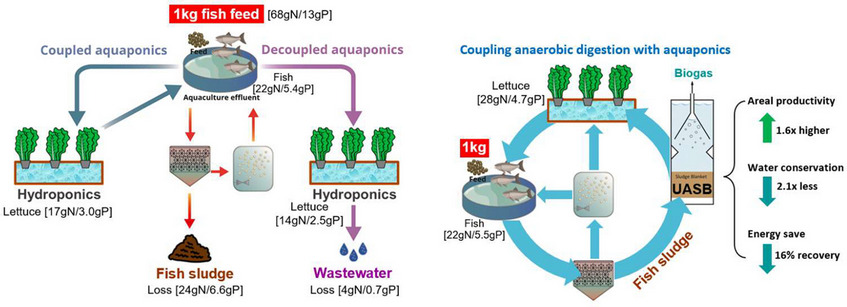
That’s where this new research steps in: coupled aquaponics are closed loop systems that recycle much of the fish effluent rather than reusing it outside of the aquaponic system. Where typically the fish solid waste is disposed of, Gross managed to treat it by anaerobic digestion and recover energy and nutrients into the system to form a near zero waste unit. This is the path to resolving the ups and downs and headaches of balancing the nutrient load in the system and what the plants need as they grow.

After more than two years of testing, Gross’s system demonstrated 1.6 times higher plant areal productivity, 2.1 times lower water usage and 16% less energy consumption per kilogram of feed than conventional systems.

Karin Kloosterman, hydroponics expert
Hydroponics plastic tubes

His calculations suggest that upscaling to about one ton of fish will allow operation of the system with no need for external energy, less than 1% water exchange, negligible waste production as well as significant carbon sequestration.

Net zero, here we come? The next grow system for the spaceship to Mars and the first Mars colony? Sustainable food that can be grown in Antarctica?
Aquaponics
Aquaponics innovation – how they do it

“Feeding the more than 8 billion people on the planet while reducing greenhouse gas emissions will require innovative technologies. Those that combine two functions in one are obviously preferable. Fish are a sustainable high-quality source of protein with a far smaller carbon footprint than most other sources. Combining fish growth with vegetable production and preventing waste is a win-win-win,” says Gross who worked with Ze Zhu and Uri Yogev from Ben-Gurion University and Prof. Karel Keesman from Wageningen University and Research in the Netherlands.

? Hydroponics, Aquaponics, and Cannabis: Growing Greener with Smart Agriculture

As the world looks for sustainable ways to grow food and medicine, modern farming methods like hydroponics, aquaponics, and even cannabis cultivation are leading a quiet revolution—especially in regions facing water scarcity, like the Middle East and North Africa.

Hydroponics uses nutrient-rich water instead of soil, saving up to 90% of water compared to traditional farming. Aquaponics adds fish into the mix, creating a closed-loop system where fish waste feeds the plants, and the plants clean the water. These systems can be set up in homes, urban rooftops, or greenhouses, making them ideal for future food security.

And yes, cannabis—the once-taboo plant—is gaining ground as a medicinal crop. Grown sustainably in hydro or aquaponic systems, cannabis can provide medical benefits without the environmental damage associated with traditional farming.

This green trifecta—hydroponics, aquaponics, cannabis—is not just a trend; it’s a glimpse into the future of ethical, sustainable agriculture.

? Learn More

Here are 5 useful links to deepen your understanding:

  1. Hydroponic Farming in the Middle East

  2. What is Aquaponics and Why is it Eco-Friendly?

  3. Israel’s Medical Cannabis Revolution

  4. Rooftop Farming in the Middle East

  5. Smart Agriculture Innovations in MENA

Karin Kloosterman
Karin Kloostermanhttp://www.greenprophet.com
Karin Kloosterman is an award-winning journalist, innovation strategist, and founder of Green Prophet, one of the Middle East’s pioneering sustainability platforms. She has ranked in the Top 10 of Verizon innovation competitions, participated in NASA-linked challenges, and spoken worldwide on climate, food security, and future resilience. With an IoT technology patent, features in Canada’s National Post, and leadership inside teams building next-generation agricultural and planetary systems — including Mars-farming concepts — Karin operates at the intersection of storytelling, science, and systems change. She doesn’t report on the future – she helps design it. Reach out directly to [email protected]

Hot this week

How Renewable Energy is Revolutionizing the Way We Power Our World

Solar has become the star of the transition thanks to modular hardware and straightforward installation. It fits dense cities and remote towns alike. Many companies are turning to rooftop arrays and carport systems - and exploring commercial solar installation as a practical way to lock in future savings.

How does one start prepping?

Faced with an extreme winter storm this year, Americans wonder how to be prepared for catastrophe. Miriam has lived through wars in the Middle East - so she's prepared on giving you a guide to prepping.

Fishermen sue tire manufacturers on behalf of the salmon

A federal trial in San Francisco has brought US tire manufacturers, fishing groups, and environmental scientists into court over a chemical most drivers have never heard of — but which scientists say may be silently reshaping aquatic ecosystems.

Listening to Water: Tarek Atoui’s Next Work for Tate Modern

Born in Beirut, Lebanon in 1980 and now living in Paris, Atoui has spent years building instruments that don’t sit comfortably in concert halls. Many of them involve water, glass, and ceramics — materials that react to sound instead of simply producing it.

Leading Through a Dual-Energy Transition: Balancing Decarbonisation with Energy Security

Experience in one area of the energy industry isn't enough to guarantee readiness across all the others. That's where a structured program like an MBA in energy can come in. Today's advanced curricula explore energy economics, finance, policy, and strategic management alongside the technical subjects. And when pursuing an energy MBA online, professionals can skill up and retrain without having to step out of the labor market -- an important perk at a time when skilled professionals are already in short supply.

Topics

How Renewable Energy is Revolutionizing the Way We Power Our World

Solar has become the star of the transition thanks to modular hardware and straightforward installation. It fits dense cities and remote towns alike. Many companies are turning to rooftop arrays and carport systems - and exploring commercial solar installation as a practical way to lock in future savings.

How does one start prepping?

Faced with an extreme winter storm this year, Americans wonder how to be prepared for catastrophe. Miriam has lived through wars in the Middle East - so she's prepared on giving you a guide to prepping.

Fishermen sue tire manufacturers on behalf of the salmon

A federal trial in San Francisco has brought US tire manufacturers, fishing groups, and environmental scientists into court over a chemical most drivers have never heard of — but which scientists say may be silently reshaping aquatic ecosystems.

Listening to Water: Tarek Atoui’s Next Work for Tate Modern

Born in Beirut, Lebanon in 1980 and now living in Paris, Atoui has spent years building instruments that don’t sit comfortably in concert halls. Many of them involve water, glass, and ceramics — materials that react to sound instead of simply producing it.

Leading Through a Dual-Energy Transition: Balancing Decarbonisation with Energy Security

Experience in one area of the energy industry isn't enough to guarantee readiness across all the others. That's where a structured program like an MBA in energy can come in. Today's advanced curricula explore energy economics, finance, policy, and strategic management alongside the technical subjects. And when pursuing an energy MBA online, professionals can skill up and retrain without having to step out of the labor market -- an important perk at a time when skilled professionals are already in short supply.

From Green Energy to Healthy Societies: Why old systems thinking is becoming relevant again

Across the Middle East and North Africa, large investments are being made in green hydrogen, renewable energy, water infrastructure and sustainability. Most of these efforts are discussed in the context of climate change, decarbonization and economic diversification. That framing is important, but it may not capture their full value.

We saw peace – an interreligious encounter deep in our eyes

They came from Israel, Palestine, Jordan, Iraq, Yemen, Morocco, Tunisia, Lebanon, Egypt… There are Sunni Muslims, Shiite Muslims, Jews (Orthodox and Reform), Orthodox Christians, Coptic Christians, Protestant Christians, Druze, Baha'is, a Scientologist.

Can biochar reduce ‘Forever Chemicals’ in food if it’s used in farms?

Biochar is produced by heating organic material in a low-oxygen environment so it does not burn. This process, known as pyrolysis, transforms plant matter into a stable, carbon-rich material.

Related Articles

Popular Categories