

Iran is gasping. Its veins—once flowing across aquifers, rivers, dams, and Lake Urmia—have run nearly dry. Across sprawling provinces, water has become an afterthought as billions flowed instead to foreign battlefields, in support of proxies like Hamas and Hezbollah. Meanwhile, the public suffers—and those who speak out are silenced.
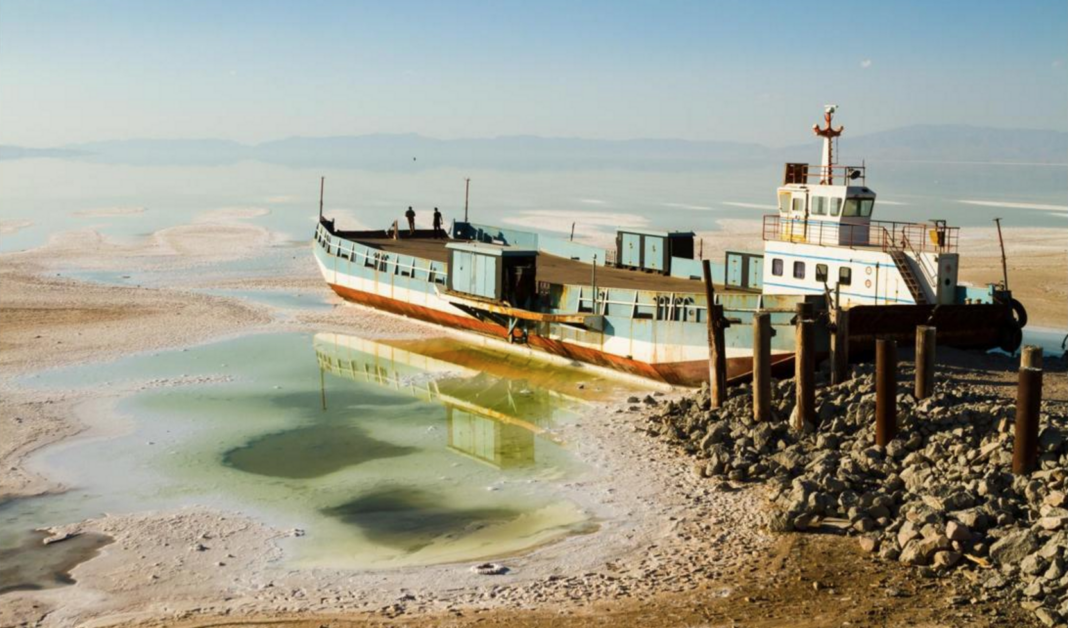
Once the Middle East’s largest saltwater lake, Lake Urmia has collapsed under a triple assault: climate change, mismanagement, and politically driven infrastructure. Since the 1970s, it has shrunk by roughly 90 percent due to damming, agricultural overuse, and drought. Though partial recovery efforts began in 2014, the lake remains perilously low—now with barely 5% of its original water volume. Dust storms carry salt and toxins across farmland, damaging crops and fueling respiratory and birth-defect clusters.
Despite this, in August 2025, civil activists detained in Tehran’s Greater Tehran Penitentiary launched a hunger strike, declaring the drying of Lake Urmia “deliberate” according to Iran Focus.
Protests stretch back over a decade: in 2011, protests in Tabriz and Urmia saw security forces attack peaceful environmental activists chanting, “Lake Urmia is thirsty”—dozens were arrested. In 2022, similar cries fueled demonstrations where protesters shouted “Lake Urmia is dying”—again met with force.
Silencing the Voices of Water
This is not idle climate conversation—it’s a pitched battle over survival. Water scientists and environmentalists who seek solutions are often branded agitators. Human rights organizations flagged arrests of scientists attempting to address water shortages, particularly in Khuzestan, during the widespread water protests of 2018. Since Amnesty International has stopped being a reputable source of information, we rely on locals reporting in Farsi to explain the situation. The NCR Iran provides an invaluable backgrounder on why Iran has become so dry.
Behind Iran’s water crisis lies a well‑entrenched “water mafia”—an entrenched nexus of officials, contractors, and entities like the IRGC’s Khatam al‑Anbiya. Critics accuse them of pushing oversized dams and water‑diversion schemes not for the public good, but for profiteering and patronage. The dams overpump and leave behind mud. Experts describe Iran as suffering “water bankruptcy”—demand far exceeding sustainable supply.
Tehran’s reservoirs have plunged: by early 2025, Tehran’s Lar Dam held just 1 percent of capacity; in Isfahan and Khorasan, dam levels are critically low; across the country, reservoir inflow in 2025 dropped 28 percent year‑on‑year
Groundwater has likewise collapsed—Tehran sinks by up to 25 cm annually, a stark sign that aquifers are being emptied.
Proxy Spending on Terror While the Home Front Perishes
As local water systems crumble, Iran continues to channel resources into foreign conflict. Since the early 1990s Iran has provided Hamas with military, financial, and training support; according to US data, its funding rose from around $100 million annually to an estimated $350 million by 2023.
Iran likewise backs Hezbollah in Lebanon, supporting its military and political functions. Without this funding men in countries like Syria and Lebanon would look for work elsewhere.
Every dollar diverted to these proxies is a dollar not invested in rebuilding aquifers, repairing aged irrigation, or empowering local water researchers. It is a stark choice: fund regional confrontation—or fix plumbing, banks of wells, and restore a dying lake.
The link between drought and unrest is not theoretical. The Syrian civil war was accelerated, in part, by agricultural collapse and water deprivation; in Iraq, tensions over the Euphrates—the container of life in Mesopotamia—fueled simmering social fractures. In Iran itself, unresolved water shortages inflamed protests in Khuzestan and Isfahan in 2021, sometimes with lethal force deployed.
Environmental mismanagement has unified disparate communities—scientists like Kaveh Madani argue that the water crisis symbolizes governmental failure, capable of mobilizing urban and rural dissent alike
Iran’s Researchers Raise the Alarm—But Are They Heard?
A handful of water experts continue to sound the alarm despite constraints. In mid‑2025, Dr Banafsheh Zehraei, a water‑resources professor at the University of Tehran, warned of an “apocalyptic” drinking‑water disaster, saying Iran had only “two to three weeks” to stave off collapse. Another piece, titled Iran’s water crisis and social consequences, argues that decades of regime inaction have created social unrest that will only intensify.
Independent researchers like Madani have documented how misallocation, poor infrastructure, and disregard for groundwater recharge are at the heart of Iran’s water collapse.
As regional conflict enters a new phase, there’s a brief window for Iran to reframe internal priorities. If Tehran were to pivot: arrest the water mafia’s corruption; restructure water policy around recharge, cloud seeding, and equitable distribution; invest in efficient irrigation and desalination; and protect researchers and right‑to‑water activists—it could reemerge with renewed domestic legitimacy.
Lake Urmia, for all its desiccation, is not beyond redemption. Past projects in the 2010s—planting salt-tolerant scrub to curb dust, allocating over $500 million to watershed restoration—show what might be done if political will follows.
Imagine a program of aquifer replenishment in drought-prone zones, a transparent water-rights system, and public involvement. The results: restored agriculture, fewer climate migrants, reduced risk of water-fuelled uprisings, and a calm society.
Iran’s current posture is unsustainable. Starving citizens of water while funding foreign conflict weakens Iran, not strengthens it. But the priorities can flip.
Water is not merely a domestic issue—it is the soil in which national strength grows. Let this moment—the collapse of Lake Urmia, the protests, the crack of civil anger—be Iran’s turning point. Refocus on water, or watch the state itself leak away.
Foreign journalists are jailed in Iran so it is difficult to get a clear picture on how the day to day water shortages affect everyday people.
Further Reading — Green Prophet
- Green Prophet: Search “Iran water”
- Green Prophet: Search “Syria water”
- Green Prophet: Search “Iraq water”
- Green Prophet: Search “Middle East water crisis”
- Green Prophet: Search “Lake Urmia”
- Green Prophet: Search “Land subsidence Iran”
Other References
- Iran’s Water Crisis Will Make It Harder for the Regime to Regain Control
- Iran’s president mocks Netanyahu over pledge of help in water crisis